Best Matcha for Bright Green Lattes and Desserts: Color Stability Guide

If you need a bright green matcha for latte and dessert lines that still looks vivid in the cup or on the plate, choose a fresh, shade-grown Japanese matcha with a genuinely green (not yellow or khaki) powder, milled fine, and matched to the application — then protect that colour in the recipe. Colour is driven first by the leaf you buy and how fresh it is, and only second by formulation. A dull starting powder cannot be rescued by technique.
For a business, the practical rule is to buy for the application, not for a photo. A drink tasted with a lot of milk and ice needs a matcha that reads green through dairy and cold; a baked or heat-treated dessert needs one that resists the browning that heat and acidity cause. This guide explains why matcha loses its green, sets a colour-stability specification by application, and gives a supplier verification checklist — so importers, OEM and private-label brands, and beverage and dessert makers can specify colour they can actually reproduce at scale.
Key Takeaways
- Colour starts with the powder. Bright green comes from chlorophyll in fresh, shade-grown leaf; a yellow or brown powder will not turn green in the cup.
- Fading is chemistry, not bad luck. Acid, heat, light, and oxygen convert green chlorophyll into olive-brown pheophytin — the same reaction that dulls any cooked green.
- Match the matcha to the application. Latte, iced, dessert/baking, and ready-to-drink each need a different colour-stability spec.
- Buy the right leaf before reaching for additives. Grade, harvest, freshness, and particle fineness are your first colour levers; colour additives carry clean-label and cross-market rules.
- Verify colour, do not assume it. Confirm harvest year, request a lot-specific Certificate of Analysis (COA), and judge colour on your own recipe with samples before committing.
For Companies Seeking Matcha Powder

We select origin, harvest, and grade from across Japan and deliver colour-tested samples, quality assurance, and export documentation as one flow — matching a bright green matcha to your latte and dessert products and your market.
Common Challenges:
- “We have projects but cannot secure stable matcha supply…”
- “We want to incorporate matcha into new café menu items!”
If you face these concerns, consult with Matcha Times. Feel free to contact us for initial inquiries.
\Read Also/
Why matcha loses its bright green
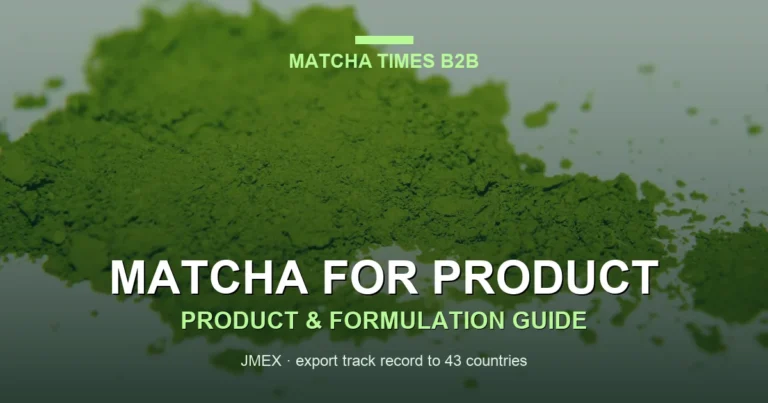
Matcha is green because of chlorophyll, the pigment concentrated by shading the plants before harvest. A peer-reviewed characterization of matcha grades in Plants (2025) notes that shade cultivation boosts chlorophyll and gives matcha its characteristic bright green colour. Because matcha is an ultra-fine powder with a large surface area, that pigment is also unusually exposed — which is exactly why colour is fragile in a finished product.
The fade itself is a well-understood reaction. Under acid or heat, the magnesium atom at the centre of the chlorophyll molecule is displaced by hydrogen ions, converting bright green chlorophyll into olive-brown pheophytin. Food-chemistry research on green vegetables — for example the study of colour loss in blanched green peas in Food Chemistry — shows that colour degrades faster as pH falls (more acidic) and accelerates with heat. It is the same chemistry that turns any cooked green from vivid to drab.
Four factors do the damage, and each maps to a decision you control:
- Acidity (low pH). Citrus, some fruit purees, and certain plant milks are mildly acidic and push the reaction toward pheophytin.
- Heat. Chlorophyll-to-pheophytin conversion rises with temperature, so steaming milk to a rolling boil or baking at high heat dulls colour.
- Light and oxygen. The large powder surface oxidises quickly; light and air fade an opened tin within weeks.
- Time and moisture. Age and humidity move a powder from green toward yellow before it is ever used.
\Read More/
What “bright green” actually depends on
Because colour in the cup is capped by the colour of the powder, selection is your most powerful and cheapest lever. Judge these attributes before you think about formulation, and confirm them with the supplier rather than eyeballing a marketing image.
| Colour lever | What to look for | Why it matters |
|---|---|---|
| Shade-grown leaf | Genuine pre-harvest shading (tencha) | Shading concentrates chlorophyll — the source of the vivid green |
| Freshness & harvest year | A stated crop year and a recent mill date | Chlorophyll fades with age; older stock trends yellow before use |
| Grade / leaf selection | Fine, tender leaf with stems and veins removed | Cleaner leaf reads brighter and more uniform; grade names are marketing, so verify the lot |
| Particle fineness | Stone-milled, uniformly fine powder | Fine particles disperse evenly and reflect light as a smooth green rather than a dull, grainy tone |
| Starting colour | Vivid green powder, not khaki, yellow, or brown | A dull powder cannot be made bright by technique; colour in the cup can only be preserved, not created |
Note that brightest is not automatically best for every use. The same grade study in Plants (2025) reports that premium grades differ from lower ones mainly in flavour chemistry — higher amino acids, fewer catechins — rather than simply more green pigment, so colour should be specified alongside flavour and cost, not in place of them.
Colour-stability specification by application
The single most useful step for a B2B buyer is to write a colour-stability spec per product, then source to it. The table below translates each application into what the matcha and the process have to withstand. It is a starting framework — always confirm with samples in your own recipe.
| Application | Main colour stressors | What to specify |
|---|---|---|
| Hot matcha latte | Milk dilution, steaming heat | Fresh, vivid, fine latte-style matcha; brew concentrate first, avoid boiling the milk |
| Iced matcha latte | Dilution by ice and milk, longer standing time | A more intensely green, fine powder so colour reads through dilution; serve promptly |
| Baking & hot desserts | High heat, sometimes acidic or fruit components | A robust, deeply green matcha; expect some dulling and dose for it, or add matcha to lower-heat steps |
| Chilled & frozen desserts | Fat, sugar, long shelf life, light exposure | Consistent-colour matcha plus opaque, low-light packaging and cold, sealed storage |
| Ready-to-drink (RTD) | Thermal processing, pH, months of shelf life | The hardest case: pilot-test stability, control pH, and validate colour over the target shelf life |
Two operating principles cover most cases: the more milk, ice, heat, or shelf life a product carries, the greener and fresher the starting matcha needs to be; and colour that must survive months on a shelf should be proven with a real stability trial, not assumed.
Formulation and preparation: protecting the colour you bought
Once you have a genuinely green powder, technique keeps it green. None of these steps can rescue a dull matcha, but the wrong technique will spoil a good one.
- Sift and make a concentrate first. Whisk or blend matcha with a little water into a smooth, lump-free concentrate before adding milk; even dispersion reads as an even, saturated green.
- Keep it hot, not boiling. Because heat drives the browning reaction, use hot — not vigorously boiling — water and avoid scorching steamed milk.
- Mind acidity and pH. Acidic ingredients such as citrus accelerate the shift to pheophytin; add them thoughtfully, add them late, or keep them separate from the matcha base.
- Choose milk with colour in mind. Higher-protein milks foam well and support a bright surface, while very fatty or strongly coloured plant milks can soften or shift the green — test your house milk.
- Serve and sell fresh. Prepared matcha dulls as it stands; build drinks to order and size dessert and RTD batches to a realistic turnover.
For any product that sits — iced drinks held in a case, chilled desserts, or RTD — validate colour over time, not just at the moment of preparation. A drink that looks perfect fresh can turn olive within hours if the matcha or the process is wrong.
The colour-additive question: clean label and cross-market rules
Manufacturers of shelf-stable products sometimes ask about colour additives — for example chlorophyll-derived colours or pH buffers — to hold green over a long shelf life. These can work technically, but they are a formulation decision with real trade-offs, not a default.
- Clean-label expectations. Many matcha buyers choose it precisely for a natural, short ingredient list; an added colour can undercut the positioning that makes matcha valuable.
- Rules vary by market. Permitted colour additives, their allowed uses, and labelling differ between regions, so a formula that is compliant in one market may not be in another. Confirm the current status of any additive with the relevant food-safety authority for each destination before you commit.
- Sensory impact. Buffers and added colours can change flavour or mouthfeel; assess taste, not just the colour reading.
For most latte and dessert programmes, the reliable path is selection and process first — a fresher, greener, finer matcha handled well — and additives only as a considered, market-checked exception for the hardest shelf-stable cases.
Cost versus colour: getting the trade-off right
Colour and cost pull against each other, and the goal is not the greenest possible matcha in every SKU — it is the right colour for the price point. Because specific prices and minimum quantities vary by grade, origin, and supplier, treat the points below as procurement logic and confirm figures at quotation.
- Vivid green carries a premium. The freshest, most intensely green lots cost more and move faster, so reserve them for products where colour is the selling point.
- Do not over-spec a masked product. A matcha buried under chocolate, heavy fruit, or dark bakes does not need top-tier colour; spending there is waste.
- Run tiered SKUs. Many buyers pair a vivid, premium matcha for hero lattes with a robust, cost-efficient lot for culinary and dessert lines.
- Cost the fade in. Colour that dulls before sale is a hidden cost — freshness, turnover, and packaging protect the money you already spent on green.
How to verify colour stability with your supplier
Colour is a claim until it is documented and tested. The checklist below works for any supplier — a farm, a manufacturer, or an export organisation, including JMEX — and turns “bright green” into a specification you can hold a supplier to.
| Criterion | What to verify with any supplier |
|---|---|
| Harvest & crop year | A stated harvest and crop year, plus a recent mill/pack date on the spec sheet |
| Colour description | How the supplier describes the powder’s colour, and against what reference |
| Particle fineness | Typical particle size or milling method (stone-milled), for even dispersion and a smooth green |
| Lot-specific COA | A Certificate of Analysis for your batch (pesticide residues, heavy metals, microbiology) |
| Batch consistency | How colour is kept stable across reorders, and whether blending is used to hold a target |
| Application samples | Multi-lot samples to test colour in your actual recipe, hot and cold, fresh and after standing |
| Shelf-life evidence | For chilled/frozen/RTD, any colour-stability or shelf-life data, or support to run a trial |
If a supplier cannot answer these in writing, the colour claim is marketing. Documentation and a sample you tested yourself are the difference between a photo and a spec you can reorder against.
Why Buyers Choose JMEX (Japan Matcha Export Organization)

Applied to a colour decision, JMEX works as the export-side partner that matches the right Japanese leaf to your application before formulation ever enters the picture. Rather than defaulting to one farm or one grade, JMEX proposes origin, harvest, and grade from across Japan — Uji, Shizuoka, Kagoshima, Yame, and more — selecting a fresh, shade-grown, finely milled matcha whose green suits a hero latte, and a robust, cost-efficient lot where the matcha is a dessert ingredient competing with heat and fat.
On the points buyers weigh most, JMEX prepares lot-specific COAs, residue analyses, and organic JAS documentation so a colour and quality claim is backed by paperwork, and with an export track record to 43 countries it handles the export-side documentation that gets the chosen matcha cleanly through customs. Supply flexes from a trial lot to steady large-volume orders, so the same partner can serve both a premium bright-green line and a high-volume culinary programme.
From the exporter’s perspective
As an export organisation, we treat colour as a specification rather than a slogan: we confirm the application, target market, and shelf-life first, then select the origin, harvest, and grade to fit, send colour-tested samples for you to judge in your own recipe, and prepare the COA and certificates for that specific lot before shipment. Specific prices, minimum quantities, and lead times are always confirmed at quotation for your market and grade rather than quoted as a single one-size-fits-all figure.
Sources & Methodology
Each source below states what it supports, its date, and its scope. All are external, peer-reviewed or official primary sources; this article makes no first-party statistical claim.
- Plants (2025) — Comparative characterization of different grades of matcha tea — Shade cultivation raising chlorophyll (the bright green), and grade differences being mainly compositional — 2025 Peer-reviewed matcha-grade characterization study
- Food Chemistry — Effect of pH on chlorophyll degradation and colour loss in blanched green peas — Chlorophyll-to-pheophytin colour loss accelerating with lower pH (acidity) and heat — peer-reviewed Food-chemistry study of green colour loss
- MAFF — Japanese Agricultural Standards (JAS), including organic — Japan’s organic certification framework referenced for documentation — accessed 2026 Japan standards
Researched and reviewed by the Matcha Times Editorial Team, operated by the Japan Matcha Export Organization (JMEX). Last reviewed: 2026-09-18. See our Editorial Policy and Sources & Methodology. Found an error? Tell us.
Frequently Asked Questions
Short, direct answers to the questions B2B buyers ask most when sourcing a bright green matcha for lattes and desserts.
Which matcha is best for a bright green latte?
A fresh, shade-grown Japanese matcha with a genuinely vivid green (not yellow) powder, milled fine so it disperses smoothly. For lattes, a fine latte-style matcha that reads green through milk is the practical choice; make a lump-free concentrate first and avoid boiling the milk.
Why does my matcha latte turn brown or yellow?
Colour fades when chlorophyll converts to olive-brown pheophytin. Acidity, heat, light, oxygen, and age all drive that reaction, and a powder that was already dull or old will look worse in the cup. Starting with fresh, green matcha and limiting heat and acidity keeps it green.
Does matcha lose its colour when heated?
Yes. The chlorophyll-to-pheophytin reaction speeds up with heat, so boiling water or high-heat baking dulls the green. Use hot rather than boiling water for drinks, and for baked desserts expect some dulling — choose a robust, deeply green matcha and dose for it.
Is the brightest green matcha always the best quality?
Not necessarily. Vivid green signals fresh, shade-grown leaf, but peer-reviewed work shows premium grades differ mainly in flavour chemistry (more amino acids, fewer catechins) rather than simply more pigment. Specify colour alongside flavour, application, and cost rather than buying on colour alone.
Should I use colour additives to keep a matcha product green?
Only as a considered exception for the hardest shelf-stable cases. Added colours can undercut matcha’s clean-label appeal, may change flavour, and are regulated differently by market, so confirm the current status with the relevant food-safety authority. For most latte and dessert lines, a fresher, greener, finer matcha handled well is the reliable path.
How can I verify colour stability before buying at volume?
Ask for the harvest and crop year, a recent mill date, and a lot-specific Certificate of Analysis, then test multi-lot samples in your own recipe — hot and cold, fresh and after standing. For chilled, frozen, or ready-to-drink products, run a colour-stability trial over the target shelf life before committing.
Learn More About Global Matcha Trends at Matcha Times

Matcha Times is a specialist media platform covering the global matcha market — sourcing and wholesale, supply and pricing, trade and regulations, production and origins, and the companies shaping the industry.
From market analysis and price trends to café case studies and interviews with tea farmers, we help buyers, importers, distributors, and manufacturers stay ahead of where matcha is heading. Explore more and put the global matcha market to work for your business.
Conclusion
When origin, grade, and export conditions align, matcha becomes a stable revenue source. Start by defining your requirements and confirming quality with a sample.
Looking for wholesale or OEM matcha samples? Contact us — we will recommend the optimal origin and grade based on your application and target markets.
Related Articles