Matcha Wholesale Price in Illinois: 2026 Landed Cost, MOQ & Delivery Guide
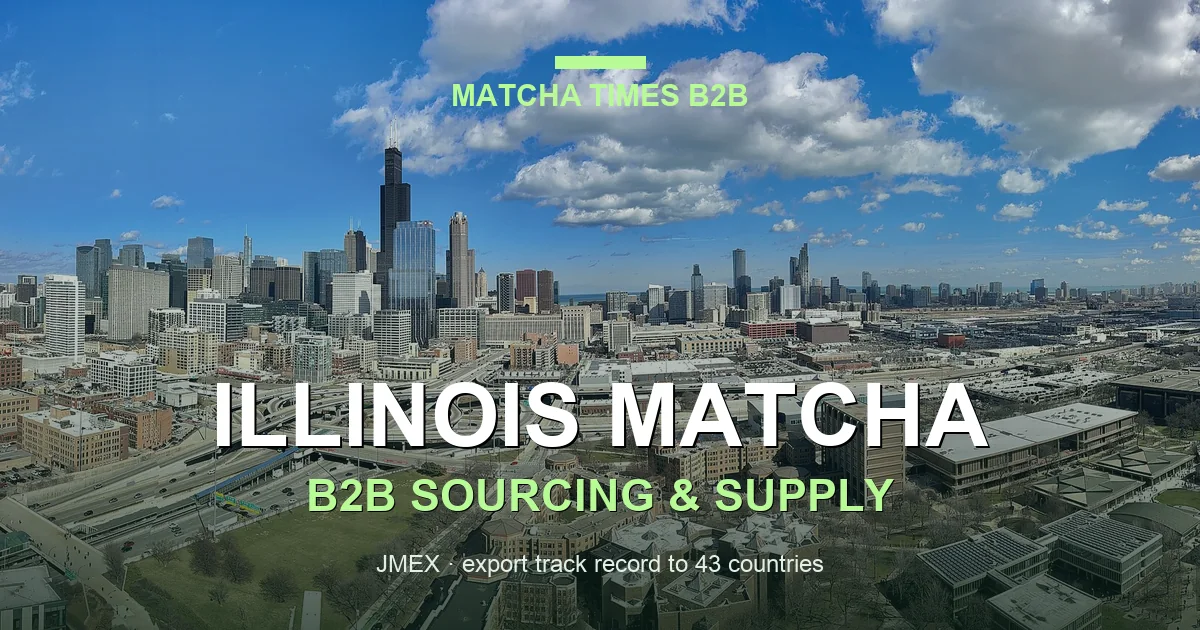
If you source matcha for a Chicago cafe group, a suburban bakery, a beverage or supplement manufacturer, a protein or wellness brand, or a food co-packer anywhere in Illinois, the honest answer on what matcha costs at wholesale in Illinois is that there is no single per-kilogram figure. A wholesale rate only becomes real once grade, origin, packaging, certification, order volume, and the trade term it is quoted against are all settled. For an Illinois buyer the number that actually decides your margin is landed cost — the powder price plus ocean freight to a US gateway, the inland rail move to Chicago, drayage, duty, insurance, and the last haul to your door — not the ex-works price printed on a product page. Illinois has a logistics personality all its own: it has no seaport, yet it sits at the center of North America’s rail network, which changes both how the powder arrives and how cheaply you can redistribute it. This guide takes an Illinois buyer through how a wholesale matcha price is assembled, how it moves by grade, what is driving it in 2026, how the powder physically reaches a landlocked state, how to store it through Midwestern winters and summers, the federal and Illinois rules that apply, and how to pin down a current, comparable quote.
For Companies Seeking Matcha Powder

We source matcha from Japan’s premier production regions including Kyoto Uji, Kagoshima, Fukuoka, and Shizuoka, offering comprehensive grade ranges from organic JAS-certified ceremonial grade to processing-grade matcha.
Common Challenges:
- “We have projects but cannot secure stable matcha supply…”
- “We want to incorporate matcha into new café menu items!”
If you face these concerns, consult with Matcha Times. Feel free to contact us for initial inquiries.
\Read Also/
Key takeaways on matcha wholesale price in Illinois
- No fixed per-kilogram wholesale price exists; it is driven by grade, origin, packaging, certification, and volume, and it only means something when quoted against a trade term such as FOB, CIF, or delivered Illinois.
- Judge suppliers on delivered landed cost into Illinois, not the sticker powder price, because ocean freight, inland rail, drayage, duty, and clearance all sit between the quote and your Illinois warehouse.
- Grade sets the tier: ceremonial sits highest, barista above culinary, and ingredient grade lowest — a retail tin price is never a wholesale benchmark.
- Illinois is landlocked, so most matcha lands at a West Coast (or Gulf) port and rails inland to Chicago’s intermodal yards — the rail and drayage legs, not a sea call, shape your delivered cost.
- That same central rail position is an advantage: from Illinois you can redistribute across the United States cheaply and quickly, which can spread freight and overhead across a larger order.
- Illinois’ continental climate is a real cost lever: humid summers, freezing winters, and sharp temperature swings all degrade matcha, so climate-stable storage belongs in your price math.
- Plan for two compliance layers — federal FDA rules plus, from July 1, 2026, an IDPH wholesale food permit for in-state processing, warehousing, or distribution — and wholesale levels have climbed since 2023 on tight Japanese supply, so ask for a current written quote.
Researched and reviewed by the Matcha Times Editorial Team, operated by the Japan Matcha Export Organization (JMEX). See our Editorial Policy and Sources & Methodology. Found an error? Tell us.
\Read More/
What a wholesale matcha price in Illinois actually includes
Wholesale is the business rate for matcha bought in bulk to resell or to use as an ingredient — not just a bigger consumer tin at a discount. The figure a supplier leads with is usually the powder price at a single trade term, and the distance between that and the cost of stock sitting in your Illinois facility is exactly where margin quietly leaks away. Reading every quote as a delivered landed cost rather than a shelf price is what keeps a comparison honest for a state that imports everything by rail or road.
| Landed-cost layer | What it pays for | Why it matters in Illinois |
|---|---|---|
| FOB / ex-works powder price | The matcha itself at a stated grade and pack size | The only piece a product page hints at; every layer below is added on top |
| Ocean freight to a US gateway | Japan to a West Coast or Gulf container port | Illinois has no seaport, so the goods always enter elsewhere first |
| Inland rail to Chicago | Intermodal line-haul from the port to a Chicago-area yard | This leg is unique to a landlocked buyer and is a major part of the delivered number |
| US import duty | Customs duty assessed at entry | Green tea and matcha are duty-free at the General rate under HTS 0902 |
| Drayage & clearance | Customs clearance and the move off the intermodal ramp | Chicago ramp drayage and broker fees, not a dockside clearance |
| Inland freight & storage | Final truck leg plus climate-stable warehousing | Temperature- and humidity-controlled storage through Midwest seasons is a recurring cost |
Two Illinois buyers can be shown the same FOB price and still land very different costs depending on grade value, which US port the container enters, how far the rail move runs, and who clears and drays it to Chicago. That is why a quote listing only a per-kilogram figure, with no trade term and no delivery point, cannot be compared fairly against another.
Matcha wholesale price by grade
Grade is the biggest single lever on price, so the discipline is to fit the grade to the job rather than default to the most prestigious tin. The tiers below run from highest to most economical, and we describe where each sits relative to the others instead of printing a per-kilogram number, because the figures published online are commercial estimates that swing widely by provider, grade definition, and order size.
| Grade tier | Typical Illinois use | Where it sits on price |
|---|---|---|
| Ceremonial | Signature whisked drinks, tasting menus, premium cafe programs | Highest — shade-grown, early-harvest, finely stone-milled tencha |
| Barista / latte | Cafe lattes and iced matcha that must hold color and taste in milk | Upper-middle — tuned for milk performance, below ceremonial |
| Culinary | Bakeries, pastry, gelato, and dessert production | Lower-middle — color built to survive baking or freezing, larger packs |
| Ingredient / industrial | RTD drinks, smoothie, protein and supplement lines, private label | Lowest per kilogram — specified for dispersion and scale, not straight drinking |
- Pouring a ceremonial grade into a baked, blended, or bottled product is money burned — a culinary or ingredient grade performs the same in that use for less.
- A barista grade priced below the culinary floor, or a “ceremonial” priced like culinary, usually signals mis-grading or dilution — confirm the grade with a sample, never a label claim.
- Within any tier, single-origin, named-region leaf and an earlier harvest command more than blended, later-harvest material.
What moves the matcha wholesale price in 2026
In short: how tight Japanese supply is, what your order profile looks like, and how the goods travel inland. Each lever below can move the final landed cost into Illinois on its own, which is why two quotes for what sounds like the same matcha rarely line up.
- Grade and specification: ceremonial, barista, culinary, and ingredient grades price in descending order, and the grade should follow the use case.
- Origin and harvest: single-origin, named-region, and earlier-harvest leaf sit above blended, later-harvest lots.
- Certification and testing: organic status, a certificate of analysis per lot, and pesticide, heavy-metal, and microbiological testing all add cost that protects you downstream.
- Packaging: retail-ready tins and sachets cost more per kilogram than bulk foodservice bags, and moisture-barrier packing earns its keep in a humid Midwest summer.
- Order size and commitment: steadier, larger volumes on contract usually earn better per-kilogram terms than one-off spot buys.
- Inland logistics and trade term: the FOB, CIF, or delivered choice, which US port the container enters, and the length of the rail-plus-truck move to Illinois all feed the landed number.
- Market pressure and FX: Japanese matcha supply is tight and the yen moves, so availability and currency both shape the 2026 picture.
On the supply backdrop, Japan’s green tea exports — counting all forms, not matcha alone — reached a record of roughly ¥36.4 billion on about 8,798 tonnes in 2024 according to the Japan Ministry of Finance Trade Statistics, with powdered tea (matcha and similar) making up about 58% of that volume in 2024. Read those as green-tea totals, labelled by value and by volume, not matcha-only values. Several industry trackers separately report that wholesale matcha prices have risen sharply since 2023 on constrained tencha supply; treat that as a commercial observation that varies by provider, and confirm today’s level with a live quote.
How matcha reaches a landlocked Illinois, and why rail routing matters
This is where sourcing into Illinois diverges from the national supplier pages, which say nothing about geography, and from coastal guides that assume a direct sea call. Illinois has no ocean port, so an imported container almost always clears a West Coast gateway such as Los Angeles or Long Beach, or occasionally a Gulf port, and then moves inland by intermodal rail. The good news is that the inland leg ends in one of the best-connected freight markets on the continent.
According to the Chicago Metropolitan Agency for Planning (CMAP), Freight and Rail, metropolitan Chicago is North America’s freight hub: all six Class I railroads operate in the region and it holds a large network of rail-truck intermodal terminals where containers are lifted between railcars and truck chassis. For a matcha buyer, that density is a double benefit — many routing and carrier options on the way in, and fast, cheap redistribution on the way out.
- West Coast entry plus rail: a West Coast port plus an intermodal train to a Chicago-area ramp is the common path; the rail-plus-drayage cost, not a dockside fee, is the inland piece to compare.
- Alternative gateways: a Gulf or occasional all-water East Coast routing can make sense for some carriers or schedules, so ask a freight forwarder to price more than one lane.
- Air freight for premium lots: for small, high-value ceremonial lots or urgent top-ups, airfreight into Chicago O’Hare trades a higher freight cost for speed and skips the ocean-plus-rail timeline.
- Central redistribution: because Illinois sits at the center of the rail map, a buyer here can serve the Midwest and much of the country from one location, which is a genuine cost advantage when you plan volume.
The working rule: make every quote name the trade term and the Illinois delivery point — for example FOB Japan, CIF Los Angeles, or delivered to your Chicago-area warehouse — so you are comparing a true landed cost, not an ex-works powder price. A supplier who understands the ocean-plus-rail reality of a landlocked state removes friction a purely product-focused vendor leaves on your desk.
How Illinois food manufacturing shapes matcha demand
Illinois demand is unusually manufacturing-heavy, and that changes how a buyer should think about grade, volume, and specification. The greater Chicago area is a dense cluster of food and beverage makers, contract manufacturers and co-packers, and supplement and nutrition brands, so a large share of the matcha moving through the state is bought as an ingredient rather than for whisking.
- Specify for the formulation: RTD drinks, smoothie and protein blends, bakery lines, and supplements usually want a culinary or ingredient grade specified for dispersion, color stability, and microbiological specs, not the most expensive ceremonial tin.
- Consistency and documentation: a co-packer or manufacturer buys to a recipe and a production schedule, so batch-to-batch consistency and a certificate of analysis per lot matter more than a one-off bargain.
- Volume planning: manufacturing volume rewards contracted monthly supply and planned allocation, which is where a steady exporter relationship beats spot buying.
Storing matcha through an Illinois winter and summer
Matcha is perishable in a way most dry ingredients are not: heat, humidity, light, and oxygen fade its color and flatten its flavor. Illinois tests all of those from both directions — humid, warm summers and cold, dry winters, with sharp temperature swings in between — so a grade you paid a premium for can lose the very quality you bought if it is stored carelessly. That makes storage a hidden part of the real cost per usable kilogram.
- Treat storage as part of price: budget for cool, dry, sealed storage — refrigerated for premium grades — because a warm summer stockroom accelerates color and flavor loss.
- Guard against condensation: moving sealed matcha between a freezing loading dock and a warm room invites condensation inside the pack, so let product temper before opening and avoid repeated freeze-thaw cycles.
- Order to turnover: buy to genuine turnover rather than over-ordering for a lower unit price, since matcha that oxidizes before it sells costs more than a higher headline rate.
- Packaging and transit handling: ask how the supplier packs for a continental climate — nitrogen-flushed or foil-sealed, moisture-barrier packaging protects what you are paying for in transit and in storage.
Order scale and how pricing improves with volume
MOQ and per-kilogram pricing are not arbitrary — they track milling runs, packing, certification paperwork, and freight economics. Rather than quote one number that shifts by supplier and grade, it is more useful to think in order-scale bands and in what genuinely improves as you climb them.
| Order-scale band | Who it fits in Illinois | What usually improves with scale |
|---|---|---|
| Sample / trial | A first evaluation before any commitment | Taste, color, and dispersion testing in your real recipe |
| Entry wholesale | A single cafe, bakery, or young brand | Case or few-kilogram packs and the first true per-unit wholesale pricing |
| Growing wholesale | Multi-site Chicago groups or a regional brand | Stronger per-kilogram terms, packaging choices, and steadier lead times |
| Volume / contract | Manufacturers, co-packers, distributors, and private label | Grade and origin customization, allocation, a COA per lot, and planned supply |
Because no price means anything without those conditions, insist on a written quote that states grade, origin, pack size, certification, volume, and the trade term — then compare like with like across suppliers.
Compliance: federal FDA rules plus an Illinois IDPH permit
Importing or wholesaling matcha in Illinois stacks two layers — the federal food-import rules that apply to every US shipment, and an Illinois permit that applies because you operate inside the state. Both run more smoothly when the supplier hands over clean documentation, and both belong in your cost and lead-time plan from the start.
- Federal facility registration: foreign facilities that manufacture, process, pack, or hold food for US consumption generally must register with the FDA, per FDA food facility registration.
- Federal FSVP: if your business is the US owner or consignee at entry, you are typically the importer of record and must run a Foreign Supplier Verification Program — hazard analysis, supplier verification, and recordkeeping — under the FDA Foreign Supplier Verification Programs (FSVP) rule.
- Federal duty: matcha and other green tea sit under HTS heading 0902, duty-free at the General (MFN) rate per the U.S. International Trade Commission Harmonized Tariff Schedule; treat any 2024–25 country-level reciprocal measure as separate, time-varying, and best confirmed with a licensed customs broker.
- Illinois IDPH wholesale food permit: per the Illinois Department of Public Health (IDPH) Manufactured Food program, from July 1, 2026 Illinois wholesale food operations — food processing plants, food storage and distribution facilities, repackagers, and shared-kitchen users — must hold an IDPH permit and pass inspection; confirm your exact scope, fee, and timeline with the department before you begin.
If you only resell pre-packaged tins through a distributor, your obligations are lighter than a direct importer’s or a repacker’s; if you import, repack, or private-label at volume, map both layers before the first container moves. A supplier whose export paperwork is already in order shortens all of it.
Price outlook for Illinois buyers
No one can promise a 2026 figure, but the direction is reasonable to plan around. Japanese tencha supply is still tight against global demand, and currency swings feed straight into import costs, so continued firmness rather than a fall is the prudent planning assumption. Two habits protect an Illinois buyer: ordering to real turnover so you are never forced to chase spot availability at a bad moment, and holding a supplier relationship that can commit to steady monthly supply at an agreed grade.
The counterweight is that Illinois logistics advantages stay strong: deep intermodal capacity and a central location can take time and cost out of both the inbound rail leg and your outbound distribution, partly offsetting powder-price pressure. The buyers who come out ahead treat price as a planned, contracted input, not a monthly scramble.
How to vet any matcha supplier on price and value
Instead of ranking vendors, hold every candidate — a US distributor, a Japanese producer, or JMEX — to the same questions. Treat each row below as something to ask in writing before you commit to volume, so the lowest headline does not quietly hide the higher true cost.
| Criterion | What to verify with any supplier |
|---|---|
| Quote structure | A written quote naming grade, origin, pack size, certification, volume, and the trade term (FOB/CIF/delivered) |
| Grade & origin control | Can they hold a defined grade and origin consistently, lot after lot? |
| Certifications | Organic, halal, or any other certifications your product or claims require |
| Documentation | A COA per lot, pesticide, heavy-metal, and microbiological testing, and clean customs paperwork |
| Logistics into Illinois | Do they understand a West Coast or Gulf entry, intermodal rail to a Chicago ramp, and realistic inland lead times? |
| Climate handling | Moisture-barrier packaging and transit handling so color and flavor survive humid summers and freezing winters |
| Formulation fit | For a manufacturer or co-packer: dispersion, color stability, and specs suited to your recipe and process |
| Lead time & supply stability | Can they commit to steady monthly supply against a tight market and a production schedule? |
A vendor who answers these in writing is easy to scale with; one who dodges them is a risk no matter how attractive the opening price looks.
Common pricing mistakes Illinois buyers make
- Comparing an ex-works powder price against a delivered price — always line up the same trade term and delivery point.
- Reading a retail tin price as a wholesale benchmark.
- Forgetting the inland rail-and-drayage leg that every landlocked shipment carries from the port to Chicago.
- Buying a ceremonial grade for a baked, frozen, or blended product where an ingredient grade performs identically for less.
- Over-ordering to chase a lower unit price, then losing color and flavor to summer humidity or freeze-thaw condensation before the stock turns over.
- Leaving federal FDA steps and the new Illinois IDPH permit until a shipment is already on the water.
How to lock a stable Illinois price
- Match your grade to your actual use with the grade table above, so you are not paying for a tier you do not need.
- Request samples and test taste, color, and dispersion in your real product or recipe before committing.
- Get a written quote naming grade, origin, pack size, certification, volume, and the trade term — the only basis for a fair landed-cost comparison.
- Settle the inbound path and compliance: importer of record, FDA registration and FSVP, US labeling, your inland rail-and-drayage lane to Chicago, and the IDPH permit if you process, store, or repack in-state.
- Place a first order sized to genuine turnover, then agree a reorder cadence and, as volume grows, a contract that fixes grade and supply against a tight market.
- Revisit the pricing as volumes and FX move, but keep the relationship that guarantees supply.
Why Buyers Choose JMEX (Japan Matcha Export Organization)

For Illinois importers, wholesalers, co-packers, manufacturers, and brands, JMEX works on the Japanese export side — origin and grade selection, certificate-of-analysis and residue testing, organic and halal certification, and customs documentation — so a quote arrives with the specification fixed and the paperwork ready, and your West Coast or Gulf clearance, intermodal rail move to Chicago, FDA filings, and Illinois IDPH permit scope all run more smoothly, whether you are serving the Midwest or redistributing nationally.
export track record to 43 countries
Frequently asked questions about matcha wholesale price in Illinois
Direct answers to the pricing questions Illinois buyers ask most before sourcing at volume.
How much does wholesale matcha cost per kilogram in Illinois?
There is no single figure, and we will not invent one. The wholesale price per kilogram turns on grade (ceremonial, barista, culinary, or ingredient), origin and harvest, packaging, certification, and order volume, and it only means something quoted against a trade term such as FOB, CIF Los Angeles, or delivered to your Chicago-area warehouse. A retail tin price is not a wholesale rate. Ask for a current written quote for your exact grade and volume so you can compare landed cost like with like.
What is landed cost for an Illinois buyer with no seaport?
Landed cost is the powder price plus ocean freight to a US gateway, the inland intermodal rail move to Chicago, drayage, duty, insurance, the final truck leg, and storage — everything it takes to get usable matcha into your operation. Because Illinois is landlocked, the rail-and-drayage leg is always part of the number, which is why two buyers shown the same FOB price can land it at different costs depending on which port the container enters and how far it travels. Compare delivered or CIF quotes, not an ex-works powder price alone.
Which matcha grade should an Illinois business buy?
Match the grade to the use. Ceremonial suits signature whisked drinks and premium cafe programs; barista or latte grade is built to hold color and taste in milk; culinary suits bakery, gelato, and desserts; and ingredient or industrial grade fits RTD drinks, blends, protein and supplement lines, and private label. Because so much Illinois demand is from manufacturers and co-packers, an ingredient grade specified for dispersion and consistency is often the right, and more economical, choice.
Is matcha subject to US import duty when it enters through Chicago?
Green tea including matcha falls under HTS heading 0902, which is duty-free at the General (MFN) rate according to the U.S. International Trade Commission’s Harmonized Tariff Schedule, regardless of whether it clears at a West Coast or Gulf port before railing to Illinois. Any country-level reciprocal measure is separate, time-varying, and best confirmed with a licensed customs broker before you ship, so it is not part of the base product duty.
What permits do I need to sell wholesale matcha in Illinois?
Expect two layers. Federally, a foreign facility generally registers with the FDA, and if you are the importer of record you run a Foreign Supplier Verification Program and meet US labeling rules. At the state level, the Illinois Department of Public Health requires wholesale food operations — processing plants, storage and distribution facilities, repackagers, and shared-kitchen users — to hold an IDPH permit and pass inspection, a requirement effective July 1, 2026. Confirm your exact obligations, fee, and timeline with the department, since they depend on what you do with the product.
Does Illinois weather really affect wholesale matcha costs?
Yes, indirectly but materially. Heat, humidity, light, and oxygen degrade matcha’s color and flavor, and Illinois pushes from both sides with humid summers and freezing winters, plus condensation risk when sealed product moves between a cold dock and a warm room. Matcha that sits in poor conditions or turns over slowly loses the quality you paid for. Cool, sealed, often refrigerated storage, moisture-barrier packaging, buying to genuine turnover, and letting product temper before opening all protect your effective cost per usable kilogram, which is why storage belongs in an Illinois price calculation.
Sources & methodology
This guide was researched and last reviewed in October 2026, and relies only on the external primary and official sources listed below — each shown with what it supports, its date, and its scope. Wholesale price levels are described qualitatively because published per-kilogram figures are commercial estimates that vary by provider, grade definition, and volume; we do not reuse a vendor’s number as fact or average differing figures. This article presents no first-party Matcha Times dataset.
- U.S. International Trade Commission, Harmonized Tariff Schedule — US duty position for green tea/matcha (HTS heading 0902, duty-free General rate); accessed 2026; scope: US MFN product duty.
- FDA, Foreign Supplier Verification Programs (FSVP) final rule — US importer verification obligations; accessed 2026; scope: US food imports.
- FDA, Registration of Food Facilities — foreign food facility registration requirement; accessed 2026; scope: US food facilities.
- Illinois Department of Public Health, Manufactured Food program — Illinois wholesale/manufactured food permit and inspection requirement (effective July 1, 2026) for processing plants, storage/distribution facilities, repackagers, and shared-kitchen users; accessed 2026; scope: Illinois wholesale food operations.
- Chicago Metropolitan Agency for Planning, Freight and Rail — metropolitan Chicago as North America’s freight hub, with all six Class I railroads and a dense network of rail-truck intermodal terminals; accessed 2026; scope: regional freight/rail infrastructure.
- Japan Ministry of Finance, Trade Statistics — Japan green tea export value/volume (all forms, 2024) and powdered-tea volume share; data year 2024; scope: Japan green tea exports.
Learn More About Global Matcha Trends at Matcha Times

Matcha Times is a specialist media platform covering the global matcha market — sourcing and wholesale, supply and pricing, trade and regulations, production and origins, and the companies shaping the industry.
From market analysis and price trends to café case studies and interviews with tea farmers, we help buyers, importers, distributors, and manufacturers stay ahead of where matcha is heading. Explore more and put the global matcha market to work for your business.
Conclusion
When origin, grade, and export conditions align, matcha becomes a stable revenue source. Start by defining your requirements and confirming quality with a sample.
Looking for wholesale or OEM matcha samples? Contact us — we will recommend the optimal origin and grade based on your application and target markets.
Related Articles