Japanese Matcha Supplier in Utah: B2B Sourcing Guide for Cafés & Brands
If you are looking for a matcha supplier in Utah, the honest starting point is that matcha is not grown, milled or produced in Utah — or anywhere in the continental United States at scale. Real Japanese matcha comes from tea regions such as Uji, Nishio, Kagoshima and Shizuoka, so a Utah cafe, roaster or wellness brand sources it either through a US-based distributor or wholesaler, or by importing directly from a Japanese processor or export organization. The right path depends on your volume, your grade, and how much of the import and compliance work you want to own.
This guide explains who actually supplies Japanese matcha to Utah buyers, how to compare a distributor against importing direct, what Utah’s landlocked logistics mean for lead time and landed cost, the US and Utah compliance steps (import duty, FDA registration, FSVP and Utah food establishment registration), a neutral checklist to verify any supplier, and how JMEX supports the export side from Japan.
For Companies Seeking Matcha Powder

We source matcha from Japan’s premier production regions including Kyoto Uji, Kagoshima, Fukuoka, and Shizuoka, offering comprehensive grade ranges from organic JAS-certified ceremonial grade to processing-grade matcha.
Common Challenges:
- “We have projects but cannot secure stable matcha supply…”
- “We want to incorporate matcha into new café menu items!”
If you face these concerns, consult with Matcha Times. Feel free to contact us for initial inquiries.
\Read Also/
Key Takeaways
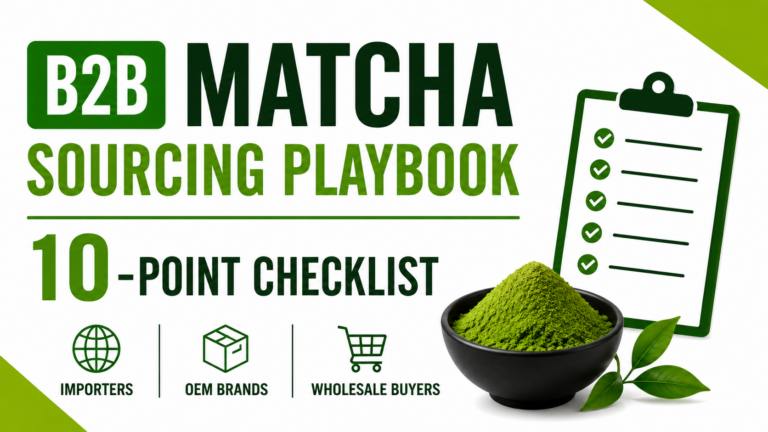
- There is no matcha grown or produced in Utah; Utah businesses buy Japanese matcha through a US distributor or by importing direct from a Japanese processor or export organization.
- Smaller cafes usually start with a US-based distributor (fast, low MOQ, no import paperwork); multi-store groups and wellness, supplement or beverage brands at scale benefit from importing direct from Japan (better unit economics, grade control, direct COA).
- Utah is landlocked, so imported matcha lands at a West Coast port and moves by rail and truck to the Salt Lake distribution hub — plan lead time and landed cost around that corridor.
- US import duty on green tea (including matcha) under HTS heading 0902 is a product-level factor to confirm with a customs broker; the bigger compliance tasks are FDA facility registration and FSVP.
- Verify every supplier the same way: a per-lot COA, Japanese origin, grade and certification scope, lot consistency, and documentation support — evidence over marketing claims.
Researched and reviewed by the Matcha Times Editorial Team, operated by the Japan Matcha Export Organization (JMEX). Last reviewed: 2026-10-05. See our Editorial Policy and Sources & Methodology. Found an error? Tell us.
\Read More/

Who actually supplies Japanese matcha to Utah buyers?
Because there is no in-state producer, a “matcha supplier in Utah” is really one of two things: a US-based distributor or wholesaler that already holds US inventory, or a Japanese processor or export organization you import from directly. Both can serve a Utah buyer well; they simply shift where the import work, the margin and the quality control sit.
A distributor is the quickest route for a single cafe: you order in kilograms, pay a US-domestic price, and skip customs entirely. Importing direct suits buyers who need consistent volume at a better unit cost, want to lock a specific origin and grade, and can handle (or delegate) FDA and FSVP obligations. The sections below compare the supplier types, then map the trade-offs to your buyer size.
Farmer, processor, trading company or export organization?
When you import direct, you are choosing among different kinds of source in Japan. Each sits at a different point on the trade-off between price, grade control, minimum order and how much export support you receive. The table compares the main supplier types a Utah buyer will encounter.
| Supplier type | Best for | Strengths | What to watch |
|---|---|---|---|
| Tea farmer / producer | Single-origin, story-driven sourcing | Direct origin, traceability, distinctive terroir | Often limited grades, higher MOQ per lot, little export/COA support |
| Matcha processor / miller | Consistent grade and volume | Stable milling, grade design, repeatable color and particle size | May require a trading partner for export documents and small orders |
| Trading company | Convenience and mixed orders | Handles logistics and paperwork, flexible volumes | Less origin transparency; confirm the certificate covers the actual production |
| Export organization (e.g. JMEX) | Buyers who want origin control + export support | Matches origin and grade to the application, consolidates COA, MRL and export docs | Confirm scope, grades and supply cadence for your exact spec |
| US distributor / wholesaler | Utah cafes and small multi-store buyers | US stock, no customs work, low MOQ, fast delivery | Higher unit cost; you inherit their origin and grade choices |
Which route fits your buyer size in Utah?
The right supplier is mostly a question of scale and how much control you need. Utah’s buyer base runs from independent Salt Lake and Utah County cafes to Park City hospitality groups and the state’s notably large cluster of wellness, supplement and functional-beverage brands. Match the route to where you sit.
- Independent cafe (one to a few locations): buy from a US distributor in kilogram quantities. You get speed and no paperwork; latte or culinary grade usually fits a menu. Revisit direct import only when monthly usage becomes predictable.
- Multi-store group or regional roaster: a hybrid works — a distributor for top-ups plus a direct trial lot to test unit economics and lock a consistent grade across stores.
- Wellness, supplement or protein brand: importing direct (or through an export organization) is usually worth it. You need a fixed origin and grade, a per-lot COA for your formulation and label claims, and a supply cadence that matches production runs.
- OEM / private label: specify particle size, color stability and microbiological limits up front, and treat COA and documentation support as non-negotiable selection criteria.
Getting matcha to a landlocked state: Utah logistics
This is the part most national “wholesale matcha” pages ignore, and it is exactly where a Utah buyer’s reality differs. Utah has no ocean port. Imported matcha from Japan arrives by ocean at a West Coast gateway — most often Los Angeles / Long Beach or Oakland — and then travels inland by rail and truck.
The Salt Lake area is a major interior distribution point: the Utah Inland Port Authority is building out intermodal rail capacity to transload West Coast ocean containers and move goods on to the Mountain West region. Union Pacific and BNSF both serve the corridor. For a matcha buyer, the practical consequences are simple: add the port-to-Salt-Lake rail and drayage leg to your lead-time estimate, and remember that inland freight is part of your landed cost, not an afterthought.
If you import direct, you (or your broker and 3PL) coordinate the ocean leg, customs clearance at the West Coast port, and inland transport to Utah. If you buy from a US distributor, that cost is already baked into the domestic price — which is often why a distributor is the sensible choice until your volume justifies owning the corridor yourself.
US and Utah compliance for imported matcha
Importing food into the United States is federally regulated, and Utah adds a state layer if you warehouse, repack or process in-state. Nothing here is Utah-only at the border — the port of entry is on the West Coast — but a Utah operator still needs to handle the items below. Confirm specifics with a licensed customs broker and the named authorities before you ship.
Import duty (HTS heading 0902)
Green tea, including matcha powder, is classified under HTS heading 0902. Confirm the exact statistical suffix and the current duty treatment for your product with the US International Trade Commission tariff schedule and a customs broker; green tea has historically carried a duty-free general rate, but any separate, time-varying country-level trade measures are a different matter and should be checked at the time of entry. The US Customs and Border Protection import process governs entry and documentation.
FDA facility registration and FSVP
Any foreign facility that manufactures, processes, packs or holds matcha for the US market must hold a current FDA food facility registration, and US importers must operate a Foreign Supplier Verification Program (FSVP) for each foreign supplier. FSVP covers documented hazards for tea — pesticide residues, heavy metals and microbiological risk — with matching verification activities such as reviewing the per-lot COA. If you have no US owner or consignee at entry, you will need an FSVP importer of record.
Utah food establishment registration (UDAF)
If you store, repack, blend or further process matcha within Utah — for example a brand building latte mixes or supplement blends — the Utah Department of Agriculture and Food requires the facility to be registered as a food establishment under its manufactured food program, in addition to the federal FDA registration. A cafe simply serving matcha drinks is regulated differently from a manufacturer; confirm which category you fall into with UDAF before you scale.
How to verify any matcha supplier
Rather than ranking suppliers, evaluate every candidate — a Utah distributor, a Japanese processor or an export organization — against the same verifiable criteria. Apply this checklist equally to each option, including JMEX, and rely on documents you can confirm.
| Criterion | What to verify with any supplier |
|---|---|
| Origin | Confirmed Japanese origin and region/cultivar for the grade you buy, not just “Japanese-style” |
| Per-lot COA | Sensory, microbiological, pesticide and heavy-metal (lead, arsenic) results from an accredited (ISO 17025) laboratory, for the exact lot |
| Grade match | That the grade (ceremonial / latte / culinary) suits your application, with stable color and particle size |
| Certifications | Organic (JAS/USDA), halal or kosher as your market needs — and that the certificate scope covers the specific SKU |
| Lot consistency | Ability to hold color, flavor and spec from a trial lot to recurring monthly volume |
| Documentation support | FDA registration, FSVP-ready records, spec sheets and export documents for a direct import |
| Logistics to Utah | Whether the price is delivered-to-Utah or FOB Japan, and who owns the port-to-Salt-Lake leg |
| Commercial terms | MOQ, lead time, incoterms (FOB/CIF) and price quoted together in writing for your exact spec |
The most useful questions to ask a supplier are specific: What is the confirmed origin and grade? Can I see the per-lot COA from an accredited lab? Is this price delivered to Utah or FOB Japan? What MOQ and lead time apply to my spec? Suppliers who answer precisely and put the answers in writing are the ones worth scaling with.
Sourcing steps: from spec to a repeatable Utah supply
A disciplined process turns a good sample into a compliant, repeatable program. A practical flow for a Utah cafe or brand sourcing Japanese matcha runs as follows:
- Define your written specification — grade, application, monthly volume, packaging and your market (foodservice, retail or formulated product).
- Decide the route: a US distributor for speed and low MOQ, or a direct import for volume, grade control and a direct COA.
- Shortlist suppliers and request a sample matched to your spec, plus a per-lot COA and confirmed Japanese origin.
- Validate the sample in your actual drink or formulation, and check the COA and certification scope against your requirements.
- For a direct import, confirm the compliance path: HTS classification and duty with a broker, FDA facility registration, FSVP records, and (if you warehouse/process in-state) UDAF registration.
- Plan the Utah logistics: West Coast port of entry, rail and drayage to Salt Lake, and whether pricing is delivered-to-Utah or FOB.
- Place a small trial order, then agree MOQ, lead time, incoterms and pricing in a written quotation before scaling to a supply agreement.
Avoid the recurring mistakes: assuming a national “wholesale” price already includes delivery to Utah, accepting a company brochure instead of a per-lot COA, ignoring the inland freight leg, and ordering more than your turnover can sell before the powder loses color and flavor.
Sources & Methodology
This guide synthesises US federal import authorities (USITC tariff schedule, CBP, FDA), Utah state logistics and food-regulation sources (Utah Inland Port Authority, Utah Department of Agriculture and Food), and Japanese customs and trade sources. Each source below states what it supports, its date and its scope. Tariff treatment, recognition lists and food rules change, so confirm the current requirement with the named authority and a licensed customs broker before importing. No unverified number is presented as fact.
- USITC — Harmonized Tariff Schedule (HTS heading 0902, tea) — US tariff classification and duty treatment for green tea / matcha — accessed 2026 US import tariff
- US Customs and Border Protection — import process — US import entry, documentation and clearance process — accessed 2026 US customs
- FDA — Foreign Supplier Verification Programs (FSVP) — US importer obligation to verify foreign suppliers for documented food hazards — accessed 2026 US food import safety
- FDA — Registration of Food Facilities — Requirement for foreign facilities handling food for the US market to register with FDA — accessed 2026 US food facility registration
- Utah Inland Port Authority — Salt Lake intermodal rail hub transloading West Coast ocean containers for inland distribution — accessed 2026 Utah logistics
- Utah Department of Agriculture and Food — Manufactured Food — Utah food establishment registration for in-state manufacturing/warehousing/repacking — accessed 2026 Utah food regulation
- Japan Customs (English) — Tea (matcha) tariff classification under HS heading 0902 at export — accessed 2026 HS classification / customs
- Japan MAFF / Ministry of Finance — tea export statistics — Market context: Japan green-tea export value/volume (green-tea TOTAL, not matcha-only) — 2024 Japan green tea exports
Why Buyers Choose JMEX (Japan Matcha Export Organization)

One supplier that meets these criteria at a high level is JMEX (Japan Matcha Export Organization), a wholesale and export partner dedicated to bringing Japanese matcha overseas. It designs origin selection, quality assurance, export documentation, and logistics as one continuous flow, built for export from the start.
With a track record of exports to 43 countries, JMEX bridges Japanese origin and the Utah buyer on the export side: confirmed Japanese origin and grade design matched to your application and target market, per-lot COA, MRL and heavy-metal testing from accredited laboratories, organic and halal certification support with certificate scope matched to your SKU, FSVP-ready records and export documentation, and stable recurring supply from 10 kg to 1 t per month for cafes, roasters, importers, wholesalers, OEM and health and wellness brands across Utah and the Mountain West.
Frequently Asked Questions
Common questions from Utah cafes, roasters and wellness brands sourcing Japanese matcha, from whether an in-state supplier exists to how it clears customs and reaches Salt Lake.
Is there a matcha supplier in Utah?
There is no matcha grown, milled or produced in Utah — authentic matcha comes from Japanese tea regions such as Uji, Nishio, Kagoshima and Shizuoka. Utah businesses buy it either from a US-based distributor that holds domestic inventory, or by importing directly from a Japanese processor or export organization. Both can serve a Utah buyer; the choice depends on your volume and how much import and quality-control work you want to own.
Where do Utah cafes and brands buy bulk matcha?
Most independent cafes start with a US distributor, ordering in kilogram quantities at a US-domestic price with no customs paperwork. Multi-store groups, roasters and wellness or supplement brands with steadier volume often move to importing direct from Japan for better unit economics, a fixed origin and grade, and a per-lot COA for their formulation and label claims.
How is matcha shipped to a landlocked state like Utah?
Because Utah has no ocean port, imported matcha arrives by sea at a West Coast gateway — usually Los Angeles / Long Beach or Oakland — and then moves inland by rail and truck. The Salt Lake area is a major interior distribution hub with intermodal rail served by Union Pacific and BNSF, so budget for the port-to-Salt-Lake leg in both lead time and landed cost.
Do I need FDA registration or FSVP to import matcha into Utah?
If you import directly, yes. The Japanese facility that processes, packs or holds the matcha must hold a current FDA food facility registration, and as the US importer you must operate a Foreign Supplier Verification Program (FSVP) for that supplier. If you warehouse, repack or process matcha within Utah, you also register the facility with the Utah Department of Agriculture and Food. Buying from a US distributor shifts the import obligations to them.
What import duty applies to matcha entering the US?
Green tea, including matcha, is classified under HTS heading 0902 and has historically carried a duty-free general rate, but you should confirm the exact statistical suffix and current treatment with the USITC tariff schedule and a licensed customs broker, and check separately for any time-varying country-level trade measures in effect at the time of entry.
Should I buy from a US distributor or import direct from Japan?
A distributor is faster, has a low minimum order and removes all import work, which suits a single cafe. Importing direct lowers the unit cost at volume and gives you origin, grade and COA control, which suits multi-store groups, roasters and wellness or OEM brands. Many Utah buyers run a hybrid: a distributor for top-ups while they validate a direct trial lot.
Learn More About Global Matcha Trends at Matcha Times

Matcha Times is a specialist media platform covering the global matcha market — sourcing and wholesale, supply and pricing, trade and regulations, production and origins, and the companies shaping the industry.
From market analysis and price trends to café case studies and interviews with tea farmers, we help buyers, importers, distributors, and manufacturers stay ahead of where matcha is heading. Explore more and put the global matcha market to work for your business.
Conclusion
A “matcha supplier in Utah” is really a choice between a US distributor and a direct import from Japan, shaped by your volume and how much control you need. Start with your spec, verify every supplier against the same checklist — confirmed Japanese origin, a per-lot COA, grade match, certification scope and clear terms — and plan for the West Coast port and rail leg into Salt Lake. JMEX supports Utah buyers on exactly these steps, from origin and grade design to per-lot COA, certification scope and export documentation for a compliant, repeatable supply.
Looking for wholesale or OEM matcha samples? Contact us — we will recommend the optimal origin and grade based on your application and target markets.
Related Articles