Best Wholesale Matcha for Cafés in Tennessee: Grade, Cost per Cup & Supply
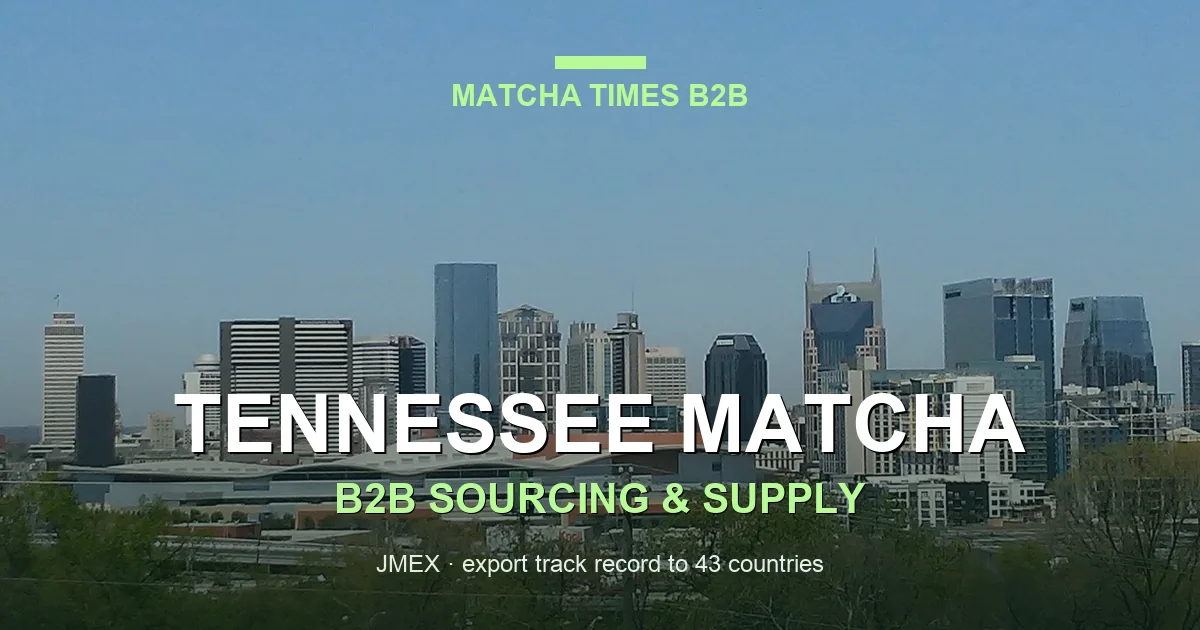
For cafés across Tennessee — from Nashville’s craft-beverage scene to Memphis foodservice operators and Knoxville’s growing specialty-tea market — the right wholesale matcha comes down to three decisions: grade matched to your menu application, cost economics that protect your margin, and a supply chain you can rely on long-term. The direct answer: most Tennessee café lattes are best served by a mid-range latte or premium culinary grade, sourced from a Japanese exporter who can provide batch-consistent COA documentation and organic or food-safety certification on request.
For Companies Seeking Matcha Powder

We source matcha from Japan’s premier production regions including Kyoto Uji, Kagoshima, Fukuoka, and Shizuoka, offering comprehensive grade ranges from organic JAS-certified ceremonial grade to processing-grade matcha.
Common Challenges:
- “We have projects but cannot secure stable matcha supply…”
- “We want to incorporate matcha into new café menu items!”
If you face these concerns, consult with Matcha Times. Feel free to contact us for initial inquiries.
\Read Also/
Key Takeaways for Tennessee Café Buyers
- Latte/café grade is the standard choice for high-volume Tennessee cafés: it disperses well in steamed milk and is more cost-effective than ceremonial grade at daily-use scale.
- Ceremonial grade is worth considering if your menu positions a premium whisked matcha as a featured item — not as the default for every milk-based latte.
- Cost per cup depends on your scoop size and wholesale price per kg, not the retail label; never use retail prices to estimate commercial COGS.
- Japanese-origin matcha from Uji, Nishio, or Yame carries verifiable terroir, traceability, and food-safety documentation — important for cafés in Tennessee’s health-conscious markets.
- Matcha powder (HTS 0902) enters the US at a 0% MFN duty-free rate under the USITC Harmonized Tariff Schedule (2026 revision) — import cost is not a barrier for Tennessee buyers.
- Always request a Certificate of Analysis (COA), pesticide residue testing results (MRL compliance), and batch traceability documentation before committing to a commercial volume order.
\Read More/
Which Matcha Grade Is Right for Your Tennessee Café?
The terms “ceremonial,” “latte,” and “culinary” are marketing conventions, not a regulated or legally defined standard — definitions vary across suppliers. What matters operationally is how the matcha performs in your specific application and at what cost per serving it fits your menu economics.
Latte / Café Grade: The Volume Workhorse
A mid-range latte or premium culinary grade is ground fine enough to disperse in steamed milk without clumping, with a flavor profile that holds up against oat, almond, or dairy milk without becoming overly bitter. For a Tennessee café running high-volume matcha lattes, this grade offers the best balance of color vibrancy, flavor stability, and cost efficiency. It is typically produced from second or third flush shaded tencha, milled to a fine particle size appropriate for beverage applications.
Ceremonial Grade: When the Preparation Is the Product
Ceremonial grade uses the youngest, first-harvest shaded tencha leaves with a sweeter, more vegetal flavor designed for drinking straight with water. If your Tennessee café menu features a traditional whisked matcha (usucha style) as a standalone offering — not mixed with milk — ceremonial grade may justify its higher wholesale cost. Using it as the default for every milk-based latte, however, drives up COGS without a proportional customer-visible flavor difference once steamed milk is added.
Culinary / Ingredient Grade: Best for Food Applications
If your Tennessee café operation extends to baked goods, sauces, or blended frozen drinks, a culinary or ingredient-grade matcha — typically from later-harvest leaves — delivers color and matcha character at the lowest wholesale cost. It is not designed for drinking straight. Many café operators source two grades: culinary for kitchen applications and latte/café grade for beverages.
Matcha Grade vs. Application: Reference Table
The following table summarizes how matcha grades map to typical café applications. Grade names are not standardized across the industry — always verify the underlying specification (leaf source, particle size, color, flavor profile) with any supplier before placing a commercial order.
| Grade Label | Typical Leaf Source | Best Application | Milk Compatibility | Relative Cost |
|---|---|---|---|---|
| Ceremonial | First-harvest, youngest tencha | Whisked straight (usucha), premium single-serve | Not optimized for milk | Highest |
| Latte / Café Grade | Mid-harvest shaded tencha | Lattes, iced matcha drinks, matcha milk | High — designed for milk | Mid-range |
| Premium Culinary | Late-harvest shaded tencha | High-volume lattes, blended drinks | Good with strong flavors | Mid-low |
| Culinary / Ingredient | Later-harvest, lightly or un-shaded | Baking, blended frozen, sauces | Acceptable (flavor competes) | Lowest |
Note: Grade terminology is not regulated. This table reflects common industry usage; individual supplier specifications will vary. Always request a product sample and technical specification sheet before a commercial commitment.
Understanding Cost per Cup for Tennessee Café Operators
Cost per cup is the metric that matters for your P&L. Wholesale price per kg tells you the input cost; cost per serving tells you what each menu item costs to produce. The two are connected by your recipe gram-per-serve.
What Drives Matcha COGS at the Cup Level
According to research published by the Specialty Coffee Association in partnership with Kizuna Matcha (2024), the matcha ingredient itself in a standard café preparation can account for approximately US$0.26 per drink at mid-range café grade, with steamed milk and packaging making up the bulk of total latte COGS. The actual figure for your Tennessee operation depends on several variables:
- Scoop size (grams per serving): industry standard for a 12–16 oz matcha latte is typically 2–4 g per serve, with some operators using more for a stronger flavor. Calculate your own baseline from your recipe before projecting per-cup cost.
- Wholesale price per kg: varies by origin, grade, certification (organic, JAS), and supplier terms. Always clarify whether a quoted price is FOB Japan, CIF, or a delivered landed cost to your Tennessee address.
- Batch consistency: inconsistent particle size or color across batches creates inconsistent flavor and appearance per cup — a hidden COGS item that affects customer experience and waste.
- Waste and shelf life: matcha oxidizes after opening. Larger minimum orders only make economic sense if your volume moves through inventory before quality degrades.
The SCA/Kizuna figure above is an industry reference estimate. Your actual cost per cup will differ based on your recipe, your negotiated wholesale price, and your local overhead. Build your own serving-cost model from your supplier’s confirmed price and your recipe specification — never use published estimates as a substitute for your own calculation.
Import Duty and Supply Chain Facts for Tennessee Buyers
Tennessee café buyers importing Japanese matcha directly — or working with a US importer who sources from Japan — benefit from a favorable trade baseline. Matcha powder classifies under HTS heading 0902 (green tea, not fermented) and enters the United States at a 0% duty-free MFN rate under the standard Most Favored Nation schedule, as listed in the current USITC Harmonized Tariff Schedule (2026 revision). Any country-specific reciprocal trade measures or additional tariff actions that may apply in a given trade period are separate from this base product rate — verify current requirements with a licensed US customs broker against Federal Register notices at the time of import.
For Tennessee operations working with Japanese exporters, key supply-chain considerations include ocean freight lead time (several weeks door-to-door, depending on routing and US customs clearance), minimum order quantities that make air freight viable only for samples or urgent small replenishments, and proper cold-chain and humidity-controlled storage to preserve color and flavor during transit and at your café.
Supplier Selection Checklist for Tennessee Cafés
Use the following criteria when evaluating any wholesale matcha supplier — whether a domestic distributor serving Nashville or Memphis, or a direct Japanese exporter. This checklist is designed for beverage and food-service application sourcing.
| Criterion | What to Verify with Any Supplier |
|---|---|
| Grade specification | Ask for leaf source (first/second/later harvest), shading period, particle size (microns), and color value — not just a marketing grade label |
| COA / batch traceability | Each batch should have a Certificate of Analysis covering heavy metals, pesticide residues (MRL compliance for US standards), and microbiological specifications |
| Certifications | Organic (JAS from the Japanese side; USDA Organic for US-market labeling), food-safety management (HACCP, ISO 22000, FSSC 22000), or halal/kosher as required by your café’s sourcing policy |
| Minimum order quantity | Verify the MOQ for your target grade; samples are typically available in small quantities for sensory evaluation before committing to a commercial order |
| Color and milk compatibility | Always prepare a sample in the exact milk type your café uses (oat, almond, dairy) — color vibrancy and flavor integration vary significantly by grade and production lot |
| Lead time and supply consistency | Confirm production lead time, shipping options (ocean vs. air), and whether the supplier can reserve stock for your regular order cycle to avoid supply gaps |
| Pricing transparency | Confirm whether the quoted price is FOB Japan, CIF, or delivered to your US address — and whether volume-tier pricing exists for your monthly usage level |
Why Japanese-Origin Matcha Matters for Tennessee Cafés
Tennessee’s specialty-café market — particularly in Nashville’s Gulch and East Nashville neighborhoods, Memphis’s Midtown and Cooper-Young districts, and Knoxville’s Old City — increasingly attracts customers who research origin and quality before choosing a café. Japanese matcha from verified growing regions carries provenance that domestic and other-origin alternatives cannot replicate: specific cultivars, defined shading protocols, and a documented production chain from farm to powder.
For café operators, this matters both as a flavor differentiator and as a menu storytelling asset. A matcha latte built on a verifiable Japanese origin — with an accessible explanation on your menu board or social media — supports a premium price point that a generic “matcha powder” cannot. The operational question is whether your Tennessee café volume justifies a direct Japanese supply relationship, or whether a US-based distributor sourcing from Japan serves your current scale more efficiently while you build volume.
Why Buyers Choose JMEX (Japan Matcha Export Organization)

Tennessee café operators sourcing wholesale matcha need a Japanese export partner who can deliver consistent grade specifications, verifiable COA documentation, and reliable supply. JMEX (Japan Matcha Export Organization) works with commercial buyers across all scales — from multi-location café groups to foodservice distributors serving the Southeast US — providing application-matched grades, organic and food-safety certifications on request, and export documentation for smooth US customs clearance. With a track record of exports to 43 countries, JMEX brings established Japanese supply-chain relationships to Tennessee café buyers who need consistency, traceability, and the flexibility to scale their matcha program as their business grows.
exports to 43 countries
FAQ: Wholesale Matcha for Cafés in Tennessee
Common questions from Tennessee café operators evaluating wholesale matcha sourcing:
What is the best matcha grade for café lattes in Tennessee?
For most Tennessee café lattes, a latte grade or premium culinary grade offers the best operational fit: it disperses smoothly in steamed milk, maintains vibrant green color, and is more cost-effective than ceremonial grade at daily-use volumes. Ceremonial grade is worth the cost premium only if your menu features a standalone whisked matcha preparation where the flavor nuance is the core offering.
How much does wholesale matcha cost per cup for a Tennessee café?
Cost per cup depends on your recipe (grams per serve) and your negotiated wholesale price per kg. Industry reference data from the Specialty Coffee Association / Kizuna Matcha (2024) estimates the matcha ingredient contribution at approximately US$0.26 per drink at typical mid-range café-grade wholesale pricing. Your actual number will differ — build your own serving-cost model from your supplier’s confirmed price and your recipe specification. Never use published estimates as your café’s actual COGS projection.
Is there an import duty on Japanese matcha for US café buyers?
Matcha powder classifies under HTS heading 0902 (green tea, not fermented) and currently enters the US at a 0% MFN (Most Favored Nation) duty-free rate per the USITC Harmonized Tariff Schedule. Any additional or country-specific reciprocal trade measures in effect at time of import are separate from this base rate — verify current requirements with your licensed customs broker before importing.
What certifications should I require from a wholesale matcha supplier?
At minimum: a Certificate of Analysis (COA) covering heavy-metal testing, pesticide residue testing (MRL compliance for US import standards), and microbiological specs for each batch. For specialty cafés in Tennessee targeting health-conscious customers, organic certification (JAS for Japanese production; USDA Organic for US-market labeling) and a food-safety management certification such as HACCP or ISO 22000 are worth requiring from any long-term supplier relationship.
What minimum order quantity (MOQ) should a Tennessee café expect?
Minimum order quantities vary by supplier and grade. Sample quantities for sensory evaluation are typically available in small amounts (100–500 g). Commercial wholesale orders — particularly for direct Japanese-export relationships — often carry a set minimum. Verify the MOQ directly with each supplier you evaluate and compare it against your projected monthly usage at your standard recipe serving size before committing.
How long does shipping take from a Japanese matcha supplier to Tennessee?
Ocean freight from Japan to US ports, with onward delivery to Tennessee, typically takes several weeks door-to-door depending on routing and customs clearance. Air freight is faster but significantly more expensive per kilogram, making it practical primarily for samples or urgent small orders. For reliable café operations, building a 4–8 week stock buffer is advisable when sourcing directly from Japan, and confirming that your supplier can reserve stock for your regular order cycle reduces supply-disruption risk.
Sources & Methodology
This article synthesizes information from the following primary and industry sources:
- USITC Harmonized Tariff Schedule (2026 revision): HTS heading 0902, MFN duty rate for green tea (not fermented). Available at hts.usitc.gov.
- Specialty Coffee Association / Kizuna Matcha (2024): industry reference estimate for matcha ingredient cost per serving in a standard café latte preparation. Source: SCA Partner Content, 2024.
- Grade terminology consolidated from established tea-industry reference sources. Note: the terms ceremonial, latte, culinary, and ingredient grade are marketing labels, not regulated standards — specifications vary by supplier.
Editorial note: This article does not rank or score individual matcha suppliers. All supplier selection criteria are presented as general procurement guidance applicable to any supplier evaluation. No JMEX-specific pricing, MOQ, or capacity figures are stated without a verified source. JMEX’s track record of exports to 43 countries is a confirmed published fact.
Learn More About Global Matcha Trends at Matcha Times

Matcha Times is a specialist media platform covering the global matcha market — sourcing and wholesale, supply and pricing, trade and regulations, production and origins, and the companies shaping the industry.
From market analysis and price trends to café case studies and interviews with tea farmers, we help buyers, importers, distributors, and manufacturers stay ahead of where matcha is heading. Explore more and put the global matcha market to work for your business.
Conclusion
When origin, grade, and export conditions align, matcha becomes a stable revenue source. Start by defining your requirements and confirming quality with a sample.
Looking for wholesale or OEM matcha samples? Contact us — we will recommend the optimal origin and grade based on your application and target markets.
Related Articles