GCC Matcha Market 2026: UAE, Saudi, Qatar, Kuwait, Bahrain & Oman
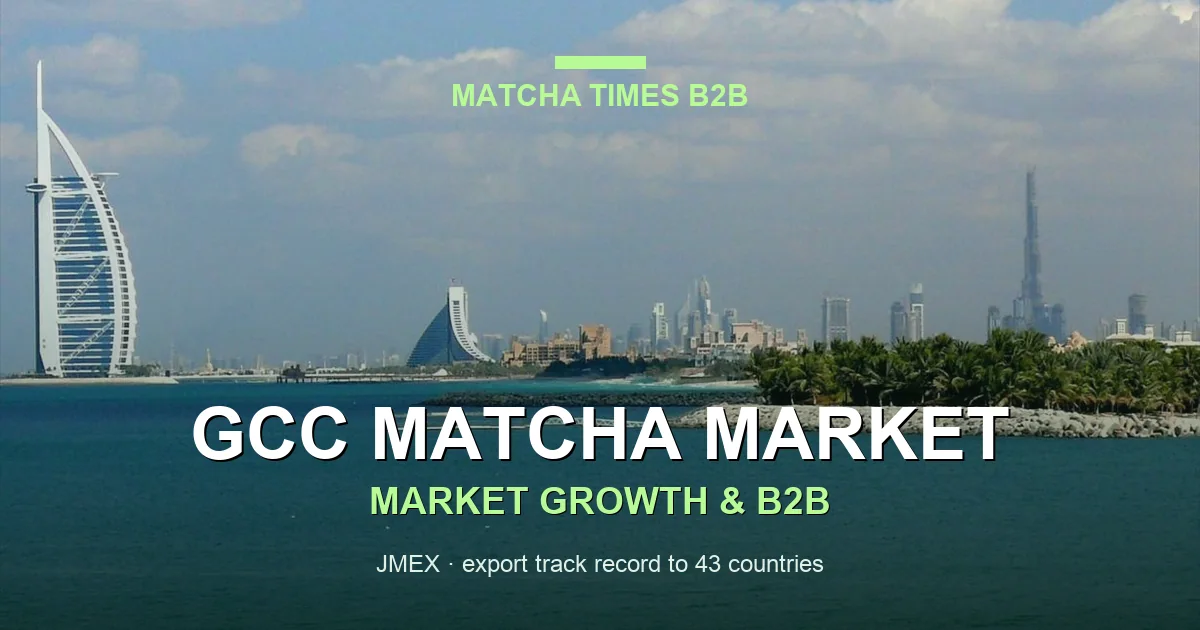
The GCC matcha market is small but among the fastest-moving matcha regions in the world. Commercial researchers put the wider Middle East & Africa (MEA) matcha market at a few tens of millions of USD in the low tens of millions of US dollars and still under 2% of global matcha demand — but growing steadily, led by the Gulf Cooperation Council states of the UAE, Saudi Arabia, Qatar, Kuwait, Oman and Bahrain. The demand is driven by a genuine consumer shift, not a fad: wellness-focused millennials, a fast-scaling specialty-cafe scene, and economic-diversification policy. This B2B guide sizes the opportunity with honestly attributed estimates, breaks the market down country by country, maps who actually buys matcha across the Gulf, explains the supply-side realities of sourcing from Japan, and sets out what it all means for an importer, wholesaler or brand — including how JMEX supports exporters into the region.
For Companies Seeking Matcha Powder

We source matcha from Japan’s premier production regions including Kyoto Uji, Kagoshima, Fukuoka, and Shizuoka, offering comprehensive grade ranges from organic JAS-certified ceremonial grade to processing-grade matcha.
Common Challenges:
- “We have projects but cannot secure stable matcha supply…”
- “We want to incorporate matcha into new café menu items!”
If you face these concerns, consult with Matcha Times. Feel free to contact us for initial inquiries.
\Read Also/
Key Takeaways
- The GCC matcha market is small in absolute size yet fast-growing: within the wider MEA market of a few tens of millions of USD, the Gulf is the growth engine, but it is still a small slice of global matcha demand.
- Demand is powered by four structural drivers — clean-caffeine wellness positioning, social-media-driven cafe culture, affluent young consumers, and diversification policy such as Saudi Vision 2030.
- The UAE is the most developed Gulf matcha market and the regional gateway; Saudi Arabia is the fastest-emerging on the back of Vision 2030 and a young population.
- Ceremonial-grade matcha dominates by value, while culinary and blend-grade matcha drives foodservice and OEM volume — the two segments need different sourcing.
- The Gulf imports the vast majority of its food and all of its matcha, so global supply strain and origin verification (Uji and other Japanese regions) are the real B2B risks — not consumer demand.
Researched and reviewed by the Matcha Times Editorial Team, operated by the Japan Matcha Export Organization (JMEX). Last reviewed: 2026-09-25. See our Editorial Policy and Sources & Methodology. Found an error? Tell us.
\Read More/

How big is the GCC matcha market?
Direct answer: there is no single official figure for a “GCC matcha market,” and the available numbers are commercial market-research estimates, not government statistics — so they must be read as attributed estimates that vary by provider and by how each firm defines “matcha.” The most useful public benchmark is the wider Middle East & Africa (MEA) region.
One widely-cited provider, Grand View Research, valued the MEA matcha market at roughly US$86 million in 2023 and projected about US$111 million by 2030, an annual growth rate near 3.6%. Other research firms publish different bases — for example an MEA figure near US$93 million in 2025 at a lower single-digit CAGR, with the region representing under 2% of the global matcha market. The numbers disagree because scope and definitions differ; estimates vary by provider and definition, and treat any single figure as indicative.
| Metric (attribution required) | Indicative estimate | Important caveat |
|---|---|---|
| MEA matcha market size, 2023 | ~US$86 million (Grand View Research) | MEA-wide, not GCC-only; commercial estimate |
| MEA matcha, 2030 projection | ~US$111 million, ~3.6% CAGR (Grand View Research) | Forecast; other providers project different paths |
| MEA share of global matcha, 2025 | under ~2% (multiple providers) | The region is small in global terms |
| Saudi green tea & matcha, forecast CAGR | ~6.6% 2026–2034 (Deep Market Insights) | Covers green tea AND matcha, not matcha alone |
| Highest-growth grade | ceremonial grade (multiple providers) | Premium positioning; segment split, not a $ value |
For a B2B reader the takeaway is not the exact dollar figure but the shape of the market: a small base, double-digit interest, premium positioning, and a demand curve pointing up. Verify any market number against the original provider report and note its year, region and whether it isolates matcha from green tea before you build it into a business case.
What is driving matcha demand across the Gulf?
Gulf matcha demand is not a single trend but a stack of reinforcing ones. Understanding them helps a B2B buyer judge which grades and channels will actually sell.
- Health and wellness positioning — matcha is marketed as a “clean caffeine” alternative to coffee, with antioxidants and the amino acid L-theanine for calmer energy; this resonates with the region’s expanding fitness and wellness culture.
- Cafe culture and social media — specialty cafes in Dubai, Abu Dhabi and Riyadh now serve matcha lattes beside karak chai, and the vivid green drink is highly shareable, spreading fast among younger consumers.
- Young, high-income demographics — the GCC skews young and affluent, a demographic that adopts premium wellness products quickly and pays for ceremonial-grade quality.
- Economic diversification — policies such as Saudi Vision 2030 actively promote a larger non-oil food-and-beverage sector, giving room for health-focused categories like matcha to scale.
- Proven market entry — international entrants have validated the market; a Japanese organic brand opened its first GCC store in Dubai in 2024, citing demand it had already seen from Gulf visitors in Tokyo, per regional reporting.
GCC matcha market: country by country
The Gulf is often treated as one market, but demand maturity and the primary sales channel differ by state. The table below summarizes the character of each of the six GCC matcha markets so a supplier can prioritize entry. It describes market character and channels, not sales figures — no reliable country-level matcha revenue split is publicly verifiable, so none is invented here.
| GCC market | Matcha market character | Primary channel & entry note |
|---|---|---|
| United Arab Emirates | Most developed and diverse; the regional trend-setter and re-export gateway | Specialty cafes, premium retail, wellness & hospitality; the natural first market and hub for the region |
| Saudi Arabia | Largest population and fastest-emerging; boosted by Vision 2030 and a young consumer base | Cafes and modern grocery in Riyadh/Jeddah; scale potential is the highest in the GCC |
| Qatar | Small, high-income, premium-led demand | Hospitality, high-end cafes and grocery in Doha; ceremonial/organic skew |
| Kuwait | Established, brand-conscious cafe and dessert scene | Cafe chains, dessert concepts and retail; strong appetite for novelty and premium |
| Oman | Emerging, smaller demand growing with cafe culture | Cafes and grocery in Muscat; earlier-stage, longer runway |
| Bahrain | Compact but cosmopolitan; spillover from regional trends | Cafes and specialty retail in Manama; often entered alongside Saudi Arabia |
A workable regional strategy for most suppliers is to enter through the UAE first, then use it as the base to expand into Saudi Arabia’s larger population, adding Qatar, Kuwait, Bahrain and Oman as demand and distribution relationships mature.
Who buys matcha in the GCC? Channels and buyer types
For a B2B supplier the more useful question than “how big is the market” is “who places the orders.” Gulf matcha demand reaches the shelf and the cup through four main channels, each with a different grade, volume and packaging need.
Foodservice: cafes, hotels and dessert concepts
The visible engine of Gulf matcha demand is foodservice. Independent specialty cafes, regional chains, hotel F&B and dessert concepts drive recurring volume in latte-grade and culinary matcha, and they value consistent color, flavour and milk compatibility batch after batch more than a single premium tin.
Retail and modern grocery
Premium supermarkets, health-food retailers and gourmet grocers stock packaged retail matcha for at-home preparation. This channel rewards clean GSO-compliant Arabic/English labeling, shelf-stable packaging and a clear grade story (ceremonial vs culinary), and it is where organic certification most often becomes a purchase condition.
Wellness brands, manufacturers and OEM
A fast-growing B2B channel is ingredient and OEM demand: supplement and functional-food brands, protein and RTD makers, and private-label projects that use matcha as an ingredient. These buyers order at scale and care most about particle size, dispersion, color stability, microbiological specs and a reliable per-lot COA.
E-commerce and direct-to-consumer
Online marketplaces and D2C wellness stores extend reach beyond the big cities and are often where new premium and organic brands first appear. Volumes per order are smaller, but the channel is a low-cost way to test a new grade or brand before committing to retail listings.
Grade demand and the supply-side reality of sourcing from Japan
Two technical realities shape every GCC matcha sourcing decision, and both sit on the supply side rather than the demand side.
First, grade demand is split. Market researchers consistently identify ceremonial grade as the largest and fastest-growing value segment in MEA, reflecting the region’s premium, gift-and-experience positioning. But culinary and blend grades carry the volume that foodservice and OEM buyers need. A serious supplier offers both and can explain the trade-offs, rather than selling one grade for every use.
Second, the Gulf is almost entirely import-dependent. The Gulf imports the overwhelming majority of its food — per regional reporting the UAE alone imports over 80% of its food supply — and it produces no matcha, so 100% is imported, overwhelmingly from Japan. Genuine matcha is stone-milled from shade-grown tencha, much of it from Uji and other established Japanese regions, and global demand has strained Japanese supply to the point that some Kyoto tea houses have imposed purchase limits. For a Gulf buyer this makes secure allocation and verified origin the decisive B2B risks — consumer demand is the easy part.
The trade context is worth stating precisely, because it is often misreported. Japan’s official green-tea export figures — about ¥36.4 billion and 8,798 tonnes in 2024 per Japan’s Ministry of Finance trade statistics — cover green tea in all forms, not matcha alone. Powdered tea (matcha and similar) is a large and rising share of that total, but do not treat the headline green-tea export number as a matcha figure.
What the GCC matcha market means for B2B buyers
Put together, the picture is a small, premium, fast-growing, fully import-dependent market where the winning constraint is supply and trust, not demand. The practical implication: choose a supplier who can prove origin, quality and continuity of allocation. Rather than ranking brands, evaluate any supplier — a regional distributor or a Japan-direct exporter — against the same verifiable criteria below.
| Criterion | What to verify with any supplier |
|---|---|
| Verified Japanese origin | Named region (e.g. Uji) and a certificate of origin — not just “Japanese matcha” |
| Grade range for your channel | Genuine ceremonial and culinary/blend options matched to foodservice, retail or OEM use |
| Per-lot COA & testing | Sensory, microbiological, pesticide/MRL and heavy-metal results from an accredited (ISO 17025) laboratory |
| GSO / GCC market-access support | Data for compliant Arabic labeling and, where a buyer requires it, halal and organic certification |
| Supply continuity & allocation | Confirmed ability to hold quality and volume despite global matcha supply strain |
| Batch consistency | Stable color, flavour and particle size across repeat production for cafes and manufacturers |
| Scale path | A clear route from a trial lot to regular monthly volume without grade drift |
A fast way to pressure-test a partner is to request a sample with its full document pack and a per-lot COA together, confirm the grade suits your channel, then place a small trial order before committing to recurring Gulf volume. Suppliers who answer origin, testing and continuity questions precisely are the ones worth scaling with across multiple GCC markets.
Sources & Methodology
This market overview synthesises commercial market-research estimates (attributed to each provider, with the caveat that estimates vary by scope and definition), reputable Gulf business journalism, and official policy and trade sources. Market-size figures are presented as provider estimates, never as official statistics; Japan’s green-tea export figures are labelled as green-tea totals (all forms), not matcha-only; and no country-level matcha revenue split is invented where none is publicly verifiable.
- Grand View Research — Middle East & Africa matcha market outlook — MEA matcha market size (~US$86M 2023) and 2030 projection (~US$111M, ~3.6% CAGR) — commercial estimate — accessed 2026 MEA matcha market sizing
- Arab News — matcha demand in the Middle East — Gulf demand drivers, ceremonial-grade lead, market entry (THE MATCHA TOKYO, Dubai 2024), supply strain — 2025 Middle East matcha trend
- Khaleej Times — Dubai cafe & matcha culture — UAE cafe culture, wellness demand, and UAE food-import dependence (>80%) — 2026 UAE matcha demand & imports
- Kingdom of Saudi Arabia — Vision 2030 (official) — economic diversification and non-oil food-and-beverage growth policy underpinning Saudi demand — accessed 2026 Saudi Arabia economic policy
- Japan MAFF / Ministry of Finance — tea export statistics — Japan green-tea export value/volume 2024 (¥36.4B / 8,798 t; green-tea TOTAL, not matcha-only) — 2024 Japan green tea exports
- Gulf Standardization Organization (GSO) — GCC-harmonized food standards framework governing labeling and halal for market access — accessed 2026 GCC standards framework
Why Buyers Choose JMEX (Japan Matcha Export Organization)

One supplier that meets these criteria at a high level is JMEX (Japan Matcha Export Organization), a wholesale and export partner dedicated to bringing Japanese matcha overseas. It designs origin selection, quality assurance, export documentation, and logistics as one continuous flow, built for export from the start.
With a track record of exports to 43 countries, JMEX is built for exactly the constraint that defines the GCC matcha market — reliable, verified supply from Japan. It handles the export side that decides whether a Gulf program succeeds: origin selection (Uji and other regions) and grade design for ceremonial, culinary and OEM use, per-lot COA, MRL and heavy-metal testing, organic (JAS) and Halal certification support, GSO-aligned labeling data and export documentation, and stable recurring bulk supply for importers, wholesalers, cafes and manufacturers across the UAE, Saudi Arabia, Qatar, Kuwait, Oman and Bahrain.
Frequently Asked Questions
Common questions from importers, wholesalers and brands evaluating the GCC matcha market, from market size to grade demand and sourcing.
How big is the matcha market in the GCC and Middle East?
There is no official figure. Commercial researchers size the wider Middle East & Africa matcha market at a few tens of millions of US dollars — for example, Grand View Research estimated about US$86 million in 2023, rising toward US$111 million by 2030 at roughly 3.6% a year, with MEA under 2% of global matcha. Estimates vary by provider and definition, so treat any single number as indicative and verify its scope.
Why is matcha becoming popular in the UAE and Saudi Arabia?
Four drivers combine: wellness positioning (matcha as a “clean caffeine” alternative with antioxidants and L-theanine), a fast-growing specialty-cafe and social-media culture, a young affluent population, and economic-diversification policy such as Saudi Vision 2030 that supports the non-oil food-and-beverage sector.
Which GCC country has the biggest matcha demand?
The UAE is currently the most developed and diverse Gulf matcha market and the regional gateway, while Saudi Arabia has the largest population and the fastest emerging demand thanks to Vision 2030. Most suppliers enter via the UAE, then scale into Saudi Arabia, adding Qatar, Kuwait, Bahrain and Oman as demand matures. Country-level revenue is not publicly broken out.
What grade of matcha sells best in the Gulf?
Ceremonial grade leads by value, reflecting the region’s premium and gift positioning, and researchers identify it as the fastest-growing segment. Culinary and blend grades, however, carry the volume used by cafes, dessert concepts and OEM manufacturers, so most B2B buyers need both grades from one supplier.
Where does GCC matcha come from?
Almost entirely from Japan — the Gulf produces no matcha and imports the vast majority of its food. Genuine matcha is stone-milled from shade-grown tencha, much of it from Uji and other established Japanese regions. Because global demand has strained Japanese supply, verified origin and secured allocation are the key sourcing considerations.
Is the GCC a good market for a matcha B2B supplier?
Yes, with the right positioning. It is small in absolute size but premium, fast-growing and fully import-dependent, so demand is rarely the constraint — supply reliability, verified Japanese origin, quality documentation and market-access compliance (GSO labeling, halal where required) are. A supplier who can prove those, lot after lot, is well placed.
Learn More About Global Matcha Trends at Matcha Times

Matcha Times is a specialist media platform covering the global matcha market — sourcing and wholesale, supply and pricing, trade and regulations, production and origins, and the companies shaping the industry.
From market analysis and price trends to café case studies and interviews with tea farmers, we help buyers, importers, distributors, and manufacturers stay ahead of where matcha is heading. Explore more and put the global matcha market to work for your business.
Conclusion
The GCC matcha market is a small but genuinely fast-growing, premium, fully import-dependent opportunity. The available market sizes are commercial estimates that vary by provider, so read them for shape, not precision: a low base, rising demand, ceremonial grade leading by value, and the UAE and Saudi Arabia setting the pace. Because every kilogram is imported and global supply is tight, the B2B winner is not whoever quotes the lowest price but whoever can prove Japanese origin, quality and continuity of allocation. Evaluate any supplier on those verifiable criteria, start with a sample and a trial order, and build from the UAE outward. JMEX supports overseas buyers across exactly these export-side steps.
Looking for wholesale or OEM matcha samples? Contact us — we will recommend the optimal origin and grade based on your application and target markets.
Related Articles