Best Wholesale Matcha for Cafés in Massachusetts: Grade, Cost per Cup & Supply
For most cafes in Massachusetts, the best wholesale matcha is a latte / premium culinary grade — not top ceremonial grade. A latte or premium culinary grade is engineered to hold its green color and matcha character through milk, costs less than ceremonial, and gives a more consistent drink across a busy bar, while ceremonial grade is built to be whisked with water and its finer nuances are largely lost under milk and ice. Your real decision is therefore a product and cost decision, not a prestige one: pick the grade that performs in your actual recipe, then size cost per cup against your menu price rather than chasing a headline per-kilogram number. Pure, unflavored matcha also enters the US as green tea and is generally duty-free under HTS heading 0902, which keeps landed cost predictable for a Boston-area buyer. This guide covers which grade to choose, the milk-performance spec to verify, a cost-per-cup framework you fill with your own quote, how to source and import into Massachusetts, and how JMEX designs product on the export side.
For Companies Seeking Matcha Powder

We source matcha from Japan’s premier production regions including Kyoto Uji, Kagoshima, Fukuoka, and Shizuoka, offering comprehensive grade ranges from organic JAS-certified ceremonial grade to processing-grade matcha.
Common Challenges:
- “We have projects but cannot secure stable matcha supply…”
- “We want to incorporate matcha into new café menu items!”
If you face these concerns, consult with Matcha Times. Feel free to contact us for initial inquiries.
\Read Also/
Key Takeaways
- For milk-based cafe drinks, choose latte or premium culinary grade; reserve ceremonial grade for a small line of straight-whisked signature drinks where customers taste it neat.
- Judge a cafe matcha on how it performs in milk — color-in-milk, particle fineness, flavor balance and dispersion — verified against a per-lot COA, not on the word “ceremonial” on the tin.
- Work out cost per cup from your own quoted price: cost per serving = (price per kg / 1000) x grams per drink. Compare that against your menu price, not against another cafe’s headline per-kg figure.
- Match MOQ and pack size to your real weekly turnover. Matcha fades in color and aroma once opened, so a cheaper large order you cannot sell through quickly is a false saving.
- Pure unflavored matcha is generally duty-free as green tea (HTS 0902); flavored or sweetened blends can be dutiable. If you import direct, FDA facility registration, Prior Notice and FSVP apply — verify the current line with a broker.
Researched and reviewed by the Matcha Times Editorial Team, operated by the Japan Matcha Export Organization (JMEX). Last reviewed: 2026-10-15. See our Editorial Policy and Sources & Methodology. Found an error? Tell us.
\Read More/
Which matcha grade should a Massachusetts cafe use?
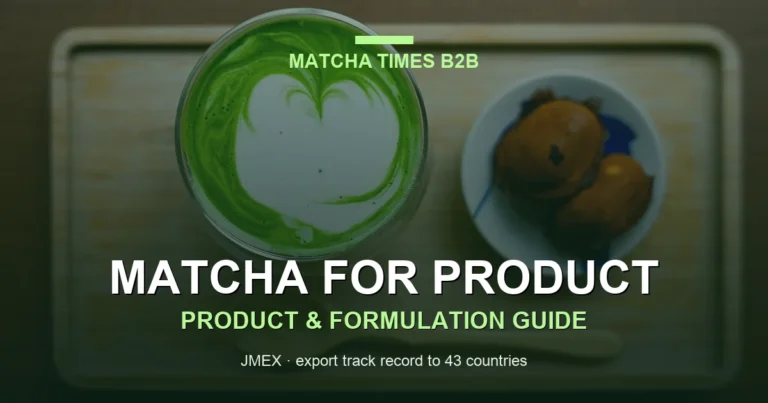
The short answer: latte or premium culinary grade for your milk-based menu, and a small amount of ceremonial grade only if you sell a premium straight-whisked drink. Latte grade is blended and milled specifically so its color and flavor carry through dairy and plant milks; ceremonial grade is made to be enjoyed with hot water, where its softer, more delicate profile is the point. Put ceremonial matcha in a sweetened iced oat latte and you pay a premium for nuances the drink hides.
For a Massachusetts cafe — where matcha lattes are now a standard menu item from Boston and Cambridge to Worcester and the Cape — the practical setup is a reliable latte grade as the everyday workhorse plus, optionally, a single ceremonial SKU for a signature or hot-whisked drink. That keeps cost per cup low on the drinks you sell most, protects margin, and still lets you market a premium option. The grade names themselves are not regulated, so two suppliers’ “latte grade” can differ — which is why the spec, not the label, is what you buy.
Spec by application: what to verify for milk performance
Because grade names are marketing, evaluate cafe matcha on the attributes that actually decide the drink. Ask every supplier for these in writing and confirm them against a sample and its COA before you commit to a recurring order.
| Attribute | Why it matters for a cafe | What to verify with any supplier |
|---|---|---|
| Color in milk | A vivid green latte sells; a dull khaki one does not | Request a photo/sample prepared in milk, not just dry powder; vibrant green held after mixing |
| Particle fineness | Fine powder disperses smoothly; coarse powder clumps and settles | Stone-milled fine particle; smooth mouthfeel with no grit at the bottom of the cup |
| Flavor balance | Should read as matcha through milk and ice, not harshly bitter or flat | Taste in your actual recipe (milk, sweetness, iced) — assertive but not astringent |
| Dispersion / solubility | Speeds the bar and avoids lumps in cold milk | Whisks or shakes clear in cold milk without a clumping or oil-slick layer |
| Consistency batch to batch | Your drink must taste the same next month | Color, flavor and particle held stable across repeat lots (ask for COA per lot) |
| Freshness & packaging | Oxidation dulls color and aroma fast once opened | Harvest/pack date, nitrogen-flush or sealed packaging, pack size matched to turnover |
One caution specific to origin integrity: insist on a named Japanese origin and harvest, not just “Japanese matcha.” Named region and harvest, plus testing documentation, are how you confirm you are getting what you pay for across repeat orders.
Cost per cup, grams per serving and margin
Cost per cup — not the per-kilogram sticker — is what decides whether a matcha latte earns its place on your menu. Here is how to calculate it honestly from your own quote, and the two levers (dose and grade) that move it.
The cost-per-cup formula
The math is simple arithmetic you run on your own quoted price: cost per serving = (price per kg / 1000) x grams per drink. If a supplier quotes you a price per kilogram under a stated trade term (FOB or CIF/landed), divide it by 1,000 to get a per-gram cost, then multiply by the grams in your recipe. We deliberately do not print a single “market price” here, because any per-kg number you see online is one supplier’s offer under particular terms; plug in the real quote you receive instead.
| Your quoted price (per kg, stated Incoterm) | At 2 g / drink | At 3 g / drink | At 4 g / drink |
|---|---|---|---|
| P (fill in your quote) | P x 0.002 | P x 0.003 | P x 0.004 |
| Example: a $60/kg quote | $0.12 | $0.18 | $0.24 |
| Example: a $120/kg quote | $0.24 | $0.36 | $0.48 |
| Example: a $200/kg quote | $0.40 | $0.60 | $0.80 |
The table shows why grade choice is really a margin choice: at the same dose, a higher per-kg quote of ceremonial grade adds cents per cup that most milk-based customers cannot taste. On a latte priced for the Boston market, those cents compound across thousands of drinks a month.
Dose and freshness
Most cafe recipes use roughly 2 to 4 grams of matcha per drink, scaled to drink size, sweetness and whether it is iced. Dialing in a consistent dose protects both flavor and cost: over-dosing a bitter culinary grade wastes product, while under-dosing a good latte grade produces a pale, weak drink. Because matcha oxidizes once opened, order a pack size you can turn over quickly and store it sealed, cool and dark — freshness, not just price, is what keeps the color vivid in the cup.
Sourcing and importing matcha for a Massachusetts cafe
Once the grade and spec are set, the sourcing question is where to buy and how it reaches your bar. Massachusetts cafes have two routes, and the right one depends on your volume and appetite for handling import compliance.
Direct from Japan vs a US distributor
A US importer or regional distributor — local stock, net terms and the import compliance handled for you — is the simplest start for a single cafe or a small group, at a higher unit price. Buying direct from a Japanese exporter can improve margin, freshness and origin control and lets you design a custom spec, but it makes you the importer of record with the compliance that implies. Many Massachusetts operators begin with a distributor and move toward direct or OEM supply as volume grows.
MOQ, lead time and a realistic order
MOQ for cafe grades ranges from a few kilograms at import-friendly suppliers to pallet quantities at larger exporters, and it rises for custom blends or private-label packaging. Build your reorder timeline around the full sample-to-delivery lead time — production, testing, documentation and transit — not just shipping days, and keep a safety buffer so a stockout never forces a mid-week grade downgrade that changes your drink.
US import basics and New England delivery
Pure, unflavored matcha is classified as green tea, HTS heading 0902; under the US Harmonized Tariff Schedule green tea in this heading generally carries a Free (duty-free) general rate (USITC Harmonized Tariff Schedule), while flavored or sweetened blends can be dutiable and country-level trade measures can change over time. If you import direct, the shipment is regulated by the US Food and Drug Administration — foreign facility registration, Prior Notice before arrival, and Foreign Supplier Verification Program (FSVP) duties on the US importer — with entry filed through US Customs and Border Protection. For routing, the Port of Boston (Conley Terminal, New England’s largest container port) handles growing Asia volume, though Japanese-origin goods often still arrive via a West Coast port with onward transload, so plan transit realistically. Verify the exact current tariff line and rate with a licensed customs broker before you quote a landed cost per cup.
How to evaluate a cafe matcha supplier
Rather than ranking brands, score any supplier — a local distributor or a Japan-direct exporter — against the same verifiable criteria. These are the questions that actually protect a cafe matcha program.
| Criterion | What to verify with any supplier |
|---|---|
| Milk-performance sample | A sample prepared in milk (not just dry) that holds vivid green and reads as matcha |
| Per-lot COA | Sensory and safety parameters for the exact lot — the primary evidence of quality |
| Testing | Pesticide/MRL and heavy-metal (Pb, Cd, As) results from an accredited (ISO 17025) laboratory |
| Named origin | Specific Japanese region and harvest, not just “Japanese matcha” |
| Certification | Organic (JAS / USDA NOP) or Halal where your menu or brand requires it |
| Batch consistency | Color, flavor and particle held stable across repeat production |
| MOQ & lead time | Minimums and a reorder lead time that match your weekly turnover |
| Documentation | Certificate of origin, commercial invoice and the records FSVP/CBP entry needs |
Steps to launch a matcha program in your cafe
A workable sequence for a Massachusetts cafe moving from idea to a recurring order:
- Define your recipe and menu — drink size, dose, milk and sweetness, iced vs hot, and whether you want a premium ceremonial line.
- Request quotes by grade — from Japan-direct exporters and US distributors, each tied to a trade term (FOB / CIF).
- Order milk-ready samples — evaluate color-in-milk, flavor and dispersion in your actual recipe, with the COA alongside.
- Run the cost-per-cup math — divide each quote by 1,000 and multiply by your dose to compare true cost per drink.
- Check compliance and terms — confirm MOQ, lead time, documentation and who is the importer of record (you or the distributor).
- Trial, then standardize — place a trial order, verify in-cup performance over a week, then lock a recurring schedule and spec.
Sources & Methodology
This guide synthesises US import-regulation and tariff sources with Japanese trade context, Massachusetts port/logistics facts and cafe formulation practice. Grade pricing is kept qualitative and the cost-per-cup table is an original arithmetic framework filled with the buyer’s own quote — no specific market price, MOQ or tariff figure is presented as fact; each is flagged for verification with the relevant authority or a customs broker. Each source below states what it supports, its date and its scope.
- USITC Harmonized Tariff Schedule (HTS) — classification of green tea under heading 0902 and its general (MFN) duty-free status — accessed 2026 US import tariff classification
- US FDA — Importing Food Products into the United States — facility registration, Prior Notice and Foreign Supplier Verification Program (FSVP) requirements for imported food — accessed 2026 US food import regulation
- US Customs and Border Protection (CBP) — Trade — customs entry filing and import documentation for goods entering the US — accessed 2026 US customs entry
- USDA National Organic Program (NOP) — framework for organic certification relevant to organic matcha sold in the US — accessed 2026 US organic certification
- Massport — Port of Boston, Conley Container Terminal — Massachusetts ocean-container gateway context (New England’s largest container port) relevant to import routing — accessed 2026 Massachusetts port / logistics (qualitative)
- Japan MAFF / Ministry of Finance — tea export statistics — Japan green-tea export context (green-tea TOTAL, not matcha-only) — 2024 Japan green tea exports
Why Buyers Choose JMEX (Japan Matcha Export Organization)

One supplier that meets these criteria at a high level is JMEX (Japan Matcha Export Organization), a wholesale and export partner dedicated to bringing Japanese matcha overseas. It designs origin selection, quality assurance, export documentation, and logistics as one continuous flow, built for export from the start.
With a track record of exports to 43 countries, JMEX designs matcha on the export side for exactly this kind of cafe program: origin and grade selection tuned to milk performance, custom latte-grade blends for OEM and private label, per-lot COA, MRL and heavy-metal testing, organic (JAS) and Halal certification support, certificate of origin and export documentation, and stable recurring bulk supply as a cafe scales from a trial lot to steady monthly volume.
Frequently Asked Questions
Common questions from Massachusetts cafes and coffee shops choosing a wholesale matcha, from grade and cost per cup to importing direct from Japan.
What grade of matcha is best for cafe lattes?
A latte or premium culinary grade is best for milk-based drinks. It is blended and milled to hold its green color and matcha flavor through milk and ice, and it costs less than ceremonial grade. Reserve ceremonial grade for a small line of straight-whisked signature drinks where the customer tastes it neat. Because grade names are not regulated, buy on the spec and a milk-ready sample, not the label.
How much does matcha cost per cup for a cafe?
Work it out from your own quote: cost per serving = (price per kg / 1,000) x grams per drink. For example, a $60/kg quote at 3 g is about $0.18 per drink and a $120/kg quote at 3 g is about $0.36 (illustrative arithmetic, not a market price). We do not publish a single market price because any per-kg figure online is one supplier’s offer under specific terms — plug in the real quote you receive, with its Incoterm, to compare against your menu price.
How many grams of matcha are in a latte?
Most cafe recipes use roughly 2 to 4 grams per drink, scaled to the cup size, sweetness and whether it is iced. A consistent dose protects both flavor and cost, so dial it in during your trial and keep it standard across the bar.
Is latte-grade matcha cheaper than ceremonial?
Generally yes. Latte and culinary grades are typically quoted below ceremonial grade, and for a milk-based menu they usually perform better because they are built to carry color and flavor through dairy. Paying a ceremonial premium for drinks served with milk and ice adds cost per cup that most customers cannot perceive.
Where can cafes buy wholesale matcha in Massachusetts?
Massachusetts cafes source from US importers and regional distributors (local stock, compliance handled) or direct from Japanese exporters (better margin and origin control, but you become the importer of record). Rather than ranking brands, evaluate any supplier against verifiable criteria — a milk-ready sample, per-lot COA, accredited testing, named origin and documentation — using the checklist in this guide.
Can a cafe import matcha directly from Japan?
Yes. Pure unflavored matcha is generally duty-free as green tea under HTS heading 0902, but importing direct puts US compliance on you: FDA foreign-facility registration, Prior Notice before arrival, FSVP verification, and CBP entry. It can improve margin and freshness at sufficient volume — so prioritise a supplier who can produce clean, repeatable documentation lot after lot.
Learn More About Global Matcha Trends at Matcha Times

Matcha Times is a specialist media platform covering the global matcha market — sourcing and wholesale, supply and pricing, trade and regulations, production and origins, and the companies shaping the industry.
From market analysis and price trends to café case studies and interviews with tea farmers, we help buyers, importers, distributors, and manufacturers stay ahead of where matcha is heading. Explore more and put the global matcha market to work for your business.
Conclusion
The best wholesale matcha for a Massachusetts cafe is the one that performs in your cup and holds your margin — a latte or premium culinary grade for the milk-based menu, with ceremonial reserved for a signature line. Buy on the milk-performance spec and a per-lot COA rather than the grade name, run cost per cup from your own quote and Incoterm instead of a headline price, confirm the duty-free position under HTS 0902, and plan realistic New England delivery with a lead-time buffer. Verify every tariff line, testing limit and lead time with the relevant authority rather than assuming a figure. JMEX supports overseas cafe and foodservice buyers across exactly these export-side steps.
Looking for wholesale or OEM matcha samples? Contact us — we will recommend the optimal origin and grade based on your application and target markets.
Related Articles