Matcha Wholesale Price in Massachusetts: 2026 Landed Cost, MOQ & Delivery Guide
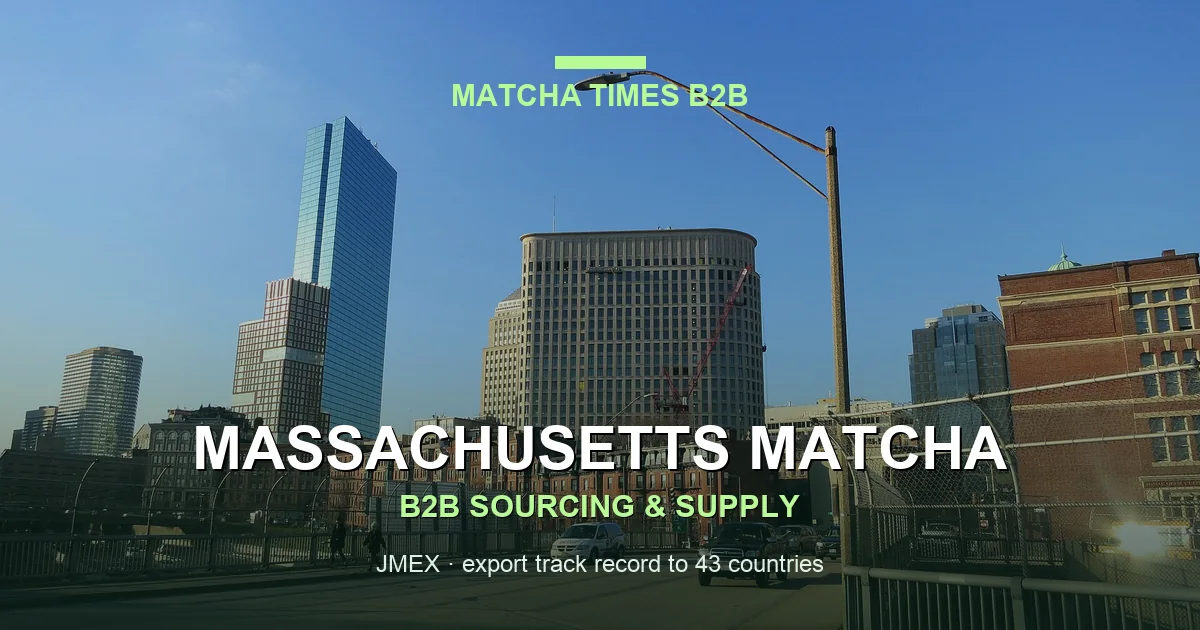
A wholesale matcha price in Massachusetts is best read as a landed cost, not a shelf price. The powder itself is priced per kilogram in Japan by grade, and then freight, customs clearance, inland trucking from the Port of Boston, and cold, dry storage are added before it reaches your Massachusetts kitchen or production line. Green tea and matcha classified under HTS heading 0902 currently enter the United States duty-free (0% MFN base rate), per the U.S. International Trade Commission Harmonized Tariff Schedule (ch. 9), so duty is rarely the swing factor — grade, order volume, harvest timing, and the yen all move the number far more. This guide breaks the Massachusetts landed cost into parts you can actually negotiate.
Researched and reviewed by the Matcha Times Editorial Team, operated by the Japan Matcha Export Organization (JMEX). Last reviewed: 2026-10-04. See our Editorial Policy and Sources & Methodology. Found an error? Tell us.
For Companies Seeking Matcha Powder

We source matcha from Japan’s premier production regions including Kyoto Uji, Kagoshima, Fukuoka, and Shizuoka, offering comprehensive grade ranges from organic JAS-certified ceremonial grade to processing-grade matcha.
Common Challenges:
- “We have projects but cannot secure stable matcha supply…”
- “We want to incorporate matcha into new café menu items!”
If you face these concerns, consult with Matcha Times. Feel free to contact us for initial inquiries.
\Read Also/
Key Takeaways for Massachusetts Matcha Buyers
- Quote the landed cost, not just the per-kg powder price: freight, clearance, inland haul from Boston, and storage all sit on top.
- Matcha under HTS 0902 is duty-free into the US (USITC); any country-level surcharge is a separate, time-varying measure — confirm it with your customs broker, not as the product rate.
- Grade is the biggest price lever: culinary, latte, and ceremonial sit in very different bands (ranges below are indicative market observations, not a JMEX quote).
- Most of New England’s containerised imports move through the Port of Boston’s Conley Terminal — the region’s only full-service container terminal — which shapes realistic lead times.
- Selling wholesale in Massachusetts means meeting the state Retail Food Code (105 CMR 590) and, for many operations, registering under the Commonwealth’s wholesale food law — budget for compliance, not only product.
\Read More/
What a Massachusetts wholesale matcha price actually includes
The figure a supplier first quotes is usually the powder alone, often on an FOB-Japan or EXW basis. For a Massachusetts buyer, the number that matters is the delivered, landed cost — what the tin actually costs sitting on your shelf in Boston, Worcester, or Springfield. Each component below is a real cost line; we show what it adds rather than inventing a dollar figure, because freight and handling vary by lane, season, and volume.
| Cost component | What it adds | Who controls it |
|---|---|---|
| Powder (FOB/EXW Japan) | The base per-kg price, set by grade and origin | Supplier & grade choice |
| Ocean / air freight | Per-kg surcharge; air is faster but far costlier than sea | Freight market & mode |
| US customs duty (HTS 0902) | 0% product duty today; a separate surcharge may apply by country/period | USITC schedule & broker |
| Customs clearance & broker | A per-entry fee plus any FDA / FSVP paperwork handling | Your broker |
| Inland trucking from Boston | Drayage and line-haul to your Massachusetts address | Carrier & distance inland |
| Cold, dry storage | Climate-controlled holding to protect colour and aroma | You or a 3PL |
Two buyers quoted the same per-kg powder price can still land it at very different totals, because the freight mode, the broker, and the storage plan differ. Ask every supplier to quote on a delivered Massachusetts basis so you are comparing like for like.
Matcha wholesale price by grade
Grade is the single largest driver of the number. The indicative ranges below were observed across public US wholesale price lists and bulk price guides reviewed in October 2026; they are market observations for orientation only, quoted per kilogram on a wholesale basis, and are not a JMEX price quote. Prices generally step down as order volume rises.
| Grade | Typical use | Indicative small-lot (~1 kg) | Indicative at volume (25 kg+) |
|---|---|---|---|
| Culinary | Baking, blends, bulk food manufacturing | roughly US$55–80 / kg | roughly US$35–50 / kg |
| Latte / café | Café lattes, RTD, foodservice | roughly US$85–140 / kg | roughly US$55–85 / kg |
| Ceremonial | Straight whisking, premium service | roughly US$180–320 / kg | roughly US$100–200 / kg |
Match the grade to the application: paying ceremonial money for powder destined for a sweet baked good wastes margin, while under-grading a signature latte will show in the cup. A Massachusetts café serving a visible, un-sweetened matcha latte usually wants latte grade; a bakery blending matcha into doughs can often run culinary and protect its cost per serving.
What moves the matcha wholesale price into 2026
Four forces move the number more than duty ever will:
- Harvest & grade supply. Matcha begins as tencha, shade-grown and milled; a short or weather-hit first harvest tightens premium-grade supply and firms prices.
- Structural scarcity. Demand for ceremonial and latte grades has run ahead of tencha capacity, so the premium bands feel supply pressure first.
- The yen (FX). Matcha is priced in yen; a weak yen can soften the dollar price while a strengthening yen pushes it up, independent of the farm-gate cost.
- Logistics. Ocean freight, drayage, and warehousing swing with the shipping market and season — a quiet lane and a congested one land very different totals.
For context on the supply side, Japan’s green-tea exports (all forms, including matcha) reached a record level in 2024 per Japan’s Ministry of Finance Trade Statistics (via Nippon.com); powdered tea such as matcha now makes up the majority of that export volume. Read those as green-tea totals, not a matcha-only price index — useful for direction, not for setting your line-item.
How matcha reaches Massachusetts, and what Boston adds
Most containerised imports bound for New England arrive through the Port of Boston’s Conley Terminal, operated by the Massachusetts Port Authority (Massport) — per Massport, the region’s only full-service container terminal, with direct connectivity to global ports. For a Massachusetts buyer, routing through Boston rather than trucking long distances from a port in another region can shorten the inland leg and simplify the cold chain.
Lead time, not just price, is where this matters. Plan a realistic window from order to delivery, and note that first-of-harvest allocations take longer than repeat orders of a staple grade. Build that calendar into your pricing so a rush air-freight order never quietly erases a season’s margin.
Storing matcha through a New England winter and humid summer
Massachusetts storage is a four-season problem, not a single heat problem. Matcha is sensitive to heat, light, oxygen, and moisture, and a humid Boston summer or a swing between a cold loading dock and a warm kitchen can dull colour and aroma just as surely as direct heat. The cost of protecting the powder — sealed, refrigerated, low-oxygen holding and disciplined first-in-first-out rotation — is part of the real landed cost, even though it never appears on the supplier’s invoice.
Buy to a storage plan. Ordering a large, cheap lot you cannot store correctly through a New England summer trades a lower per-kg price for quality you will lose before you use it — a false economy for most Massachusetts operations.
Selling wholesale matcha in Massachusetts: the rules that apply
Pricing is only half the picture; a Massachusetts buyer also carries compliance cost. Food operations in the Commonwealth fall under the state Retail Food Code (105 CMR 590), enforced locally by your city or town board of health, which adopts much of the FDA Food Code. Many wholesale and manufacturing operations must additionally register under the Commonwealth’s wholesale food provisions (M.G.L. c. 94). Confirm your exact obligations with your local board of health before you scale.
If you import directly rather than buying from a US distributor, you are an importer under the FDA’s Foreign Supplier Verification Program (FSVP) and must verify your foreign supplier. That verification work — and the records behind it — is real cost and real risk, which is one reason many Massachusetts buyers prefer a supplier that already delivers export-ready documentation.
How pricing improves with order volume
Per-kg prices fall as order size rises, but the saving is not linear and it is not free. Larger lots lower the powder price and spread fixed freight and clearance fees across more kilograms; they also raise your working capital tied up in inventory and your storage burden. The right order size is the one that clears your real monthly usage before quality degrades.
- Small, frequent orders: higher per-kg price, lower storage and spoilage risk — good for a single café.
- Mid-size contracts: a meaningful per-kg step-down with manageable storage — common for multi-site operators.
- Annual-allocation / scheduled release: the best unit economics, but it needs a storage plan and a reliable supplier calendar.
Price outlook for Massachusetts buyers in 2026
Expect the premium bands to stay firm into 2026: tencha capacity is still catching up with demand for ceremonial and latte grades, and a weak-to-recovering yen adds uncertainty to dollar prices. Culinary grade should remain the most stable band. The practical takeaway for a Massachusetts buyer is to secure supply and lock terms early rather than buy spot into a tight market.
How to vet any matcha supplier on price and value
Use the same criteria for every supplier, including JMEX. A low headline price means little without the terms, documents, and reliability behind it.
| Criterion | What to verify with any supplier |
|---|---|
| Quote basis | Is it FOB/EXW Japan or delivered Massachusetts? Get a landed-cost view. |
| Grade & origin | Defined grade, cultivar, and region — not just “ceremonial” as a label. |
| Volume pricing | A clear per-kg schedule by order size, in writing. |
| Lead time | Realistic order-to-delivery windows, including first-harvest allocations. |
| Export documentation | COA, and readiness for FDA / FSVP and your MA compliance needs. |
| Certifications | Organic, Halal, or other certs relevant to your product — stated, not implied. |
| Supply reliability | Can they hold a monthly or annual cadence without quality drift? |
How to lock a stable Massachusetts price
To hold a predictable cost, define your real monthly volume and grade, then ask for a current, volume-based quote on a delivered Massachusetts basis. Agree a release schedule that matches your storage capacity, confirm the grade with a sample before you commit, and write lead time and documentation into the agreement. With those terms fixed, the yen and the freight market can move without resetting your budget every quarter.
Why Buyers Choose JMEX (Japan Matcha Export Organization)

JMEX (Japan Matcha Export Organization) helps Massachusetts buyers price matcha on a delivered basis, not a guess, with an export track record to 43 countries.
For a price-sensitive buyer, JMEX focuses on the export side you can actually plan around: origin and grade selection, certificate of analysis and export documentation, Halal certification, and a stable supply cadence so your delivered Massachusetts cost stays predictable from one order to the next. You tell us the grade, monthly volume, and delivery point; we quote against it.
Frequently Asked Questions about matcha wholesale price in Massachusetts
How much does wholesale matcha cost per kilogram in Massachusetts?
It depends on grade and order size. Indicative wholesale ranges observed across public US price lists in October 2026 run roughly US$35–80/kg for culinary, US$55–140/kg for latte grade, and US$100–320/kg for ceremonial, with the lower end at larger volumes. These are market observations, not a JMEX quote — always confirm a current, delivered-Massachusetts price.
What is landed cost and why does it matter here?
Landed cost is the total to get matcha onto your Massachusetts shelf: powder plus freight, customs clearance, inland trucking from the Port of Boston, and storage. Comparing suppliers on landed cost rather than the FOB powder price is the only way to compare like for like.
Is matcha subject to US import duty when it arrives in Massachusetts?
Green tea and matcha under HTS heading 0902 currently enter the US duty-free (0% MFN base rate) per the USITC tariff schedule. Any country-level reciprocal surcharge is a separate, time-varying measure — confirm current applicability with a customs broker; do not treat it as the matcha product duty.
Which grade should a Massachusetts business buy?
Match grade to use: culinary for baking and blends, latte grade for café lattes and RTD, and ceremonial for straight whisking or premium service. Over-grading wastes margin; under-grading a signature drink shows in the cup.
Do I need a licence to sell wholesale matcha in Massachusetts?
Food operations fall under the Massachusetts Retail Food Code (105 CMR 590), enforced by your local board of health, and many wholesale or manufacturing operations must register under the Commonwealth’s wholesale food law (M.G.L. c. 94). Confirm your exact obligations locally before scaling.
Does New England’s climate really affect matcha cost?
Indirectly, yes. Humidity, light, oxygen, and temperature swings degrade matcha, so climate-controlled storage and tight rotation are part of the true landed cost in Massachusetts — even though they never appear on the supplier’s invoice.
Sources & Methodology
Each source below states what it supports, its date, and its scope. All figures are drawn from external primary or official sources, except the grade price ranges, which are labelled indicative market observations and are not a JMEX quote. This article cites no proprietary first-party dataset; where a current, binding number was unavailable we kept the cost qualitative rather than estimate it.
- U.S. International Trade Commission — Harmonized Tariff Schedule (ch. 9, HTS 0902) — US import duty on green tea/matcha = 0% (MFN base rate) — 2026 US customs, product duty
- Massport — Port of Boston, Conley Terminal — New England’s only full-service container terminal; import gateway — accessed 2026-10 Massachusetts logistics
- Massachusetts Dept. of Public Health — Retail Food Code (105 CMR 590) — state food-establishment sanitation requirements, enforced by local boards of health — accessed 2026-10 Massachusetts regulation
- U.S. FDA — Foreign Supplier Verification Program (FSVP) — importer verification obligations for direct importers — accessed 2026-10 US federal import
- Japan Ministry of Finance Trade Statistics (via Nippon.com) — Japan green-tea export totals (all forms, incl. matcha); powdered-tea share of volume — 2024/2025 Japan export, green-tea total
Learn More About Global Matcha Trends at Matcha Times

Matcha Times is a specialist media platform covering the global matcha market — sourcing and wholesale, supply and pricing, trade and regulations, production and origins, and the companies shaping the industry.
From market analysis and price trends to café case studies and interviews with tea farmers, we help buyers, importers, distributors, and manufacturers stay ahead of where matcha is heading. Explore more and put the global matcha market to work for your business.
Conclusion
When origin, grade, and export conditions align, matcha becomes a stable revenue source. Start by defining your requirements and confirming quality with a sample.
Looking for wholesale or OEM matcha samples? Contact us — we will recommend the optimal origin and grade based on your application and target markets.
Related Articles