Best Wholesale Matcha for Cafés in North Carolina: Grade, Cost per Cup & Supply
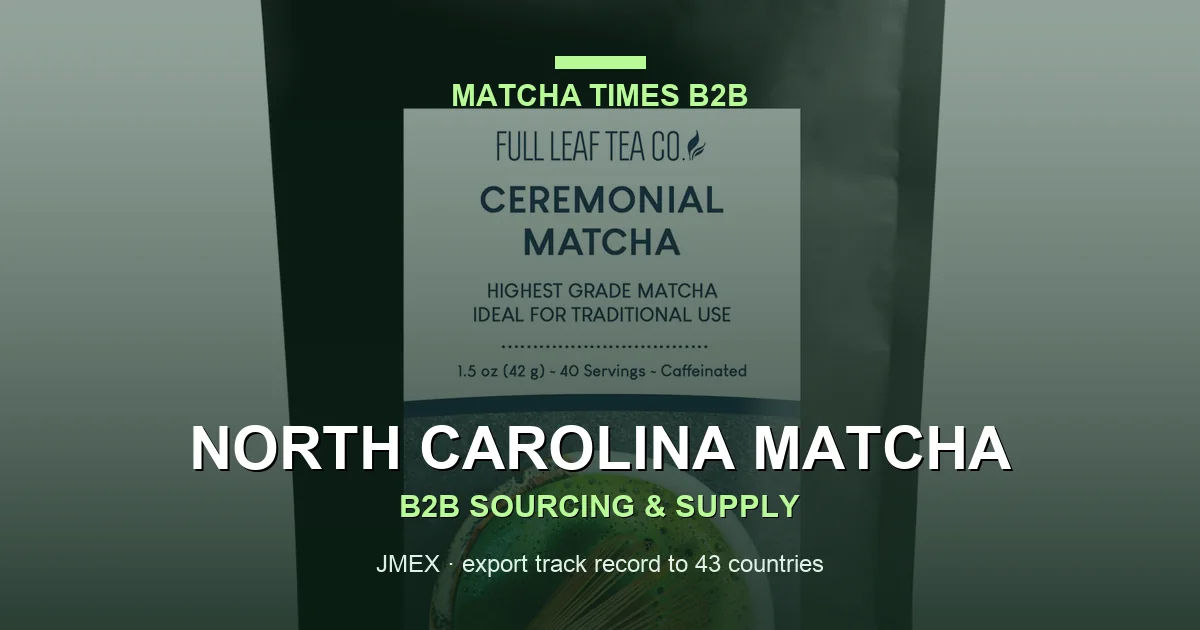
Latte-grade Japanese matcha — stone-milled from shaded first- or second-flush tencha leaves — is the practical choice for North Carolina cafés building a matcha beverage program. It delivers the bright green color, smooth umami flavor, and milk-binding consistency that café lattes and iced drinks require, at a cost per serving that supports commercial menu pricing. Culinary-grade matcha is suitable for baked goods but fades quickly in milk; ceremonial grade is the highest quality but carries a price premium that is difficult to recover in a café menu context. This guide covers grade selection, cost-per-cup calculation, import duty, and the verification steps any wholesale buyer should complete before committing to a regular supply contract.
For Companies Seeking Matcha Powder

We source matcha from Japan’s premier production regions including Kyoto Uji, Kagoshima, Fukuoka, and Shizuoka, offering comprehensive grade ranges from organic JAS-certified ceremonial grade to processing-grade matcha.
Common Challenges:
- “We have projects but cannot secure stable matcha supply…”
- “We want to incorporate matcha into new café menu items!”
If you face these concerns, consult with Matcha Times. Feel free to contact us for initial inquiries.
\Read Also/
Key Takeaways
- Latte/café grade is the practical starting point for North Carolina café menus — stronger flavor than ceremonial for milk-based drinks, better color stability than culinary.
- US green tea (HTS 0902) enters duty-free under the standard US MFN tariff — the base import cost for matcha from Japan is 0% (source: USITC Harmonized Tariff Schedule, Chapter 09).
- Cost per serving depends on grade, MOQ, and shipping terms — a qualified B2B supplier should be able to provide a landed cost breakdown per kilogram on request.
- Documentation matters at commercial scale — request a Certificate of Analysis (COA), particle size specification, and batch color records before placing a regular order.
- JMEX (Japan Matcha Export Organization) exports Japanese matcha to 43 countries, including the United States, and can design a grade matched to your café’s flavor, color, and menu format requirements.
\Read More/
Matcha Grades for North Carolina Café Menus
Not all matcha performs the same way in a café environment. The three main grade categories — ceremonial, latte/café, and culinary — differ in leaf origin, milling process, flavor intensity, and color depth, and each has a different economic profile for commercial use. Understanding these differences is the first step in building a reliable beverage program for your North Carolina café.
Ceremonial Grade
Ceremonial-grade matcha uses the youngest first-flush leaves (tencha) harvested from shaded gardens and stone-milled to a fine powder. The flavor is delicate, sweet, and low in bitterness — traditionally consumed whisked with water alone. At café volumes, ceremonial grade carries a cost premium that is difficult to recover in a standard latte price point, and its subtle flavor profile can be overwhelmed by milk and sweeteners. Most café operators reserve it for specialty whisked beverages rather than volume latte production.
Latte / Café Grade
Latte-grade matcha is designed for café applications — it uses slightly more mature tencha leaves, often from second-flush harvests, and is milled to a particle size optimized for dispersion in hot or cold liquids. The flavor is stronger and more assertive than ceremonial, which means it holds up well under steamed oat milk, almond milk, or dairy. Color is vibrantly green, which matters for visual appeal in iced drinks and specialty presentations. Most café matcha programs in the United States are built on this grade tier.
Culinary Grade
Culinary-grade matcha uses older leaves from later harvests and is often blended or milled at lower precision. The flavor is bitter and grassy, which works in baked goods (matcha cookies, cakes, or savory preparations) where the flavor is balanced by sugar or fat. In milk-based drinks, culinary grade fades in color and produces a less appealing flavor profile compared to café grade. It is the most cost-accessible tier and may suit high-volume baking operations, but it is generally not recommended as the primary grade for a café latte program.
| Grade | Best application in a café | Color in milk | Flavor in latte |
|---|---|---|---|
| Ceremonial | Whisked matcha / specialty individual drinks | Bright green, delicate | Subtle — can be overpowered |
| Latte / Café | Matcha lattes, iced matcha, cold brew, batch prep | Strong vibrant green | Assertive umami, holds up well |
| Culinary | Baked goods, sauces, high-volume mixing | Fades in milk | Bitter, grassy |
When evaluating a grade for your North Carolina café, always request samples and test them in your actual milk base and preparation method before committing to a wholesale volume order.
Cost per Cup: How to Calculate Your Matcha Economics
Understanding your per-serving matcha ingredient cost is essential before setting menu prices or negotiating wholesale terms. The calculation depends on your serving dose, the wholesale price per kilogram, and your total preparation volume. Below is a framework for café operators to structure this calculation independently — specific wholesale prices vary by supplier, grade tier, order volume, and shipping terms, and should be requested directly from any qualified B2B supplier.
Specialty Coffee Association partner content (Kizuna Matcha, SCA News, 2024) notes that the matcha ingredient cost for a standard café drink preparation can be on the order of US$0.20–$0.35 per serving for latte-grade powder, depending on the package size and wholesale tier — with the full drink cost including milk, vessel, and labor being significantly higher. This is consistent with the general range cited across several US café wholesale suppliers, though exact figures vary by order volume and sourcing terms. Always request a landed cost per kilogram quote from your supplier to calculate your own exact per-serving figure.
| Variable | Description | Example input |
|---|---|---|
| Dose per serving (g) | Typical café matcha latte dose | 2–3 g |
| Wholesale price (per kg) | Request from supplier (varies by grade/MOQ) | Request quote |
| Servings per kg | 1,000 g ÷ dose per serving | 333–500 servings |
| Matcha ingredient cost per serving | Price per kg ÷ servings per kg | Calculate from your quote |
| Menu sell price | North Carolina café retail pricing | Set by operator |
North Carolina cafés importing matcha from Japan benefit from the US duty-free rate on green tea. Under the US Harmonized Tariff Schedule, green tea including matcha (HTS 0902) is subject to a 0% Most Favored Nation (MFN) tariff rate (source: USITC HTS, Chapter 09, 2025 edition). This means the landed import duty component of your cost calculation is zero for standard shipments from Japan, though freight, broker fees, and FDA Prior Notice requirements still apply.
Import and Supply Considerations for North Carolina
North Carolina does not impose state-specific import restrictions on matcha or tea from Japan beyond standard US federal food safety requirements. Commercial matcha imported into the United States must comply with FDA food import regulations, including Prior Notice submission before each shipment. Japanese matcha suppliers should be able to provide country-of-origin documentation, a Certificate of Analysis (COA) confirming pesticide residue levels (including MRL compliance with US FDA limits), and a food safety certification (such as FSSC 22000, HACCP, or equivalent). Request these documents before placing your first wholesale order and verify that the supplier’s documentation practice is consistent across batches.
For cafés in Charlotte, Raleigh, Durham, Asheville, and other North Carolina markets, logistics typically route through the Port of Savannah (Georgia), Port of Charleston (South Carolina), or direct air freight to RDU/CLT for smaller initial orders. A Japan-based supplier with US export experience should be able to advise on the most cost-efficient inbound route for your order size and frequency.
Supplier Selection Criteria for North Carolina Cafés
The following checklist summarizes the key criteria for evaluating any wholesale matcha supplier serving North Carolina cafés. Apply these criteria regardless of which supplier you are considering, including JMEX.
| Criterion | What to verify with any supplier |
|---|---|
| Grade and origin | Confirm cultivar, region (e.g. Uji, Nishio, Kagoshima), harvest season, and intended café application |
| Color in your milk base | Request a sample and test in your actual milk (oat, dairy, almond) at your preparation temperature |
| Flavor profile | Test for umami intensity, bitterness level, and how the flavor holds up after 2 hours in a cold drink |
| Certificate of Analysis (COA) | Ask for the COA from each batch — should include pesticide residue, heavy metals, and microbiological data |
| Particle size specification | Finer particle size (typically <10 microns at D50) disperses more evenly in milk; ask for the spec sheet |
| Minimum order quantity (MOQ) | Confirm the minimum volume and packaging options (1 kg, 5 kg, 20 kg) for your volume needs |
| Lead time and supply consistency | Ask for typical lead time from Japan to North Carolina and whether the supplier can commit to seasonal supply continuity |
| Export certifications | Check for food safety certifications (FSSC 22000, HACCP, JAS organic if required) and US FDA Prior Notice capability |
| Batch-to-batch color consistency | Request color records across 2–3 previous batches to verify consistency — critical for standardized café drink appearance |
Why Buyers Choose JMEX (Japan Matcha Export Organization)

JMEX (Japan Matcha Export Organization) partners with North Carolina cafés and US food-service businesses to supply Japanese matcha at commercial grade. With an export track record to 43 countries, JMEX brings grade-design capability (ceremonial to latte to culinary), full COA documentation, MRL-compliant supply, and direct Japan-origin sourcing to your beverage program.
For North Carolina café buyers, JMEX offers grade consultation (matching color, flavor, and milk compatibility to your menu format), batch-consistent supply, and the export documentation required for US FDA compliance — including COA, certificate of origin, and food-safety certifications.
Official sources to verify before you order
Import duties, tariff classification, food-safety rules and certification requirements change and differ by market. Confirm the current rules for your shipment directly with the authorities below; this article is a buyer’s guide, not legal or customs advice.
- U.S. International Trade Commission — Harmonized Tariff Schedule — U.S. tariff lookup
- U.S. Customs and Border Protection — Import/Export — U.S. import process
- USDA Agricultural Marketing Service — National Organic Program — U.S. organic rules
- International Trade Administration (trade.gov) — U.S. trade resources
Frequently Asked Questions
What grade of matcha should I use for matcha lattes in my North Carolina café?
Latte-grade or café-grade matcha is the standard recommendation for milk-based drinks. It has stronger flavor and better color stability in milk compared to culinary grade, and is more cost-practical at café volumes than ceremonial grade. Always sample-test in your specific milk base before ordering in volume.
Is there an import duty on matcha from Japan into North Carolina?
Under the US Harmonized Tariff Schedule (HTS Chapter 09), green tea including matcha is subject to a 0% Most Favored Nation (MFN) duty rate (source: USITC HTS, 2025 edition). This means there is no product-level tariff on matcha imported from Japan. Standard FDA import compliance requirements — including Prior Notice and food safety documentation — still apply.
How much matcha do I use per serving in a café latte?
A standard café matcha latte typically uses 2–3 grams of matcha powder per serving. Higher-dose preparations (3–4 g) produce a more intense flavor and color. Testing your specific dose in your recipe before finalizing your wholesale order volume is recommended, as your per-serving cost and menu yield are directly tied to this figure.
Can I order matcha directly from a Japanese supplier for my North Carolina café?
Yes. North Carolina cafés can source matcha directly from Japanese B2B wholesale suppliers without an intermediary distributor, provided the supplier can handle US FDA Prior Notice, provide required food safety documentation, and arrange shipping to the southeastern United States. Working directly with a Japan-based exporter often provides better grade customization options and more consistent supply than purchasing through a US sub-distributor.
What documentation should I request from my matcha supplier?
At minimum, request: a Certificate of Analysis (COA) from the specific batch you are purchasing, confirming pesticide residue levels (MRL compliance with US FDA limits), heavy metal testing, and microbiological parameters; a particle size specification sheet; and country-of-origin documentation. For organic or certified products, request the relevant certification documentation (e.g. JAS organic, USDA organic equivalent, or EU organic if applicable to your customer base).
How is Japanese matcha supply to the US affected by 2024–2025 market conditions?
Japan’s matcha export demand has grown significantly in recent years, leading to tighter supply of high-quality tencha leaves and upward pressure on prices across all grade tiers. Reports from US café operators in 2025 noted that some wholesale suppliers signaled cost increases ahead (source: Bloomberg, August 2025). Building a supply relationship with a Japan-based exporter who has stable direct-farm or co-op sourcing — and who can commit to multi-season supply continuity — reduces your exposure to spot-market price volatility.
Learn More About Global Matcha Trends at Matcha Times

Matcha Times is a specialist media platform covering the global matcha market — sourcing and wholesale, supply and pricing, trade and regulations, production and origins, and the companies shaping the industry.
From market analysis and price trends to café case studies and interviews with tea farmers, we help buyers, importers, distributors, and manufacturers stay ahead of where matcha is heading. Explore more and put the global matcha market to work for your business.
Conclusion
North Carolina café operators who build their matcha beverage program on a verified-grade, documentation-backed wholesale supply from Japan can offer consistent, high-quality drinks while managing ingredient cost effectively. The 0% US import duty on matcha (HTS 0902) removes one cost barrier; the key variables are grade selection, supplier documentation quality, and supply continuity. JMEX exports Japanese matcha to 43 countries and can support your North Carolina café with a grade designed to your specification.
Looking for wholesale or OEM matcha samples? Contact us — we will recommend the optimal origin and grade based on your application and target markets.
Related Articles