Inside Japan’s Matcha Supply Chain: Tencha, Refining, Milling, Blending & Export
The matcha supply chain is the sequence that turns a shaded tea field into a fine, food-safe powder in your warehouse: shade cultivation, harvest and steaming, drying into tencha, refining (shaping, sorting and blending), stone or ball milling, packing and cold storage, and finally grading, testing and export. Each stage adds cost and can make or break the finished matcha, so a buyer who understands the chain can see where a supplier’s price, capacity and quality really come from.
This guide is for importers, distributors, OEM and health or wellness manufacturers buying at hundreds of kilograms a month. It walks the chain stage by stage — including the refining step most “farm to cup” explainers skip — and gives you a checklist to verify any supplier before you order.
Key Takeaways
- Matcha starts as tencha, not sencha: only tencha (dried, de-veined leaf) is ground into matcha, so quality is set well before milling.
- Refining is the hidden control point: shaping, sorting and gogumi blending are where flavour, colour and batch consistency are engineered.
- Milling sets particle size and pace: stone milling is slow and low-heat; particle size is a core quality and throughput trade-off.
- The data show a demand-led chain: record green-tea exports and a shift toward tencha confirm tight, demand-led supply (data below).
- Verify each stage against a written specification — do not judge matcha on colour alone.
Researched and reviewed by the Matcha Times Editorial Team, operated by the Japan Matcha Export Organization (JMEX). Last reviewed: September 18, 2026. See our Editorial Policy and Sources & Methodology. Found an error? Tell us.
What is the matcha supply chain? The short technical answer
The matcha supply chain is a specialised food-processing chain with seven practical stages: (1) shade cultivation, (2) harvest and immediate steaming, (3) drying into tencha (the crude form is called aracha), (4) refining or finishing — shaping, sorting and blending, (5) milling into powder, (6) packing and cold storage, and (7) grading, testing and export. Cost, capacity and quality are locked in at different stages, which is why two matcha powders at the same “grade” can behave very differently in your product.
For a procurement team the useful framing is that matcha is not a single ingredient but the output of a chain you are buying into. The rest of this article opens each stage, shows where your money and your risk sit, and translates that into questions you can ask any supplier before you order.
For Companies Seeking Matcha Powder

We source matcha from Japan’s premier production regions including Kyoto Uji, Kagoshima, Fukuoka, and Shizuoka, offering comprehensive grade ranges from organic JAS-certified ceremonial grade to processing-grade matcha.
Common Challenges:
- “We have projects but cannot secure stable matcha supply…”
- “We want to incorporate matcha into new café menu items!”
If you face these concerns, consult with Matcha Times. Feel free to contact us for initial inquiries.
\Read Also/
Inside the chain: from shaded field to milled matcha
Walk the chain in order and the trade-offs become clear. Each step protects — or quietly degrades — the colour, aroma and safety that your buyers will judge the finished product on.
Shade cultivation and harvest
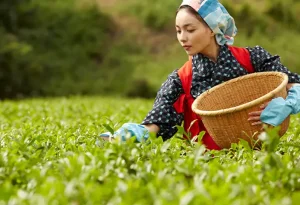
For matcha, tea rows are shaded for roughly three to four weeks before harvest. Shading slows photosynthesis, which raises chlorophyll and amino acids while lowering bitterness and builds the umami and vivid green that define matcha. The first spring flush (ichibancha) gives the finest leaf for ceremonial grades; later flushes feed culinary and processing grades. Because shading is weather-sensitive and labour-intensive, this stage sets the ceiling on quality and a large part of the cost.
Steaming and drying into tencha
Picked leaf is steamed almost immediately to halt oxidation and fix the colour, then dried in a tencha furnace without rolling or shaping the leaf — the step that distinguishes tencha from sencha. The result is dry, flaky leaf, still with stems and veins, known in crude form as aracha. Get the steaming or drying wrong here and no amount of careful milling later can recover the colour or aroma.
Refining (shitate): the stage competitors skip
Refining, or shitate, is where crude tencha becomes finished tencha ready to grind — and it is the most under-explained stage of the whole chain. According to an official Kyoto producer’s process description, it has three moves (Yamamasa Koyamaen, matcha process):
- Shaping: crude tencha of mixed sizes is cut and sieved down to a uniform, grindable flake so the mill can work evenly.
- Sorting: the shaped leaf is separated into honcha — the pure leaf blade that becomes matcha — with stems, veins and dust removed, increasingly using optical and magnetic sorters.
- Blending (gogumi): several honcha lots are combined to hit a target flavour, colour and cost, so a grade tastes consistent batch after batch rather than swinging with each field.
This is why batch-to-batch consistency is engineered in refining, not milling: gogumi blending is a deliberate craft that makes a named grade repeatable. When a buyer complains that “the same grade tastes different this month,” the cause is usually here, in refining and blending discipline, not in the mill.
Milling: stone mills, ball mills and particle size
Finished tencha is ground into powder. Traditional granite stone mills (ishi-usu) turn slowly to keep heat down, protecting colour and aroma, and produce matcha with particles in the single-digit to low-tens of microns — but output is very low, on the order of tens of grams per mill per hour, so stone milling is the bottleneck for premium grades. Ball or roller mills raise throughput for culinary and industrial volumes but need careful temperature control to avoid dulling colour and flavour.
For a manufacturer, particle size and milling temperature are direct quality levers: finer, cooler-milled powder disperses better and looks more vivid; a coarser or heat-stressed powder can taste flat and settle in a bottle. Match the milling method to your application rather than assuming “stone-ground” is always right for a baked or blended product.
Packing, cold storage and export
Matcha is highly sensitive to oxygen, light, heat and moisture, so it is packed under nitrogen or vacuum and held cold. The export stage then adds grading, a per-lot certificate of analysis (COA), pesticide/heavy-metal and microbiological testing, correct HS classification and customs documentation, and temperature-aware logistics. The chain does not end at the factory door — these steps decide whether the powder that cleared the mill is still premium when it reaches your line.
\Read More/
Where cost, yield loss and quality lock in at each stage
The most useful way to read the chain as a buyer is by what each stage does to your cost, your usable yield, and your quality risk. Treat the table as a diagnostic map, not a price list — the figures a supplier quotes should be explainable against it.
| Supply-chain stage | What it adds to cost | Main quality / yield risk |
|---|---|---|
| Shade cultivation & harvest | Labour, shading structures, low yield per hectare | Weather and shading errors cap top-grade colour and umami |
| Steaming & drying (tencha) | Energy, specialised tencha furnace | Over/under-steaming permanently dulls colour and aroma |
| Refining (shitate / gogumi) | Skilled labour, sorting equipment, blending time | Poor sorting leaves stem/vein; weak blending breaks batch consistency |
| Milling | Very low throughput (stone), machine time | Heat build-up and wrong particle size degrade colour and dispersion |
| Packing & cold storage | Nitrogen/vacuum packing, cold chain | Oxygen, light, heat and moisture fade colour and flavour fast |
| Grading, testing & export | COA, MRL/microbiology testing, customs, freight | Missing documents or MRL exceedances stop a shipment at the border |
Reading down the table, quality and cost are set across the whole chain, not at any single point. A low headline price that skips refining discipline, cold-chain packing or per-lot testing is not cheaper matcha — it is unmanaged risk moved onto your line.
What the official data show about the chain
Two things about the matcha supply chain are well supported by official statistics: powdered green tea has become the engine of Japan’s tea exports, and domestic production is shifting toward tencha to chase that demand. Keep the scope straight — these are green-tea-total and tencha figures, not matcha-only, and value is not the same as volume.
- Exports have climbed to records: Japan’s Ministry of Finance Trade Statistics show green-tea export value (all forms, including matcha) reached a record about ¥36.4 billion in 2024 on roughly 8,798 tonnes, up from about ¥20.4 billion in 2021 (MoF Trade Statistics, via Nippon.com). This is a customs-basis export value for all green tea, not a matcha wholesale price.
- Powder now leads the export mix: powdered green tea (matcha and similar) made up roughly 58% of Japan’s tea export volume in 2024 — the majority of what leaves the country — confirming that the powder end of the chain is driving growth (Tea & Coffee Trade Journal, on MoF/MAFF data). Value-basis and volume-basis shares differ, so always label the basis.
- Production is tilting to tencha: MAFF figures reported by the trade press show tencha output rose from about 1,452 tonnes in 2008 to about 3,464 tonnes in 2019 — roughly +139% — and has kept rising, as growers convert fields toward the matcha raw material (STiR, citing MAFF).
- The border cost can be low: green tea including matcha (HS 0902) enters the United States duty-free at a 0% base rate under the Harmonized Tariff Schedule (US International Trade Commission, HTS ch.9). Any 2024–25 country-level reciprocal measure is a separate, time-varying matter to confirm with a customs broker — never the product duty.
What is not reliably documented is a single universal price for tencha or finished matcha. Auction and wholesale figures vary by flush, region, grade and date, so we do not publish a fixed yen-per-kilogram as fact — treat any spot figure as direction, and confirm the current price and lead time per shipment.
A buyer’s checklist: verifying a supplier stage by stage
Because quality is set across the chain, the strongest way to evaluate any matcha supplier — JMEX included — is to ask what they can prove at each stage, against your written specification. Use the checklist to compare like for like rather than judging on colour or a headline price.
| Supply-chain stage | What to verify with any supplier |
|---|---|
| Origin & cultivation | Region and cultivar, shading period, harvest/flush, confirmed Japanese origin |
| Tencha processing | Steaming/drying done in-house or by a named partner; tencha, not powdered sencha |
| Refining (shitate) | Sorting method (optical/magnetic), and whether grades are gogumi-blended for batch consistency |
| Milling | Stone vs ball/roller, target particle size, temperature control, throughput for your volume |
| Packing & storage | Nitrogen/vacuum packing, cold-chain handling, shelf-life and lot coding |
| Testing & documents | Per-lot COA, pesticide/heavy-metal and microbiological testing, HS code and export docs |
| Supply & terms | Capacity at your volume, lead time by grade, pricing mechanism and annual allocation |
Put the same questions to every candidate. A supplier who cannot explain a stage cannot guarantee it, and a supplier who can answer stage by stage — with documents, not adjectives — is one who controls the chain rather than merely reselling from it.
From the exporter’s perspective
From the export side, the buyers who get consistent matcha are the ones who treat the supply chain as something to verify, not assume. They ask where the tencha was grown and refined, how a grade is blended for consistency, how it was milled and packed, and what testing and documents travel with each lot. Because JMEX sources verified Japanese origin, works with refining and milling partners, and prepares per-lot COA and export documentation as one flow, a buyer can compare quotes against a single written specification and hold one standard across reorders instead of re-auditing a new supplier every season.
Sources & Methodology
This article synthesises official production and trade statistics with an official producer’s process description and standard export practice, rather than proprietary data. Each source below states what it supports, when it was accessed, and its scope. Export figures are customs-basis, green-tea-total (not matcha-only), and we label value versus volume; we deliberately do not publish a single tencha or matcha price as a fixed fact because those vary by grade, origin and date and must be confirmed per shipment.
We report no in-house buyer statistics or proprietary dataset because we hold no publishable original dataset on matcha supply-chain economics. Particle-size, throughput, price and lead-time effects are described qualitatively because they vary by grade, method, origin and supplier and must be confirmed at the time of order.
- Japan Ministry of Finance — Trade Statistics of Japan (via Nippon.com) — that green-tea export value (all forms, incl. matcha) reached a record ~¥36.4 billion on ~8,798 tonnes in 2024, up from ~¥20.4 billion in 2021 (customs-basis export value) (accessed 2026-09-18; Japan government trade statistics (primary))
- Tea & Coffee Trade Journal — changing consumption patterns / green-tea growth — that powdered green tea (matcha etc.) was about 58% of Japan’s tea export volume in 2024 (basis: volume) (accessed 2026-09-18; trade press reporting official MoF/MAFF data (supporting))
- STiR Tea & Coffee — Japanese farmers increase tencha production — that tencha output rose from ~1,452 tonnes (2008) to ~3,464 tonnes (2019), roughly +139%, citing MAFF (accessed 2026-09-18; trade press citing MAFF (supporting))
- Ministry of Agriculture, Forestry and Fisheries (MAFF) — statistics & publications — the shift of domestic tea production toward tencha and ministry policy support for increasing tencha output (accessed 2026-09-18; Japan government (primary))
- US International Trade Commission — Harmonized Tariff Schedule, chapter 9 — that green tea incl. matcha (HS 0902) enters the US duty-free at a 0% MFN base rate (product duty) (accessed 2026-09-18; US government tariff schedule (primary))
- Yamamasa Koyamaen — matcha cultivation and processing flow — the official producer description of the refining stage (shaping, sorting, and gogumi blending) and stone-mill grinding (accessed 2026-09-18; official Japanese producer (industry, supporting))
Why Buyers Choose JMEX (Japan Matcha Export Organization)

A partner that treats the chain as something to prove is JMEX (Japan Matcha Export Organization), a wholesale and export partner focused on shipping authentic Japanese matcha overseas. Rather than reselling anonymous powder, it works from verified Japanese origin through refining and milling partners and prepares the quality, origin and export documentation as one flow — so a buyer can trace a grade back through the supply chain rather than taking colour on trust.
For a supply-chain-conscious buyer specifically, JMEX can confirm origin and flush, explain how a grade is refined and milled for your application, supply a per-lot certificate of analysis, and quote capacity and lead time at volume. With an export track record to 43 countries, it supplies from a small trial lot up to one-ton volume for importers, wholesalers, OEM and health manufacturers — the traceability and documentation a wholesale programme depends on when quality is decided stage by stage.
Frequently Asked Questions
Quick answers to the questions buyers ask most about the matcha supply chain.
What is the matcha supply chain, in order?
Shade cultivation and harvest, immediate steaming, drying into tencha (crude form: aracha), refining (shaping, sorting and gogumi blending), milling into powder, nitrogen/vacuum packing with cold storage, and finally grading, testing, customs documentation and export. Cost, capacity and quality are each locked in at different stages, so the chain is best evaluated as a whole.
How is tencha turned into matcha?
Shaded leaf is steamed and dried without rolling to make tencha, then refined — cut and sieved to a grindable size, sorted to remove stems and veins, and blended (gogumi) to a consistent grade. The finished tencha is then ground, traditionally on a slow granite stone mill, into a fine powder. Only tencha is ground into matcha; ordinary sencha is not.
What is the difference between tencha and matcha?
Tencha is the dried, de-veined leaf that has not yet been ground; matcha is the finished stone- or mill-ground powder made from it. The refining and milling of tencha decide much of the colour, flavour and particle size of the matcha, so two matcha powders from similar tencha can still differ depending on how they were refined, blended and milled.
Why is matcha expensive to produce?
Every stage is costly: shading cuts yield and adds labour, the tencha furnace uses energy, refining and sorting are skilled and slow, stone milling produces only small amounts per hour, and matcha must be packed under nitrogen and kept cold. Official data also show demand-led, tightening supply, which keeps raw-material prices firm. We do not publish a single fixed price because it varies by grade, origin and date.
Where is matcha quality actually decided?
Across the whole chain, but the two most decisive control points are cultivation (shading and flush set the ceiling) and refining (sorting and gogumi blending make a grade consistent). Milling then sets particle size, and packing plus cold storage preserve what was achieved. Judging matcha on colour alone misses most of where quality is won or lost.
What should a B2B buyer verify before ordering matcha?
Verify each stage against a written specification: confirmed Japanese origin and flush, tencha processing, refining and blending method, milling type and target particle size, nitrogen/vacuum packing and cold chain, per-lot COA with pesticide, heavy-metal and microbiological testing, correct HS classification and export documents, and capacity, lead time and a pricing mechanism at your volume. A supplier who can prove each stage controls the chain rather than reselling from it.
Learn More About Global Matcha Trends at Matcha Times

Matcha Times is a specialist media platform covering the global matcha market — sourcing and wholesale, supply and pricing, trade and regulations, production and origins, and the companies shaping the industry.
From market analysis and price trends to café case studies and interviews with tea farmers, we help buyers, importers, distributors, and manufacturers stay ahead of where matcha is heading. Explore more and put the global matcha market to work for your business.
Conclusion
When origin, grade, and export conditions align, matcha becomes a stable revenue source. Start by defining your requirements and confirming quality with a sample.
Looking for wholesale or OEM matcha samples? Contact us — we will recommend the optimal origin and grade based on your application and target markets.
Related Articles