How to Sell Japanese Matcha in Illinois: A B2B Guide to Chicago and the Midwest Wholesale & Foodservice Market
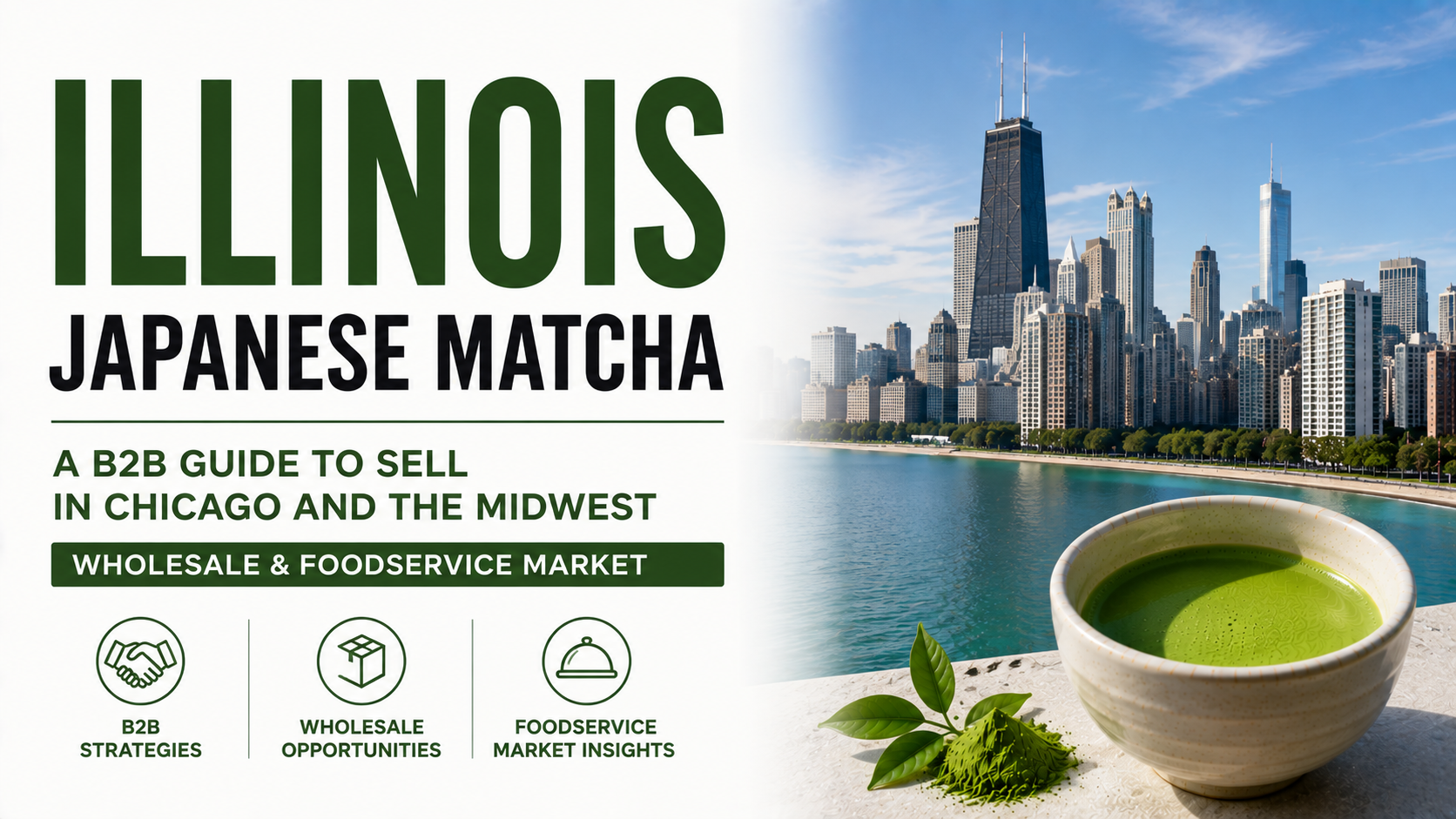
America’s matcha boom is no longer confined to the coasts. Demand is quietly but steadily spreading across the Midwest, and standing at its gateway is Illinois — with Chicago at its heart. The center of gravity of the U.S. matcha market is shifting inland. This guide breaks down the market structure, wholesale routes, and regulatory requirements you need to sell Japanese matcha in Illinois and expand across the Midwest from a Chicago base — all from a B2B buyer’s point of view. Which segments to target first, which pitfalls to avoid, and who to partner with for repeat orders — we organize the practical decision points one by one, grounded in local market data and logistics.
For Companies Seeking Matcha Powder
We source matcha from Japan’s premier production regions including Kyoto Uji, Kagoshima, Fukuoka, and Shizuoka, offering comprehensive grade ranges from organic JAS-certified ceremonial grade to processing-grade matcha.
Common Challenges:
- “We have projects but cannot secure stable matcha supply…”
- “We want to incorporate matcha into new café menu items!”
If you face these concerns, consult with Matcha Times. Feel free to contact us for initial inquiries.
\Read Also/
→ What Matcha Sells in Florida? Tourism, Hotels & Wellness Demand in Miami and Orlando
Why Illinois and Chicago Are the Strategic Key to the Midwest Matcha Market

The short answer: Illinois should be evaluated not just as a single state, but as a launchpad for distribution across the entire Midwest. Start with the market size. The U.S. matcha market was valued at roughly $640 million in 2024, about $690 million in 2025, and is projected to reach around $1.35 billion by 2035, growing at roughly 7% annually. Notably, North America shows the highest regional growth rate, so the upside is not limited to the coasts.
On top of that, Chicago’s location is decisive. The city is North America’s largest rail hub, where six of the continent’s seven Class I railroads converge and roughly a quarter of all U.S. rail freight passes through. O’Hare International Airport ranks among the top five cargo airports in the country, handling over two million metric tons of air freight a year. The Chicago metro moves roughly $3 trillion in goods annually, making it an ideal base for re-distributing matcha arriving from Japan to surrounding states.
In other words, building a sales channel in Illinois is the same as securing an artery that delivers Japanese matcha into the vast internal-demand zone of the Midwest. Few places in the country combine both a growing market and this kind of logistical centrality.
The depth of the market itself matters too. Illinois is home to roughly 12 million people, and the Chicago metro is the third-largest in the United States. A high-disposable-income urban core coexists with solid, dependable buyers in the suburbs and beyond, which means you can bundle demand across price points — from premium beverage grades to volume-driven functional uses — within a single state. With competition still less dense than on the coasts, now is a strong window to establish relationships early.
But “Store It in Chicago and It Spreads Across the Midwest” Is a Myth

Being at the center of logistics does not mean product sells itself once it hits a warehouse. The Midwest presents several distinct barriers to entry.
First, temperature swings and long inventory dwell times that come with being inland. Chicago winters stay below freezing while summers are hot and humid. Matcha is a powder extremely sensitive to light, heat, humidity, and oxygen, and storage without temperature control quickly leads to fading color and flavor loss. The long lead time of moving product from coastal ports inland only raises the freshness risk.
Second, the complexity of multi-state distribution. Wholesalers who cover the Midwest as a region ship simultaneously to Illinois plus Ohio, Michigan, Indiana, Wisconsin, Missouri, and Kentucky. Each state has its own food-labeling and operating rules, and approaching deals with a single-city mindset can trip you up.
Third, the reality that “made in Japan” alone is not a differentiator. Chicago already has a deep layer of Asian food wholesalers, and cheaper matcha from other origins is in circulation. If you cannot speak to quality, regulatory compliance, and supply stability, you will be swallowed by price competition.
Building relationships with local wholesalers also takes time. The larger the regional wholesaler, the more they tend to expect a meaningful first order and a promise of uninterrupted, continuous supply. When a buyer who wants to test small volumes meets a wholesaler seeking a stable, long-term partner, samples may pass but the real order never lands if that gap goes unaddressed. That is exactly why choosing a supplier who can plan supply alongside you is the first fork in the road.
Mapping Midwest Matcha Demand by Segment and Region
Demand is not uniform. By end use, foodservice accounts for about 35% of matcha demand, and that foodservice segment keeps growing at over 7% a year. Drawing a clear picture of who to sell to, in which channel, and in which area is the starting point for winning the Midwest.
And here is the point not to forget: Chicago’s demand does not stop at the Illinois state line. Some Chicago-based wholesalers distribute across a seven-state footprint including Ohio, Michigan, Indiana, Wisconsin, Missouri, and Kentucky through a single network. One account in Chicago can become the entry point to a distribution web spanning the whole Midwest. Thinking regionally and capturing the wholesale network as a whole pays off in this market.
Downtown and the Loop: Foodservice and Specialty Cafés
Central Chicago’s Japanese dining scene is deepening — from omakase sushi to ramen and modern tea cafés. A steady rise in cafés and restaurants adding matcha lattes and matcha desserts is generating demand not only for beverage grade but for confectionery use as well. What matters here is consistency of taste and a supply that never runs out during peak season.
Northwest Suburbs and College Towns: New Demand
Northwest suburbs such as Arlington Heights are gaining attention as hidden hubs where authentic Japanese food has taken root. College towns anchored by schools like the University of Illinois offer fertile ground where health-conscious younger consumers embrace matcha drinks as an everyday habit. Price competition is gentler than downtown, and stable, repeat demand is realistic — that is the appeal of this segment.
Health, Wellness Brands, and Protein Manufacturers
Often overlooked, this is where the Midwest’s upside is greatest. As a functional ingredient that combines antioxidants with gentle caffeine, matcha is seeing rising demand for use in protein powders, smoothie mixes, and functional foods. These manufacturers, who source meaningful volumes on a continuous monthly basis, are the top-priority customers for a B2B buyer.
- Beverage and confectionery grade for foodservice: judged on taste consistency and zero stockouts
- Repeat demand in suburbs and college towns: gentler pricing, easier to convert into ongoing orders
- Protein and functional-food makers: the prime target, won by reliable monthly volume supply
Sequencing is a strategy in itself. Rather than chasing every segment at once, a sound approach is to first build a supply track record with suburbs and functional-food makers where repeat demand is predictable, then carry that trust into downtown foodservice chains. Establish one solid account in Chicago and it becomes far easier to ripple out to neighboring states through the same wholesale network — the Midwest way to grow.
The Typical Traps That Sink Buyers on Procurement

Buyers who stumble in the Midwest tend to share the same pitfalls. Know them in advance and most are avoidable.
- Overlooking pesticide residue limits (MRLs): matcha that fails U.S. limits is held at customs and, worst case, destroyed or returned
- Missing a Certificate of Analysis (COA): major wholesalers and functional-food makers will not adopt an ingredient without complete documentation
- Over-ordering without considering turnover: long inland dwell times degrade freshness and trigger quality complaints before the pack is even opened
- Relying on one-off spot buys: without a continuous supply backing, the moment a repeat order arrives your supply breaks down
Each of these stems from making “buy it cheap” the single top priority. In a long-distance, multi-state market like the Midwest, quality assurance and continuity of supply, not price, are what ultimately protect your margins.
Storage conditions are especially easy to overlook. Matcha quality shifts not only after opening but throughout transport and storage. Keep it cool, dark, and sealed, away from direct sun and heat and humidity — neglect this and vivid green dulls within weeks. In an inland city like Chicago with sharp seasonal swings, temperature control in the wholesaler’s warehouse and order sizing based on turnover are the lifeline of quality. Look for a supplier who can advise on packaging, portion units, and recommended storage from the procurement stage.
\Read More/
Where Smart Buyers Gain the Edge: A Supplier Scorecard
So what do successful buyers use as their selection criteria? They come down to these five axes.
- Can they recommend the best origin by use? Beverage, confectionery, and functional uses each demand different taste and grade
- Can they meet U.S. export regulations? Without FDA requirements, COA, and MRL compliance, shipments stop at customs
- Is there lot flexibility? From small trial lots to large production runs
- Can they supply monthly without gaps? A system that keeps up with repeat orders
- Do they have B2B and OEM export experience? A history across many countries and regulations is proof of reliability
Line up the main suppliers along these five axes and the differences come into sharp focus.
| Criterion | What to verify with any supplier |
|---|---|
| Grade & origin options | Confirm the grade range (ceremonial to culinary) and origin/cultivar options matched to your application. |
| Export & safety documentation | Request per-lot COA and the export, customs and food-safety documents your destination market requires (MRL/limit matching). |
| Lot flexibility & MOQ | Check the minimum order quantity, trial-lot/sample availability, and the ability to scale from a small start to larger volumes. |
| Supply stability | Confirm monthly capacity and stable supply across your contract period. |
| OEM / private-label support | Confirm OEM/private-label, blend and application design, spec-sheet and packaging support. |
Apply this checklist to each supplier on your shortlist and decide on current quotes, samples and documentation. JMEX (Japan Matcha Export Organization) is an export-focused Japanese matcha supplier with export experience to 43 countries; you can request pricing and terms directly and assess it against the criteria above.
Based on the criteria shown, Japan Matcha Export Organization (JMEX) provides balanced coverage across all five areas. Its combination of application-specific origin recommendations, FDA/COA/MRL support, flexible lot sizes, and stable supply makes JMEX a practical option for wholesalers, foodservice operators, and growing matcha brands.
Why the Japan Matcha Export Organization (JMEX) Is Chosen
Behind those five ◎ marks is a structure only a dedicated export organization can offer. Three reasons stand out.
Recommending the Best Japanese Origin for Each Use
Uji, Shizuoka, Kagoshima, Yame — each origin differs in both flavor and price. The strength here is combining the optimal origin and grade to fit the use, whether beverage lattes, confectionery, or functional foods. For example, a latte that must stand up to milk and a confectionery use that prizes color and solubility call for different origins and grades. Because the recommendation is built around your intended use, one partner can serve the Midwest’s diverse channels.
Full Compliance with FDA and Other Export Standards
From the FDA-related requirements essential for the U.S., to preparing the COA, meeting pesticide residue (MRL) limits, and Organic JAS compliance, documentation and quality are assembled with export practice in mind. Ingredients that clear customs and that major wholesalers can adopt as-is are prepared thoroughly within the exporter’s scope of responsibility.
Stable Monthly Supply and Deep B2B Export Experience
Rather than spot trades, JMEX maintains a system that supplies meaningful volumes continuously on a monthly basis. Backing that up is a track record of exporting to 43 countries. Experience supplying across diverse countries, regulations, and business customs forms a solid foundation for sustaining repeat orders in the Midwest.
When these three come together, the meaning for a buyer is clear. No hesitation in choosing an origin, no stoppage at customs, no stockouts on repeat orders — the three points most likely to trip you up in the Midwest are resolved together at the point of supply. Being able to entrust everything to one partner, rather than summing up separate strengths, is the greatest reassurance in a long-distance, multi-state market.
Certification also resonates with the Midwest’s strongly health- and wellness-minded customers. Matcha compliant with Organic JAS and other organic standards slots straight into the “clean ingredient” story that protein and functional-food brands seek. Quality and compliance convert directly into selling points — another edge you gain only by partnering with a supplier built for export.
A Procurement Flow to Expand Across the Midwest from Chicago
Finally, here is the flow from actually sourcing Japanese matcha to rolling it out across the Midwest. With the exporter’s scope — what JMEX can handle — as the subject, we lay it out in five steps.
- STEP 1 — Inquiry and requirements: share your sales region, channel, and expected volume, and we propose the optimal origin and grade
- STEP 2 — Sample evaluation: we send candidate matcha so you can check taste, color, and solubility firsthand
- STEP 3 — Documentation and compliance: COA, MRL, organic certification and other documents required for U.S. import are prepared on the export side
- STEP 4 — First export and customs: shipped with proper packaging and temperature care, then connected to wholesalers and warehouses after arrival in Chicago
- STEP 5 — Continuous supply and volume growth: stable monthly supply supports repeat orders and drives expansion across Midwest states
The advantage of this flow is that you clear a small first box reliably, then grow volume as the track record builds. Confirm quality with samples, clear customs with documents in order, gain traction with the first export, then move to a continuous contract — with that staged design, even a first-time Japanese matcha import avoids outsized risk. A manageable growth curve from a small start to the whole Midwest is exactly the aim of this approach.
Buyer-specific steps such as local importer registration and state-by-state sales permits remain, but from origin selection to quality assurance, documentation, and continuous shipping — the areas the export side can handle, JMEX takes on together. That lets buyers focus on building their local sales channels.
Learn More About Global Matcha Trends at Matcha Times

UK-spreading matcha booms result from overlapping health consciousness, Japanese culture popularity, and lifestyle transformations. However, matcha’s appeal and potential still lie ahead. Knowing latest trends across countries and Japanese tea region initiatives reveals matcha’s deeper dimensions.
Matcha Times broadly publishes from matcha market analysis to cafe situations and farmer interviews. Won’t you also take this opportunity to deeply explore matcha’s world? The more you know matcha, the more surely its charm will draw you in.
Conclusion: Illinois Is the Launchpad for the Midwest
Illinois and Chicago are a rare launchpad where a growing U.S. matcha market overlaps with one of North America’s largest logistics networks. But it is not a “store it and it sells” market; you need a design that clears the walls of temperature swings, multi-state distribution, and quality competition.
The key is choosing a supplier who can satisfy origin recommendation by use, export compliance, and stable monthly supply all in one. With a track record of exporting to 43 countries, the Japan Matcha Export Organization (JMEX) supports Midwest expansion with exactly that all-around capability.
Start small, clear one box, and build one solid account in Chicago. That single step becomes the launchpad for a Midwest rollout across neighboring states’ wholesale networks. Let’s bring the weapon of Japanese matcha quality to market with the right design. To take the lead in the Midwest — the next battleground — the time to move is now.
Looking for wholesale or OEM matcha samples? Contact us — we will recommend the optimal origin and grade based on your application and target markets.
Related Articles
→ Will Matcha Latte Take Off in Washington State? A 2026 Deep Dive into the B2B Cafe Market