Will High-Quality Matcha Demand Grow in Virginia? An In-Depth Look at Northern Virginia’s Affluent, International Market
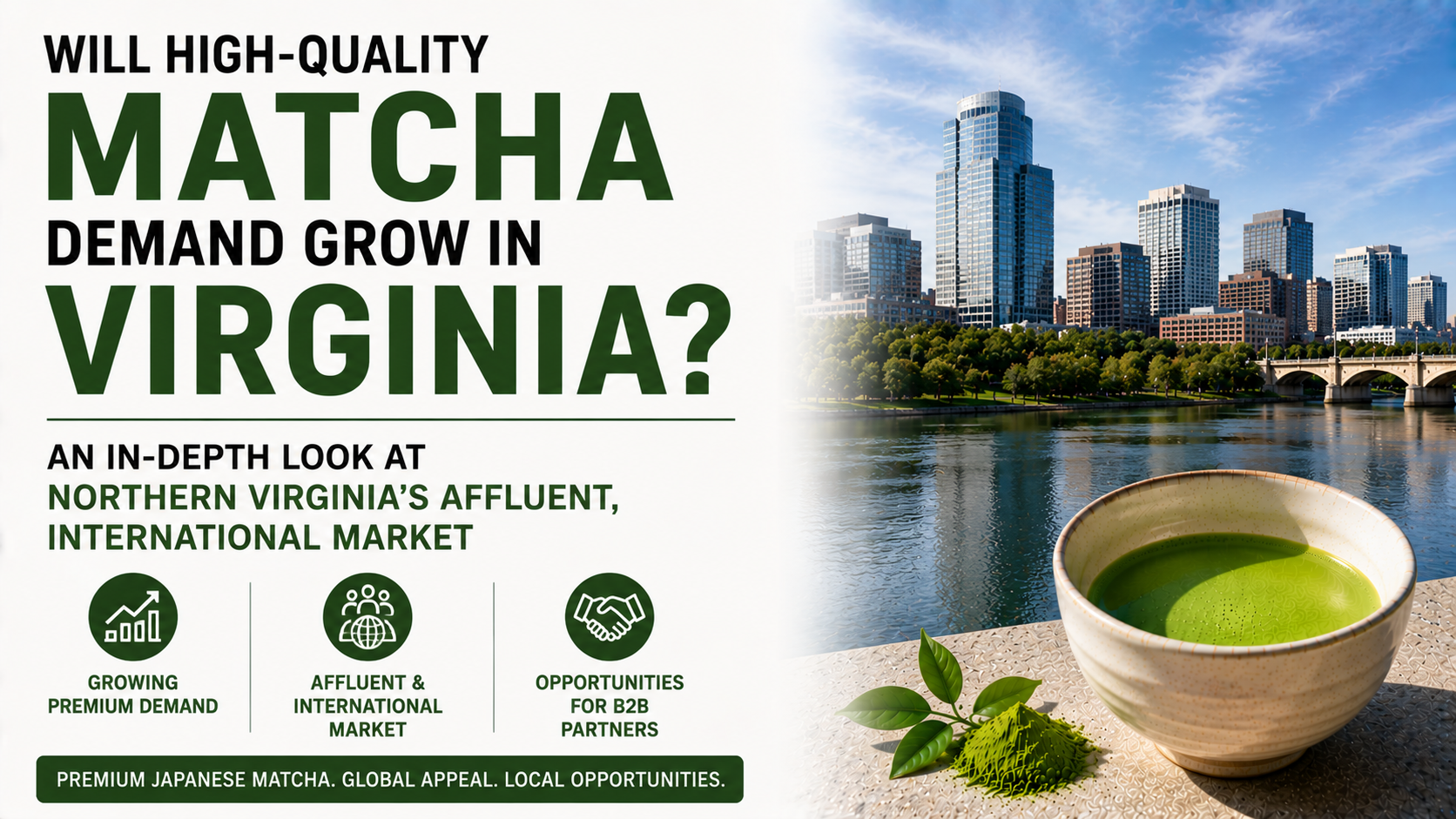
“Northern Virginia may be one of the most promising markets in the entire U.S. for high-quality matcha” — and there is solid evidence behind that claim. This region combines exceptional household incomes, a level of international diversity found few other places in America, and an established Asian-food distribution network. In this article, we break down the Northern Virginia (NoVA) market from a B2B supply perspective: is demand really growing, and if you want to enter, what should you prepare?
The short answer is a qualified yes. NorthVA’s demand structure is nothing like the average American suburb. A large, discerning segment here values quality, provenance, and certification over price. But reaching that segment requires genuine quality assurance and export readiness from day one.
For Companies Seeking Matcha Powder
We source matcha from Japan’s premier production regions including Kyoto Uji, Kagoshima, Fukuoka, and Shizuoka, offering comprehensive grade ranges from organic JAS-certified ceremonial grade to processing-grade matcha.
Common Challenges:
- “We have projects but cannot secure stable matcha supply…”
- “We want to incorporate matcha into new café menu items!”
If you face these concerns, consult with Matcha Times. Feel free to contact us for initial inquiries.
\Read Also/
Why high-quality matcha deserves attention in Northern Virginia now

Across the U.S., matcha is no longer a niche product for enthusiasts. On various industry estimates, the global matcha market surpassed USD 4 billion in 2025 and is projected to reach USD 10 billion by 2030, with the United States emerging as one of the largest importers of Japanese matcha. Across beverages, sweets, and supplements alike, good ceremonial- and culinary-grade powder is in chronically short supply.
Japanese matcha wins trust not only on taste and quality but as “an ingredient you can consume with confidence.” For American consumers who prioritize safety and traceability, a Japanese origin with clear provenance and processing is itself a reason to buy. In an information-savvy region like NoVA, that trust translates into value beyond price.
What sets Northern Virginia apart within the U.S. is purchasing power. Fairfax and Loudoun Counties consistently rank among the highest median-household-income areas in the nation, and Loudoun County is frequently cited as the single wealthiest county in America. High disposable income maps directly onto the capacity to spend on premium beverages.
High-income, highly educated, dual-earner professional households want products that satisfy both wellness and premium consumption. As a drink that delivers gentle caffeine while sustaining focus, matcha slots remarkably naturally into this segment’s lifestyle — from office-district cafés and gym-adjacent juice bars to luxury hotel lounges.
The area also has a deep fitness-and-wellness culture, with yoga studios, boutique gyms, and cold-pressed juice shops reaching well into residential neighborhoods. Matcha lattes and smoothies fit effortlessly into that health-conscious routine. And with Dulles International Airport as a logistics hub, the region also offers advantages in import lead times and inventory turnover — demand and logistics sit in the same place.
But “high income” does not automatically mean “it sells”

It is worth pausing on the assumption that “anything sells in a wealthy market.” The reality is often the opposite: the more affluent the consumer, the sharper their eye for quality — and a product that disappoints is dropped after a single try. Without substance to justify a premium price, there are no repeat purchases.
NoVA is also home to many expatriates, diplomats, and Asian residents who know authentic Japanese tea. They can tell cheap, coarse powder from properly stone-milled, tencha-based matcha the moment it touches their palate. Enter with mediocre quality and you risk not just weak sales but real damage to your brand. In this market, the quality you design at the entry point decides everything.
One factor often overlooked is competition from low-cost Chinese matcha. Compete on price alone and you disappear fast; but for NoVA’s discerning audience, the umami, vivid color, and origin-level transparency unique to Japanese matcha become your strongest differentiator. Winning on quality and story, not on price, is the dividing line for success here.
\Read More/
→ Navigating the Global Matcha Boom: Understanding Market Challenges and Smart Sourcing Strategies
Mapping demand potential by area and channel

“Northern Virginia” is not one market. Demand quality varies sharply by area and channel. Organized from a B2B supply standpoint, the major areas look like this:
| Key area | Core demand base | Promising channels | Potential |
|---|---|---|---|
| Tysons / McLean | Affluent professional households | Premium cafés, hotels, gifting | High |
| Arlington / Alexandria | Young professionals, DC commuters | Specialty cafés, D2C | High |
| Annandale / Centreville | Korean-American community | Asian food wholesale, confectionery | High |
| Falls Church (Eden Center) | Vietnamese-American community | Beverages, sweets | Medium |
| Loudoun (Ashburn / Reston) | Tech workforce, new-build residents | Wellness, office demand | Medium |
What stands out is the Korean supermarket presence (H Mart and others) in Annandale and Centreville, and the Vietnamese hub around Eden Center in Falls Church. These areas already have complete distribution networks for Japanese and Asian tea, so getting matcha onto shelves is far easier here than in most states. Riding existing wholesale routes dramatically speeds up your launch.
Don’t overlook the embassies and international organizations concentrated in Washington, DC. People working across borders often seek the authentic Japanese tea they knew back home, and their palates are well trained. This international character makes NoVA a “microcosm of the world” — a place where world-class quality is genuinely put to the test.
Add to that the “Data Center Alley” around Ashburn and a dense cluster of government-contracting enterprises, and office and catering demand keeps growing. Adopting matcha lattes for employee cafeterias and wellness perks is spreading, quietly building a B2B2E channel that reaches consumers through companies. Arlington’s specialty-coffee culture is another tailwind, creating fertile ground for barista-led, high-value matcha menus.
In short, Northern Virginia is a rare market that simultaneously holds both “premium demand from high earners” and “everyday demand from Asian communities”. Being able to attack on both wheels — not just one — is the decisive difference from other major U.S. metros.
Three miscalculations that trip up buyers entering the market

Precisely because the opportunity is real, plenty of players stall by diving in underprepared. Here are three miscalculations we hear about most often from overseas buyers.
Miscalculation 1: Assuming a “Made in Japan” label guarantees quality
Matcha is an agricultural product; color and aroma shift with harvest timing, climate, and origin lot. Source on the strength of a “Made in Japan” label alone and lot-to-lot variation will erode trust after you scale up. A good sample is no guarantee that mass production matches it.
Miscalculation 2: Deferring U.S. pesticide and labeling requirements
In the U.S., compliance with the FDA’s FSMA and state-level labeling rules is mandatory, and an “Organic” claim requires formal organic certification. Shipping without a COA and residue data in hand, only to be stopped at customs or on the shelf, is an all-too-common story.
Miscalculation 3: Misreading supply cycles and running out in peak season
Because matcha production concentrates around the first flush, failing to secure volume in advance means stockouts during your busiest months. Losing a hard-won shelf placement because supply couldn’t keep up is the failure you least want. Choosing a partner who can supply reliably is a lifeline for business continuity.
What all three miscalculations share is that each was preventable with due diligence. Conversely, cover the right checkpoints up front and NoVA’s high bar is entirely clearable. Next, let’s look concretely at the criteria that successful buyers actually use.
How smart buyers vet their suppliers
So what do buyers who avoid these miscalculations use as their benchmark? The answer is simple: they quantitatively confirm three things before signing — origin proposals fit for the application, export-compliance capability, and supply stability. They verify with documents and samples, not gut feel. For reference, measuring the major domestic suppliers on the same yardstick looks like this:
| Criterion | What to verify with any supplier |
|---|---|
| Export track record & references | Ask for export track record and references in your target market(s). |
| Export & safety documentation | Request per-lot COA and the export, customs and food-safety documents your destination market requires (MRL/limit matching). |
| Grade & origin options | Confirm the grade range (ceremonial to culinary) and origin/cultivar options matched to your application. |
| Lot flexibility & MOQ | Check the minimum order quantity, trial-lot/sample availability, and the ability to scale from a small start to larger volumes. |
| Supply stability | Confirm monthly capacity and stable supply across your contract period. |
Apply this checklist to each supplier on your shortlist and decide on current quotes, samples and documentation. JMEX (Japan Matcha Export Organization) is an export-focused Japanese matcha supplier with export experience to 43 countries; you can request pricing and terms directly and assess it against the criteria above.
In particular, being able to propose the optimal matcha from multiple origins — Uji, Shizuoka, Kagoshima, Yame and more — according to the use case carries real practical value for buyers designing everything from beverages to sweets to supplements. Not being tied to a single origin becomes proposal power across diverse channels.
In practice, the vetting checklist is surprisingly simple. At the first meeting, ask for a COA, at least three lots’ worth of samples, conformity to the destination’s pesticide residue limits, and a compensation clause for defect claims. Those four questions alone reveal most of a partner’s true capability. Settling this before price negotiation is the shortest path to avoiding accidents at scale.
Why JMEX is chosen as a Northern Virginia entry partner
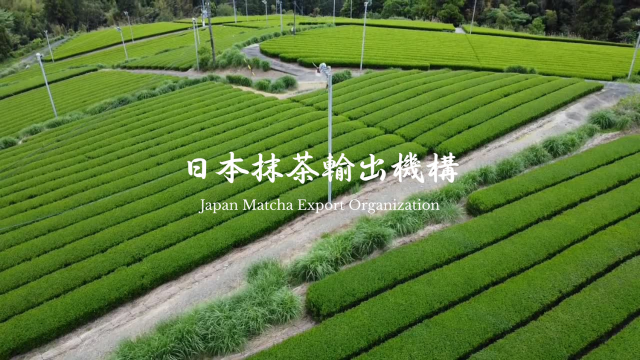
Among many suppliers, there are clear reasons the Japan Matcha Export Organization (JMEX) is chosen as a partner by buyers aiming to expand overseas. Here are three strengths.
Strength 1: Optimal origin proposals by application
Rich color and umami for lattes, vibrant hue for sweets, functionality for supplements — every use demands different characteristics. JMEX combines and proposes the optimal leaf from origins across Japan such as Uji, Shizuoka, Kagoshima, and Yame to match each use, covering NoVA’s diverse channels from a single partner.
Strength 2: Full compliance with each country’s export standards
From COA and pesticide residues (MRL) to organic certification, the documentation is thorough. JMEX meets the export standards of major markets including the EU, U.S. FDA (FSMA), Taiwan TFDA, and Singapore SFA, preparing the analytical data and labeling requirements the U.S. demands in advance. Lowering regulatory risk at the entry point is a significant reassurance in practice.
Strength 3: B2B-dedicated stable supply and a proven record
JMEX specializes in B2B, supplying reliably from 10 kg trial volumes to one-ton mass production. Most notable is a track record of exporting to 43 countries. Operations that have held up across such diverse global markets are firm assurance in a demanding market like Northern Virginia.
These three strengths matter only in combination. Delivering the right origin, with compliant documentation, in exactly the volume needed, without interruption — this end-to-end capability is what keeps you chosen over the long term in a high-bar market like NoVA. Whether a supplier functions as a partner that sustains your business, not just a one-off vendor, is where the practical case for JMEX lies.
How to get a matcha business off the ground in Northern Virginia
Finally, here is a practical, step-by-step approach from the first inquiry to full-scale supply. Follow this order and you set up a launch with far less backtracking.
- Define your target segment and channel: decide which NoVA area and channel will be your main battlefield first.
- Evaluate samples (at least three lots): verify lot variation and consistency hands-on.
- Scrutinize the documents: cross-check COA, residues, and certification against U.S. FSMA and labeling requirements.
- Run a productization test with a trial lot: confirm with your actual recipe and packaging.
- Put contract terms in writing: lock in price, FX handling, volume, and quality compensation.
- Full-scale supply and periodic review: maintain inventory planning and quality checks with peak season in mind.
Follow this sequence and you head off most post-scale problems before they start. The more carefully you handle the first two stages — defining your segment and evaluating samples — the smoother negotiation and supply become afterward. Building the foundation without rushing turns out to be the fastest route.
In a market like NoVA where competition has not yet fully intensified, the buyer who secures a reliable supply network and shelf space first gains the edge. Rather than moving after the market fully matures, lock down the three points — origin, documentation, and supply plan — with a partner now. That becomes the difference years down the line.
Learn More About Global Matcha Trends at Matcha Times

UK-spreading matcha booms result from overlapping health consciousness, Japanese culture popularity, and lifestyle transformations. However, matcha’s appeal and potential still lie ahead. Knowing latest trends across countries and Japanese tea region initiatives reveals matcha’s deeper dimensions.
Matcha Times broadly publishes from matcha market analysis to cafe situations and farmer interviews. Won’t you also take this opportunity to deeply explore matcha’s world? The more you know matcha, the more surely its charm will draw you in.
Conclusion: Northern Virginia rewards the prepared buyer
Northern Virginia is a rare “high-upside market” for premium matcha, combining some of the nation’s highest incomes, deep international diversity, and a fully built-out Asian-food distribution network. Its two-layer structure of premium and everyday demand is a strength few other U.S. metros can match.
Yet only the buyer who designs quality assurance and export readiness from the very start can turn that potential into results. To keep being chosen by premium consumers, a trusted supply partner working alongside you is essential. Start by defining the segment you’re targeting, then find a partner who will help you map the right origin and grade. The door of Northern Virginia is genuinely open to those who prepare well — and with the market wind at your back, now is the time to take that first, sample-sized step.
Looking for wholesale or OEM matcha samples? Contact us — we will recommend the optimal origin and grade based on your application and target markets.
Related Articles
→ Will Matcha Latte Take Off in Washington State? A 2026 Deep Dive into the B2B Cafe Market