Why the Matcha Market Is Growing in North Carolina: B2B Opportunities in Charlotte & the Research Triangle
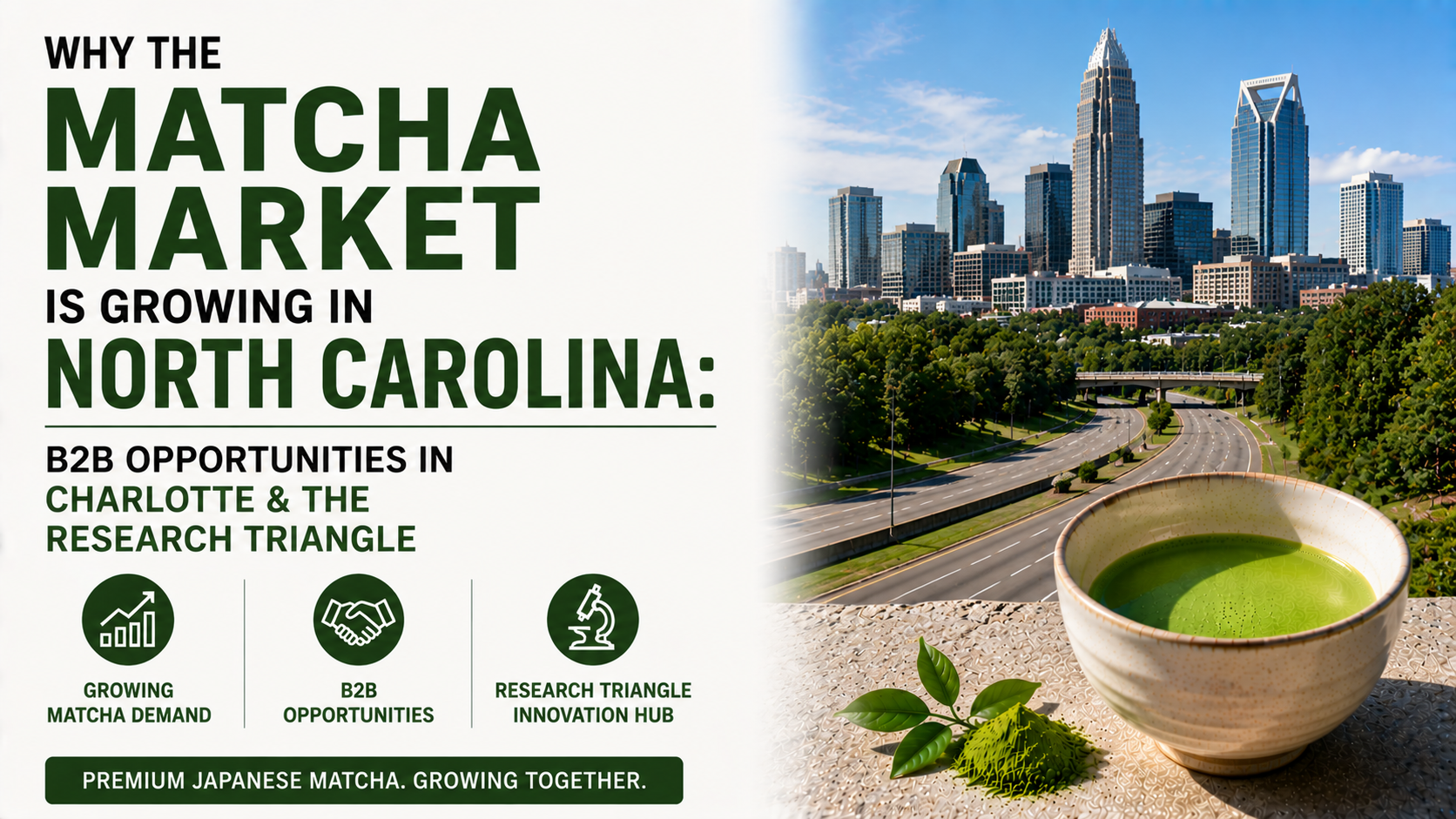
North Carolina has quietly become one of the fastest-growing states in the U.S. South. Its 2025 population reached roughly 11.2 million, and it led the entire country in net domestic migration—more than 110,000 people moved in from other states in a single year. More residents means more cafés, grocery aisles, gyms and offices, and with them a wave of demand for new beverages. Two engines—the financial hub of Charlotte and the university-and-research corridor known as the Research Triangle—are lifting demand for wellness drinks like matcha. Drawing on the perspective of the Japan Matcha Export Organization (JMEX), which has delivered Japanese matcha to 43 countries worldwide, this article breaks down why North Carolina is the next matcha market to watch.
For Companies Seeking Matcha Powder
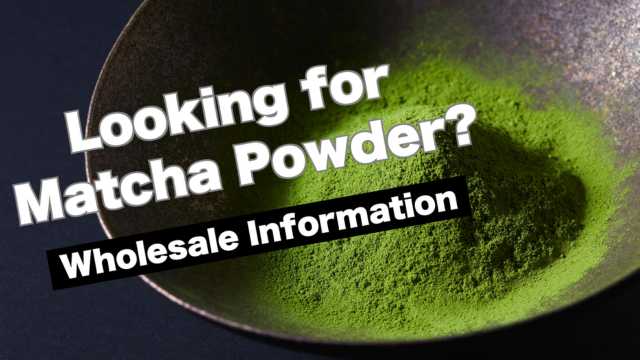
We source matcha from Japan’s premier production regions including Kyoto Uji, Kagoshima, Fukuoka, and Shizuoka, offering comprehensive grade ranges from organic JAS-certified ceremonial grade to processing-grade matcha.
Common Challenges:
- “We have projects but cannot secure stable matcha supply…”
- “We want to incorporate matcha into new café menu items!”
If you face these concerns, consult with Matcha Times. Feel free to contact us for initial inquiries.
\Read Also/
Why the Matcha Market Is Growing in North Carolina Right Now
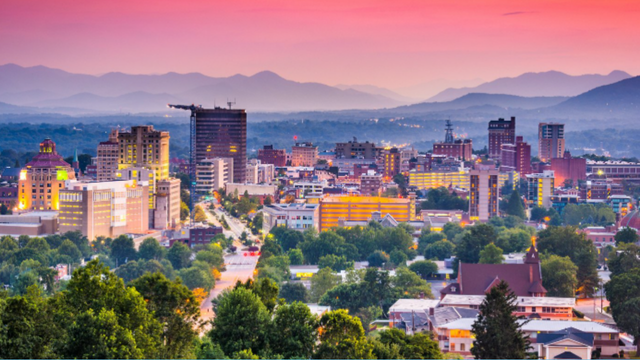
In short, it is because population, income and health-consciousness are all rising at once. In the U.S. Census Bureau’s 2025 estimates, North Carolina ranked first in the nation for net in-migration. Many of the new arrivals are professionals in their 20s to 40s with strong disposable income and an appetite for new food experiences—exactly the demographic that reaches for a drink that is both healthy and feel-good.
The broader market is a tailwind, too. The global matcha market is estimated at about USD 4.6 billion in 2026 and is expected to keep growing at near double-digit rates. North America is expanding at roughly 8.6% a year, led by fast-growing metros in the South. Unlike mature markets such as New York or California, North Carolina is still at the stage just before matcha lattes and iced matcha become an everyday habit.
That “just before” stage is precisely the opportunity for B2B buyers. Café menus, retail shelves and beverage recipes have not yet locked in their default matcha. Securing accounts and supply routes now will shape market share for years.
North Carolina also has strong ports and logistics. Imports flow easily through major East Coast ports, and both the Charlotte and Raleigh metros host food distributors and restaurant-chain hubs. Once a deal begins, it is easy to expand across the state and the wider South—a natural fit for a “prove it in one city, then scale to neighboring states” strategy.
But “More People” Does Not Automatically Mean “More Matcha Sales”
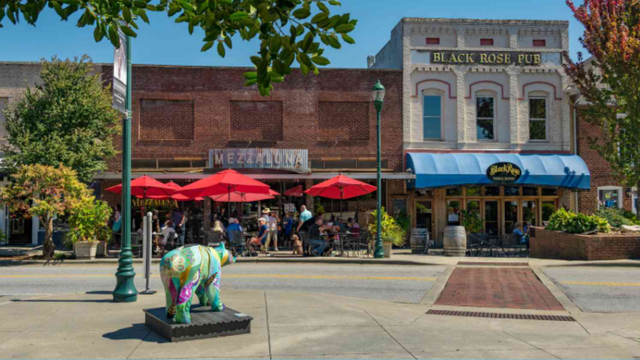
It is worth pausing here. North Carolina’s food culture differs from coastal giants like New York and Los Angeles. The inland South has long centered on coffee and sweet drinks, and matcha is still an early-stage, insider category.
That is not a weakness—it is proof that first-mover advantage is still available. But importing the exact playbook from a mature market usually misses. Reading local taste, distribution and price sensitivity, then designing around an easy first cup, is the shortcut to lasting adoption. For newcomers, start with a milk-and-sweetness latte; for the health-minded, propose smoothies and functional drinks—tailored entry points by segment work best.
\Read More/
The Two Engines Driving the State: Charlotte and the Research Triangle
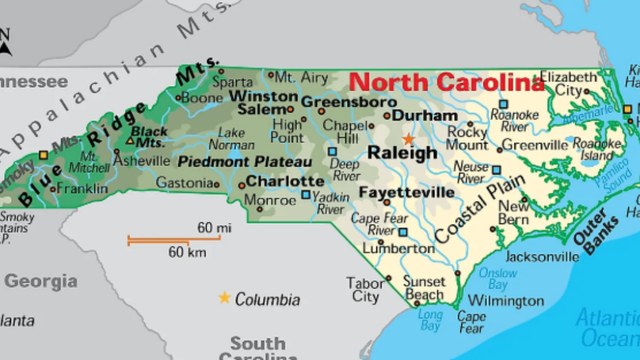
Charlotte: High-Purchasing-Power Urban Consumption
The Charlotte metro is home to about 2.8 million people and added roughly 69,000 residents in a single year (2024–2025), ranking among the nation’s top gainers alongside Houston and Atlanta. As a banking hub with several major U.S. bank headquarters, its Uptown core is dense with hotels, restaurants and specialty cafés.
Because it draws finance and professional talent, Charlotte is a city that buys on quality and story rather than price for its own sake. It pairs well with premium matcha lattes and ceremonial-grade menus—strong potential for hotel afternoon tea service and design-forward cafés.
Research Triangle: Wellness Demand from Researchers and Young Professionals
The Research Triangle links Raleigh, Durham and Chapel Hill. Its core, Research Triangle Park (RTP), alone spans about 7,000 acres with 300+ companies and 50,000 employees, one of the largest research hubs in the country. IT leaders such as IBM, Cisco and Lenovo sit alongside global pharma and biotech firms, while Duke University, UNC and NC State keep supplying top talent.
Consumers here are highly attuned to health, function and scientific evidence. Walking trails and container-style food hubs surround offices and campuses, and healthy eating is woven into daily life. There is fertile ground for matcha to be embraced as a “healthy cup that helps you focus”, thanks to its antioxidants and L-theanine, and Raleigh recently topped 500,000 residents, deepening the young consumer base.
With so many research institutions and universities, the area is rich in institutional accounts that move volume—staff cafeterias, campus cafés and corporate wellness programs. Separate from consumer storefronts, these steady-demand channels are easier to plan around and make attractive targets for B2B buyers.
A Demand Map by Application and Area for North Carolina Matcha
“Matcha” sells in different forms depending on the channel. Mapping promising outlets by application and key area looks like this:
| Channel | Main Demand | Strongest Areas |
|---|---|---|
| Cafés & coffee roasters | Matcha lattes, iced matcha | Charlotte / Durham |
| Health & wellness (gyms, smoothies) | Protein blends, functional drinks | Research Triangle |
| Functional & RTD beverages | OEM blending for cans/bottles | In-state manufacturers |
| Bakery & confectionery | Color and flavor for desserts | Metro-wide |
| University & corporate dining | Volume supply, menu staples | RTP / campuses |
The key is to match grade and application to the character of each area. Use ceremonial-leaning grades for Charlotte’s urban cafés and culinary/OEM-friendly commercial grades for RTP and universities. Trying to cover every channel with a single grade usually ends up either too expensive to sell or too plain to satisfy.
Three Common Pitfalls in Matcha Sourcing

In new markets especially, sourcing oversights break your sales channels later. When supplying North Carolina, watch for three things:
- Lot-to-lot color and flavor variation: samples may look great, but color drift at scale makes the product diverge from the menu photo—and in the social-media era, that shows up immediately in reviews.
- Non-compliance with residue limits and export rules: matcha that fails U.S. FDA standards or MRLs can be stopped at customs and, in the worst case, cost you the whole channel.
- Supply interruptions: suppliers who rely only on first-flush inventory run out during peak demand, and you lose the staple menu you worked to build.
What makes these tricky is that they stay invisible at the sample stage and only surface after you scale or hit peak season. So choose suppliers not only on unit price, but on whether they can hold quality and supply once volume ramps.
In a launch-phase market like North Carolina, a single incident can brand matcha as “hard to work with” and sink the whole category. Conversely, getting the first rollout right makes every later expansion far easier. Your first supplier choice means more than just picking a vendor.
What Smart Buyers Look For: Comparing Wholesale Matcha Suppliers
Before you commit to a matcha supplier for this use case, evaluate every candidate on the same criteria. Use the checklist below when you request quotes and samples.
| Criterion | What to verify with any supplier |
|---|---|
| Lot flexibility & MOQ | Check the minimum order quantity, trial-lot/sample availability, and the ability to scale from a small start to larger volumes. |
| Export & safety documentation | Request per-lot COA and the export, customs and food-safety documents your destination market requires (MRL/limit matching). |
| Grade & origin options | Confirm the grade range (ceremonial to culinary) and origin/cultivar options matched to your application. |
| Export track record & references | Ask for export track record and references in your target market(s). |
Apply this checklist to each supplier on your shortlist and decide on current quotes, samples and documentation. JMEX (Japan Matcha Export Organization) is an export-focused Japanese matcha supplier with export experience to 43 countries; you can request pricing and terms directly and assess it against the criteria above.
Why Overseas Buyers Choose the Japan Matcha Export Organization (JMEX)
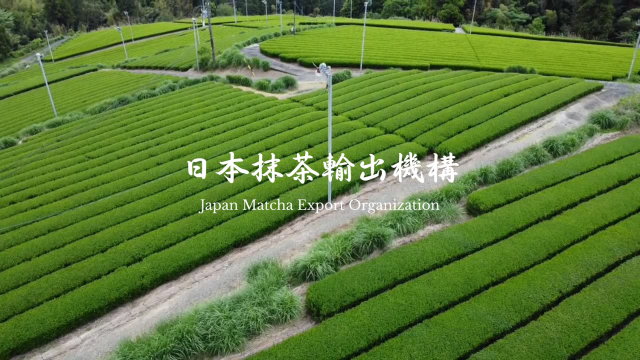
JMEX specializes in B2B, delivering Japanese matcha worldwide. In an emerging market like North Carolina, three strengths stand out.
- Optimal origins proposed by application: Uji, Shizuoka, Kagoshima, Yame and more, selected by working backward from whether the use is latte, confectionery or ceremonial.
- Full compliance with export standards: meeting U.S. FDA and EU, Taiwan and Singapore requirements, with COAs, MRL data and organic certification prepared.
- Stable supply from 10 kg to 1 ton per month: inventory designed not to hinge on the first-flush season, so your staple menu never stops.
What we care about is maximizing what the export side can handle so the buyer’s burden shrinks. Buyer-specific steps like local importer registration remain, but by taking on origin selection, documentation and stable supply on the export side, we make first-time matcha trade far less daunting—even if you are starting from “I don’t know where to begin.”
Japanese vs. Chinese Matcha: Where the Difference Shows in B2B
On price alone, cheaper Chinese matcha can be tempting. But in commercial use, the gap with Japanese matcha becomes clear over time. The vivid green, umami and clean finish that come from shade-growing and tencha processing translate directly into color and aftertaste in lattes and desserts—driving both photogenic appeal and repeat rate.
U.S. labeling and residue rules also tighten each year. Whether you can document traceability such as origin, cultivation history and test data affects not only customs clearance but also trust with your accounts. Choosing on stable quality and explainable safety rather than cheapness is the realistic call for competing long-term in a new market.
FAQ: Sourcing Matcha for North Carolina
Q. How small can the first lot be?
A. A small start is possible if you narrow the application. We support test rollouts from around 10 kg per month and scale up as you gauge response.
Q. Can we get samples?
A. Yes. After hearing your application and target area, we prepare samples of candidate origins and grades. Ask us about multi-lot evaluation to check color consistency.
Q. Who prepares the customs paperwork?
A. JMEX prepares the documents that can be handled on the export side—COAs, MRL data, organic certifications. We support buyer-specific steps like local importer registration by sharing the information you need.
Q. Which grade is safest to start with?
A. For latte-centric cafés, a beverage commercial grade; for design-forward urban cafés and hotels, a ceremonial-leaning premium grade. We tailor the answer to your area and clientele.
Steps to Succeed in the North Carolina Matcha Market
Introducing matcha in a new market goes smoothly in four steps:
- STEP 1 – Define application and sales area: decide first whether you are targeting Charlotte’s urban cafés or beverage bases for RTP and universities.
- STEP 2 – Evaluate multiple lots of samples: request several lots, not one, and verify color and flavor consistency with your own eyes and palate.
- STEP 3 – Confirm documents and regulations: assemble COAs, MRL data and certifications, and cross-check them against U.S. import requirements.
- STEP 4 – Test-sell, then make it a staple: start with a limited menu, then decide on staple status and volume increases.
With this flow you can test small, confirm what works, and raise volume in stages, growing the market while keeping inventory risk low. Letting test-sales data guide you beats rushing in volume—and often makes adoption faster.
Learn More About Global Matcha Trends at Matcha Times

UK-spreading matcha booms result from overlapping health consciousness, Japanese culture popularity, and lifestyle transformations. However, matcha’s appeal and potential still lie ahead. Knowing latest trends across countries and Japanese tea region initiatives reveals matcha’s deeper dimensions.
Matcha Times broadly publishes from matcha market analysis to cafe situations and farmer interviews. Won’t you also take this opportunity to deeply explore matcha’s world? The more you know matcha, the more surely its charm will draw you in.
Conclusion: Claim the Matcha Shelf in a Fast-Growing State
Backed by the nation’s top net in-migration, North Carolina is a rare growth market with two very differentcommercial hubs—high-purchasing-power Charlotte and health-minded Research Triangle—at the same time. Now, before matcha fully becomes an everyday cup, is the moment of opportunity for B2B buyers.
Success hinges on designing application and grade to fit each area and choosing an export partner that holds quality and supply even at scale. Get those two right, and you can turn a growing state’s demand into steady revenue. Wait until the market is set, and the shelves and accounts are already taken—so test now, while the defaults are still open, and start with a small sample lot.
Looking for wholesale or OEM matcha samples? Contact us—we will recommend the optimal origin and grade based on your application and target markets.
Related Articles
→ Why Massachusetts Chooses Premium Matcha: Inside Boston’s University, Research & Medical Market
→ California Matcha Market 2026: A B2B Deep Dive Into Café, Wellness, and Food Brand Demand