Red Flags When Choosing a Matcha Supplier: 15 Checks for B2B Buyers
The clearest matcha supplier red flags are a supplier with no batch-level Certificate of Analysis (COA), a vague or unverifiable origin, a price far below the prevailing market, a refusal to send samples, and certifications you cannot confirm on an official register. Any one of these is a reason to slow down; two or more together is usually a reason to walk away.
This guide gives B2B importers, wholesalers, and OEM buyers a neutral, verification-first framework: 15 concrete checks, a way to confirm each claim against the actual public register, and how the trade-offs shift with your order size. It is built to evaluate any supplier — including JMEX — not to rank named brands.
For Companies Seeking Matcha Powder
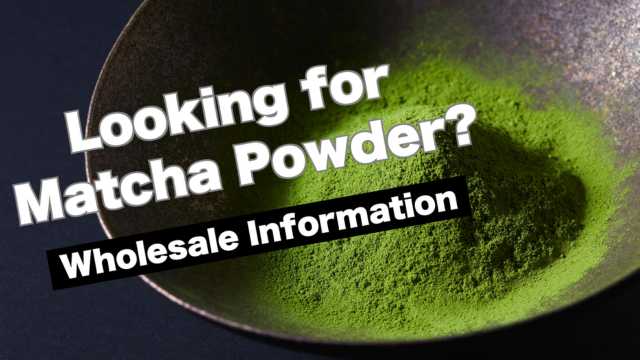
We source matcha from Japan’s premier production regions — Uji (Kyoto), Kagoshima, Fukuoka, and Shizuoka — across grades from organic JAS-certified ceremonial to processing grade, with the export documentation buyers need.
Common Challenges:
- “We have projects but cannot secure stable matcha supply…”
- “We want to incorporate matcha into new café menu items!”
If you face these concerns, consult with Matcha Times. Feel free to contact us for initial inquiries.
\Read Also/
Key Takeaways
- The five fastest warning signs: no COA, hidden origin, suspiciously cheap price, no samples, and unverifiable certificates.
- Verify, don’t trust: an organic claim can be checked in the USDA Organic Integrity Database and Japan’s Organic JAS listings; test data should come from an ISO/IEC 17025-accredited lab.
- Match the certificate holder’s name to the exporter — a mismatch is a red flag on its own.
- Know your supplier type — tea farmer, processor, or trading/export company — because each has different strengths and blind spots.
- Choose the supplier whose quality, lot flexibility, and export documentation fit your use, volume, and destination market — not the lowest headline unit price.
Researched and reviewed by the Matcha Times Editorial Team, operated by the Japan Matcha Export Organization (JMEX). Last reviewed: September 2026. See our Editorial Policy and Sources & Methodology. Found an error? Tell us.
\Read More/
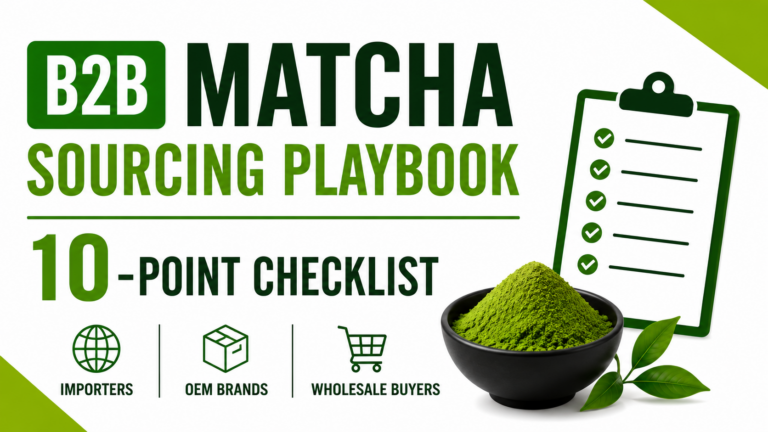
The 15 matcha supplier red flags at a glance
Use the table below as a buyer’s checklist and supplier due-diligence framework. Each row pairs a red flag with what a trustworthy supplier does and how you can verify it yourself. It is written to evaluate any supplier on the same criteria.
| Red flag | What a trustworthy supplier does / how to verify |
|---|---|
| 1. No batch-level COA | Shares the latest lot’s third-party Certificate of Analysis on request; a blanket ‘it’s safe’ is not a COA. |
| 2. Vague or ‘Japan-style’ origin | Names the prefecture (e.g. Uji/Kyoto, Kagoshima, Shizuoka, Yame/Fukuoka) and cultivar; genuine origin is a selling point, not a secret. |
| 3. Certificate name ≠ exporter name | The organic/quality certificate holder matches the company issuing your invoice; a mismatch means the certificate may not cover your shipment. |
| 4. Won’t share a certificate ID / registration number | Provides the number so you can confirm status independently on an official register. |
| 5. Price far below the prevailing market | Explains what drives the cost; suspiciously cheap ‘matcha’ is often sencha powder, aged stock, or non-compliant product. |
| 6. No sample before a bulk order | Offers paid or free trial lots so you can judge color, aroma, particle size, and solubility against your use. |
| 7. Heavy-metal / pesticide testing ‘not available’ | Supplies lab results for lead, arsenic, cadmium, and mercury plus a pesticide-residue panel from an accredited lab. |
| 8. No traceability to a production region | Traces each lot back to a farm or cooperative, with harvest and processing details. |
| 9. Can’t speak to your destination market’s rules | Understands the destination regime — for the U.S., FDA FSVP; for the EU, the electronic Certificate of Inspection via TRACES. |
| 10. No written product specification | Provides a spec sheet (particle size, color, moisture, sensory profile); ‘trust us’ is not a specification. |
| 11. Evasive on MOQ, lead time, and replenishment | Gives transparent minimums, realistic lead times, and a replenishment plan — signs of real inventory and production. |
| 12. No interest in your use case or volume | Asks about application, target market, and projected volume so grade and origin actually fit. |
| 13. Only retail packaging, no bulk export packaging | Uses nitrogen-flushed foil/bulk packaging and correct export labeling — not clear retail bags for wholesale volumes. |
| 14. Compliance documents promised ‘after payment’ | Puts COA, residue analysis, certificate of origin, and organic certificate on the table before you commit. |
| 15. Slow, vague, or scattered communication | Gives you one accountable contact and responsive answers — a good predictor of how problems get solved later. |
Farmer, processor, or trading company: who should you buy from?
There is no single ‘best’ supplier type — the right answer depends on your volume, your market, and how much export support you need. The comparison below evaluates the three common models on neutral criteria, not by brand.
| Supplier type | Typical strengths | What to verify / watch-outs |
|---|---|---|
| Tea farmer / producer | Origin authenticity, cultivar knowledge, freshness, single-estate story | May lack export documentation, English support, and small-lot export logistics; confirm they can issue a COA and ship to your market. |
| Processor / manufacturer | Large-lot supply, blending and food-grade processing for confectionery, beverage, and RTD | Origin can be blended or opaque; ask for lot traceability and per-batch test data. |
| Trading / export company | Export documentation, multi-market compliance, consolidated supply from several origins | Confirm they control quality and can trace origin — that they are a partner, not just a reseller passing on risk. |
An export-focused supplier that also controls origin selection and quality assurance combines the farmer’s authenticity with the trader’s paperwork. That is the model to look for when you export across several markets.
Trade-offs by buyer size
The same red flags matter to everyone, but priorities shift with order scale:
- Café or small multi-store pilot — prioritize sample quality, small trial lots, and consistent color; MOQ flexibility matters more than the lowest unit price.
- Mid-size importer or wholesaler (hundreds of kg/month) — prioritize lot consistency, replenishment reliability, and a complete export-document set for your destination market.
- OEM or manufacturer — prioritize written specs (particle size, dispersion, color and heat stability), batch consistency, and microbiological specifications for your production line.
How to verify a COA, certifications, and lot consistency
The difference between a good supplier and a risky one is often not what they claim but what you can independently confirm. Treat every document as a claim to be checked, and use these criteria to evaluate the evidence:
- Certificate of Analysis (COA). A per-lot COA should show numeric results for the four heavy metals (lead, arsenic, cadmium, mercury), a pesticide-residue panel, and microbiological tests. Prefer results from a laboratory accredited to ISO/IEC 17025, the international standard for testing-laboratory competence.
- Organic certification. For the U.S. market, confirm the operation and its certificate in the USDA Organic Integrity Database. For Japanese product, check the Organic JAS scheme run by Japan’s Ministry of Agriculture, Forestry and Fisheries. Confirm the certificate holder’s name matches your exporter.
- Import documentation for your market. U.S. importers operate under the FDA’s Foreign Supplier Verification Programs (FSVP), which require you to verify your supplier. EU organic imports require an electronic Certificate of Inspection issued through the European Commission’s TRACES system.
- Lot consistency. Ask for the last few lots’ COAs side by side; a reliable supplier’s color, particle size, and residue results stay within a tight, documented range rather than drifting batch to batch.
If a supplier cannot point you to the register entry, the accredited lab, or the export document for your market, treat the claim as unverified — not confirmed.
Questions to ask any matcha supplier before you order
Bring this short list to every first conversation; the answers separate partners from resellers:
- Which prefecture and cultivar is this lot from, and is it shade-grown tencha stone-milled into matcha?
- Can you send the most recent lot’s COA from an accredited lab, plus the last two lots for comparison?
- What certifications do you hold, and what is the certificate registration number so I can verify it?
- What is your MOQ, lead time, and replenishment cycle at my target volume?
- Which export documents can you issue for my market (COA, residue analysis, certificate of origin, organic certificate)?
- Can I order a paid sample before committing to a bulk order?
Common mistakes B2B matcha buyers make
- Deciding on price alone — the cheapest option often lacks the paperwork to clear customs or the quality your product needs.
- Skipping the sample step — color, aroma, and solubility can only be judged with the real product against your recipe.
- Leaving compliance for later — ordering before checking residue limits and label rules risks a shipment held at the border.
- Vague volume planning — ordering without set quantities and replenishment cycles invites both stockouts and dead stock.
- Confusing retail reviews with B2B reliability — a strong consumer brand is not automatically a strong export partner.
Matcha supplier due diligence, step by step
A repeatable process turns the checklist above into a decision:
- Define requirements — write down the application, target grade, monthly volume, sales region, and price range before you compare suppliers.
- Shortlist and screen — run each candidate against the 15-check table and drop anyone with an unresolved red flag.
- Request samples — verify color, aroma, solubility, and taste with the real product against your use.
- Verify documents — confirm certifications on the official registers and check COAs come from an accredited lab.
- Quote and document check — confirm export paperwork, lead time, and minimum lot alongside the unit price and landed cost.
- Start small, then scale — place a trial lot, confirm quality and operations, then grow volume with demand.
Sources & Methodology
Every rule in this guide is drawn from the external primary and official sources below; each entry states what it supports, its date, and its scope. This article makes no first-party statistical claims — where a supplier claim cannot be confirmed against one of these registers or an accredited lab, we treat it as unverified rather than presenting it as fact.
- U.S. FDA — Foreign Supplier Verification Programs (FSVP) — the U.S. importer’s legal duty to verify foreign suppliers (FSMA final rule, United States imports)
- USDA Organic Integrity Database — independently verifying an operation’s USDA organic certification (accessed 2026, USDA organic)
- MAFF — Organic JAS — Japan’s official organic standard and certification scheme (accessed 2026, Japan organic)
- ISO/IEC 17025 — testing and calibration laboratories — the accreditation standard behind a credible third-party COA (ISO/IEC 17025:2017, international)
- European Commission — TRACES — the electronic Certificate of Inspection required for EU organic imports (accessed 2026, European Union imports)
Why Buyers Choose JMEX (Japan Matcha Export Organization)

One supplier that meets these criteria at a high level is JMEX (Japan Matcha Export Organization), a wholesale and export partner dedicated to bringing Japanese matcha overseas. It designs origin selection, quality assurance, export documentation, and logistics as one continuous flow, built for export from the start.
Rather than tying you to a single region, JMEX proposes the optimal leaf from across Japan — Uji, Shizuoka, Kagoshima, Yame, and more — and, with a proven export track record across 43 countries, bridges origin and buyer with the COA, residue analysis, and organic-JAS documentation your destination market requires.
Frequently Asked Questions
Short, direct answers to the questions B2B buyers ask most often when vetting a matcha supplier.
What are the biggest red flags when choosing a matcha supplier?
No batch-level Certificate of Analysis, a vague or unverifiable origin, a price far below the market, no samples before a bulk order, and certifications you cannot confirm on an official register. One is a caution; several together usually mean walk away.
How do I verify a matcha Certificate of Analysis (COA)?
Check that it is per-lot, shows numeric results for lead, arsenic, cadmium, and mercury plus a pesticide-residue panel, and comes from a laboratory accredited to ISO/IEC 17025. Compare the last few lots to confirm the results stay within a tight range.
How can I check that an organic matcha certificate is genuine?
Confirm the operation in the USDA Organic Integrity Database for the U.S. or in Japan’s Organic JAS scheme, and make sure the certificate holder’s name matches your exporter. A refusal to share the registration number is itself a red flag.
Is very cheap wholesale matcha a bad sign?
It can be. A price far below the prevailing market often signals sencha powder sold as matcha, aged stock, or product that lacks the testing and documentation to clear customs. Ask what drives the cost and compare the landed price for a grade that actually suits your use.
Should I buy from a tea farmer, a processor, or a trading company?
It depends on volume and export needs. Farmers offer origin authenticity but may lack export documentation; processors offer large-lot supply but can blend origins; trading/export companies offer documentation and multi-market compliance — verify they also control quality and traceability.
What documents do I need to import matcha?
Typically a COA, a pesticide-residue analysis, a certificate of origin, and an organic certificate where relevant. U.S. importers also work under FDA FSVP, and EU organic imports need an electronic Certificate of Inspection via TRACES.
Learn More About Global Matcha Trends at Matcha Times

Matcha Times is a specialist media platform covering the global matcha market — sourcing and wholesale, supply and pricing, trade and regulations, production and origins, and the companies shaping the industry.
From market analysis and price trends to café case studies and interviews with tea farmers, we help buyers, importers, distributors, and manufacturers stay ahead of where matcha is heading. Explore more and put the global matcha market to work for your business.
Conclusion
When origin, grade, and export conditions align, matcha becomes a stable revenue source. Start by defining your requirements and confirming quality with a sample.
Looking for wholesale or OEM matcha samples? Contact us — we will recommend the optimal origin and grade based on your application and target markets.
Related Articles