Best Wholesale Matcha for Cafés in Bahrain: Grade, Cost per Cup & Supply
For matcha for cafes in Bahrain, a latte-grade or culinary-grade Japanese matcha is the practical starting point: it delivers the vivid green color and clean umami that milk lattes require, holds up under steam without turning brown, and arrives at a cost per serving that keeps your menu margins intact. Ceremonial grade is rarely the right choice for high-volume café use—its subtle flavor is lost in milk, and the price premium does not translate into a better-tasting latte. This guide covers how to match the grade to your application, what documentation Bahrain importers need, and what questions to ask any supplier before placing a first wholesale order.
For Companies Seeking Matcha Powder

We source matcha from Japan’s premier production regions including Kyoto Uji, Kagoshima, Fukuoka, and Shizuoka, offering comprehensive grade ranges from organic JAS-certified ceremonial grade to processing-grade matcha.
Common Challenges:
- “We have projects but cannot secure stable matcha supply…”
- “We want to incorporate matcha into new café menu items!”
If you face these concerns, consult with Matcha Times. Feel free to contact us for initial inquiries.
\Read Also/
Key Takeaways for Bahrain Café Buyers
- Latte/culinary grade Japanese matcha is the professional standard for café lattes and blended drinks—smooth color, consistent flavor, cost-effective at serving scale.
- Ceremonial grade adds cost without improving the customer experience in milk-based drinks; reserve it only for straight whisked matcha service if your menu demands it.
- Bahrain imports from GCC Common External Tariff partners; general food goods carry a 5% ad valorem duty—confirm the current rate for your HS code with Bahrain Customs before ordering (U.S. Commercial Guide, Bahrain Import Tariffs).
- Halal certification is not legally required for plain matcha powder in Bahrain, but many hospitality groups and foodservice buyers in the GCC operate internal halal procurement policies—a certified product removes friction at the purchasing stage.
- A COA (Certificate of Analysis) covering pesticide residues (MRL) and microbiological specs is the minimum documentation for any commercial food import.
- JMEX (Japan Matcha Export Organization) supports café buyers with grade-matched samples, export documentation, and a supply track record of exports to 43 countries.
\Read More/
Which Matcha Grade Is Right for Your Bahrain Café?
The matcha industry uses grade terms—ceremonial, premium, latte, culinary, barista—that are marketing categories, not regulated specifications. What matters for a café buyer is the functional profile: how the powder behaves in milk, whether the color holds under heat, and whether the cost works at your cup count. The table below maps the common grade labels to practical café applications.
| Grade Label | Typical Profile | Best Café Application | Buyer Note |
|---|---|---|---|
| Ceremonial | First-harvest, vibrant green, delicate umami, low bitterness | Straight whisked matcha (otemae style); rarely cost-effective for lattes | Premium price rarely justified in milk drinks; use only if straight service is a menu feature |
| Premium Latte / Barista | Second-harvest or blended; bright color, full body, mild bitterness, holds well under steam | Matcha latte, iced matcha, blended drinks—the professional café standard | Ask for a spec sheet and color reference; “barista grade” is not standardized |
| Culinary | Blended harvest; more robust flavor, slightly more bitterness, good dispersion | Baking, smoothies, high-volume latte programs; slightly lower cost per serving | Suitable for large-volume café programs where menu price is a primary variable |
Important: Grade names alone are not a purchasing specification. Always request a sample, a COA, and a color reference panel before committing to a wholesale volume. Two products sold as “latte grade” can differ substantially in color intensity and flavor.
Formulation Guidance: Building a Consistent Matcha Menu
Getting the recipe right before you scale to wholesale quantities saves waste and training time. The variables that matter most for a café are dose per serving, dispersion method, and milk compatibility.
Dose and Dispersion
A standard café matcha latte typically uses 2–3 g of powder per 240 ml serving. At the lower end (2 g), you get a lighter, more approachable flavor suitable for markets new to matcha; at 3 g, the character of the matcha is more pronounced and the color more vivid. Sifting the powder before whisking or blending reduces clumping in cold milk. For blended drinks using culinary grade, a brief shaker step or immersion blender gives a smoother result than hand whisking.
Milk Compatibility and Color Stability
Full-fat dairy produces the richest mouthfeel and best color contrast; oat milk is now the dominant plant-based pairing across GCC specialty cafés. Color stability under steam is a key differentiator between grades: a latte-grade or premium culinary matcha from Japan, shaded and stone-ground in proper conditions, retains its green hue under 65–70°C steaming temperatures. Avoid bright UV lighting in display cases, as matcha oxidizes and yellows with prolonged light exposure. Store opened bags in a sealed, cool, dark container and work through stock within four to six weeks of opening.
Cost Per Serving: What Café Buyers in Bahrain Should Know
The matcha ingredient cost per latte depends on three variables: the wholesale price per kilogram you negotiate, your dose per serving, and your menu price. Because wholesale pricing varies by grade, origin, volume bracket, and supplier, specific per-kg figures in this article would be misleading without your exact order context. What the market data does show is the structural picture:
- At a 2 g dose, a 1 kg bag yields roughly 500 servings. The ingredient cost share of your retail latte price is typically a small single-digit percentage of the menu price—making grade selection and consistency more important than chasing the cheapest option, which often delivers inconsistent color or flavor.
- Industry guides (such as the Specialty Coffee Association’s commercial partner matcha resources) note that the matcha ingredient cost in a café latte is a minor cost driver compared with dairy, labor, and overhead. Quality sourcing at a sensible grade is more margin-protective than buying the cheapest available powder.
- Bahrain café menu prices for specialty matcha lattes at premium venues are publicly listed in the BHD 2–4 range based on local press coverage as of 2025, suggesting the market already supports a mid-to-premium positioning that accommodates quality sourcing.
To build an accurate cost model, request a quotation from your supplier for the specific grade and volume bracket you need. The resulting cost-per-serving calculation is straightforward once you have the per-kg price and your confirmed dose.
Import Requirements and Halal Considerations for Bahrain
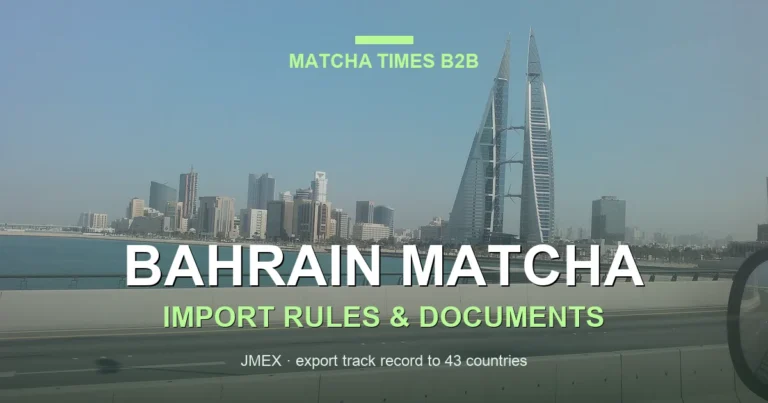
Bahrain operates within the GCC Common External Tariff framework. For general food goods, the standard import duty rate is 5% of the CIF value, as published in the U.S. government’s Bahrain Country Commercial Guide on import tariffs. The applicable rate for your specific HS code (green tea / matcha) should be confirmed directly with the Bahrain Directorate of Customs and Ports before your first shipment.
Standard food import documentation for Bahrain typically includes: a commercial invoice and packing list, a certificate of origin, a health or phytosanitary certificate from the exporting country, and a manufacturer’s declaration that the product does not contain cyclamates. Bahrain’s food authority also recommends pre-import label approval, particularly for new-to-market products—this significantly speeds import clearance (U.S. ITA — Bahrain Import Requirements and Documentation).
Halal Certification for GCC Hospitality Procurement
Pure, unadulterated Japanese matcha—stone-ground tencha leaves, no additives—is generally considered permissible under Islamic dietary law. However, formal halal certification is a commercial requirement for many hospitality groups, hotel chains, and institutional foodservice buyers operating in Bahrain and the wider GCC. A certified product—certified by a recognized body—streamlines your internal procurement process and removes the documentation burden that can slow purchasing decisions at large venues. If your café targets hotel group supply or franchise agreements, ask your supplier specifically whether their matcha holds a current, transferable halal certificate covering the grade you need.
Why Buyers Choose JMEX (Japan Matcha Export Organization)

JMEX specializes in export-side matcha supply to international café and foodservice buyers. With a track record of exports to 43 countries, the organization works from origin—grade design, harvest-lot selection, and export documentation—rather than simply forwarding commodity powder. For Bahrain café buyers, the practical offer includes: latte-grade and culinary-grade options calibrated to café formulation requirements, COA and MRL testing documentation, halal certification options, and the ability to supply stable volumes across seasons. JMEX also provides commercial samples so buyers can verify color, flavor, and dispersion before placing a wholesale order.
Supplier Selection Checklist for Café Matcha in Bahrain
When evaluating any matcha supplier for a café wholesale program, use the criteria below. This checklist applies to any supplier you consider, including JMEX.
| Criterion | What to Verify with Any Supplier |
|---|---|
| Grade specification | Ask for a written spec sheet (particle size, color reference, moisture), not just a grade label. “Latte grade” is not a regulated standard. |
| COA and MRL testing | Request a current Certificate of Analysis covering pesticide residues, heavy metals, and microbiological specs. Confirm it covers GCC/Bahrain import requirements. |
| Halal certification | Confirm whether a current halal certificate is available for the specific grade and batch, and which certifying body issued it. |
| Color and flavor sample | Request a 100 g–500 g commercial sample before committing to a wholesale order. Test it in your actual latte recipe and with the milk type you use. |
| MOQ and volume brackets | Understand the minimum order quantity and whether pricing changes at higher volumes. Align with your expected monthly cup count. |
| Lead time and shipping | Confirm production-to-delivery lead time (Japan to Bahrain), shipping terms (FOB/CIF), and whether the supplier handles export documentation. |
| Batch consistency | Ask how the supplier manages harvest-to-harvest color and flavor consistency. Inconsistent matcha creates retraining costs and customer complaints. |
| Export documentation | Confirm the supplier can provide a certificate of origin, health certificate, and manufacturer’s declaration for Bahrain customs clearance. |
Frequently Asked Questions: Matcha for Cafés in Bahrain
What grade of matcha should a Bahrain café use for lattes?
A latte-grade or premium culinary-grade Japanese matcha is the professional standard for milk-based drinks. It delivers a vivid green color, holds up under steam, and is cost-effective at café serving volumes. Ceremonial grade is rarely justified in lattes, where the delicate flavor notes that make it valuable are masked by dairy.
Is matcha halal in Bahrain?
Pure Japanese matcha powder—ground tencha leaf, no additives—is generally considered permissible under Islamic dietary law. For procurement at hospitality groups, hotel chains, or franchise operations in Bahrain and the GCC, a formal halal certificate from a recognized body is advisable. It removes documentation friction in internal purchasing processes and satisfies institutional halal procurement policies.
What is the import duty on matcha in Bahrain?
Bahrain applies a general food import duty rate of 5% of the CIF value under the GCC Common External Tariff, according to U.S. government trade guidance. The applicable rate for your specific HS code should be confirmed directly with the Bahrain Directorate of Customs and Ports before your first shipment, as classification determines the rate.
How much matcha does a café need per serving?
A standard matcha latte uses approximately 2–3 g of powder per 240 ml serving. At 2 g, a 1 kg bag yields roughly 500 servings. Your actual dose depends on your recipe and the intensity of matcha character you want to present. Test your recipe before finalizing the dose for a wholesale order.
What documentation do I need to import matcha to Bahrain?
Standard documentation typically includes a commercial invoice, packing list, certificate of origin, health or phytosanitary certificate from Japan, and a manufacturer’s declaration confirming the product does not contain cyclamates. Bahrain’s food authority also recommends pre-import label approval for new products. Work with your supplier to confirm which documents they provide and which you need to arrange through your Bahrain-side customs agent.
Can I get OEM or private-label matcha for my café brand in Bahrain?
Yes. OEM and private-label matcha—custom packaging, your brand, your grade specification—is an option for café groups and hospitality operators that want to differentiate their beverage program and control their sourcing. JMEX supports OEM matcha programs for export buyers. Minimum volume and lead time for OEM typically differ from standard wholesale; request a specific OEM quotation with your grade and packaging specifications.
Learn More About Global Matcha Trends at Matcha Times

Matcha Times is a specialist media platform covering the global matcha market — sourcing and wholesale, supply and pricing, trade and regulations, production and origins, and the companies shaping the industry.
From market analysis and price trends to café case studies and interviews with tea farmers, we help buyers, importers, distributors, and manufacturers stay ahead of where matcha is heading. Explore more and put the global matcha market to work for your business.
Conclusion
Sourcing matcha for a Bahrain café comes down to matching the grade to your application, verifying the documentation your import and hospitality compliance requires, and testing before you scale. Latte-grade Japanese matcha, with a valid COA and—where needed—halal certification, is the practical choice for most café programs. The supplier questions that protect your operation are the ones about batch consistency, export documentation, and color specification—not just price. If you are ready to explore wholesale or OEM matcha supply for Bahrain, JMEX provides commercial samples matched to your intended application.
Sources & Methodology
Import tariff information: U.S. International Trade Administration — Bahrain Import Tariffs (trade.gov). Import documentation requirements: U.S. International Trade Administration — Bahrain Import Requirements and Documentation (trade.gov). Grade terminology and café formulation guidance referenced from industry sources including the Specialty Coffee Association’s commercial partner resources; serving-size estimates are indicative ranges drawn from public café operator guides. No proprietary JMEX data (price, MOQ, capacity, lead time) has been used or stated in this article.
Looking for wholesale or OEM matcha samples? Contact us — we will recommend the optimal origin and grade based on your application and target markets.
Related Articles