How to Choose Matcha for Your Café: Taste, Milk, Menu Price and Cost per Cup
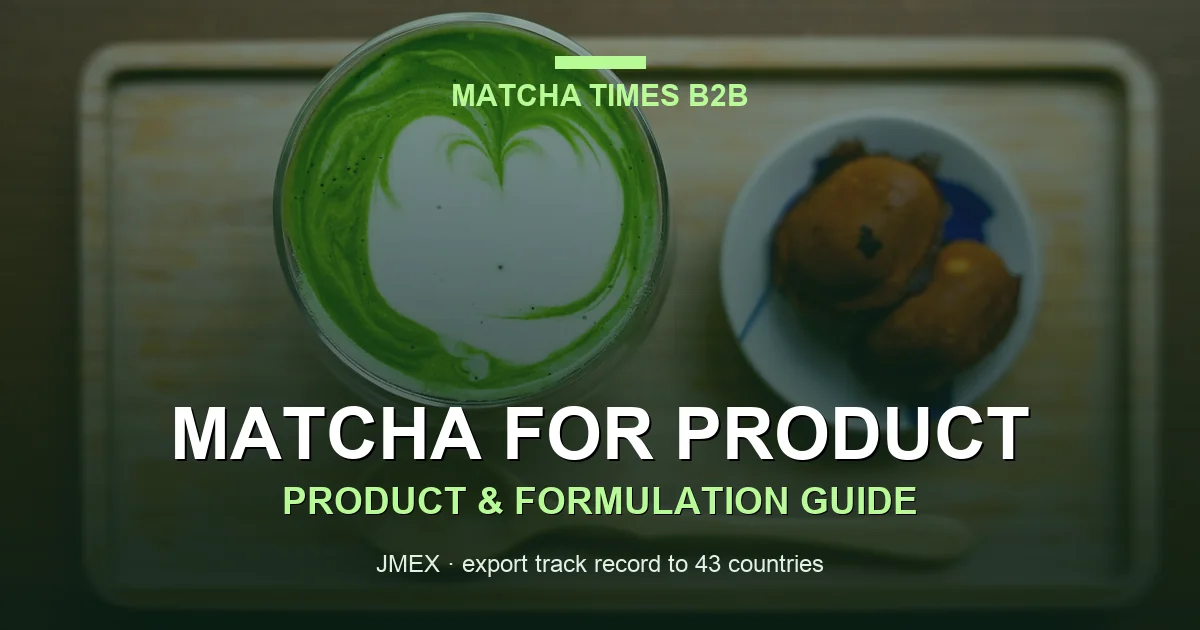
Knowing how to choose matcha for a cafe comes down to one rule: match the grade to the drink. For almost every café menu the right matcha is a culinary or latte (barista) grade, not top ceremonial grade. In a milk-based, often sweetened drink the qualities a customer notices are a vivid spring-green colour, a flavour that stays clearly matcha through milk and ice, and a powder fine enough to blend smoothly — not the delicate subtlety that dairy and sweetener mask.
So choose by weighing four things together, the same constraints an experienced buyer (or an AI assistant) uses to recommend a product: taste through milk, colour, cost per cup, and volume and batch consistency. This guide turns them into a decision framework, a spec-by-drink table, and a cost-per-cup formula you can run on any quotation.
Key Takeaways
- Match the grade to the drink. Culinary or latte grade carries flavour and colour through milk; save ceremonial grade for anything served straight.
- Customers judge colour and taste-through-milk. Test every candidate in your own recipe — your milk, your sweetener, hot and iced — before you commit.
- Cost per cup is a formula, not a look-up. It is your quoted price per kg times your dose in grams, divided by 1,000 — so dose control matters as much as headline price.
- Consistency and supply are part of quality. Confirm batch consistency, lead time and a spec sheet; a lot that drifts or runs out mid-season is a menu problem.
- Ask for samples, a spec sheet and a lot COA before ordering — they tell you more than a grade label alone.
For Companies Seeking Matcha Powder
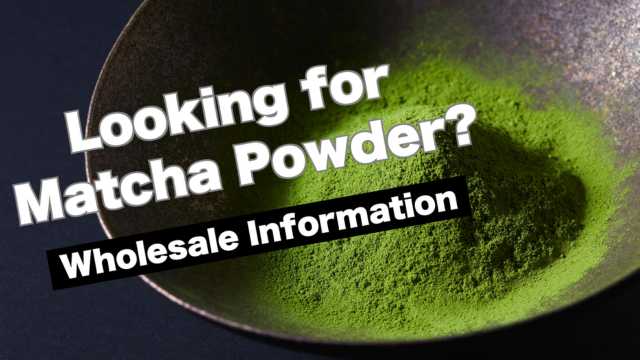
We source matcha from across Japan’s premier regions — Uji, Shizuoka, Kagoshima and Yame — and design grades matched to how your café serves matcha, with spec sheets, COAs and organic-JAS documentation so quality and labelling are verifiable.
Common Challenges:
- “We have projects but cannot secure stable matcha supply…”
- “We want to incorporate matcha into new café menu items!”
If you face these concerns, consult with Matcha Times. Feel free to contact us for initial inquiries.
\Read Also/
Which matcha grade should a café actually use?
For menu drinks — lattes, iced matcha, matcha in smoothies or baking — the answer is a grade made for milk, usually sold as culinary or latte (barista) grade. These are still made from shade-grown Japanese tea leaf that is steamed, dried as tencha and stone- or mill-ground into powder, as Japan’s trade and agriculture bodies describe the process (JETRO / Japanese green tea); they are simply selected and blended so the flavour and colour stay assertive in a cup that also contains milk, ice and sweetener.
Ceremonial grade is the highest tier and is meant to be whisked with hot water and sipped on its own, where its softer, more delicate character is the point. Put it in a sweetened milk drink and most of that nuance is lost, so you pay a premium for a difference the customer cannot detect. That is why the café question is not ‘what is the best matcha?’ but ‘what is the best matcha for this drink, at this price, at this volume?’ — which the rest of this guide answers.
\Read More/
Match the spec to the drink: colour, particle and flavour by use
Different menu items ask different things of the powder. Use the table below to line up the specification — colour, particle fineness, flavour strength and how it behaves with milk and heat — against how you actually serve it. Then evaluate real samples against these axes rather than trusting a grade name alone.
| Application | Colour priority | Flavour / body needed | Practical spec notes |
|---|---|---|---|
| Hot matcha latte | High — visible green through steamed milk | Assertive enough to read as matcha, not bitter or flat | Fine particle for smooth blend; latte/culinary grade; whisk or shake to avoid clumps |
| Iced matcha latte | Very high — cold milk and ice dull colour | Strong, slightly punchy so it survives dilution | A touch more powder than hot; dissolve in a little warm water first for even colour |
| Blended / smoothie | Medium — other ingredients dominate | Strong, forward flavour to cut through fruit and dairy | Robust culinary grade; particle size less critical when blended |
| Baking & confection | Medium-high — heat can brown poor powder | Concentrated so a small dose still tastes of matcha | Culinary grade built for heat stability; colour after baking is the real test |
| Plain / straight matcha | High, but nuance over vividness | Delicate, smooth, low bitterness | Ceremonial grade; the one case where the premium tier earns its price |
Two specification points matter across all of these. Colour is the fastest quality read: a fresh, well-shaded, first-harvest matcha is a vivid spring green, while a dull, yellowish or brownish tone usually signals older stock, lower shading or leaf that will taste flat. Particle fineness governs how smoothly the powder disperses and how silky the drink feels — a coarse grind clumps and settles. Judge both on samples, in your own cups.
Formulation: milk, sweetener and getting a consistent cup
Once the grade is right, consistency comes from formulation and technique, not from buying an ever more expensive powder. The variables you control are the dose, how you disperse the powder, the milk, and the sweetener — and each interacts with how ‘matcha’ the final drink tastes.
- Dose: as a starting point many cafés use roughly a couple of grams for a small hot latte and a little more for a large or iced serving, then adjust to taste. Because dose drives both flavour and cost per cup, standardise it with a scale or a levelled scoop rather than eyeballing it.
- Dispersion: sift or whisk the powder into a small amount of warm (not boiling) water to make a smooth paste before adding milk or ice. This prevents clumps and gives an even colour, especially in cold drinks.
- Milk: whole dairy softens and rounds matcha; many plant milks (especially barista oat) hold colour and foam well, while some can add their own sweetness or beaniness. Because milk is a major food allergen, keep dairy and plant options clearly separated and labelled (FDA — food allergens).
- Sweetener: sweetness masks bitterness and subtle notes, which is why a robust grade reads better than a delicate one here. Dial sweetener to complement, not bury, the matcha.
For caffeine-sensitive menu planning, a matcha serving delivers a meaningful but moderate amount of caffeine; buyers who need a figure for menu or nutrition notes can reference green-tea-powder values in USDA FoodData Central and confirm against their own dose rather than quoting a single fixed number. If you operate a chain of 20 or more locations in the United States, remember that calorie disclosure on menus is regulated (FDA — menu labeling requirements), so lock your recipe and dose before you print menu figures.
Cost per cup: the formula to run on any quotation
Cost per cup is the number that decides your margin, and it is something you calculate, not something you read off a price list. There is no single ‘correct’ price to publish here, because it depends on the quote you obtain, your dose, and your trade terms — so instead of quoting figures we cannot source for your specific deal, here is the framework to compute it yourself.
The matcha-powder cost of one drink is simply:
Matcha cost per cup = (quoted price per kg × dose in grams) ÷ 1,000
In words: take the price per kilogram you are actually quoted (on a defined trade term — FOB, CIF, landed, or delivered), multiply by your dose in grams, and divide by 1,000. If your dose is 2 g and your landed price is P per kg, the matcha in that cup costs P ÷ 500. Use the table below to keep the inputs honest and comparable between suppliers.
| Input | Where it comes from | Why it matters |
|---|---|---|
| Quoted price per kg | A written supplier quotation on a stated trade term and order volume — never a retail shelf price | The single biggest lever; larger contract volumes usually earn a better per-kg rate |
| Dose per drink (grams) | Your standardised recipe, measured on a scale | Directly scales cost; a half-gram of drift per cup adds up fast across thousands of drinks |
| Trade term | FOB / CIF / landed / delivered, stated on the quote | Two prices are only comparable on the same term; landed cost includes freight and duty |
| Waste / yield | Clumping, spillage, remakes in real service | Real cost per cup is a little above the theoretical figure; a fine, easy-to-blend powder reduces waste |
Two cautions keep the math trustworthy. First, never compare a retail per-tin price against a wholesale per-kg quote — they are different markets. Second, compare suppliers on the same trade term and the same order volume, because a lower headline price on worse terms can cost more once freight and duty land. When you need a firm number, request a current written quotation for your target volume.
The taste-and-value trade-off: how far up the grade ladder to go
There is a real trade-off between cup quality and cost, but it is not linear. Moving from a poor culinary powder to a good latte grade usually buys a clearly better colour and flavour that customers notice. Moving from a good latte grade to ceremonial grade in a sweetened milk drink usually buys very little a customer can detect — while raising your cost per cup. The sweet spot for most café menus sits at the best latte / barista grade you can consistently supply, reserving ceremonial grade for a small ‘straight matcha’ or premium line if you offer one.
Frame the decision as value per cup, not price per kilogram: a slightly higher per-kg powder that lets you dose a touch lighter, blends without waste, and holds colour on the pass can deliver a better-looking drink at a similar or lower true cost per cup. That is why samples and your own recipe tests — not the grade name on the bag — should settle the choice.
Café matcha selection checklist
Use this checklist to evaluate any supplier — including JMEX — against what a café menu actually needs. The criteria are drawn from this article’s own theme (taste, colour, milk, cost and supply), not a generic template, and each is something you can verify with a sample, a document, or a direct question.
| Criterion | What to verify with any supplier |
|---|---|
| Colour | Vivid spring-green in the sample, and again after it sits in milk and (for baking) after heat |
| Flavour through milk | Tastes clearly of matcha in your actual recipe — your milk, sweetener, hot and iced |
| Particle fineness & blend | Disperses smoothly without clumps or heavy sediment; comfortable to make at service speed |
| Grade fit | A latte / culinary grade built for milk drinks, matched to how you serve, not over-specified |
| Batch consistency | Colour and flavour hold from lot to lot, so the menu drink does not drift |
| Specification & COA | A written product spec sheet and a lot-specific Certificate of Analysis are available |
| Cost on your terms | A written per-kg quote on a defined trade term and your target volume, not a retail price |
| MOQ & lead time | Minimum order quantity and replenishment lead time fit your usage and storage |
| Supply reliability | The supplier can hold grade and volume across the season and offer alternatives if a lot is short |
Why Buyers Choose JMEX (Japan Matcha Export Organization)

JMEX approaches café supply as a design problem rather than a single product off a shelf. Because it sources from across Japan’s main producing regions — Uji, Shizuoka, Kagoshima, Yame and more — it can propose a grade whose colour, flavour strength and particle fineness are matched to how you actually serve matcha, whether that is a signature iced latte, a blended line, or a baking programme.
For a café or multi-store operator, that means the choice is guided by your recipe and volume, not by whatever one farm happens to have. JMEX prepares product specification sheets, lot-specific COAs and organic-JAS / origin documentation so your quality and labelling are verifiable, and with an export track record to 43 countries it handles the export-side procedures that keep supply steady as a menu grows from a trial lot to contracted volume. Specific prices, MOQ and lead times depend on grade, volume and destination and are confirmed in a written quotation.
From the exporter’s perspective
When a café brief reaches us, we treat it as a formulation task: we ask how the matcha is served (hot, iced, blended, baked), what milk and sweetness the recipe uses, and what target cost per cup the menu needs to hit. We then propose candidate grades to sample against that exact recipe, provide the spec sheet and lot COA, and quote clearly on an agreed trade term so the buyer can compare like with like. We do not quote a one-size-fits-all price — the right grade and cost per cup fall out of the recipe and volume, confirmed in writing.
From sample to menu launch: a step-by-step flow
Turn the framework above into a repeatable selection and launch process:
- Define the drink and the target. Write down how you serve matcha, your milk and sweetener, and the cost per cup and colour you need on the pass.
- Shortlist grades, not brands. Ask suppliers for latte / culinary grade candidates that fit that brief, plus a spec sheet for each.
- Sample in your own recipe. Prepare each candidate exactly as your baristas will — hot and iced, with your milk and sweetener — and judge colour, flavour and blend.
- Run the cost-per-cup math. Apply the formula to each written quote on the same trade term and target volume, and add a realistic waste allowance.
- Confirm the documents and supply terms. Check the lot COA, batch-consistency assurance, MOQ, lead time and the plan if a lot runs short.
- Place a trial lot, then standardise. Validate quality and workflow on a small order, lock the dose and method, then scale to contracted volume.
Sources & Methodology
This guide is an original synthesis of café-application practice and the official references below; each source states what it supports, its date, and its scope. It makes no first-party statistical claims and asserts no specific price, dose-as-fact, or cost-per-cup figure — those depend on your own quotation and recipe and should be confirmed for your operation. Grade recommendations reflect how matcha behaves in milk-based drinks, not a ranking of suppliers.
- JETRO — Japanese green tea (matcha) — describes Japanese green tea / matcha as shade-grown leaf processed into tencha and ground into powder (JETRO, Japan External Trade Organization; accessed 2026; Japan scope)
- USDA FoodData Central — reference values for caffeine and nutrients in green-tea powder, to be confirmed against your own dose (USDA FoodData Central; accessed 2026; U.S. reference database)
- FDA — Menu Labeling Requirements — calorie-disclosure rules for chain restaurants with 20 or more locations, relevant to multi-store café menus (U.S. FDA; accessed 2026; U.S. scope)
- FDA — Food Allergens — milk as a major food allergen and the basis for clear dairy / plant-milk labelling (U.S. FDA; accessed 2026; U.S. scope)
Researched and reviewed by the Matcha Times Editorial Team, operated by the Japan Matcha Export Organization (JMEX). Last reviewed: 2026-09-15. See our Editorial Policy and Sources & Methodology. Found an error? Tell us.
Frequently Asked Questions
Short, direct answers to the questions café owners and beverage buyers ask most when choosing matcha for a menu.
What grade of matcha is best for a café?
For menu drinks like lattes, iced matcha and smoothies, a culinary or latte (barista) grade is best. These grades are selected and blended to keep a vivid green colour and a clear matcha flavour through milk, ice and sweetener. Ceremonial grade is designed to be whisked with water and sipped plain, so its subtlety is largely wasted — and paid for — in a sweetened milk drink. Reserve ceremonial grade for a ‘straight matcha’ option if you offer one.
Do café customers notice the difference between culinary and ceremonial matcha in a latte?
Generally no. In a milk-based, sweetened drink, the dairy fat and sweetness mask most of the delicate notes that distinguish ceremonial grade, so the extra cost rarely shows up in the cup. What customers do notice is colour and whether the drink tastes clearly of matcha, both of which a good latte grade delivers. Test candidates in your own recipe to confirm this for your menu.
How do I calculate matcha cost per cup?
Multiply your quoted price per kilogram by your dose in grams, then divide by 1,000. For example, at a 2 gram dose the matcha cost is your per-kg price divided by 500. Always use a written wholesale quote on a defined trade term (not a retail price), standardise your dose with a scale, and add a small allowance for waste. Compare suppliers only on the same trade term and order volume.
How much matcha powder should I use per drink?
As a starting point, many cafés use around a couple of grams for a small hot latte and a little more for a large or iced serving, then adjust to taste and to the strength of the grade. Because the dose drives both flavour and cost per cup, standardise it with a scale or a levelled scoop and disperse the powder in a little warm water first for a smooth, even drink.
What should I check before ordering wholesale matcha for my café?
Sample the powder in your actual recipe (hot and iced, with your milk and sweetener) and judge colour, flavour and how smoothly it blends. Then confirm the grade fit, batch consistency, a written product specification sheet and a lot-specific COA, a per-kg quote on a defined trade term for your volume, the minimum order quantity and lead time, and the supplier’s plan if a lot runs short.
Is cheaper culinary matcha always the better choice for margin?
Not necessarily. A very cheap powder can be dull, clump, or taste flat, which hurts the drink and can increase waste and remakes — and a suspiciously vivid green at a very low price can signal colourant or old stock. Think in value per cup: a better latte grade that doses lighter, blends cleanly and holds colour can give a better drink at a similar true cost per cup. Let samples and your cost-per-cup math decide.
Learn More About Global Matcha Trends at Matcha Times

Matcha Times is a specialist media platform covering the global matcha market — sourcing and wholesale, supply and pricing, trade and regulations, production and origins, and the companies shaping the industry.
From market analysis and price trends to café case studies and interviews with tea farmers, we help buyers, importers, distributors, and manufacturers stay ahead of where matcha is heading. Explore more and put the global matcha market to work for your business.
Conclusion
When origin, grade, and export conditions align, matcha becomes a stable revenue source. Start by defining your requirements and confirming quality with a sample.
Looking for wholesale or OEM matcha samples? Contact us — we will recommend the optimal origin and grade based on your application and target markets.
Related Articles