Can Japanese Matcha Sell in Oregon’s Organic Market? A B2B Guide to Portland’s Cafe & Natural-Food Demand
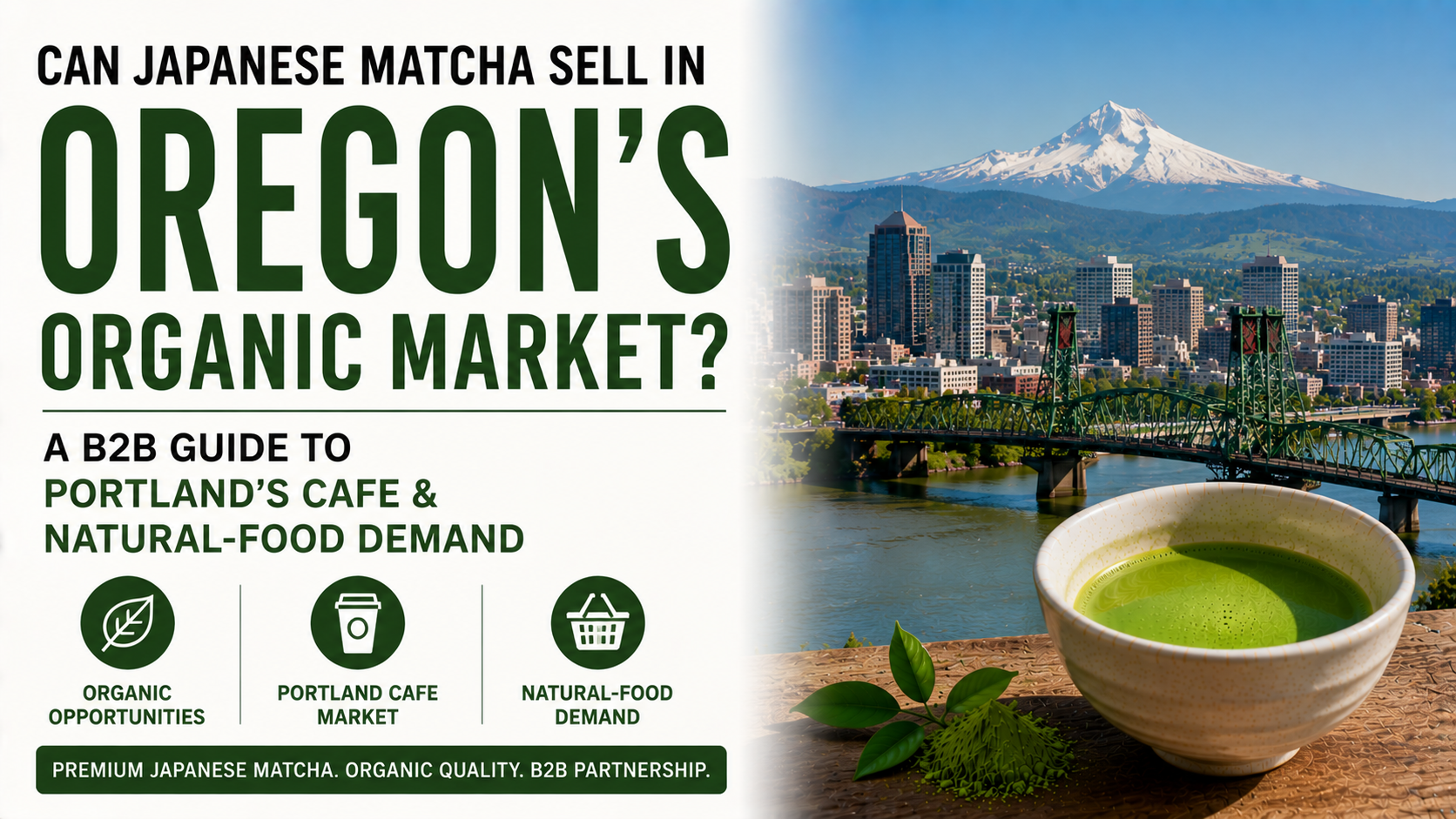
“Can Japanese matcha really sell in Oregon — especially in Portland?” It is a question we hear more and more from buyers and OEM teams exploring the North American market. The short answer: Oregon is one of the rare U.S. markets that is genuinely well-suited to Japanese matcha. A deep-rooted organic culture and a Gen Z–driven specialty-matcha boom have arrived at the same time. But demand existing and being able to deliver into it are two different things. This article breaks down Oregon’s organic demand and the café / natural-food retail channels from a B2B perspective — from how to vet a supplier to the practical steps for entering the market, backed by concrete numbers.
For Companies Seeking Matcha Powder
We source matcha from Japan’s premier production regions including Kyoto Uji, Kagoshima, Fukuoka, and Shizuoka, offering comprehensive grade ranges from organic JAS-certified ceremonial grade to processing-grade matcha.
Common Challenges:
- “We have projects but cannot secure stable matcha supply…”
- “We want to incorporate matcha into new café menu items!”
If you face these concerns, consult with Matcha Times. Feel free to contact us for initial inquiries.
\Read Also/
→ Why Matcha Demand Is Rising in Colorado: Analyzing the Outdoor, Fitness & Wellness Market
Why Japanese matcha is growing in Oregon’s organic market

Start with the momentum of the market itself. The global matcha market is projected to grow from about USD 4.53 billion in 2025 to roughly USD 7.86 billion by 2033. The standout segment is organic, which is expanding at around 12.7% a year — the fastest-growing category. Driving this are West Coast consumers who prize clean-label products and health.
What is easy to miss is how geographically concentrated the demand is. Just five coastal cities — Los Angeles, New York, San Francisco, Seattle and Portland — account for about 40% of U.S. matcha consumption. That a mid-sized city like Portland sits alongside those metros is significant. In other words, Oregon has an unusually high per-capita appetite for matcha.
You can see that appetite on the street. Portland saw a wave of dedicated matcha shops open in 2025: “Project Matcha” on NE Couch Street drew lines down the sidewalk, and “Mako Matcha Mill” — milling matcha on site and serving soft serve and wagashi — has become a talking point. Established spots like “Behind the Museum Café,” “Soro Soro” and “Matcha Cafe Maiko” add real depth. Matcha is settling in as a culture, not a passing fad, which is what makes the demand durable.
There are structural reasons organic culture runs so deep in Oregon. The state has a strong environmental, buy-local ethos, and farmers markets and natural-food grocers are woven into daily life. Portland is also known as a hub of B Corp–certified companies, so “where and how it was made” genuinely shapes buying decisions. For B2B this is a tailwind: the more carefully you document certification and provenance, the more your product is rewarded.
The macro numbers reinforce this. The U.S. organic food market reached about USD 71.6 billion in 2024 and keeps expanding on the back of health and clean-label demand. Matcha sits at the intersection of that broad organic wave and the premium appeal of Japanese origin. In short, Oregon’s matcha demand is not a fleeting boom but a long-run demand supported by a structural shift toward organic.
But assembling matcha that “works in Oregon” is harder than it looks

The tailwind is real. Yet once you are the one actually supplying the product, several walls come into view. So you don’t misjudge the path, here are the three main obstacles up front.
First is a price-and-supply mismatch. Organic matcha has seen demand surge while raw-material supply tightens; at one point procurement costs rose about 21.4% year over year. This is a category where “it sells, but you can’t reliably source it” happens easily.
Second, Oregon consumers hold an especially demanding view of organic certification and traceability. “Seems healthy” does not cut it here. Only when origin, cultivation method, pesticide residues and certification all line up do you earn a place on the shelf and a chance to be chosen.
Third is regulatory compliance. To call a product organic in the U.S., USDA Organic (NOP) compliance is mandatory, and as of July 15, 2025 an NOP Import Certificate (NOPID) must accompany shipments at import. Whether you have a supply structure that can meet these requirements directly decides whether you can enter at all.
What these three obstacles share is that none can be cleared by “having good matcha” alone. What you need is a trinity: sourcing power that absorbs price swings, documentation that proves certification and quality, and an export structure that satisfies regulation. Flip that around and partnering with a supplier who has that structure turns Oregon’s tailwind straight into your own opportunity.
Three channels driving Oregon’s matcha demand: cafés, natural-food grocers, wellness

If you plan to sell matcha in Oregon, design around the fact that quality and lot size differ by channel. The main outlets fall into three groups: specialty cafés, natural-food grocers, and wellness / D2C brands. Let’s look at each in detail.
Lot sizes also shift by channel. Independent cafés want small volumes across many SKUs; natural-food grocery chains want steady, sizeable lots; wellness OEM buyers want larger still. Whether one supply line can cover everything from small lots to bulk becomes the lifeline when you pursue several channels at once.
Specialty cafés: chosen for quality and story
Portland is nationally known for its specialty-coffee culture, and that exacting eye carries straight over to matcha. Demand centers on ceremonial to premium grades whose origin and grade can be clearly stated, and the vivid green and rich aroma that show up in a latte or iced matcha are decisive. Quality and backstory tend to outweigh price here, so it is a channel where you can command a higher unit price.
Natural-food grocers: certification and local focus are key
Portland-born “New Seasons Market,” founded in 2000 with about 22 locations in the region, is a B Corp–certified natural-food chain built around local sourcing and organic procurement. To reach shelves like these, USDA Organic certification and a stable supply lot are prerequisites. Conversely, once certification and supply are in place, it is a channel where you can borrow the retailer’s trust and settle in.
Wellness / D2C brands: demand for OEM and ingredient supply
Wellness brands blending matcha into protein, smoothies and supplements are a growth story of their own. Here bulk, steady supply and submission of a COA (Certificate of Analysis) matter most, and matcha’s strength as a B2B ingredient is put to the test. Ingredient-level price competitiveness and consistent quality — not retail packaging — decide adoption.
Where buyers commonly stumble on entry

Even with ample demand, cases where Oregon entry fails to take off share a few common patterns. All of them are avoidable if you know them in advance.
- Certification gaps: not compliant with USDA Organic (NOP) or NOPID, so you can’t reach natural-food grocery shelves
- Misunderstanding U.S.–Japan equivalence: unaware of how JAS Organic and USDA relate, and you carry needless re-certification cost
- Missing quality documents: unable to provide a COA or pesticide-residue (MRL) data, so you can’t earn a buyer’s confidence
- One-off, spot sourcing: no proof of continuous supply, so it never leads to repeat orders or a permanent shelf spot
Here is a piece of good news. Since 2014 the U.S. and Japan have held an organic equivalence arrangement, so matcha certified under JAS Organic can be sold as USDA Organic with no re-certification. Team up with a supplier who understands and can work this mechanism and the certification hurdle drops sharply in practice. Most stumbles can be avoided with the right knowledge and structure.
Leave even one of these pitfalls unaddressed, though, and the effects cascade. Without certification you miss the grocery shelf; without documents you lose the wellness OEM deal. Once you are labeled a supplier who cannot deliver, the next opportunity itself drifts away — that is the reality of overseas B2B. Which is exactly why choosing a well-equipped supplier at the very entrance is, though it looks like a detour, the shortest route.
\Read More/
→ Navigating the Global Matcha Boom: Understanding Market Challenges and Smart Sourcing Strategies
How sharp buyers evaluate a supplier
So what do seasoned buyers use as their yardstick? The key is a comprehensive read across five axes: origin proposals by use, export-standard compliance, stable supply, quality retention & freshness, and overseas-buyer support. Judge on name recognition or price alone and you tend to pay for it downstream. Here are representative Japanese suppliers, lined up along those five axes.
| Criterion | What to verify with any supplier |
|---|---|
| Grade & origin options | Confirm the grade range (ceremonial to culinary) and origin/cultivar options matched to your application. |
| Export & safety documentation | Request per-lot COA and the export, customs and food-safety documents your destination market requires (MRL/limit matching). |
| Supply stability | Confirm monthly capacity and stable supply across your contract period. |
| Quality & freshness | Confirm quality control and freshness management (storage, packaging, shelf life). |
| Export track record & references | Ask for export track record and references in your target market(s). |
Apply this checklist to each supplier on your shortlist and decide on current quotes, samples and documentation. JMEX (Japan Matcha Export Organization) is an export-focused Japanese matcha supplier with export experience to 43 countries; you can request pricing and terms directly and assess it against the criteria above.
When choosing a supplier, checking these points concretely keeps your judgment sound:
- Certification and documents: compliant with USDA Organic / JAS equivalence, and able to present COA and MRL data on demand
- Origin-and-use proposal power: able to switch origin and grade to match the channel and application
- Supply stability: able to commit to continuous lead times and lots, from small lots to bulk
- Hands-on export experience: fluent in export procedures and dealing with on-the-ground buyers
Why JMEX is chosen as a supply partner for Oregon
There are clear reasons the Japan Matcha Export Organization (JMEX) has been chosen in Oregon-entry conversations. Here are the three strengths that matter most in practice.
1. Proposing the optimal origin for each use
A café latte, grocery retail, and a wellness ingredient each call for different color, aroma and price points. JMEX can propose the optimal grade for the application from origins across Japan — Uji, Shizuoka, Kagoshima, Yame and more. The ability to specify “this origin, this grade, for this Oregon channel” is a strength few others offer.
2. Full, one-stop export-standard compliance
From certification that leverages USDA Organic / JAS equivalence, to preparing COA and pesticide-residue (MRL) data, to FDA (FSMA) compliance, JMEX assembles the documents and standards required for the U.S. on the export side, all in one place. Because it supports the front end of the import procedures buyers handle locally, it markedly lightens the on-the-ground team’s load.
3. Stable supply backed by a 43-country track record
JMEX has a supply structure covering anywhere from 10 kg to one ton a month, built on an export track record across 43 countries. Because it can accompany you consistently from small-lot trials to full-scale trade, its supply is designed not to “place it and leave” but to keep the product on Oregon shelves. That consistency is what turns into repeat orders and expanding placement.
On the practical side, its fluency with export procedures and on-the-ground buyer communication is not to be overlooked. Differences in language, business customs and document formats eat up more time than expected in a first overseas deal. Simply having a partner who knows these details inside out changes the speed and certainty of Oregon entry dramatically.
A sourcing roadmap for a successful Oregon launch
Finally, here is a realistic way to get matcha off the ground in Oregon, in four steps. Working through them in order keeps rework and inventory risk down, and verifying each stage without rushing is, in the end, the fastest path to a lasting foothold.
- Step 1 — Get samples: for each intended channel (café / natural food / wellness), request candidate grades by application
- Step 2 — Check certification and documents: verify USDA Organic, JAS equivalence, COA and MRL data
- Step 3 — Small-lot trial: test the response in a limited set of stores and SKUs, gauging fit on color, aroma and price
- Step 4 — Full order and steady supply: agree on continuous lots and lead times, converting into repeats and permanent placement
Run this process together with a supplier who can handle certification and stable supply end to end and you turn Oregon’s tailwind into dependable sales. Steps 2 and 3 are the ones most often skipped; the more carefully you take them, the smaller your post-order trouble and returns.
Learn More About Global Matcha Trends at Matcha Times

UK-spreading matcha booms result from overlapping health consciousness, Japanese culture popularity, and lifestyle transformations. However, matcha’s appeal and potential still lie ahead. Knowing latest trends across countries and Japanese tea region initiatives reveals matcha’s deeper dimensions.
Matcha Times broadly publishes from matcha market analysis to cafe situations and farmer interviews. Won’t you also take this opportunity to deeply explore matcha’s world? The more you know matcha, the more surely its charm will draw you in.
In closing: turning Oregon’s tailwind into results
Oregon — Portland in particular — is a promising market where organic culture and a Gen Z matcha boom overlap. The fact that five coastal cities account for roughly 40% of U.S. consumption speaks to its potential. At the same time, whether you can meet the practical requirements of USDA Organic compliance, quality documentation and continuous supply is what separates capturing that demand from missing it.
Partnering with a supplier who can assemble all of this on the export side is the key to a successful Oregon launch by the shortest route. With an export track record across 43 countries, JMEX accompanies you end to end — from origin proposals by use to certification and stable supply. Whichever channel you target — Portland cafés, natural-food grocers, or wellness brands — its strength is designing the right origin and grade together with you to fit local demand. If you are considering entering the Oregon market, start by telling us your application — we are glad to help.
Looking for wholesale or OEM matcha samples? Contact us — we will recommend the optimal origin and grade based on your application and target markets.
Related Articles
→ Texas Matcha Market Is Booming: Houston, Dallas, and Austin B2B Demand Analysis 2026
→ 2026 Shincha Market Flash Report: Tencha Prices double?! — 3 Things Buyers Must Know Now