Matcha Color Quality Guide: L*a*b* Values, Grades & Buyer Standards
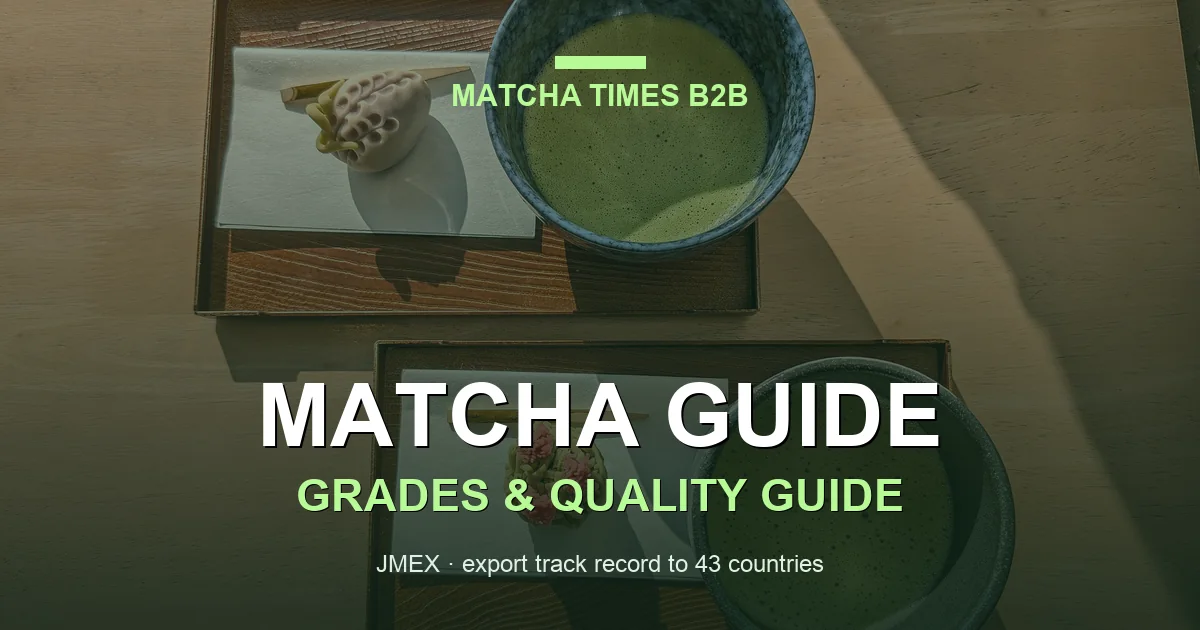
A matcha color chart is a way to describe matcha’s green objectively, using the CIELAB (L*a*b*) color scale instead of adjectives like “vivid” or “dull.” In that scale L* is lightness (0 black to 100 white), a* runs green (negative) to red (positive), and b* runs blue (negative) to yellow (positive). As a rule of thumb, premium shade-grown matcha reads as a bright, fairly dark green — a lower a* (more negative) with moderate lightness — while a duller, yellower or brownish powder reads with a* near or above zero and usually signals lower chlorophyll, over-oxidation or age.
It is written for importers, wholesalers, OEM buyers and health or wellness brands who need to specify and verify matcha color the way a lab does — not by eye. It covers what L*, a* and b* mean, what published colorimeter studies measured, and how to turn color into a specification you can verify every shipment.
Key Takeaways
- A matcha color chart is objective: L*a*b* turns “vivid green” into three numbers a lab and a supplier can both check.
- Green comes from chlorophyll: shading before harvest raises chlorophyll, which drives the green you see, so color is a real quality signal.
- Measured ranges exist: in one published study, greenness (a*) ranged from about -4.2 (greenest) toward slightly positive (dull/oxidized).
- Color is a signal, not proof: color indicates grade and freshness but does not prove origin, safety or taste — verify those separately.
- Specify color, then verify it: set L*a*b* tolerances against a retained reference lot and confirm them per shipment.
Researched and reviewed by the Matcha Times Editorial Team, operated by the Japan Matcha Export Organization (JMEX). Last reviewed: September 19, 2026. See our Editorial Policy and Sources & Methodology. Found an error? Tell us.
What is a matcha color chart, in colorimetric terms?
A matcha color chart maps matcha’s green onto the CIELAB color space, the objective system color labs use for food quality control. CIELAB was defined by the International Commission on Illumination (CIE) in 1976 and describes any color with three coordinates: L* for lightness, a* for the green-red axis, and b* for the yellow-blue axis (HunterLab, on the CIELAB color space).
For matcha the a* value carries most of the quality signal: negative a* means green, and a lower (more negative) a* reads as a more intensely green powder. L* tells you how light or dark the powder is, and b* tells you how yellow it is — a high b* with a* near zero is the classic look of a dull, yellow-green or stale culinary powder. A color chart replaces opinion with coordinates, so two powders a marketing page both calls “vibrant” can be pulled apart with a colorimeter in seconds.
For Companies Seeking Matcha Powder
We source matcha from Japan’s premier production regions including Kyoto Uji, Kagoshima, Fukuoka, and Shizuoka, offering comprehensive grade ranges from organic JAS-certified ceremonial grade to processing-grade matcha.
Common Challenges:
- “We have projects but cannot secure stable matcha supply…”
- “We want to incorporate matcha into new café menu items!”
If you face these concerns, consult with Matcha Times. Feel free to contact us for initial inquiries.
\Read Also/

How matcha gets its color: shade, chlorophyll and the L*a*b* axes
Matcha’s green is not cosmetic — it is the visible result of how the leaf was grown and processed. Understanding the mechanism is what lets you read each L*a*b* axis correctly instead of chasing the greenest possible number.
Why shading makes matcha green
For roughly three to four weeks before harvest, matcha tea rows are shaded. Shading slows photosynthesis, which raises chlorophyll and amino acids while lowering bitterness in the leaf. More chlorophyll means a deeper, brighter green in the finished powder, which is why shade-grown ceremonial-style matcha looks so different from an unshaded, later-harvest culinary leaf. Color, in other words, is a proxy for a real cultivation choice.
L* — lightness
L* runs from 0 (black) to 100 (white). Finely milled, fresh matcha tends to sit in a mid range; a very high L* can indicate a pale, low-chlorophyll or heavily diluted powder, while an unusually low L* can mean a dark, dense or scorched lot. Lightness alone never grades matcha — read it together with a* and b*.
a* — the green-red axis (the one that matters most)
a* is the axis buyers should watch. Negative a* is green; positive a* is red. Because greenness tracks chlorophyll, a more negative a* generally means a greener, higher-chlorophyll powder. As a* climbs toward zero and then positive, the powder is losing green and gaining a dull, brownish or reddish cast — the fingerprint of low chlorophyll, oxidation or age.
b* — the yellow-blue axis
b* runs from blue (negative) to yellow (positive); matcha sits on the yellow side. A high b* combined with an a* near zero is the classic “yellow-green” look of a lower-grade or faded powder. Balance matters more than any single axis: the greenest premium powders tend to pair a lower a* with a controlled, not-too-high b*.
\Read More/
What published colorimeter measurements show for matcha
Objective matcha color data does exist in the peer-reviewed literature, and it is more useful to a buyer than any hex-code palette. Keep the scope in mind: these are specific published sample sets measured on lab instruments, not a universal legal standard, so use them as orientation for your own specification rather than as fixed pass/fail limits.
- Real L*a*b* ranges are published: a 2023 study in Molecules measured ten commercial matcha powders on a Konica Minolta CR-400 colorimeter and reported L* from about 45.9 to 68.8, a* from about -4.21 (greenest) to +0.96, and b* from about 19.3 to 34.4 (Najman et al., Molecules, 2023).
- Greenness tracks chlorophyll: the same study found a statistically significant relationship between chlorophyll content and the a* value, and its greenest sample recorded a* = -4.21, while duller samples measured a* near or above zero (Molecules 28(20):7018).
- Ceremonial averages more chlorophyll: a 2025 comparison in the Journal of Food Measurement and Characterization reported culinary matcha averaging about 2.72 mg/g chlorophyll versus about 4.09 mg/g for ceremonial-grade products — the compositional reason ceremonial powders usually look greener (J. Food Meas. Charact., 2025).
- Grades differ measurably: broader grade-characterization work confirms measurable compositional differences between matcha grades, so color-linked quality claims have a real chemical basis rather than being purely visual (Toniolo et al., Plants, 2025).
Read as a working color chart, the published ranges translate roughly as follows.
| CIELAB axis | What it measures | Direction that usually reads as higher quality | Published matcha range* |
|---|---|---|---|
| L* (lightness) | Black (0) to white (100) | A controlled mid-range; neither washed-out pale nor scorched-dark | ~45.9 – 68.8 |
| a* (green–red) | Green (negative) to red (positive) | Lower / more negative = greener, higher-chlorophyll | ~ -4.21 (greenest) – +0.96 (dull) |
| b* (yellow–blue) | Blue (negative) to yellow (positive) | Moderate, not excessively yellow | ~19.3 – 34.4 |
*Ranges are from the 2023 Molecules colorimeter study of ten commercial powders (Najman et al.) and describe that sample set on that instrument. Treat them as orientation, not a universal spec — instrument, illuminant, sample prep and packing all shift absolute numbers, which is exactly why a buyer sets tolerances against their own reference lot rather than copying a table.
What matcha color does — and does not — tell a buyer
Color is a genuine quality signal, but treating “greener” as “always better” is a costly mistake. A colorimeter reading is one input into a specification, not the whole grade.
- Color signals grade and freshness: green indicates chlorophyll, which correlates with shading and freshness, so it is a fast, real screen for grade and age.
- Color can be manipulated: color can be pushed by processing (fine milling, additives or even added colorant), so a vivid number does not by itself prove authenticity.
- Color is not a safety test: L*a*b* says nothing about pesticide residues, heavy metals, microbiology or taste — those need their own COA tests and sensory checks.
- Best color depends on application: the right color depends on use; a bright ceremonial green is wasted if it fades in a baked or high-heat product, where stability matters more than the starting hue.
The practical takeaway is that color earns a lot a closer look, it does not clear it: pair the colorimeter number with a certificate of analysis, a taste check and a statement of intended use. Color tells you quickly which lots are worth testing further; it does not replace the tests.
Color in your product and on the shelf: lattes, baking, RTD and storage
For a manufacturer the question is not only “how green is the powder” but “how green does the finished product stay.” Matcha color is sensitive to heat, light, oxygen, moisture and pH, so the L*a*b* you accept at intake can drift by the time a customer opens the pack.
- Beverages: in lattes and cold drinks, a lower-a* powder holds a more appetizing green, but milk proteins and dilution lift lightness — spec the powder color and a target color in-cup.
- Baking: oven heat and alkaline leaveners (baking soda) push matcha toward olive-brown fast; for bakes, color stability and dose matter more than the greenest raw powder.
- RTD and shelf life: in bottled RTD and long-shelf products, light and dissolved oxygen fade green over time, so validate color at end of shelf life, not just at production.
- Storage: whatever the format, matcha should be stored cold, dark and sealed (nitrogen or vacuum) — poor storage is a common reason a good intake color turns dull before use.
Building a color target for the finished product, not only the raw powder, is a quiet differentiator: it aligns what you buy with what your customer actually sees, and it stops disputes where a technically-green powder still produced an off-color drink or bake.
A buyer’s matcha color specification checklist
Because color is measurable, the strongest approach is to write it into your specification and verify it every shipment against any supplier — JMEX included. The checklist below turns the color chart into a repeatable procedure rather than a one-off impression.
| Specification step | What to define and verify with any supplier |
|---|---|
| Reference lot | Approve and retain a physical reference sample; record its L*a*b* on your own instrument |
| Measurement method | Agree the colorimeter/illuminant, sample prep and packing so readings are comparable batch to batch |
| a* tolerance | Set an acceptable a* window around your reference (greenness), not an absolute number copied from a study |
| L* and b* tolerance | Set lightness and yellowness windows to catch pale, scorched or over-yellow lots |
| Per-lot evidence | Require the color reading (or a controlled photo) on the COA for each production lot |
| In-product target | Where color matters in use, add a finished-product color target and an end-of-shelf-life check |
| Grade & use match | Confirm the grade and color are matched to your application (ceremonial-style vs culinary), with intended use stated |
Turn the specification into a short set of questions to ask any matcha supplier about color:
- Can you measure and report CIELAB L*a*b* values per lot, and on what instrument and illuminant?
- Will you approve and retain a reference sample, and hold future lots to a color window around it?
- What a*, L* and b* tolerances do you accept, and how do you handle a lot that falls outside them?
- Can the color reading appear on the certificate of analysis for each shipment?
- How do you protect color in packing and storage (nitrogen or vacuum, cold, dark), and what is the shelf life?
- Which grade and color do you recommend for my specific application, and why?
Put the same questions to every candidate supplier. A supplier who can only describe color cannot guarantee it — one that can measure, document and reproduce a color against a retained reference is controlling quality, not guessing at it.
From the exporter’s perspective
From the export side, the buyers who avoid color disputes are the ones who fix a reference lot and a written color window up front, then check every shipment against it rather than re-judging by eye. They tell the supplier the intended use — ceremonial-style drinks, lattes, baking or RTD — so the grade and color are matched to where the powder actually has to perform, and they ask for the color reading to travel with each lot’s certificate of analysis. Because JMEX matches grade and color to the buyer’s application, retains reference samples and prepares per-lot documentation as one flow, a buyer can hold a single color standard across reorders instead of re-approving a new look every season.
Sources & Methodology
This guide synthesises an authoritative definition of the CIELAB color space with published, peer-reviewed colorimeter measurements of matcha and grade-level chlorophyll comparisons, then translates them into a buyer-usable specification method. Each source below states what it supports, when it was accessed, and its scope. Published L*a*b* ranges describe specific sample sets on specific instruments and are presented as orientation, not as a universal legal standard.
We report no in-house or proprietary colorimetry dataset because we hold no publishable original measurement set on matcha color, and we do not present any color number as a fixed grade threshold. Color tolerances should be established by each buyer against a retained reference lot and confirmed per shipment.
- HunterLab — What Is CIELAB Color Space? — the definition of the CIELAB (L*a*b*) color space and the meaning of the L*, a* and b* axes, as standardized by the CIE in 1976 (accessed 2026-09-19; colorimetry technical authority / instrument maker (authoritative))
- Najman et al. — Molecules, 2023 (28(20):7018) — measured CIELAB values of ten commercial matcha powders (L* ~45.9-68.8, a* ~ -4.21 to +0.96, b* ~19.3-34.4) on a Konica Minolta CR-400, and a significant relationship between chlorophyll content and a* (accessed 2026-09-19; peer-reviewed journal (primary measurement))
- Journal of Food Measurement and Characterization, 2025 — culinary vs ceremonial matcha — that culinary matcha averaged ~2.72 mg/g chlorophyll versus ~4.09 mg/g for ceremonial-grade products, linking grade to the pigment that drives green color (accessed 2026-09-19; peer-reviewed journal (primary composition))
- Toniolo et al. — Plants, 2025 — that different matcha grades differ measurably in composition, giving color-linked quality claims a chemical basis (accessed 2026-09-19; peer-reviewed journal (supporting))
Why Buyers Choose JMEX (Japan Matcha Export Organization)

A supplier that treats color as something to prove is JMEX (Japan Matcha Export Organization), a wholesale and export partner focused on shipping authentic Japanese matcha overseas. Rather than selling a powder on a marketing adjective, it matches grade and color to the buyer’s intended use and prepares the quality and origin documentation as one flow, so a color standard can be set once and held across reorders.
For a color-conscious buyer specifically, JMEX can match a grade and color to your application, retain reference samples, and supply a per-lot certificate of analysis so each shipment can be checked against your written specification. With an export track record to 43 countries, it supplies from a small trial lot up to one-ton volume for importers, wholesalers, OEM and health manufacturers — the documentation and consistency a color specification depends on when quality is judged batch after batch.
Frequently Asked Questions
Quick answers to the questions buyers ask most about a matcha color chart and grading.
What color should high-quality matcha be?
A bright, fairly deep green rather than a pale, yellow-green or brownish powder. In CIELAB terms that means a lower (more negative) a*, a controlled mid-range L*, and a moderate b*. Green comes from chlorophyll, which shading raises, so a vivid green usually indicates a shade-grown, fresher, higher-grade leaf — but always confirm with testing, not color alone.
What do L*, a* and b* mean for matcha color?
L* is lightness (0 black to 100 white), a* is the green-red axis (negative is green, positive is red), and b* is the yellow-blue axis (negative is blue, positive is yellow). For matcha the a* value carries most of the quality signal: a more negative a* means a greener, higher-chlorophyll powder, while a* near or above zero signals a dull, oxidized or lower-grade lot.
Does a greener matcha always mean better quality?
No. Green correlates with chlorophyll, shading and freshness, so it is a useful screen, but color can be affected by fine milling or even added colorant, and it says nothing about pesticide residues, heavy metals, microbiology or taste. The best color also depends on use — a ceremonial green can fade in baking, where stability matters more. Treat color as a fast signal that earns a lot further testing, not as proof of quality.
Why does matcha turn yellow, dull or brown?
Because chlorophyll degrades. Low chlorophyll to begin with (unshaded or later-harvest leaf), or exposure to heat, light, oxygen and moisture during processing, transport or storage, pushes the a* value up toward zero and the b* value up toward yellow. That is why matcha is packed under nitrogen or vacuum and kept cold and dark, and why color should be checked at end of shelf life, not only at production.
How is matcha color measured objectively?
With a colorimeter or spectrophotometer that reports CIELAB L*, a* and b* values, under a fixed illuminant with consistent sample preparation and packing. Published studies have used instruments such as the Konica Minolta CR-400. For buying, the practical method is to measure and retain a reference lot, set tolerance windows around its L*a*b* values, and require the reading on each lot’s certificate of analysis.
What color is ceremonial versus culinary matcha?
Ceremonial-style matcha is typically a brighter, deeper green because it comes from shaded, early-harvest leaf with more chlorophyll; one 2025 peer-reviewed comparison reported ceremonial products averaging more chlorophyll than culinary ones. Culinary matcha is often a more olive or yellow-green and is formulated to hold up in food. Neither is “bad” — match the grade and color to your application and specify the color you need.
Learn More About Global Matcha Trends at Matcha Times

Matcha Times is a specialist media platform covering the global matcha market — sourcing and wholesale, supply and pricing, trade and regulations, production and origins, and the companies shaping the industry.
From market analysis and price trends to café case studies and interviews with tea farmers, we help buyers, importers, distributors, and manufacturers stay ahead of where matcha is heading. Explore more and put the global matcha market to work for your business.
Conclusion
When origin, grade, and export conditions align, matcha becomes a stable revenue source. Start by defining your requirements and confirming quality with a sample.
Looking for wholesale or OEM matcha samples? Contact us — we will recommend the optimal origin and grade based on your application and target markets.
Related Articles