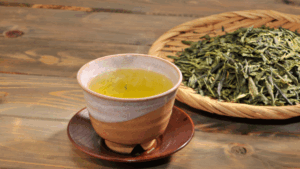
Matcha Flavor Degradation: Storage Time, Oxygen, Light & Temperature Effects
Matcha flavor degradation is the loss of umami, fresh aroma and vivid green that happens when the powder reacts with oxygen, light, heat, moisture and time. The direct answer for a buyer is that this is chemistry, not spoilage: light and heat break chlorophyll down toward brown pheophytin (the colour dulls), and oxygen drives the catechins that give matcha its character to oxidise, epimerise and polymerise (umami fades, astringency and bitterness rise). Temperature is the master lever because these reactions speed up as it climbs, so the same lot ages far faster in a warm warehouse than under cold chain.
This guide separates the four drivers, grounds each in peer-reviewed kinetics, shows how the changes hit your finished product, and gives a reproducible storage-stability test you can run on arrival. It quotes no shelf-life figure as fact — condition, packaging and grade decide the real timeline — so verify every incoming lot against a retained fresh reference.
For Companies Seeking Matcha Powder
We prepare and hold each matcha lot for stability — cold chain, low-oxygen bulk packaging and a per-lot COA — so the colour, aroma and umami you sample are what arrives, and so a ΔE and sensory re-check on receipt confirms it.
Common Challenges:
- “We have projects but cannot secure stable matcha supply…”
- “We want to incorporate matcha into new café menu items!”
If you face these concerns, consult with Matcha Times. Feel free to contact us for initial inquiries.
\Read Also/
Key Takeaways
- Five variables control it: oxygen, light, temperature, moisture and time. Oxygen and heat do the most damage; controlling them preserves colour and taste.
- Colour and taste degrade by different reactions. Chlorophyll converts to brown pheophytin (colour), while catechins oxidise, epimerise and polymerise (taste).
- Temperature dominates the rate. Catechin loss in green-tea powder follows first-order, Arrhenius kinetics with temperature the leading factor (Wang et al., 2011) — cold storage slows every reaction at once.
- Oxygen outweighs light for catechins. EGCG auto-oxidises in air; oxygen had a more pronounced effect on EGCG stability than sunlight in controlled tests (Zhu et al., 2018).
- Verify, don’t assume. Run a timed sensory + colour-difference (ΔE) check against a fresh reference lot rather than trusting a printed shelf-life alone.
\Read More/
What “Flavor Degradation” Means in Matcha
“Degradation” here is not microbial spoilage — dry matcha has too little water for that. It is a set of chemical reactions in the leaf compounds themselves. Three families of molecules carry matcha’s quality, and each fails in its own way. Understanding which reaction you are seeing tells you which storage variable failed.
Colour: chlorophyll turning to pheophytin
The jade-green of shade-grown matcha comes from chlorophyll a and b, which are abundant in matcha relative to other teas (HPLC-MS² analysis of green-tea chlorophylls). Chlorophyll is fragile: light, heat and oxygen strip the central magnesium atom and convert it to olive-brown pheophytin and related derivatives. That is why a dulling, yellow-brown shift is the first visible sign of a badly stored lot — the pigment chemistry has moved before most buyers taste a problem.
Taste: catechin oxidation, epimerization and polymerization
Matcha’s savoury-astringent balance rests on catechins (notably EGCG). In storage they oxidise, epimerise and polymerise — the same reaction families reviewed for green-tea catechins across processing and storage (Ananingsih et al., 2013). Oxidation and polymerisation build coloured, astringent products (the pathway that turns green tea toward black-tea character), while epimerisation interconverts catechin forms; below roughly 44 °C degradation tends to dominate and at higher temperatures epimerisation becomes relatively faster (Wang et al., 2008). The sensory result is less umami and sweetness and more flat bitterness.
Aroma: loss of fresh volatiles
The bright, grassy top notes of fresh matcha come from volatile aroma compounds that are, by nature, easily lost. Air exchange and warmth drive them off first, which is why a lot can still look acceptable yet smell flat. Aroma is therefore an early-warning sense: if the fresh-green nose is gone, the chemistry is already moving even when colour lags behind.
| What you notice | Underlying chemistry | Main drivers |
|---|---|---|
| Dull, olive/yellow-brown colour | Chlorophyll → pheophytin (loss of Mg) | Light, heat, oxygen |
| Umami & sweetness fade | Catechin oxidation / polymerisation | Oxygen, heat, moisture |
| Rising flat bitterness / astringency | Oxidised & polymerised catechin products | Oxygen, heat, time |
| Grassy top notes disappear | Loss of volatile aroma compounds | Air exchange, heat |
| Clumping / caking | Moisture uptake by the powder | Humidity, condensation |
Storage Time: How the Timeline Actually Works
Time is not itself a cause — it is the axis the other reactions run along. What matters is the condition the clock runs under. A sealed, cold, low-oxygen, opaque pack ages slowly; an opened tin on a warm shelf ages quickly. Two practical rules follow. First, the clock speeds up once a pack is opened, because headspace air and repeated exposure are introduced. Second, because degradation is continuous rather than a cliff-edge, a printed “best-by” date is a guide, not a guarantee — actual condition depends on how the lot was handled. Treat elapsed time as a prompt to re-verify against a fresh reference, not as proof of quality on its own.
Oxygen: The Primary Chemical Threat
Oxygen is the driver most worth engineering out. Catechins such as EGCG auto-oxidise on contact with air, and in controlled tests oxygen had a more pronounced effect on EGCG stability than sunlight, with samples kept from both air and light staying most stable (Zhu et al., 2018). For matcha this means the headspace inside a container — and the air pulled in every time it is opened — is doing quiet damage. Practical controls: minimise headspace, use nitrogen-flushed or low-oxygen packaging for bulk, reseal fast, and decant working quantities so the main lot is opened as little as possible.
Light: Photodegradation of Pigments and Catechins
Light — sunlight and, over time, warehouse and display lighting — accelerates the breakdown of both chlorophyll and catechins. It is a secondary driver next to oxygen for taste, but it is a primary driver for colour, and colour is the quality signal buyers and their customers judge first. The fix is simple and cheap: store and display matcha in opaque, light-blocking packaging and keep bulk stock in the dark. Clear jars on a lit shelf are convenient for merchandising but hostile to the pigment you are selling.
Temperature: The Master Rate Lever
Temperature deserves top billing because it governs the speed of every reaction above at once. In green-tea powder, catechin degradation follows first-order kinetics whose rate constants fit the Arrhenius equation, and across tested conditions (25–60 °C; 43–97% relative humidity) temperature was the dominant factor over humidity (Wang et al., 2011). As a general chemical-kinetics rule of thumb, reaction rates rise roughly two- to three-fold for every 10 °C increase (a Q₁₀ of about 2–3) — a heuristic, not a matcha-specific measurement, but it explains why a cold chain buys so much stability. Keep bulk matcha cold and stable; avoid warm, fluctuating storage.
One caution with cold storage: condensation. Moving a cold, sealed pack straight into warm air lets water condense on the powder, and moisture then feeds clumping and further reactions. Let a sealed container reach room temperature before opening, and keep relative humidity low wherever the pack is opened.
How Degradation Affects Your Finished Product
Why this matters commercially: the degradation you cannot see in the tin becomes the defect your customer sees in the cup or the bake. The impact differs by application, so the tolerance you set should match how the matcha is used.
- Lattes & ready-to-drink: colour is the product. A lot whose chlorophyll has shifted looks grey-brown in milk and reads as “cheap” regardless of taste.
- Baking & confectionery: oven heat already pushes chlorophyll toward brown, so starting from an already-degraded lot leaves little green in the finished item.
- Protein & functional blends: oxidised catechins taste flatter and more bitter, and the antioxidant story that sells the blend weakens as catechins break down.
- Culinary vs ceremonial grades age differently — set acceptance criteria per grade and per use, not one blanket rule.
A Reproducible Storage-Stability Test (0/7/14/30/60 Days)
Here is the export-side method we recommend buyers adopt, and the concrete gap most storage articles leave open: instead of trusting a printed date, measure degradation on a timeline. Hold samples of a lot under your real storage conditions and evaluate at day 0, 7, 14, 30 and 60 on two axes — a short sensory panel (colour, aroma, umami, bitterness) and an instrument colour-difference (ΔE) reading against the day-0 reference. This is a framework to run on your own material; the cells below are left for your measured results, not pre-filled numbers.
| Checkpoint | Sensory (colour / aroma / umami / bitterness) | ΔE vs day 0 | Decision |
|---|---|---|---|
| Day 0 (reference) | Baseline — describe the fresh lot | 0 (reference) | Set as reference |
| Day 7 | Record | Measure | Accept / watch |
| Day 14 | Record | Measure | Accept / watch |
| Day 30 | Record | Measure | Accept / re-grade |
| Day 60 | Record | Measure | Accept / re-grade / reject |
On reading the numbers: ΔE (CIE Lab colour difference) grows as the powder browns, and a value near 1 is a commonly cited just-noticeable-difference benchmark in colorimetry — set your own accept/reject threshold against a fresh reference and your customers’ tolerance. Pair every ΔE reading with the sensory notes: colour and taste degrade by different reactions, so neither axis alone tells the whole story.
Storage & Handling Checklist for B2B Buyers
Use these criteria to evaluate any matcha supplier or 3PL — including how you hold stock yourself — so freshness is provable rather than assumed:
| Criterion | What to verify with any supplier / 3PL |
|---|---|
| Oxygen control | Nitrogen-flushed or low-oxygen bulk packaging; minimal headspace; fast reseal after sampling |
| Light protection | Opaque, light-blocking packaging and dark bulk storage — no clear jars under lighting |
| Temperature & cold chain | Cold, stable storage; documented temperature during transit and warehousing; no warm fluctuation |
| Moisture / condensation | Low-humidity handling; sealed packs equilibrated to room temperature before opening |
| Per-lot COA | Lot-specific quality data so incoming material can be matched to spec on arrival |
| Fresh reference & ΔE | A retained day-0 reference and a colour-difference + sensory re-check on receipt and over time |
| Traceability | Lot numbers traceable to harvest and handling for any quality query |
Questions to ask before you commit to a lot:
- “How is bulk matcha packed for oxygen and light — nitrogen flush, opaque packaging, headspace?”
- “What temperature is the material held at in storage and in transit, and is it documented?”
- “Will you provide a per-lot COA I can match against the goods on arrival?”
- “Can you retain or supply a day-0 reference so I can run a ΔE and sensory check over time?”
- “How is each lot traceable back to harvest and handling if I see early browning?”
Sources & Methodology
This guide synthesises peer-reviewed food-chemistry research on catechin and chlorophyll stability and applies it to B2B matcha handling. It makes no first-party statistical claim and quotes no shelf-life, price or MOQ figure as fact; the “every 10 °C” statement is labelled a general kinetics rule of thumb, and the storage-stability table is an empty protocol for the reader’s own measurements. Because degradation depends on grade, packaging and real conditions, verify each lot against a fresh reference rather than relying on a printed date.
- Wang, Zhou & Jiang — Degradation Kinetics of Catechins in Green Tea Powder — catechin degradation in green-tea powder follows first-order, Arrhenius kinetics with temperature dominant over humidity (25–60 °C, 43–97% RH); J. Agric. Food Chem., 2011 (accessed 2026-09-18; green-tea powder scope)
- Zhu et al. — Effect of Ultrasound, Oxygen and Sunlight on EGCG Stability — oxygen had a more pronounced effect than sunlight on EGCG stability; EGCG auto-oxidises in air; Molecules, 2018 (accessed 2026-09-18; EGCG stability scope)
- Ananingsih et al. — Green Tea Catechins during Food Processing and Storage — review of green-tea catechin oxidation, epimerization and polymerization during processing and storage; Trends in Food Science & Technology, 2013 (accessed 2026-09-18; review scope)
- Wang et al. — Reaction Kinetics of Degradation and Epimerization of EGCG — EGCG degradation vs epimerization across a wide temperature range (degradation dominates below ~44 °C); J. Agric. Food Chem., 2008 (accessed 2026-09-18; EGCG kinetics scope)
- HPLC-MS² Analysis of Chlorophylls in Green Teas — chlorophyll a/b content and profile in green teas by HPLC-MS² (accessed 2026-09-18; green-tea pigment scope)
Researched and reviewed by the Matcha Times Editorial Team, operated by the Japan Matcha Export Organization (JMEX). Last reviewed: 2026-09-18. See our Editorial Policy and Sources & Methodology. Found an error? Tell us.
Why Buyers Choose JMEX (Japan Matcha Export Organization)

On the export side, JMEX manages the variables this article is about: origin selection and grade design, cold-chain handling, low-oxygen bulk packaging and a per-lot COA, so a lot reaches you with its freshness intact. With an export track record to 43 countries, we bridge origin and buyer so quality is preserved from tencha to your warehouse.
For matcha flavour stability this means one export partner controls oxygen, light, temperature and moisture through shipping, documents each lot, and supplies a fresh reference you can run a colour-difference and sensory check against — verified per lot, never assumed.
Frequently Asked Questions
Short, direct answers to the questions B2B matcha buyers ask most about degradation and storage.
Does matcha go bad or expire?
Dry matcha does not usually spoil microbially — it has too little moisture for that. Instead it degrades chemically: chlorophyll converts toward brown pheophytin (the colour dulls) and catechins oxidise and polymerise (umami fades, bitterness rises). So matcha becomes progressively worse rather than suddenly “bad”, and a printed date is a guide, not a guarantee. Judge condition by colour, aroma and taste against a fresh reference, not the calendar alone.
Why does matcha lose its bright green colour?
Because chlorophyll, the pigment behind matcha’s jade colour, is broken down by light, heat and oxygen and converted to olive-brown pheophytin. Matcha is chlorophyll-rich relative to other teas, so the shift is very visible. A dulling, yellow-brown colour is typically the first sign of a poorly stored lot, often appearing before the taste change is obvious.
Does matcha oxidise, and what causes it?
Yes. Its catechins (notably EGCG) auto-oxidise on contact with air, and in controlled studies oxygen affected EGCG stability more than sunlight did. Oxidation and polymerisation of catechins build coloured, astringent compounds and flatten umami. This is why minimising oxygen — low headspace, nitrogen-flushed or low-oxygen packaging, and fast resealing — is the single most effective control.
Does temperature really change how fast matcha degrades?
Strongly. Catechin degradation in green-tea powder follows first-order, Arrhenius kinetics, and temperature was the dominant factor over humidity in controlled tests. As a general rule of thumb, reaction rates rise roughly two- to three-fold for every 10 °C, so cold, stable storage slows every degradation reaction at once. Warm, fluctuating storage does the opposite.
What is the best way to store matcha to keep it fresh?
Control all five variables: keep it cold and at a stable temperature, sealed with minimal oxygen (nitrogen flush for bulk), in opaque light-blocking packaging, at low humidity, and opened as little as possible. Let a cold sealed pack reach room temperature before opening to avoid condensation. For bulk stock, decant working quantities so the main lot stays sealed.
How can I tell if a lot of matcha has degraded?
Check three senses against a fresh reference: colour (dull or brown-shifted rather than vivid green), aroma (flat instead of fresh-grassy), and taste (weaker umami, more flat bitterness). For an objective record, add a colour-difference (ΔE) reading against a retained day-0 sample and a short sensory score, repeated over a storage timeline. That combination catches degradation earlier and more consistently than eyeballing a tin.
Learn More About Global Matcha Trends at Matcha Times

Matcha Times is a specialist media platform covering the global matcha market — sourcing and wholesale, supply and pricing, trade and regulations, production and origins, and the companies shaping the industry.
From market analysis and price trends to café case studies and interviews with tea farmers, we help buyers, importers, distributors, and manufacturers stay ahead of where matcha is heading. Explore more and put the global matcha market to work for your business.
Conclusion
When origin, grade, and export conditions align, matcha becomes a stable revenue source. Start by defining your requirements and confirming quality with a sample.
Looking for wholesale or OEM matcha samples? Contact us — we will recommend the optimal origin and grade based on your application and target markets.
Related Articles