Common Matcha Quality Complaints: Color, Flavor, Clumping, Sediment & How B2B Buyers Should Respond
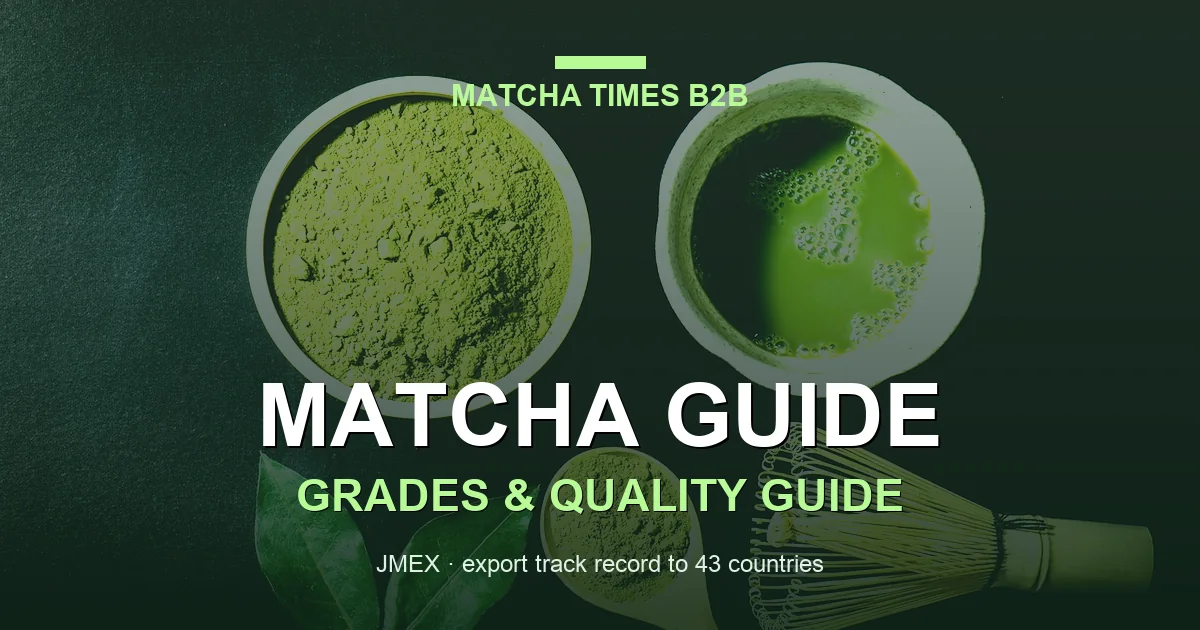
Most matcha quality complaints — a dull or brownish colour, harsh bitterness, powder that clumps, or grit that settles in the cup — are diagnosable, and for a B2B buyer the first job is to work out whether the problem is the product or the way it was handled. A genuine product fault points to grade, freshness, milling, or storage on the supply side; the same symptom can also come from over-hot water, no sifting, or humid storage after opening.
It is written for importers, wholesalers, OEM and private-label brands, and beverage or wellness makers who field these complaints at scale. It sets out what each complaint signals, a symptom → likely cause → what to verify → action diagnostic table, and the specification a buyer should confirm with any supplier so the same complaint does not recur.
Key Takeaways
- Diagnose before you refund. Colour, bitterness, clumping and sediment each have a supply-side and a handling-side cause; deciding which one you are looking at is the whole game.
- Colour is a freshness proxy. A vivid jade fades to olive-brown as chlorophyll converts to pheophytin under light, heat and oxygen — a documented marker of degraded, poorly stored, or old tea.
- Bitterness and grade are linked, not identical. Lower grades carry more catechins and fewer amino acids, but over-hot water and over-dosing turn even good matcha harsh.
- Clumping and sediment are physics, then quality. Ultra-fine, hygroscopic powder clumps and needs sifting; persistent grit and heavy sediment point to coarse or uneven milling.
- Prevent recurrence with a spec. Fix grade, colour target, particle fineness, packaging and a lot-specific COA with the supplier so the next shipment is verifiable, not hopeful.
For Companies Seeking Matcha Powder
We help buyers prevent and diagnose matcha quality complaints — matching grade, colour and particle spec to your product and documenting it with a lot-specific COA and export paperwork as one flow.
Common Challenges:
- “We have projects but cannot secure stable matcha supply…”
- “We want to incorporate matcha into new café menu items!”
If you face these concerns, consult with Matcha Times. Feel free to contact us for initial inquiries.
\Read Also/
The four most common matcha quality complaints and what each one signals
Almost every complaint that reaches a wholesale buyer falls into one of four buckets. Before assigning blame, it helps to read each symptom for what it most often means — while remembering that the same symptom can have a supply-side or a handling-side cause.
| Complaint | What the customer sees or tastes | What it most often signals |
|---|---|---|
| Dull / brown colour | Olive, khaki, or yellow-green instead of a vivid jade green | Chlorophyll degradation from age, heat, light or oxygen — or a lower grade from later, less-shaded leaf |
| Bitter / harsh flavour | Aggressive astringency and bitterness, little sweetness or umami | Higher-catechin lower grade, over-hot water, over-dosing, or oxidised/stale powder |
| Clumping | Lumps that resist the whisk and leave pockets of dry powder | Normal behaviour of ultra-fine, moisture-absorbing powder without sifting — or moisture ingress in storage |
| Sediment / grit | Powder that falls out of suspension, a gritty or sandy mouthfeel, separation on top | Coarse or uneven particle size, or simply an unwhisked, unsifted preparation |
The pattern is the same in every row: a complaint is a starting point, not a verdict. The value a B2B buyer adds is turning “the matcha is bad” into a specific, testable hypothesis that can be confirmed against the lot, the storage history, and the preparation method.
\Read More/
What actually causes dull colour, bitterness, clumping and sediment
To diagnose a complaint you need the mechanism behind it. Each of the four has a well-understood cause that is documented in peer-reviewed work, which is what lets you separate a real defect from a preparation issue rather than guess.
- Colour: chlorophyll converts to pheophytin. Matcha’s vivid green comes from chlorophyll built up by shading the plants. A study in Molecules (2018) describes how chlorophyll is unstable under light, heat and oxygen and decomposes into pheophytin, turning green tea olive-brown, and notes the chlorophyll-to-pheophytin ratio as a marker of colour and shelf life. A dull tin is therefore usually old, heat- or light-exposed, or oxidised — not “a bad batch” by default.
- Bitterness: the catechin-to-amino-acid balance. Research on matcha grades in Plants (Basel, 2025) found amino acids (including theanine, which reads as sweetness and umami) decline from ceremonial toward culinary grade while catechins — behind astringency and bitterness — increase. Grade shifts the baseline, but hot water and heavy dosing extract still more bitterness, so flavour complaints are frequently a handling issue on an otherwise sound product.
- Clumping: fine, hygroscopic powder. Matcha is milled extremely fine, and fine powder both holds static and readily absorbs moisture from humid air, so it naturally forms lumps unless it is sifted and whisked into a paste first. Persistent clumping in sealed, in-date stock, however, points to moisture ingress or poor packaging rather than user error.
- Sediment and grit: particle size. A Frontiers in Nutrition (2023) analysis reported matcha particle size typically controlled around 10 micrometres, within a national-standard ceiling of 18 micrometres, with finer, more even milling associated with better quality. Coarse or uneven particles fall out of suspension and feel gritty, so heavy, recurring sediment is a genuine milling and specification signal.
Read together, these mechanisms give a simple rule: colour and sediment lean toward supply-side quality, while bitterness and clumping are often preparation or storage — but each needs to be confirmed, which is what the next section is for.
Matcha complaint diagnosis: symptom, likely cause, what to verify, action
This is the tool the consumer-facing guides leave out. For each complaint, the table separates the likely product cause from the likely handling cause, tells you what to check to confirm which one you have, and gives the action — on the supplier side or the customer side — that resolves it and stops it recurring.
| Symptom | Likely cause (product vs handling) | What to verify | Action |
|---|---|---|---|
| Dull / brown colour | Product: old, oxidised, or lower grade. Handling: light/heat exposure or an opened tin left too long | Harvest year and lot on the COA; open date and storage at the customer; colour of a fresh sealed retain sample | If the retain is also dull, treat as a supply/freshness defect and request a fresh lot; if only opened stock is dull, fix storage and rotation |
| Bitter / harsh flavour | Product: high-catechin lower grade or oxidised stock. Handling: water too hot, too much powder | Grade and amino/catechin profile on the spec; brewing temperature and dose used; taste of a correctly prepared control cup | If a correctly brewed control tastes clean, retrain preparation; if it is still harsh, review grade selection with the supplier |
| Clumping | Product: moisture ingress or weak packaging. Handling: no sifting, powder added straight to a full cup | Seal integrity and packaging type; storage humidity; whether staff sift and paste-first | If sealed in-date stock clumps hard, raise packaging with the supplier; otherwise standardise sifting and a paste-first method |
| Sediment / grit | Product: coarse or uneven particle size. Handling: under-whisked or unsifted | Particle-size spec on the COA; consistency of a properly whisked control; mouthfeel across multiple lots | If grit persists in a well-prepared control across lots, treat as a milling/spec defect; otherwise correct preparation |
Used this way, a complaint stops being an argument about blame and becomes a short checklist that ends in a decision: correct the preparation, fix the storage, or go back to the supplier with a documented, specification-level request.
What a quality complaint really costs a B2B buyer
For a business the stakes are not one disappointing cup. Unmanaged complaints erode margin and brand in ways that a diagnostic-first approach directly protects against.
- Returns and waste. A colour or flavour defect on a large lot can mean refunds, replacements, and written-off stock — a direct hit that is avoidable when defects are caught against a spec on arrival.
- Menu and product inconsistency. If colour or flavour drifts lot to lot, a signature latte or a packaged product stops being repeatable, which is the one thing multi-store and manufacturing buyers cannot tolerate.
- Brand and review risk. Visible defects — a brown latte, gritty sediment — show up in customer photos and reviews, so a quiet supply problem becomes a public brand problem.
- Wasted staff time. Every unresolved complaint consumes counter and management time; a standard diagnosis turns a recurring dispute into a two-minute check.
The through-line is that prevention is cheaper than remediation: specifying and verifying quality up front costs far less than absorbing returns and reputational damage after a shipment has already reached customers.
What to verify with your supplier after a matcha quality complaint
When a complaint points to the product, treat it as a set of documented requests rather than a dispute. The checklist below works for any supplier — a farm, a manufacturer, or an export organisation, including JMEX — and turns a subjective “bad matcha” into verifiable specification points. Japan’s organic and labelling framework is set out by MAFF’s Japanese Agricultural Standards (JAS), a useful reference when you ask for documentation.
| Criterion | What to verify with any supplier |
|---|---|
| Grade & harvest year | The stated grade and crop year on the specification and COA, since both drive colour, sweetness and bitterness |
| Colour target | A defined colour target for your product, plus a fresh sealed retain sample you can compare a complaint lot against |
| Particle-size spec | The particle fineness on the COA, since coarse or uneven milling drives grit and sediment |
| Lot-specific COA | A Certificate of Analysis for your batch covering pesticide residues, heavy metals and microbiology, tied to a lot number |
| Packaging & freshness protection | How the powder is protected from oxygen, moisture and light (for example nitrogen-flushed, sealed, opaque packaging) to slow colour and flavour loss |
| Batch consistency | How the supplier keeps colour, flavour and particle size stable across batches, and how a variable crop year is handled |
| Storage & handling guidance | Recommended storage, shelf life after opening, and preparation guidance you can pass to staff to rule out handling causes |
If a supplier cannot answer these in writing, a quality claim cannot be resolved objectively. Documentation is what turns a complaint into a specification you can hold every future shipment to.
Why Buyers Choose JMEX (Japan Matcha Export Organization)

Applied to complaint handling, JMEX works as the export-side partner that helps a buyer prevent the four complaints before shipment and diagnose them quickly if they arise. Because colour, flavour and texture trace back to grade, freshness, milling and storage, JMEX selects across Japan — Uji, Shizuoka, Kagoshima, Yame and more — to match a grade and profile to your application, then documents it so a complaint can be checked against a spec rather than argued.
On the points buyers weigh most, JMEX backs a quality claim with a specification sheet, a lot-specific COA, residue and heavy-metal analyses, and organic JAS documentation, and prepares the export-side paperwork that gets matcha cleanly through customs on the strength of an export track record to 43 countries. Freshness-protective packaging, defined colour and particle-size targets, and supply that flexes from a trial lot to steady large-volume orders all reduce the chance of a colour, flavour, clumping or sediment complaint in the first place.
From the exporter’s perspective
As an export organisation, we treat quality complaints as a specification question rather than a blame question: we confirm the grade, colour target and particle-size spec up front, protect freshness in packaging, and issue a lot-specific COA so a buyer can check any complaint lot against documented values. Specific prices, minimum quantities and lead times are always confirmed at quotation for your market and grade rather than quoted as a single one-size-fits-all figure.
Sources & Methodology
Each source below states what it supports, its date, and its scope. All are external, peer-reviewed or official primary sources; this article makes no first-party statistical claim.
- Plants (Basel), 2025 — Multianalytical characterization of different grades of matcha — Amino acids/theanine declining and catechins (bitterness) rising from ceremonial to culinary grade; shading building chlorophyll — 2025 Peer-reviewed matcha grade characterization
- Molecules (MDPI), 2018 — Determination of chlorophyll and pheophytin in green tea — Chlorophyll degrading to pheophytin under light/heat/oxygen, turning green tea olive-brown; the ratio as a colour/shelf-life marker — 2018 Peer-reviewed pigment/quality study
- Frontiers in Nutrition, 2023 — Variations of main quality components of matcha — Matcha particle size typically ~10 µm within an 18 µm standard ceiling; finer, even milling associated with quality — 2023 Peer-reviewed matcha quality-component analysis
- MAFF — Japanese Agricultural Standards (JAS), including organic — Japan’s organic certification and labelling framework referenced for supplier documentation — accessed 2026 Japan government standards
Researched and reviewed by the Matcha Times Editorial Team, operated by the Japan Matcha Export Organization (JMEX). Last reviewed: 2026-09-18. See our Editorial Policy and Sources & Methodology. Found an error? Tell us.
Frequently Asked Questions
Short, direct answers to the questions B2B buyers ask most when handling matcha quality complaints.
Why is my matcha dull or brown instead of bright green?
Usually because chlorophyll has degraded to pheophytin under light, heat, oxygen or time, which turns green tea olive-brown; it can also mean a lower grade from later, less-shaded leaf. Compare the complaint lot against a fresh sealed retain sample: if the retain is also dull it points to a supply or freshness issue, while if only opened stock is dull, storage and rotation are the likely cause.
Why does matcha taste bitter?
Bitterness comes from catechins, which are higher in lower grades, but preparation matters just as much: water that is too hot and too much powder both extract extra astringency. Brew a correctly prepared control cup with cooler water and a measured dose; if that tastes clean, the issue is handling, and if it is still harsh, review the grade with your supplier.
Why does matcha clump, and is it a quality fault?
Matcha is milled very fine and readily absorbs moisture and holds static, so some clumping is normal and is solved by sifting and making a paste first. Hard clumping in sealed, in-date stock is different — that points to moisture ingress or weak packaging and is worth raising with the supplier.
Why is there sediment or grit at the bottom of the cup?
Fine, even particles stay in suspension, so heavy sediment or a gritty mouthfeel usually points to coarse or uneven milling, though an under-whisked, unsifted preparation causes the same thing. If grit persists in a properly whisked control across multiple lots, treat it as a milling and specification issue.
Is a matcha complaint the supplier’s fault or a preparation problem?
It can be either, which is why you diagnose before you decide. Colour and sediment lean toward supply-side quality, while bitterness and clumping are often preparation or storage; confirm which by checking the lot and COA, the storage history, and a correctly prepared control cup before assigning the cause.
What should a wholesale buyer verify with the supplier after a complaint?
Ask for the grade and harvest year, a defined colour and particle-size specification, and a lot-specific Certificate of Analysis tied to your batch, plus details of packaging, batch consistency and recommended storage. Documented specifications let you hold every future shipment to the same standard instead of relitigating each complaint.
Learn More About Global Matcha Trends at Matcha Times

Matcha Times is a specialist media platform covering the global matcha market — sourcing and wholesale, supply and pricing, trade and regulations, production and origins, and the companies shaping the industry.
From market analysis and price trends to café case studies and interviews with tea farmers, we help buyers, importers, distributors, and manufacturers stay ahead of where matcha is heading. Explore more and put the global matcha market to work for your business.
Conclusion
When origin, grade, and export conditions align, matcha becomes a stable revenue source. Start by defining your requirements and confirming quality with a sample.
Looking for wholesale or OEM matcha samples? Contact us — we will recommend the optimal origin and grade based on your application and target markets.
Related Articles