Missouri Matcha Market 2026: Cafe Growth, Consumer Trends & B2B Opportunities
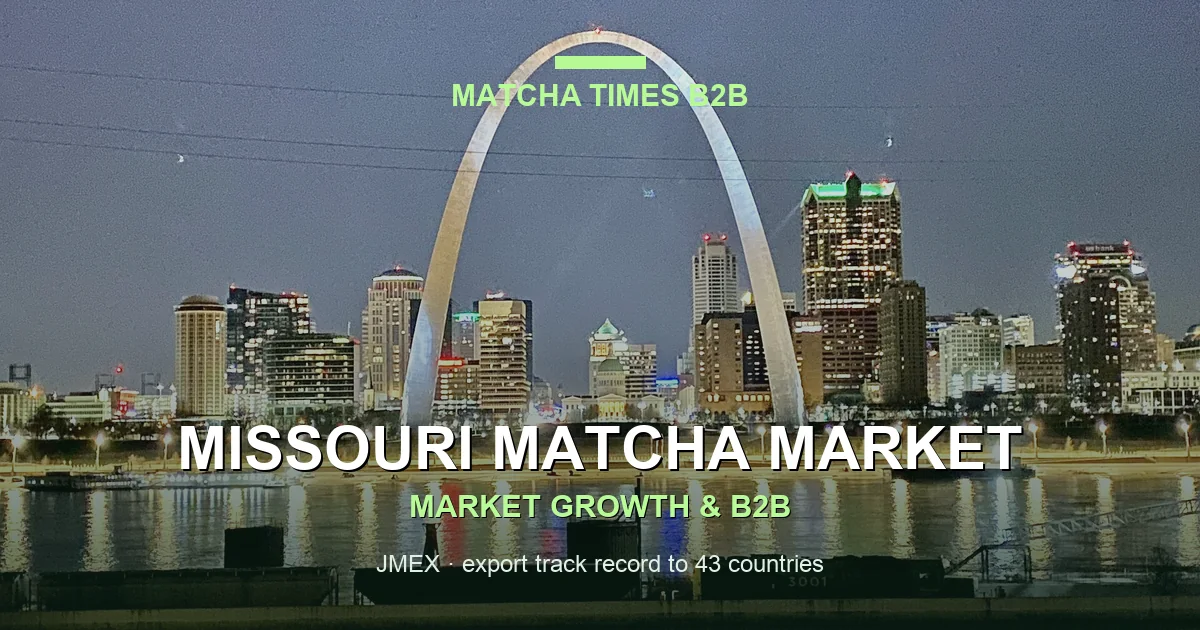
The short read on the Missouri matcha market is that demand has moved from a coastal novelty to a steady Midwest menu staple — and because no tea is grown commercially in Missouri or anywhere in the continental United States, every gram of that demand is met by imported powder. For a B2B buyer, that makes Missouri a sourcing question, not a lifestyle one. Cafes in St. Louis, Kansas City and the Columbia university corridor now build drinks around matcha, and the buyers who supply them win on grade consistency, compliant documentation and reliable inland delivery — not on hype.
This guide is written for importers, wholesalers, OEM formulators and health or protein brands supplying Missouri at scale. It reads the state’s demand as a procurement brief: market sizing, demand drivers, why supply is structurally import-dependent, US import compliance, and a supplier-selection checklist you can apply to any supplier.
Key Takeaways
- Demand is real and import-dependent: Missouri grows no commercial tea, so its 6.2 million residents (US Census, 2024) are served only through imports.
- Size the state from national estimates: treat US matcha figures as commercial provider estimates (e.g. Grand View Research), not official Missouri statistics.
- Duty is not the obstacle: green tea under HS 0902 is duty-free (0%, USITC HTS); compliance and consistency are the real gates.
- Compliance is the buyer’s job: US importers must run an FDA Foreign Supplier Verification Program (FSVP) and meet US labeling rules.
- Inland logistics matter: a landlocked state adds ocean-plus-inland transit, so lead time and safety stock belong in every MOQ decision.
Researched and reviewed by the Matcha Times Editorial Team, operated by the Japan Matcha Export Organization (JMEX). See our Editorial Policy and Sources & Methodology. Found an error? Tell us.
For Companies Seeking Matcha Powder
We source matcha from Japan’s premier production regions including Kyoto Uji, Kagoshima, Fukuoka, and Shizuoka, offering comprehensive grade ranges from organic JAS-certified ceremonial grade to processing-grade matcha.
Common Challenges:
- “We have projects but cannot secure stable matcha supply…”
- “We want to incorporate matcha into new café menu items!”
If you face these concerns, consult with Matcha Times. Feel free to contact us for initial inquiries.
\Read Also/

How big is the Missouri matcha market?
There is no official, Missouri-specific matcha market figure, so the honest answer is to size the state from national estimates and treat them as directional. Provider estimates vary by definition and methodology, so attribute each figure rather than presenting a single canonical number.
| Estimate (attributed) | Figure | Basis |
|---|---|---|
| Global matcha market (Grand View Research) | US$5.1B (2025) → US$8.9B (2033) | Provider estimate, 7.1% CAGR |
| US matcha tea category (Grand View Research) | ~US$340.0M by 2033 | Provider estimate, 8.5% CAGR |
| Missouri population (US Census) | 6,245,466 (2024) | Verified primary (addressable base) |
| Japan green-tea exports (Japan MoF) | ¥36.4B / 8,798 t (2024) | Green-tea total, all forms — not matcha-only |
Read the table with scope discipline. The Grand View figures are commercial estimates, not government statistics, and the Japan Ministry of Finance export figure is green tea in every form — not a matcha-only number. What is verifiable for Missouri is the addressable base: a growing population of more than six million, concentrated in metro St. Louis and Kansas City, with no local leaf supply to draw on.
\Read More/
What is driving matcha demand in Missouri?
Three forces overlap in Missouri, and together they explain why the category has held rather than faded. None of them is unique to the coasts, which is exactly why the Midwest has caught up.
A young, cafe-first consumer base
Matcha’s core audience skews young, health-aware and social-media-native, and Missouri’s college towns and metros supply that audience in volume. The University of Missouri in Columbia, plus the student and young-professional density in St. Louis and Kansas City, gives operators a reliable base for an iced matcha latte program. For a buyer, that means demand is menu-driven and repeatable, not a one-off seasonal spike.
St. Louis, Kansas City and Columbia cafe growth
Independent specialty cafes across the state now treat matcha with the same care as espresso, and national matcha-forward concepts have begun entering the St. Louis area. As more venues add matcha lattes, strawberry-matcha and matcha soft-serve, the per-location powder requirement rises, and multi-store operators start consolidating purchasing — the point at which a wholesale relationship replaces retail tins.
Health, wellness and Japanese-culture interest
Matcha rides two durable trends at once: functional-beverage interest (a calmer caffeine curve, L-theanine, antioxidants) and sustained interest in Japanese food culture. Those position matcha beyond coffee shops — into smoothie bars, protein and supplement brands, and packaged-goods makers reformulating for a green, natural halo. Each of those channels is a distinct B2B buyer with distinct grade and particle-size needs.
Why Missouri matcha demand is a sourcing story, not just a demand story
Here is the mechanism buyers must internalize: the United States has effectively no commercial tea cultivation at scale, and Missouri has none at all. Unlike coffee or dairy, matcha cannot be regionally substituted — authentic matcha is shade-grown tencha, stone-milled in Japan, and quality is set at origin by cultivar, shading and milling. That makes every Missouri cup the end of an import supply chain that begins in Japanese tea fields.
The practical consequence is that your competitive advantage is your supply chain, not your location. Two buyers serving the same Kansas City cafes will differ on grade consistency batch to batch, on whether their documentation clears US import review without delay, and on whether inland delivery to a landlocked state stays predictable. Those are sourcing decisions made long before the powder reaches Missouri.
Importing matcha into Missouri: FSVP, HS codes, labeling and certification
Bringing matcha into Missouri is a US federal import process, not a state one. The four items below are where buyers most often lose time, so confirm each with your customs broker for your specific shipment and destination.
- Tariff classification & duty: green tea, including matcha powder, generally falls under HS heading 0902 (USITC HTS), where the base MFN rate is duty-free (0%). Any country-level US “reciprocal” measure is separate, time-varying, and should be confirmed with a broker — never assumed as the matcha product rate.
- FDA FSVP: as the US owner or consignee, the importer must operate a Foreign Supplier Verification Program — hazard analysis, supplier verification and records that FDA can request at any time.
- Labeling: US FDA food-labeling rules apply (ingredient statement, net quantity, allergen and facility information as applicable); confirm your artwork before the first commercial run.
- Certification & testing: USDA Organic (via a recognized equivalence with Japan’s JAS) for an organic claim, and a current Certificate of Analysis covering pesticide MRLs and heavy metals. Halal certification is optional and market-driven, not a US import requirement.
None of these is a Missouri-only rule, but all of them decide whether your first container clears cleanly. The recurring failure mode is treating documentation as an afterthought — a missing COA field or a mislabeled ingredient panel can hold a shipment that the tariff schedule would have waved through for free.
A supplier-selection checklist for Missouri matcha buyers
Use the criteria below to evaluate any supplier on equal terms, including JMEX. They are drawn from what actually determines success in an inland US market: grade fit, documentation, and delivery reliability rather than headline price alone.
| Criterion | What to verify with any supplier |
|---|---|
| Grade & application fit | Ceremonial vs. culinary/latte vs. ingredient grade matched to your menu or formulation; request samples per intended use. |
| Origin & cultivar | Named growing region and cultivar; shade-grown tencha, stone-milled; consistency across harvests. |
| Batch consistency | Color, flavor and particle-size stability lot to lot — the single biggest café complaint at scale. |
| Documentation | Certificate of Analysis (pesticide MRLs, heavy metals, microbiology), organic/JAS and halal certificates if claimed. |
| Import readiness | Supplier able to support your FSVP verification and provide export/customs paperwork without delay. |
| MOQ & supply cadence | Minimum order and repeatable monthly volume that match your run rate; ask how supply scales with you. |
| Inland lead time | Realistic door-to-door transit to Missouri (ocean plus inland) and buffer stock guidance for a landlocked state. |
| Pricing transparency | Quote with the trade term stated (FOB/CIF/EXW) so landed cost is comparable across suppliers. |
From the exporter’s perspective
For an inland market like Missouri, the questions that separate a smooth program from a stalled one are rarely about price. They are: can the supplier hold grade across harvests, will the documentation clear US import review the first time, and can monthly volume scale without a gap? JMEX frames every quotation around those three, and confirms grade, certification and lead time in writing rather than leaving them to be discovered on arrival.
Sources & Methodology
Each source below states what it supports, its date and its scope. All figures in this article are from external primary, official or attributed commercial sources; market-size numbers are provider estimates that vary by definition, and are labeled as such rather than presented as official statistics. This article contains no proprietary buyer statistics.
- USITC Harmonized Tariff Schedule (HS 0902) — US import duty classification for green tea/matcha (duty-free) (2026, US primary/official)
- US FDA — Foreign Supplier Verification Programs (FSVP) — Importer food-safety verification obligations (current, US primary/official)
- US Census Bureau QuickFacts — Missouri — Missouri resident population (addressable base) (2024, US primary/official)
- Grand View Research — Matcha Market — Global matcha market size/CAGR (attributed commercial estimate) (2026, provider estimate)
- Grand View Research — US Matcha Tea Market Outlook — US matcha tea category size/CAGR (attributed commercial estimate) (2026, provider estimate)
- Japan Ministry of Finance — Trade Statistics — Japan green-tea export value/volume (all forms, not matcha-only) (2024, Japan primary/official)
Why Buyers Choose JMEX (Japan Matcha Export Organization)

JMEX (Japan Matcha Export Organization) supplies Missouri-bound buyers from origin: we match cultivar, shading and grade to your application, and back every shipment with a Certificate of Analysis, MRL and heavy-metal testing, and organic/JAS or halal documentation where you need it.
with an export track record to 43 countries
Frequently Asked Questions (FAQ)
Short, direct answers to the questions Missouri matcha buyers ask most often before they commit to a supplier.
How big is the Missouri matcha market?
There is no official Missouri-only figure. Size it from national estimates: Grand View Research puts the US matcha tea category on track for roughly US$340 million by 2033, and the global matcha market at about US$5.1 billion in 2025 — both are commercial provider estimates that vary by definition. Missouri’s addressable base is its 6.2 million residents (US Census, 2024).
Why is matcha so popular in Missouri right now?
A young, cafe-first consumer base in St. Louis, Kansas City and the Columbia university corridor overlaps with functional-beverage and Japanese-culture interest. Specialty cafes and national matcha concepts have expanded menus, turning matcha into a repeatable staple rather than a fad.
Where do Missouri cafes buy their matcha?
Almost entirely from imports, because no commercial tea is grown in Missouri or the continental US. Small venues buy retail tins; multi-store operators and brands move to wholesale suppliers or importers for grade consistency, documentation and volume pricing.
Is there a US import duty on matcha?
Green tea, including matcha, generally classifies under HS heading 0902, where the base MFN rate is duty-free (0%) per the USITC Harmonized Tariff Schedule. Any country-level reciprocal measure is separate and time-varying — confirm current conditions with a customs broker.
What do US importers need to do to bring matcha into Missouri?
Operate an FDA Foreign Supplier Verification Program (FSVP), meet US FDA labeling requirements, and hold a Certificate of Analysis covering pesticide MRLs and heavy metals. Classification and clearance are US federal processes; Missouri adds no separate import rule.
Does matcha need organic or halal certification to sell in Missouri?
Neither is legally required to sell matcha in Missouri. USDA Organic (via equivalence with Japan’s JAS) is required only if you make an organic claim, and halal certification is optional and market-driven. Both are commercial choices, not US import conditions.
Learn More About Global Matcha Trends at Matcha Times

Matcha Times is a specialist media platform covering the global matcha market — sourcing and wholesale, supply and pricing, trade and regulations, production and origins, and the companies shaping the industry.
From market analysis and price trends to café case studies and interviews with tea farmers, we help buyers, importers, distributors, and manufacturers stay ahead of where matcha is heading. Explore more and put the global matcha market to work for your business.
Conclusion
When origin, grade, and export conditions align, matcha becomes a stable revenue source. Start by defining your requirements and confirming quality with a sample.
Looking for wholesale or OEM matcha samples? Contact us — we will recommend the optimal origin and grade based on your application and target markets.
Related Articles