Tennessee Matcha Market 2026: Café Growth, Consumer Trends & B2B Opportunities
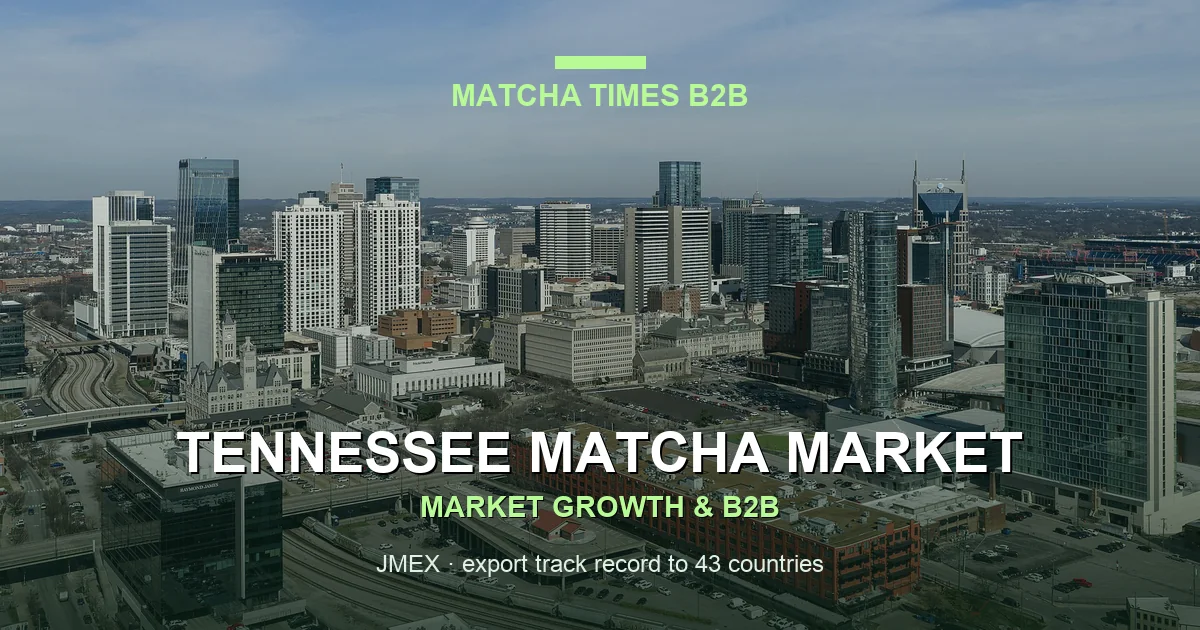
The Tennessee matcha market is best understood as a fast-growing consumer-demand story that is quietly turning into a B2B sourcing question. Nashville’s café scene has added a visible cluster of matcha-focused venues, and matcha’s move from a niche tea to an everyday coffee alternative mirrors a national shift. For a wholesaler, café group, private-label brand or health-product maker serving Tennessee, the practical issue is not whether demand exists — it is how to source authentic Japanese matcha reliably, at the right grade and price, and clear it through US food import rules.
This guide separates what is verifiable from what is merely estimated. There is no official Tennessee-only matcha market figure, so we use documented local café growth, verified US import and Japanese export data, and clearly-attributed industry estimates — never a single made-up number — and then translate all of it into the sourcing decisions a B2B buyer actually has to make.
Key Takeaways
- Demand is local and real, but not officially measured. Nashville’s matcha café cluster is well documented by local media; a Tennessee-specific market size is not published, so treat any state dollar figure with caution.
- US matcha market sizing is an estimate, not a statistic. Research firms publish widely differing numbers depending on how ‘matcha’ is defined — attribute each figure to its provider.
- Japanese matcha enters the US duty-free at the product level. Green tea, including matcha, sits under HTS heading 0902 at a 0% base (MFN) duty; separate country-level surcharges have been time-varying and should be confirmed with a customs broker.
- Grade and document quality decide repeat business. Café-driven demand rewards consistent color, flavor and milk compatibility, backed by a per-lot COA and residue testing.
- The B2B win is reliability, not the lowest quote. Match origin and grade to the application, then confirm supply cadence, lead time and compliance before scaling.
For Companies Seeking Matcha Powder
We source matcha from across Japan’s premier regions — Uji, Shizuoka, Kagoshima and Yame — and match grade to your application, then prepare COA, residue, origin and organic documentation so your US shipments clear customs cleanly.
Common Challenges:
- “We have projects but cannot secure stable matcha supply…”
- “We want to incorporate matcha into new café menu items!”
If you face these concerns, consult with Matcha Times. Feel free to contact us for initial inquiries.
\Read Also/
What is driving matcha demand in Tennessee?
The short answer: a young, health-oriented urban consumer base meeting a rapidly professionalising café scene. Tennessee’s largest metros — Nashville, Memphis, Knoxville and Chattanooga — have grown quickly, and Nashville in particular has become a visible hub for specialty matcha drinks rather than just an add-on to a coffee menu.
This is not merely anecdotal. Local outlets including the Nashville Scene and the Vanderbilt Hustler have documented a growing cluster of dedicated matcha cafés in the city — venues such as Forevermore, Babychan, Matryoshka and Mott Cha — alongside seasonal matcha events and cafe crawls. That density of specialist demand is the clearest local signal that matcha in Tennessee has moved beyond a passing trend.
Two consumer patterns sit underneath it. First, matcha is increasingly bought as a coffee and soda alternative by Millennial and Gen Z drinkers who value its steadier caffeine profile and its association with wellness. Second, the drink is highly visual and social: bright-green lattes, strawberry-matcha layers and seasonal specials travel well on social media, which pulls independent cafés toward higher-quality, better-coloured powder that photographs and tastes the part.
\Read More/
How Tennessee’s café boom becomes a B2B opportunity
Rising cups sold is a consumer trend; it becomes a business opportunity the moment those cafés, and the brands around them, need a dependable wholesale supply. The mechanism is straightforward: as a venue moves from a few drinks a day to a core menu item, guesswork sourcing (a retail tin here, an inconsistent import there) stops working, and the operator starts looking for a wholesale partner who can hold grade, colour and price steady across every order.
That shift opens several distinct B2B lanes in a market like Tennessee: café and multi-store food-service supply; private-label and OEM matcha for regional wellness and beverage brands; ingredient supply to bakeries, protein and functional-food makers; and distribution to grocery and specialty retail. Each lane wants a slightly different grade — a latte-focused café prioritises milk compatibility and colour, while a manufacturer cares about particle size, dispersion and batch consistency — which is exactly why matching grade to application matters more than chasing a single ‘best’ matcha.
The buyer’s real question is therefore not ‘is there demand in Tennessee?’ but ‘can I secure the right grade, at a stable price, with clean documentation, delivered on a schedule my customers can rely on?’ The rest of this guide answers that.
US matcha market context: what the numbers do and don’t tell you
Because no official Tennessee-level figure exists, buyers reasonably look to US and global matcha data. Use it — but read it critically. Market-size figures for matcha are commercial research estimates, not government statistics, and they vary widely because providers define ‘matcha’ differently (pure matcha powder versus every matcha-flavoured product).
As an illustration of that spread: industry estimates commonly place the US matcha market in the mid-hundreds of millions of dollars (one frequently-cited estimate is around US$560 million for 2024), while global matcha estimates from different research firms range roughly from a few billion to well over six billion dollars across their forecast years. These are useful for direction, not precision: attribute each figure to its provider and its year, and never average competing estimates into a single ‘fact’.
What can be stated with confidence comes from official trade data. Japan’s green-tea exports (all forms, including matcha) reached a record ¥36.4 billion on about 8,798 tonnes in 2024, according to Japan’s Ministry of Finance trade statistics (as compiled by Nippon.com). Powdered tea — matcha and similar — made up roughly 58% of that export volume in 2024. Note the scope carefully: this is green-tea-total, value-and-volume data for Japan, not a matcha-only or US-only number — but it confirms the supply-side trend of rising Japanese matcha exports that a US buyer is tapping into.
The honest bottom line for Tennessee: the direction of travel — more demand, more premiumisation, more Japanese export volume — is well supported. A precise state-level market value is not, so build your business case on your own pipeline (café accounts, order volumes, repeat rate), not on a borrowed headline number.
What Tennessee matcha buyers should verify with any supplier
Whether you are supplying cafés, building a private-label line, or sourcing an ingredient, the same verification set protects quality and margin. Use this checklist with any supplier — including JMEX — and weight the criteria toward your specific application.
| Criterion | What to verify with any supplier |
|---|---|
| Grade fit for application | Ceremonial/latte-grade for café drinks (colour, umami, milk compatibility) vs culinary grade for baking and manufacturing; ask for the grade matched to your use, not a generic ‘premium’ label |
| Colour & flavour consistency | Vivid green with no yellow-brown cast, and a stable taste profile batch to batch — the traits café-driven demand rewards |
| Certificate of Analysis (COA) | A lot-specific COA per shipment (not only for the first order) covering quality and safety parameters |
| Residue / MRL testing | Pesticide-residue results that meet US limits; ask which authority’s limits are used and for the test report |
| Origin & traceability | Confirmed Japanese origin and region/cultivar detail; a certificate of origin for provenance and tariff treatment |
| Organic certification | Valid JAS and US-recognised organic documentation if you sell the matcha as organic |
| MOQ, pricing basis & lead time | Minimum order quantity, the trade term behind any quote (e.g. FOB/CIF), and realistic lead time — confirmed in writing, never assumed |
| Supply cadence & scalability | Ability to hold grade and price from a trial lot up to steady monthly volume as your accounts grow |
Notice what this checklist deliberately avoids: ranking named brands. A responsible sourcing decision compares suppliers on verifiable criteria for your own use case, not on a one-size-fits-all ‘best matcha’ list.
Import and compliance basics for bringing matcha into the US
Sourcing from Japan means importing a food, so two things sit alongside quality: the tariff and the food-safety filings. On the tariff, green tea — including matcha — is generally classified under HS heading 0902, and enters the United States at a 0% base (MFN) customs duty per the US Harmonized Tariff Schedule (USITC). In other words, the product duty on matcha itself is zero.
One caution: separately from that product duty, the US has applied country-level trade measures in 2024–2026 that have been time-varying and legally contested. Those are not the matcha product rate and can change; confirm the current landed cost for Japan with a licensed customs broker before you commit to a price to your Tennessee customers — do not treat any surcharge figure as a fixed matcha tariff.
On food safety, imported matcha must clear US Food and Drug Administration requirements. Covered importers must file FDA Prior Notice before a shipment arrives, and operate a Foreign Supplier Verification Program (FSVP) to verify their supplier produces the food safely. Whoever is named importer of record carries these duties, so agree early who files what — and make sure your supplier can produce the COA, residue and origin documents those programs rely on.
Why Buyers Choose JMEX (Japan Matcha Export Organization)

For a Tennessee buyer, the value of an export-side partner is that quality and compliance arrive together. JMEX (the Japan Matcha Export Organization) selects origin and grade from across Japan’s matcha regions and prepares the document package US customs and the FDA actually check — so the café-ready colour and the clean paperwork are not two separate problems.
Practically, that means JMEX can propose leaf from multiple regions — Uji, Shizuoka, Kagoshima, Yame and more — matched to your application (latte colour and milk compatibility for cafés, or particle size and batch consistency for manufacturing), and prepare COAs, residue analyses, and organic-JAS and origin documentation aligned to US requirements. With an export track record to 43 countries, JMEX handles the export-side procedures so shipments clear customs cleanly, and can scale supply from a trial lot to steady monthly volume as your Tennessee accounts grow — without tying you to a single farm.
From the exporter’s perspective
As an export organisation, we start from the buyer’s application rather than a fixed product list: for a café programme we prioritise colour and milk compatibility; for a manufacturer, dispersion and batch consistency. We then confirm the destination’s document and residue requirements up front, prepare a lot-specific COA and the certificates the market checks, and quote clearly on an agreed trade term so buyers compare like with like. Specific prices, MOQs and lead times depend on grade, volume and route and are always confirmed in a written quotation — never quoted as a one-size-fits-all number.
From demand to reliable supply: a step-by-step sourcing flow
Turn Tennessee demand into a dependable programme with a repeatable process:
- Define the application and grade — café latte, ceremonial retail, baking, or manufacturing ingredient? This sets the colour, flavour and particle-size targets before you talk price.
- Size your real demand from your own accounts (drinks per day, orders per month, repeat rate), not from a national headline figure, so your MOQ and cadence are grounded.
- Shortlist suppliers on the checklist above — grade fit, COA, residue testing, origin, certifications, MOQ, lead time and scalability — and request written detail.
- Confirm import and compliance ownership — agree who is importer of record and who files FDA prior notice and holds the FSVP, and confirm landed cost with a customs broker.
- Request a trial lot and a written quote on a stated trade term, and validate colour, flavour, milk performance and the document flow before scaling.
- Lock a supply cadence — move to a contracted monthly or seasonal schedule so grade and price stay stable as your Tennessee accounts expand.
Sources & Methodology
This guide combines documented local café-market signals, verified official trade data, and clearly-labelled commercial estimates; each source below states what it supports, its date, and its scope. It makes no first-party statistical claims and asserts no specific Tennessee-state market value, because none is officially published. Market-size figures are attributed provider estimates, not statistics. No specific price, MOQ, freight or duty-surcharge figure is stated as fixed — each varies by grade, route and market and should be confirmed in a written quotation and with a customs broker.
- Nashville Scene — Nashville matcha feature — documents Nashville’s growing specialty-matcha café scene and demand (local journalism; 2026; Nashville, TN scope)
- The Vanderbilt Hustler — Nashville matcha guide — guide to Nashville matcha cafés, corroborating the local café cluster (local journalism; 2026; Nashville, TN scope)
- USITC — Harmonized Tariff Schedule (ch. 9, 0902) — US import classification and the 0% base (MFN) duty for green tea/matcha under heading 0902 (USITC; current 2026; US import scope)
- FDA — Filing Prior Notice of Imported Foods — the requirement to file prior notice before imported food arrives (FDA; accessed 2026; US scope)
- FDA — Foreign Supplier Verification Programs (FSVP) — the importer’s obligation to verify foreign food suppliers (FSMA final rule, FDA; accessed 2026; US scope)
- Nippon.com — Japan green tea export data (MoF Trade Statistics) — Japan’s record green-tea export value/volume for 2024 and the powdered-tea share, from Ministry of Finance trade statistics (2024–25; Japan green-tea-total scope)
Researched and reviewed by the Matcha Times Editorial Team, operated by the Japan Matcha Export Organization (JMEX). Last reviewed: 2026-09-23. See our Editorial Policy and Sources & Methodology. Found an error? Tell us.
Frequently Asked Questions
Short, direct answers to the questions B2B buyers ask most about sourcing matcha for the Tennessee market.
How big is the Tennessee matcha market?
There is no official Tennessee-only matcha market figure, so treat any state-level dollar number with caution. What is documented is strong local demand — Nashville in particular has a growing cluster of specialty matcha cafés reported by local media — set against a broader US shift toward matcha as a coffee alternative. For a business case, size demand from your own café accounts and order volumes rather than from a borrowed national estimate.
Is matcha demand actually growing in Nashville and Tennessee?
Yes, by the available evidence. Local outlets such as the Nashville Scene and the Vanderbilt Hustler have documented a fast-expanding set of dedicated matcha cafés and matcha events in Nashville, and matcha’s popularity as a wellness-oriented coffee alternative is a national trend that Tennessee’s young, urban metros reflect. Precise growth rates for the state are not officially published.
What does it cost to import matcha into the US, and is there a tariff?
At the product level, green tea including matcha is generally classified under HS heading 0902 and enters the US at a 0% base (MFN) customs duty per the USITC Harmonized Tariff Schedule. Separately, the US has applied country-level trade measures in 2024–2026 that have been time-varying and legally contested; those are not the matcha product duty and can change, so confirm the current landed cost for Japanese matcha with a licensed customs broker.
What grade of matcha should I buy to serve Tennessee cafés?
Match grade to application. Café latte and ceremonial-style drinks reward a vivid-green, milk-compatible powder with a smooth, umami-forward taste, while baking and manufacturing prioritise culinary grade with the right particle size, dispersion and batch consistency. Ask the supplier for the grade matched to your specific use, and validate it with a trial lot before scaling.
What should I verify before choosing a matcha supplier?
Confirm grade fit for your application, consistent colour and flavour, a lot-specific Certificate of Analysis, pesticide-residue testing against US limits, Japanese origin and traceability, valid organic documentation if you sell it as organic, and a clear MOQ, pricing basis and lead time in writing. Just as important, confirm the supplier can hold grade and price as your volume grows.
Can JMEX supply matcha for a US B2B buyer in Tennessee?
Yes. JMEX (Japan Matcha Export Organization) selects origin and grade from across Japan’s matcha regions, prepares COA, residue, origin and organic-JAS documentation aligned to US requirements, and, with an export track record to 43 countries, handles export-side procedures so shipments clear US customs cleanly. Specific prices, MOQs and lead times are confirmed in a written quotation based on your grade, volume and route.
Learn More About Global Matcha Trends at Matcha Times

Matcha Times is a specialist media platform covering the global matcha market — sourcing and wholesale, supply and pricing, trade and regulations, production and origins, and the companies shaping the industry.
From market analysis and price trends to café case studies and interviews with tea farmers, we help buyers, importers, distributors, and manufacturers stay ahead of where matcha is heading. Explore more and put the global matcha market to work for your business.
Conclusion
When origin, grade, and export conditions align, matcha becomes a stable revenue source. Start by defining your requirements and confirming quality with a sample.
Looking for wholesale or OEM matcha samples? Contact us — we will recommend the optimal origin and grade based on your application and target markets.
Related Articles