Matcha Supplier Philadelphia: Wholesale Japanese Matcha for Cafés, Hotels & Brands
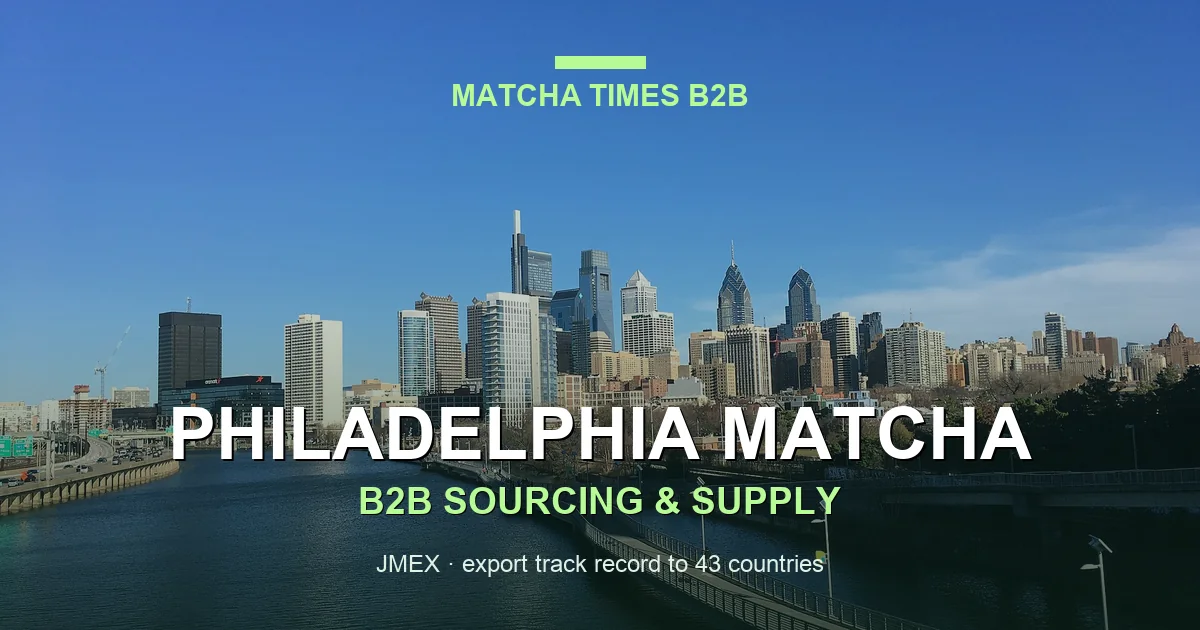
A business looking for a matcha supplier Philadelphia cafes, hotels and brands can rely on has four realistic ways to buy wholesale Japanese matcha: through a US-based importer or distributor that keeps stock on US soil, straight from a Japanese farm or stone-mill processor, or via a Japanese export organization that takes care of origin, grading and the export documentation. No single route is universally “best” — the right choice follows your monthly volume, the grade your menu demands, and how much of the import and compliance burden you want to shoulder yourself. One thing holds true across all four: regardless of where the leaf was grown, you prove its quality with a per-lot certificate of analysis (COA), origin evidence and consistent lot-to-lot results.
This guide speaks to the Philadelphia and Greater Philadelphia buyer directly. It walks through who to buy from and how the trade-offs shift with order size, how to pick a grade for a Center City cafe or a hotel beverage program, how to vet a supplier before you commit to bulk, the federal US import route, and — the local angle national pages tend to skip — how matcha actually reaches the city through the Port of Philadelphia, what Foreign-Trade Zone 35 does (and does not) deliver for a duty-free product, Pennsylvania and Philadelphia food licensing, and where JMEX fits on the export side.
For Companies Seeking Matcha Powder

We source matcha from Japan’s premier production regions including Kyoto Uji, Kagoshima, Fukuoka, and Shizuoka, offering comprehensive grade ranges from organic JAS-certified ceremonial grade to processing-grade matcha.
Common Challenges:
- “We have projects but cannot secure stable matcha supply…”
- “We want to incorporate matcha into new café menu items!”
If you face these concerns, consult with Matcha Times. Feel free to contact us for initial inquiries.
\Read Also/
Key Takeaways
- Pick the route that fits your scale: a US importer-distributor when you want convenience and modest volumes, or a Japanese processor / export organization when you want origin control, grade design and stronger unit economics at volume.
- Most Philadelphia cafes and hotels standardise on a culinary / cafe grade for lattes and food use and hold a little ceremonial stock for premium service — choose grade by the application, not by the label.
- Vet every supplier identically: a per-lot COA from an accredited lab, organic (USDA / JAS) and food-safety certification where it matters, and stable colour, particle size and flavour across repeat orders.
- Pure, unflavored matcha enters the United States duty-free under HTS heading 0902; the genuine import work is FDA facility registration, Prior Notice and Foreign Supplier Verification (FSVP).
- Philadelphia is served by the Port of Philadelphia (PhilaPort) on the Delaware River — a leading US gateway for refrigerated and perishable cargo — so the region is a genuine import point with strong cold-chain capacity, not merely a delivery market.
Researched and reviewed by the Matcha Times Editorial Team, operated by the Japan Matcha Export Organization (JMEX). Last reviewed: 2026-10-05. See our Editorial Policy and Sources & Methodology. Found an error? Tell us.
\Read More/
Who should a Philadelphia business buy wholesale matcha from?
Begin by naming your supply route, because each one moves price, lead time and the amount of compliance you carry. For a Philadelphia buyer the four usual options are a US importer-distributor, a Japanese farm selling direct, a Japanese processor (the stone-mill maker), and a Japanese export organization. The comparison below weighs them on the factors that really decide a wholesale program.
| Supplier type | Best for | Trade-off to weigh |
|---|---|---|
| US importer / distributor | Cafes and small chains that want domestic stock, fast reorders and zero import paperwork | You pay for the convenience; less grip on origin, grade and lot-to-lot consistency |
| Japanese farm (direct) | Buyers after a single-origin story and traceability to one garden | Narrow grade range and limited volume; import, testing and logistics are yours |
| Japanese processor (stone-mill maker) | Mid-to-large buyers needing defined grades and dependable monthly volume | You still run US import compliance unless they or a partner handle the export documents |
| Japanese export organization | Importers, OEM and brands wanting origin, grade design and export paperwork in one relationship | Strongest at recurring volume; put scope, certifications and MOQ in writing |
For a single Philadelphia cafe trialing a matcha latte, a US distributor is usually the sensible first step. As you grow toward hundreds of kilograms a month — a multi-location cafe group, a hotel F&B contract, a smoothie or protein brand, or an OEM run — sourcing nearer to origin through a Japanese processor or export organization tends to lift both consistency and landed cost, since fewer middlemen stand between the garden and your warehouse.
Choosing a matcha grade for a Philadelphia cafe, hotel or brand
Grade describes fitness for a use, not a league table of quality. “Ceremonial” and “culinary” are marketing descriptors rather than regulated categories, so two suppliers can label an almost identical powder differently. Decide by how the matcha will be prepared and tasted.
- Ceremonial / premium grade — smooth, naturally sweet and vividly green; for straight usucha, premium tea service and a signature drink where the matcha stands alone on the palate.
- Culinary / cafe grade — bolder, more astringent and more cost-effective; engineered to carry colour and flavour through milk, ice, sweetener and oven heat. This is the everyday workhorse for Philadelphia lattes, smoothies, soft serve and bakery.
- For a brand or manufacturer, judge the functional spec over the label: particle size, dispersion, colour stability and how the powder performs in your real recipe at production scale.
A workable method for a hotel or multi-site operator is to settle on one dependable culinary grade for volume drinks and keep a small ceremonial lot for premium or seasonal moments. Always confirm on a paid sample in your own recipe and water before committing — taste it the way your customer will.
Verifying a matcha supplier before a bulk order
Whatever route you take, verification is one discipline: ask for evidence tied to the exact lot you will receive, not a generic brochure. Three things carry the most weight — the COA, the certifications you truly need, and proof of consistency.
Per-lot certificate of analysis (COA)
A per-lot COA should report sensory results, microbiological safety, pesticide residues and heavy metals (lead, cadmium and arsenic among them) from an accredited (ISO/IEC 17025) laboratory. Check that pesticide residues clear US EPA tolerances, which can diverge from the origin market’s limits. A supplier who can hand over a current, lot-specific COA on request is operating at the standard a US importer should expect.
Organic and food-safety certifications
If you market the product as organic in the United States, the supply chain has to satisfy the USDA National Organic Program (Japanese JAS organic certification is commonly recognised via equivalence); request the certificate and confirm it covers the specific product, not just the company. For food-safety management, a recognised GFSI scheme (FSSC 22000, for instance) plus documented HACCP points to a mature processor. Ask for the certificates themselves instead of trusting a logo on a website.
Lot consistency and origin evidence
Because matcha is agricultural, colour and flavour shift between harvests and gardens. Ask how the supplier keeps a grade steady from trial lot to recurring monthly volume — blending discipline, cultivar and region, harvest timing, and whether they will commit to a reference sample you re-order against. Origin evidence (prefecture, garden or cooperative) underwrites the Japanese-origin claim your own label will carry.
Importing matcha through the Port of Philadelphia
Two layers govern how matcha travels from a Japanese garden to a Philadelphia shelf: the federal import rules that apply at any US port, and the local gateway that happens to specialise in exactly the kind of cargo food buyers care about.
On the federal layer, pure unflavored matcha is classified as green tea under HTS heading 0902 and carries a duty-free (Free) general rate of duty; flavored green tea is handled differently, so classification matters. Any separate country-level “reciprocal” or additional tariff measures are time-varying and sit apart from the product’s base rate — verify the current position with a licensed customs broker. The real work is food-safety compliance: the overseas facility must be registered with the FDA, every shipment needs Prior Notice, and the US importer must run a Foreign Supplier Verification Program (FSVP) to confirm the supplier meets US standards.
On the local layer, this is where Philadelphia stands apart from most “matcha supplier [city]” pages. The Port of Philadelphia — anchored by the Packer Avenue Marine Terminal on the Delaware River and operated under PhilaPort — is a leading US gateway for refrigerated and perishable cargo, with substantial on-site reefer capacity and immediate highway and rail connections. For a food and beverage buyer that matters: the region has deep cold-chain, warehousing and 3PL capacity, and Philadelphia sits mid-way on the I-95 corridor between New York and Washington, making it a practical, lower-cost distribution base for the Mid-Atlantic rather than only an end market.
You may also come across Foreign-Trade Zone 35, for which PhilaPort is the grantee across the Philadelphia region. An FTZ lets an importer defer, reduce or avoid duty on goods held inside the zone. Here is the honest nuance for matcha: since pure matcha is already duty-free, an FTZ yields little duty saving on the matcha itself. Its genuine value is for operations with dutiable co-imports (packaging, equipment, blended or flavored products), cash-flow timing, weekly-entry processing-fee savings, or re-export — not a reason to over-engineer a straightforward matcha program.
Pennsylvania and Philadelphia food licensing for matcha
A step national supplier pages gloss over is the licensing that kicks in once you store, repack or sell food in Pennsylvania and in the City of Philadelphia. It works on two levels, and scoping both early keeps a landed shipment from stalling.
- At the state level, a commercial food establishment that manufactures, packs, holds or distributes food — such as a matcha warehouse or wholesale distributor — generally registers with the Pennsylvania Department of Agriculture Bureau of Food Safety, with plan review and an on-site inspection before operating.
- Within the city, a retail food establishment such as a cafe or retail counter needs a Food Establishment Retail license from the City of Philadelphia Department of Public Health, Office of Food Protection, and applicants also need a Commercial Activity License first — a Philadelphia-specific layer worth planning around.
- Whichever applies, keep your import documents (FDA registration, Prior Notice, FSVP records, per-lot COA) aligned with your food license so a single lot can be traced from the garden to the counter.
A checklist to evaluate any Philadelphia matcha supplier
Instead of ranking brands, score every candidate — a US distributor, a Japanese processor or an export organization — against the same verifiable criteria. Apply it evenly to each option, including JMEX, and lean on documents and samples you can confirm rather than on marketing claims.
| Criterion | What to verify with any supplier |
|---|---|
| Origin & traceability | Confirmed Japanese origin with prefecture / garden or cooperative evidence for the actual lot |
| Grade fit | That the grade suits your application (latte, baking, RTD, premium service) on a paid sample in your own recipe |
| Per-lot COA | Sensory, microbiology, pesticide (EPA tolerances) and heavy-metal results from an accredited (ISO 17025) lab |
| Certifications | Organic (USDA / JAS) where you market organic, plus a recognised food-safety scheme (GFSI / HACCP), with current certificates |
| Lot consistency | How colour, particle size and flavour are held stable from trial lot to recurring monthly volume |
| US import support | FDA facility registration, Prior Notice and FSVP support — or whether that compliance falls to you |
| Commercial terms | MOQ, lead time, incoterms (FOB / CIF) and price quoted together in writing for your exact spec |
| Logistics & licensing | Cold-chain handling via the Port of Philadelphia, plus PA food-establishment registration and City of Philadelphia retail licensing |
The most useful questions to ask a supplier are concrete: What prefecture and harvest is this lot from? May I see the per-lot COA and your organic certificate? How do you hold this grade consistent month to month? What are the MOQ, lead time and incoterms in writing? Suppliers who answer precisely and commit the answers to writing are the ones worth scaling with.
Sourcing steps: from shortlist to recurring Philadelphia supply
A disciplined sequence turns a promising sample into a dependable program and sidesteps the familiar mistakes — over-ordering before you know your turnover, accepting a company-level certificate that does not cover the actual product, or leaving import compliance until a shipment is already on the water.
- Write a one-page specification: grade, application, monthly volume, packaging, organic or other requirements, and your delivery point in the Philadelphia area.
- Shortlist across routes (US distributor, Japanese processor, export organization) and request a paid sample matched to your spec, together with a per-lot COA.
- Validate the sample in your own operation — your recipe, your water, your equipment — and review the COA and any organic certificate.
- Confirm the US import path: foreign-facility FDA registration, Prior Notice and FSVP, and whether the supplier supports it or you will; engage a customs broker on classification and any current tariff measures.
- Scope your Pennsylvania and Philadelphia food licensing (PA Department of Agriculture registration and/or City of Philadelphia retail licensing) and your cold-chain and warehousing plan via the Port of Philadelphia before the first bulk lot lands.
- Agree MOQ, lead time, incoterms and pricing in a written quotation, then place a small trial order before signing up for recurring supply.
Sources & Methodology
This guide synthesises official US import authorities (USITC tariff schedule, FDA food-import rules), Pennsylvania and City of Philadelphia food-licensing requirements, the Port of Philadelphia and its Foreign-Trade Zone, USDA organic standards, and Japanese customs and trade statistics. Each source below states what it supports, its date and its scope. Tariff measures, recognition lists and food rules change, so confirm the current position with the named authority or a licensed customs broker before importing. No unverified number is presented as fact; figures are labelled by basis, scope and year.
- USITC — Harmonized Tariff Schedule (heading 0902, tea) — Green tea classification under HTS heading 0902; unflavored tea general rate is Free (duty-free) — accessed 2026 US tariff classification / duty
- FDA — FSMA Foreign Supplier Verification Programs (FSVP) — US importer obligation to verify foreign suppliers meet US food-safety standards — accessed 2026 US food import compliance
- FDA — Prior Notice of Imported Foods — Requirement to file Prior Notice before a food shipment arrives in the US — accessed 2026 US food import compliance
- FDA — Registration of Food Facilities — Requirement for the overseas manufacturing/processing facility to register with the FDA — accessed 2026 US food facility registration
- PhilaPort — Packer Avenue Marine Terminal — Port of Philadelphia as a leading US gateway for refrigerated/perishable cargo with on-site reefer capacity on the Delaware River — accessed 2026 Local import gateway / cold-chain logistics
- PhilaPort — Foreign-Trade Zone 35 — FTZ 35 duty deferral/reduction/exemption mechanics; PhilaPort is the regional grantee — accessed 2026 US Foreign-Trade Zone
- Pennsylvania Department of Agriculture — Commercial Food Establishments — Pennsylvania registration of commercial food establishments (manufacture/pack/hold/distribute) — accessed 2026 Pennsylvania wholesale food registration
- City of Philadelphia — Food Establishment Retail license — City of Philadelphia (Dept of Public Health, Office of Food Protection) retail food licensing; Commercial Activity License prerequisite — accessed 2026 Philadelphia retail food licensing
- USDA AMS — National Organic Program (organic standards) — US organic standard governing how a product may be marketed as organic — accessed 2026 US organic certification
- Japan Customs (English) — Tea (matcha) tariff classification under HS heading 0902 at origin — accessed 2026 HS classification / customs
- Japan Customs / Ministry of Finance — Trade Statistics — Market context: Japan green-tea export value/volume (¥36.4B / 8,798 t, 2024) — green-tea TOTAL, not matcha-only — 2024 Japan green tea exports (value and volume)
Why Buyers Choose JMEX (Japan Matcha Export Organization)

One supplier that meets these criteria at a high level is JMEX (Japan Matcha Export Organization), a wholesale and export partner dedicated to bringing Japanese matcha overseas. It designs origin selection, quality assurance, export documentation, and logistics as one continuous flow, built for export from the start.
Backed by an export track record to 43 countries, JMEX connects Japanese origin with the US buyer on the export side: confirmed Japanese origin and grade design for your application, per-lot COA with MRL and heavy-metal testing, organic (JAS) and food-safety documentation, customs and export paperwork, and stable recurring supply from 10 kg to 1 t per month for Philadelphia importers, wholesalers, OEM runs and health and wellness brands. Instead of asking you to coordinate a chain of intermediaries, JMEX folds origin selection, certification support and destination-market documentation into one relationship, so your Philadelphia program stays consistent from the first trial lot through to regular volume.
Frequently Asked Questions (FAQ)
Common questions from Philadelphia cafes, hotels and brands sourcing wholesale Japanese matcha, from where to buy to how it clears US import through the Port of Philadelphia.
Where can Philadelphia cafes and brands buy wholesale Japanese matcha?
Through four routes: a US importer-distributor that holds stock domestically, a Japanese farm selling direct, a Japanese stone-mill processor, or a Japanese export organization that handles origin, grading and export paperwork. A single cafe trialing a latte usually starts with a US distributor; a multi-site operator, hotel program or brand ordering hundreds of kilograms a month typically gains consistency and a better unit cost by buying closer to origin.
What grade of matcha do Philadelphia cafes need, ceremonial or culinary?
Most Philadelphia cafes, hotels and brands run a culinary or cafe grade for lattes, smoothies, soft serve and baking, because it keeps colour and flavour through milk, ice, sweetener and heat, and they hold a small ceremonial lot for premium service. The labels are marketing descriptors, not regulated terms, so validate any grade on a paid sample in your own recipe before committing.
Is there an import duty on matcha entering the United States?
Pure, unflavored matcha is classified as green tea under HTS heading 0902 and carries a Free (duty-free) general rate of duty; flavored green tea is treated differently. Separate country-level “reciprocal” or additional tariff measures can apply and are time-varying, so confirm the current position with a licensed customs broker rather than treating any such measure as the product’s base rate.
What documents are required to import matcha into the USA?
The overseas facility must be registered with the FDA, each shipment needs Prior Notice, and the US importer must operate a Foreign Supplier Verification Program (FSVP). Commercially you should also hold a per-lot certificate of analysis, an organic certificate if you market organic, and standard shipping documents (commercial invoice, packing list, bill of lading). If you store, repack or sell in Pennsylvania or Philadelphia, scope PA food-establishment registration or City of Philadelphia retail licensing too.
Does matcha for Philadelphia arrive through the Port of Philadelphia?
Often, yes. The Port of Philadelphia, anchored by the Packer Avenue Marine Terminal on the Delaware River under PhilaPort, is a leading US gateway for refrigerated and perishable cargo, so food shipments routinely move through the region with strong cold-chain support. That said, your supplier’s routing and incoterms determine the exact port of entry.
Can a Pennsylvania business buy matcha direct from Japan?
Yes. A Philadelphia importer, brand or OEM can buy direct from a Japanese processor or export organization, which sharpens origin control and unit economics at recurring volume. In exchange you take on the US import compliance (FDA registration, Prior Notice, FSVP) and logistics, unless the supplier or an export organization supports that side for you.
Learn More About Global Matcha Trends at Matcha Times

Matcha Times is a specialist media platform covering the global matcha market — sourcing and wholesale, supply and pricing, trade and regulations, production and origins, and the companies shaping the industry.
From market analysis and price trends to café case studies and interviews with tea farmers, we help buyers, importers, distributors, and manufacturers stay ahead of where matcha is heading. Explore more and put the global matcha market to work for your business.
Conclusion
Sourcing wholesale Japanese matcha for a Philadelphia cafe, hotel or brand comes down to matching the supplier route to your volume, picking a grade by application, and vetting every candidate the same way — per-lot COA, the certifications you actually need, and proven lot consistency. Add the US import path, the cold-chain strength of the Port of Philadelphia, a clear-eyed read on Foreign-Trade Zone 35, and Pennsylvania and Philadelphia food licensing, and you have a program that holds steady as you scale. JMEX supports buyers across exactly these steps, from Japanese origin and grade design to per-lot COA, MRL and heavy-metal testing, organic documentation and export paperwork, with stable recurring supply for importers, wholesalers, OEM and health and wellness brands.
Looking for wholesale or OEM matcha samples? Contact us — we will recommend the optimal origin and grade based on your application and target markets.
Related Articles