Washington Matcha Market 2026: Café Growth, Consumer Trends & B2B Opportunities
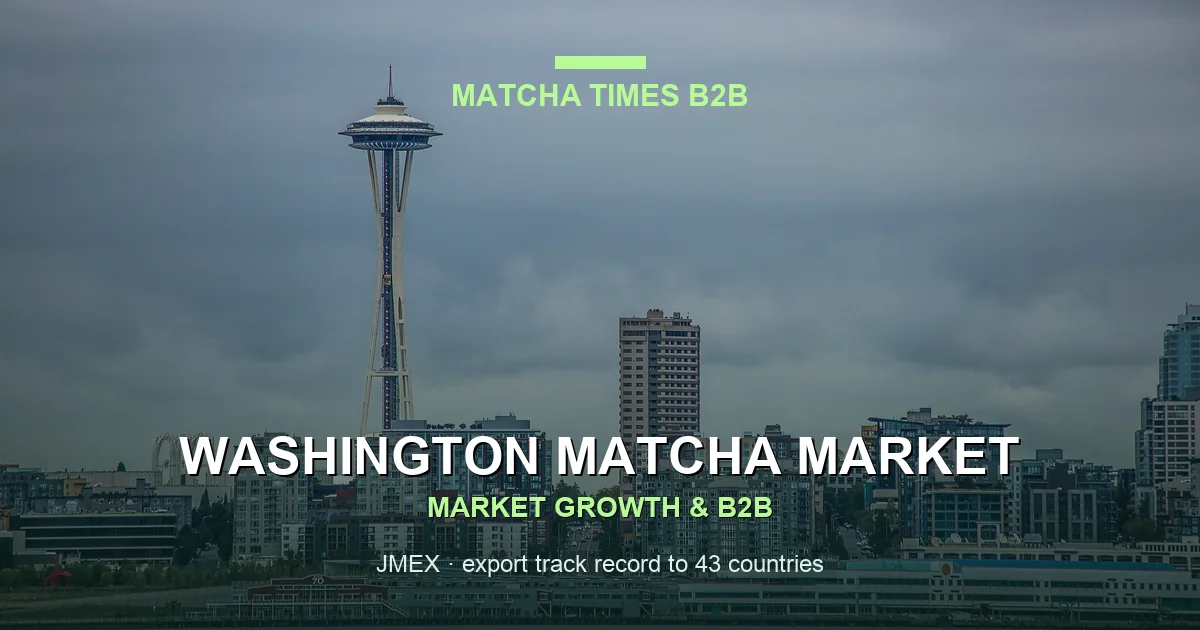
Washington State — anchored by Seattle’s long-established specialty-beverage culture — is one of the United States’ most commercially active regional markets for premium Japanese matcha in 2026. A combination of sustained café growth, health-conscious consumers, and strong Pacific Northwest import infrastructure creates measurable B2B opportunities for importers, wholesalers, OEM manufacturers, and food brands sourcing Japanese matcha at commercial volumes. This article maps the market’s current shape, outlines the regulatory baseline, and gives B2B buyers a practical sourcing framework.
For Companies Seeking Matcha Powder

We source matcha from Japan’s premier production regions including Kyoto Uji, Kagoshima, Fukuoka, and Shizuoka, offering comprehensive grade ranges from organic JAS-certified ceremonial grade to processing-grade matcha.
Common Challenges:
- “We have projects but cannot secure stable matcha supply…”
- “We want to incorporate matcha into new café menu items!”
If you face these concerns, consult with Matcha Times. Feel free to contact us for initial inquiries.
\Read Also/
Key Takeaways
- Seattle’s café scene has elevated matcha from niche to mainstream — new matcha-focused concepts opened across the city in 2025 and are drawing consistent consumer traffic.
- B2B demand spans multiple buyer segments: independent cafés, multi-location wellness chains, health-food retailers, RTD beverage producers, and OEM/private-label manufacturers — each with different grade and volume requirements.
- Japanese matcha (HTS 0902) enters the United States duty-free; buyers should confirm current tariff status at their time of importation, as trade policy can change.
- FDA food facility registration and Foreign Supplier Verification Program (FSVP) compliance are the core federal requirements for importing matcha into the U.S., including Washington State.
- Global supply tightness reported through 2025 makes verifiable, long-term supplier relationships — rather than spot purchasing — the prudent sourcing strategy for Washington operators.
- Origin transparency (Uji, Nishio, shade-grown tencha) is increasingly a menu-differentiation signal for Washington’s specialty cafés, raising the quality bar for B2B supply.
\Read More/

Washington’s Matcha Landscape in 2026
Washington’s relationship with premium Japanese tea predates the broader U.S. matcha boom. Seattle’s food culture — historically influenced by Pacific Rim trade, proximity to Japan-facing ports, and a large Asian-American community — created an early consumer base for quality matcha. Established local shops such as Miro Tea built a following for ceremonial-grade Japanese teas well before matcha became a national trend.
In 2025, Seattle Met documented a visible acceleration: new matcha-focused cafés drawing sidewalk-spanning lines across the city, with consumer interest extending well beyond early adopters into mainstream café culture. (Seattle Met, July 2025.) This pattern mirrors the trajectory of specialty coffee in the Pacific Northwest — a region that has historically shaped national beverage trends rather than followed them.
For B2B buyers, this means Washington is not a speculative emerging market — it is an active, quality-sensitive market where operators are already investing in matcha menu programs and looking for reliable supply partners. The relevant B2B demand today comes from:
- Independent specialty cafés and matcha bars — the fastest-growing format, typically requiring ceremonial or high-grade culinary matcha at consistent monthly volumes
- Multi-location coffee and wellness chains — standardized culinary-grade supply at higher volumes with strict batch consistency requirements
- Health-food retailers and supplement brands — powder-format matcha for in-store beverages, RTD products, and functional blends
- Food manufacturers and OEM/private-label producers — food-grade matcha for baked goods, protein supplements, sauces, and confectionery
Washington’s role as a major West Coast port — with Seattle serving as one of the primary gateways for Japanese food products entering North America — also gives buyers in the state structural procurement advantages: established customs brokers familiar with Japanese food imports, proximity to cold-chain distributors, and access to regional food-service distribution networks.
Consumer Trends Shaping B2B Demand
Three structural trends are defining what Washington’s B2B matcha buyers actually need from their suppliers in 2026:
Origin and Quality Transparency
Washington’s café operators — shaped by specialty coffee culture — increasingly communicate matcha origin, grade, and production method on their menus. Uji vs. Nishio, shade duration, cultivar, and processing method have moved from supplier specification sheets to front-of-house menu copy. This raises the documentation bar for B2B buyers: operators expect their supplier to provide production-region traceability and grade-level documentation, not just a product name and price.
Health and Functional Positioning
Washington has a concentrated health-food and functional-beverage sector — protein brands, supplement manufacturers, RTD producers, and specialty retailers — that uses matcha as a key ingredient. For these buyers, matcha’s L-theanine content, antioxidant profile, and clean-label appeal are the value proposition. Supply requirements differ from cafés: particle size, solubility, heat stability, and color retention under processing matter as much as flavor profile. Consistent batch-to-batch specs and third-party COA documentation are baseline requirements.
Supply Reliability as a Differentiator
By mid-2025, industry observers reported global matcha supply tightening, with some wholesalers pausing or limiting new wholesale accounts. (NBC Bay Area, 2025.) For Washington buyers, this underscores a sourcing risk: relying on spot purchasing or domestic resellers during high-demand periods exposes operators to availability gaps and price volatility. Direct supplier relationships with Japanese exporters who hold allocated production capacity offer greater supply security.
Regulatory and Import Baseline for Washington Buyers
Matcha imported from Japan into the United States — and sold in Washington State — is governed primarily by federal regulations, not state-specific rules. Washington State’s WSDA oversees intrastate food labeling for products sold within the state, but follows the federal FDA framework for imported foods. Key regulatory touchpoints for B2B buyers:
Import Duty: HTS 0902
Japanese matcha is classified under HTS Chapter 09.02 (green tea, whether or not flavored). The standard U.S. import duty rate for HTS 0902 is 0% — duty-free under the U.S. tariff schedule. (Source: U.S. International Trade Commission, HTS Schedule.) Buyers should verify current rates at their actual time of importation, as trade-policy measures — including any temporary reciprocal measures — can affect rates independently of the base tariff and may change.
FDA Registration and FSVP
Japanese matcha exporters must hold active FDA food facility registration under 21 U.S.C. §350d. Washington importers who receive direct shipments from Japan are subject to FDA’s Foreign Supplier Verification Program (FSVP) under 21 C.F.R. Part 1, Subpart L, which requires importers to verify that their foreign suppliers produce food in a manner that provides the same level of public health protection as U.S. standards. In practice, this means buyers should maintain current supplier COA, audit records, and MRL testing documentation on file. (Source: FDA, FSMA Final Rule on FSVP.)
Maximum Residue Levels (MRL)
Matcha sold in the U.S. must comply with EPA pesticide tolerance standards under 40 C.F.R. Part 180. Buyers should request third-party residue testing results specific to each production lot — not a generic certificate — from their supplier. MRL requirements differ between the U.S., Japan (JAS/MAFF), and the EU; a supplier with multi-market documentation simplifies compliance across distribution channels.
Supplier Selection Criteria for Washington Buyers
Washington’s market diversity — cafés, health brands, manufacturers — means there is no single “right” grade or format. The checklist below supports evaluation of any commercial matcha supplier, regardless of segment:
| Criterion | What to Verify with Any Supplier |
|---|---|
| Origin and traceability | Prefecture, tea-garden or co-op name, cultivar (e.g., Okumidori, Yabukita), shade duration; documented in COA or spec sheet? |
| Grade definition | Ceremonial vs. premium culinary vs. culinary vs. food-grade — defined by objective spec (particle size, color, L-value) or by marketing label only? |
| MRL and residue testing | Per-lot third-party pesticide residue test against U.S. EPA tolerances (40 C.F.R. Part 180); request the actual result, not just a compliance statement |
| COA and batch consistency | Certificate of Analysis per batch with moisture, color, particle size, and microbial count; acceptable lot-to-lot variation range stated? |
| Export documentation | Active FDA food facility registration number; phytosanitary certificate; FSVP-supporting records available on request |
| Supply volume and lead time | MOQ for initial and repeat orders; typical lead time to U.S. port; allocation policy during peak demand periods |
| Cold-chain and packaging | Nitrogen-flush or vacuum packaging; refrigerated freight options; shelf life from production date at stated storage conditions |
| Certifications available | JAS Organic, USDA Organic, Kosher, Halal — held by producer vs. requiring separate importer certification? |
Sourcing Strategy for Washington Operators
Washington buyers scaling their matcha programs face a practical choice: domestic wholesale distributors vs. direct Japanese export relationships. Each has trade-offs:
Domestic distributors offer faster delivery, smaller minimums, and simpler logistics — but at a margin premium and with less origin visibility. They suit low-volume buyers or those still testing matcha menu programs.
Direct Japanese export relationships offer grade customization, origin transparency, stable pricing at volume, and supply allocation during tight-market periods — but require higher minimum order volumes, longer lead times, and FSVP compliance management. For operators at hundreds-of-kg/month scale, the economics typically favor a direct relationship.
Japan’s green tea export sector reached ¥36.4 billion and 8,798 tonnes in 2024 (Japan Ministry of Finance, 2024; note: this covers all green tea exports by value and volume, not matcha specifically). The U.S. receives a significant portion of Japan’s premium green-tea export value, and Washington’s port infrastructure positions state-based buyers to access Japanese supply efficiently.
Sources & Methodology
This article draws on publicly available regulatory sources — U.S. Harmonized Tariff Schedule (USITC); FDA FSMA Final Rule on FSVP (21 C.F.R. Part 1, Subpart L); EPA pesticide tolerances (40 C.F.R. Part 180) — and Japan Ministry of Finance 2024 green tea export statistics (covers all green tea exports by value and volume, not matcha alone). Regional café trends are sourced from Seattle Met (July 2025). No proprietary market-size figure is presented as authoritative; commercial market estimates from research providers vary significantly by methodology. No JMEX-specific pricing, MOQ, or capacity data is presented without an owner-confirmed source.
Why Buyers Choose JMEX (Japan Matcha Export Organization)

Washington-based buyers sourcing premium Japanese matcha for cafés, wellness brands, or food manufacturing operations can consult JMEX (Japan Matcha Export Organization), a Japanese exporter with an export track record to 43 countries.
JMEX works directly with Japanese matcha producers across Uji, Nishio, and other major growing regions, supporting buyers on grade selection, origin documentation, COA and MRL compliance records, and logistics from Japan to U.S. ports. Export capability for orders from 10 kg/month trial quantities to full container loads positions JMEX as a sourcing partner for Washington buyers across café, supplement, and food-manufacturing segments.
Frequently Asked Questions
What grade of matcha do Washington cafés typically purchase at wholesale?
Most Washington specialty cafés purchase premium culinary-grade or high-grade culinary matcha for lattes and mixed drinks, while matcha bars and ceremonial-focused concepts purchase ceremonial-grade for straight preparation. Washington’s quality-driven café culture means buyers generally prefer documented grade specs over generic “café grade” labeling — request a COA with color L-value and particle-size data from any supplier.
Is matcha subject to any Washington-specific import rules beyond federal FDA requirements?
No Washington-specific import regulations apply uniquely to matcha beyond the federal framework. The Washington State Department of Agriculture (WSDA) oversees intrastate food labeling aligned with 21 C.F.R. Buyers importing directly from Japan follow federal FSVP requirements. Verify current requirements with WSDA and FDA for your specific product configuration.
What is the import duty rate for matcha from Japan to Washington?
Matcha (HTS 0902 — green tea, whether or not flavored) enters the United States at a 0% base duty rate under the U.S. Harmonized Tariff Schedule. Confirm the rate applicable at your actual date of entry using the USITC HTS database, as temporary trade measures can apply independently of the base rate.
How can Washington buyers manage supply risk during matcha shortages?
Supply tightness documented through 2025 is driven by demand growing faster than tencha production capacity. Mitigation strategies: (1) establish a direct export relationship with a supplier holding allocated production; (2) secure forward purchase agreements for 3–6 months of volume; (3) diversify grade levels to increase sourcing flexibility; (4) maintain safety stock appropriate to your lead time. Spot buying during shortage periods typically results in grade inconsistency and higher unit costs.
What documentation should Washington importers request from a Japanese matcha exporter?
FSVP-compliant importers should maintain, at minimum: the supplier’s current FDA food facility registration confirmation; a per-lot Certificate of Analysis (color, moisture, particle size, microbial counts); third-party pesticide residue testing results against U.S. EPA tolerances; and a phytosanitary certificate issued by MAFF or its authorized body. For organic certification, verify that the NOP certificate covers the specific production lot and confirm whether it is held by the Japanese producer or must be obtained by the importer.
Learn More About Global Matcha Trends at Matcha Times

Matcha Times is a specialist media platform covering the global matcha market — sourcing and wholesale, supply and pricing, trade and regulations, production and origins, and the companies shaping the industry.
From market analysis and price trends to café case studies and interviews with tea farmers, we help buyers, importers, distributors, and manufacturers stay ahead of where matcha is heading. Explore more and put the global matcha market to work for your business.
Conclusion
When origin, grade, and export conditions align, matcha becomes a stable revenue source. Start by defining your requirements and confirming quality with a sample.
Looking for wholesale or OEM matcha samples? Contact us — we will recommend the optimal origin and grade based on your application and target markets.
Related Articles