Best Wholesale Matcha for Cafés in Vietnam: Grade, Cost per Cup & Supply
For cafés in Vietnam, a mid-grade Japanese matcha — sometimes labeled “culinary” or “latte grade” — is the practical choice for milk-based drinks. Its stronger, slightly roasted character holds up against full-fat milk, oat milk, and sweeteners; the more delicate ceremonial tier is better reserved for straight whisked tea where every nuance matters. For cafés building a full matcha menu, stocking both a latte-suitable grade and a higher-grade option allows tiered pricing across the menu.
For Companies Seeking Matcha Powder

We source matcha from Japan’s premier production regions including Kyoto Uji, Kagoshima, Fukuoka, and Shizuoka, offering comprehensive grade ranges from organic JAS-certified ceremonial grade to processing-grade matcha.
Common Challenges:
- “We have projects but cannot secure stable matcha supply…”
- “We want to incorporate matcha into new café menu items!”
If you face these concerns, consult with Matcha Times. Feel free to contact us for initial inquiries.
\Read Also/
Key Takeaways for Vietnamese Café Buyers
- Grade choice is application-driven: milk-based drinks tolerate a robust, bolder grade; straight matcha tea demands a bright, low-bitterness ceremonial grade.
- No universal grade standard exists: “latte grade,” “culinary grade,” and “ceremonial grade” are vendor marketing terms, not regulated specifications — always request a Certificate of Analysis (COA) and a sample before committing to volume.
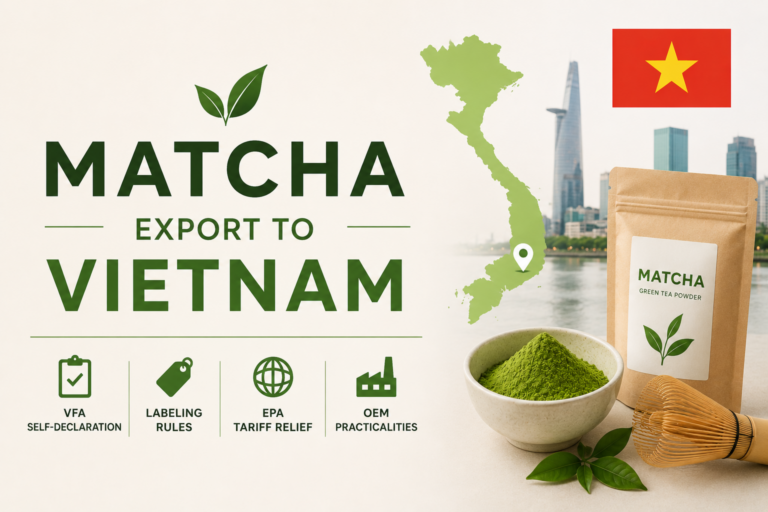
- Vietnamese cafés need VFA compliance documentation: imported matcha must pass Vietnam Food Administration (VFA) self-declaration; your supplier should provide COA, MRL test results, and origin certificates.
- Local Vietnamese matcha is mostly culinary/industrial grade: farms in Phu Tho and Ha Giang produce blending-suitable material, but for café-quality Japanese-style matcha, Japan-origin supply currently leads on color, flavor, and consistency.
- Retail menu prices in Vietnam range widely: from roughly 30,000 VND at value cafés to 130,000 VND or more at premium Japanese-branded outlets in Hanoi and Ho Chi Minh City (sources: Vietcetera, Tuoi Tre News) — your grade choice directly sets which price tier your menu can support.
- JMEX exports to 43 countries and can design grades matched to specific café applications, complete with VFA-ready documentation.
\Read More/

Matching Matcha Grade to Your Café Application
The single most important decision a Vietnamese café operator makes when sourcing matcha is matching the grade to its intended use. Ordering an expensive ceremonial-tier product for a sweetened iced latte wastes margin; using a low-grade industrial powder for a straight hot tea disappoints customers expecting Japanese café quality. The table below maps application to typical grade characteristics — use it as a framework when requesting samples, not as a fixed sourcing rule.
| Café Application | Recommended Grade Characteristics | Key Quality Signals to Request |
|---|---|---|
| Iced or hot matcha latte (milk-based) | Robust flavor, vibrant green color, holds character against milk. Mid-tier Japanese tencha-based powder. | Color score (SEM/visual), flavor notes (umami present, bitterness controlled), dispersion in cold liquid, COA with pesticide MRL |
| Straight whisked matcha (traditional style) | Bright, low-bitterness, strong umami. First or second harvest, shade-grown tencha. | Harvest date, shade-growing period, L* color value, aroma profile, no astringency peak |
| Matcha blend drinks (smoothies, shakes, RTD) | Consistent color, neutral-to-mild flavor that blends without overpowering. Often culinary tier. | Color stability in acidic/sweet media, particle size (fine dispersion), batch-to-batch color consistency |
| Matcha baked goods, desserts | Culinary/food-grade: strong color retention under heat, cost-efficient. Industrial-grade acceptable. | Color after baking test, flavor intensity, moisture content, food-safety COA |
Important: “latte grade” is not a regulated industry classification. It is a convenience label used by suppliers to indicate a mid-tier product suitable for milk-based drinks. The only way to verify suitability is to request a COA, pesticide residue test results, and actual samples to taste and prepare.
Formulation Guidance for Café Drinks
Getting the recipe right matters as much as sourcing the right grade. Industry guidance from the Specialty Coffee Association (SCA) on matcha beverage programs emphasizes that matcha is best prepared by sifting the powder first to break up clumps, then whisking with a small amount of hot water (not boiling — typically 70–80°C) before adding cold or steamed milk. This two-step method produces a smoother texture and reduces the grassy, astringent notes that result from insufficient hydration.
- Dosage per drink: industry convention cited by multiple supplier guides is approximately 2 grams of matcha powder per 350–475 ml (12–16 oz) beverage. Adjust upward for a stronger flavor profile or premium menu position.
- Water temperature: 70–80°C for initial whisking; using boiling water intensifies bitterness in lower-grade matcha.
- Milk compatibility: full-fat dairy, oat milk, and soy milk all emulsify well. For the Vietnamese market, condensed-milk matcha drinks are a popular local variation — a slightly more robust grade that holds its color and flavor against sweetness is preferable.
- Cold preparation: for iced drinks, dissolve matcha in a small amount of hot water first, then pour over ice. Cold-shaker methods without pre-dissolving typically leave powder sediment at the bottom.
- Storage at the café level: matcha oxidizes with light and humidity. Sealed, refrigerated storage after opening slows color loss. SCA guidance recommends opening large supply pouches only once per shift to limit air exposure.
Cost vs. Quality: Framing the Value Decision
Vietnamese café operators face a unique cost-quality equation. Menu matcha drink prices in Vietnam range from around 30,000 VND at value outlets to 130,000 VND or more at premium Japanese-branded cafés in Hanoi and Ho Chi Minh City (Vietcetera; Tuoi Tre News). This price spread means that the grade you source directly determines which segment you can serve profitably.
At a value price point, a cost-efficient culinary grade from a reliable supplier allows acceptable margin on a sweetened latte. At the premium end — where Vietnamese consumers are demonstrably willing to pay for Japanese origin and quality — a verifiable single-origin Japanese matcha with documented grade and harvest information is not just a product preference; it is the sales story. Branding “Japanese-origin, Japan-export certified” matters in a market where consumers in Hanoi and Ho Chi Minh City are increasingly knowledgeable about the difference.
When evaluating your cost-per-drink calculation, the key variables are: matcha dose per drink, FOB price of the grade you are importing, shipping and VFA compliance costs, and storage waste from oxidation. Request current FOB pricing from your shortlisted Japanese suppliers and ask for the COA reference batch to verify what you are buying before large-volume commitment.
Never combine a price from one source with an MOQ from a different source when building your cost model — these figures are batch- and term-specific. Ask each potential supplier for a written quotation that states FOB origin, MOQ, lead time, and the specific batch COA in the same document.
Vietnam Market Context: Why Japanese Matcha Matters for Cafés
Vietnam’s matcha café segment is in an expansion phase. IMARC Group (a commercial market research provider) estimates the Vietnam matcha tea market at USD 14.4 million in 2025, with a projected CAGR of 5.85% through 2034 — estimates vary by provider and market definition. Ho Chi Minh City and Hanoi are the dominant café hubs, with high-density office districts, a growing middle class, and strong Gen Z demand driving matcha menu additions across both specialty coffee shops and standalone matcha-focused outlets.
Vietnam does have domestic matcha production — farms in Phu Tho Province and Ha Giang produce green tea including culinary and industrial matcha-style powders. However, the Vietnamese café premium segment, particularly those competing on quality or Japanese-brand positioning, sources from Japan. The processing precision, shade-growing protocols, and milling standards required to deliver the vivid green color and umami flavor that Vietnamese café customers associate with “genuine matcha” remain more consistently available from Japanese tencha producers.
VFA Compliance: What Vietnamese Café Importers Need to Know
Matcha imported into Vietnam falls under the jurisdiction of the Vietnam Food Administration (VFA), which requires a food safety self-declaration process for imported food products including tea and tea-based powders. Vietnamese café operators importing directly — or buying from a local distributor who imports — should confirm the following documentation is in place for every lot:
- Certificate of Analysis (COA): batch-specific testing for pesticide residues (MRL), heavy metals, microbiology, and moisture. Issued by an accredited laboratory.
- Certificate of Origin: verifying Japan as the country of origin. Required for customs and may qualify the shipment for preferential tariff treatment under the Japan–Vietnam Economic Partnership Agreement (JVEPA).
- Product label compliance: Vietnamese labeling rules require Vietnamese-language labels on imported foods. Your distributor or customs broker can advise on format requirements.
- Self-declaration filing: under Vietnamese food safety law, the importer (or a designated customs clearance agent) files the product self-declaration with the relevant authority. Your Japanese supplier should be able to provide all supporting documents; confirm this in writing before the first shipment.
Consult a licensed Vietnamese customs broker or food import specialist for current VFA requirements, as regulations are periodically updated by the Ministry of Health and the Ministry of Agriculture and Rural Development (MARD). Do not rely solely on a supplier’s verbal assurance that documentation is “sufficient” — request the actual documents and have them reviewed before importing.
Why Buyers Choose JMEX (Japan Matcha Export Organization)

JMEX specializes in the export side of the matcha supply chain — origin selection, grade design, documentation, and stable supply to international buyers. JMEX exports to 43 countries, including established markets in Southeast Asia. For Vietnamese café operators, relevant JMEX capabilities include:
- Grade design by application: rather than selling from a fixed product catalog, JMEX can design or select a grade matched to your specific café application — latte-suitable, straight tea, or OEM blend — and document it consistently across orders.
- COA and MRL documentation: all shipments include batch-specific certificates. JMEX’s documentation is structured for VFA compliance support.
- Organic and other certifications: available on request; specify your certification requirements early in the sourcing conversation.
- OEM and private-label packaging: for café chains in Vietnam looking to build a house brand, JMEX can supply packaged matcha under your label directly from Japan.
- Stable supply volume: JMEX supports buyers from smaller trial quantities up to consistent large-volume monthly orders.
Supplier Checklist: Evaluating Any Matcha Supplier for Vietnamese Cafés
Use this checklist when evaluating any matcha supplier — including JMEX — before committing to a volume order.
| Criterion | What to Verify with Any Supplier |
|---|---|
| Grade definition | Ask the supplier to specify exactly what “latte grade,” “culinary,” or “ceremonial” means in their own grading system. Request the internal spec sheet or the COA parameters used to assign that grade. |
| Color and flavor | Request a sample of the actual batch available. Assess color (vivid green vs. yellowish-brown = oxidized), aroma (fresh, grassy), and taste (umami present, bitterness manageable in a milk-based drink). |
| Pesticide MRL compliance | Request the COA for the specific batch, issued by an accredited laboratory. Confirm the tested parameters match EU or Japanese MRL standards (stricter than many other markets). |
| Origin documentation | Request a Certificate of Origin (Japan) for customs and VFA compliance purposes. |
| MOQ and lead time | Get a written quotation specifying FOB price, MOQ, production lead time, and packaging options in the same document. |
| Batch consistency | Ask how color and flavor consistency is maintained across batches. Blending protocols and color measurement records are signs of a production-ready supplier. |
| Minimum order flexibility | For cafés starting a matcha program, ask whether a sample or trial order is available before committing to full MOQ. |
OEM and Private-Label Options for Vietnamese Café Chains
Multi-location café operators in Vietnam increasingly want to differentiate with a branded matcha product — their own label, their own house blend — rather than reselling a supplier’s standard product. OEM sourcing from Japan allows a Vietnamese café chain to position its matcha as proprietary, Japanese-origin, and quality-verified — a significant advantage in a competitive HCMC or Hanoi market where consumers compare menus carefully.
An OEM arrangement typically involves: defining the grade and application specification with your supplier, agreeing on a packaging design and label (with Vietnamese regulatory compliance), setting a production schedule that matches your usage volume, and establishing a documentation protocol for reorders. For cafés at the growth stage, confirming that your supplier can scale with you — from a few kilograms per month to multi-dozen kilograms as you open more locations — is an important procurement consideration.
Official sources to verify before you order
Import duties, tariff classification, food-safety rules and certification requirements change and differ by market. Confirm the current rules for your shipment directly with the authorities below; this article is a buyer’s guide, not legal or customs advice.
- World Customs Organization — Harmonized System — HS classification basics
- JETRO — Japan External Trade Organization — Japan export & market support
- MAFF — Ministry of Agriculture, Forestry and Fisheries of Japan — Japanese agricultural exports
- FAO/WHO Codex Alimentarius — International food standards
FAQ: Matcha Sourcing for Cafés in Vietnam
What grade of matcha is best for café lattes in Vietnam?
A mid-tier Japanese matcha with a robust flavor and vivid green color — often labeled “culinary” or “latte grade” by suppliers — is the practical choice for milk-based drinks. The stronger character holds up against dairy and sweeteners. For premium straight matcha tea, a higher-grade, low-bitterness product is more appropriate. Always request samples for both applications before placing a volume order.
How much matcha powder does a café use per drink?
Industry supplier guidance commonly cites approximately 2 grams per 350–475 ml (12–16 oz) drink as a standard starting dose. The right amount for your menu depends on desired flavor intensity, your grade’s strength, and local customer preference. Adjust based on taste testing with your actual supply lot.
Can Vietnamese cafés import Japanese matcha directly?
Yes. Vietnamese businesses can import Japanese matcha directly, subject to Vietnam Food Administration (VFA) self-declaration requirements and standard customs procedures. Your Japanese supplier should provide batch-specific COA, Certificate of Origin, and other documentation required for the import process. Consult a licensed Vietnamese customs broker for current VFA filing requirements.
What is the difference between ceremonial and culinary grade matcha?
These are vendor-defined terms, not regulated standards. In practice, ceremonial-tier products typically use first-harvest, finely ground, shade-grown tencha with a bright color and low bitterness — suited to straight whisked matcha. Culinary-tier products use lower-harvest or blended tencha with a stronger, more astringent profile — suited to cooking, baking, and milk-based lattes where other flavors are present. Always verify the supplier’s specific definition and get the COA, not just the grade label.
How do I calculate matcha cost per cup for my café menu?
Your cost per cup depends on: (1) the FOB price of your chosen grade, (2) shipping, customs, and VFA compliance costs, (3) storage waste from oxidation over time, and (4) your per-drink dose in grams. Request a written quotation from your supplier that includes FOB price, MOQ, and the specific batch COA. Never combine price data from one source with MOQ data from another — the figures are batch- and term-specific.
What certifications should I ask a matcha supplier for?
At minimum: a batch-specific Certificate of Analysis (COA) from an accredited laboratory covering pesticide residues (MRL), heavy metals, and microbiology; a Certificate of Origin (Japan) for customs; and product labeling documentation. For premium positioning or VFA compliance, also confirm whether the supplier can provide Japanese organic (JAS), Halal, or other certifications relevant to your market or buyer profile.
Learn More About Global Matcha Trends at Matcha Times

Matcha Times is a specialist media platform covering the global matcha market — sourcing and wholesale, supply and pricing, trade and regulations, production and origins, and the companies shaping the industry.
From market analysis and price trends to café case studies and interviews with tea farmers, we help buyers, importers, distributors, and manufacturers stay ahead of where matcha is heading. Explore more and put the global matcha market to work for your business.
Conclusion
Vietnamese cafés have a real opportunity in matcha — from value-segment lattes to premium Japanese-style straight tea. The grade decision, supplier evaluation, and VFA compliance process are the three decisions that determine whether your matcha program is profitable and defensible over time. Start with a clear application brief, request samples before volume, and confirm all documentation before your first import shipment.
JMEX — with its track record of exports to 43 countries — can supply grade-designed Japanese matcha matched to your café application, with the documentation package your VFA compliance process requires. Contact us to request a sample set tailored to your menu.
Sources & Methodology
This article draws on the following sources: Vietnam matcha market size estimate from IMARC Group (commercial market research; estimates vary by provider and market definition); Vietnam café market context from Nexdigm Vietnam market research and B-Company Vietnam 2025 Coffee Shop Market report; retail matcha drink price range in Vietnam from Vietcetera and Tuoi Tre News (2024–2025 observation); matcha beverage program guidance from the Specialty Coffee Association (SCA) partner content; VFA import process from the Vietnam Ministry of Health framework (consult a licensed customs broker for current requirements). No JMEX proprietary pricing, MOQ, or capacity data has been cited without verification. The dosage figure (approximately 2g per drink) is drawn from supplier guidance in publicly available café program resources and should be verified against your actual product lot.
Looking for wholesale or OEM matcha samples? Contact us — we will recommend the optimal origin and grade based on your application and target markets.
Related Articles