The Complete 2026 Guide to Exporting Matcha to Vietnam: VFA Self-Declaration, Labeling Rules, EPA Tariff Relief, and OEM Practicalities
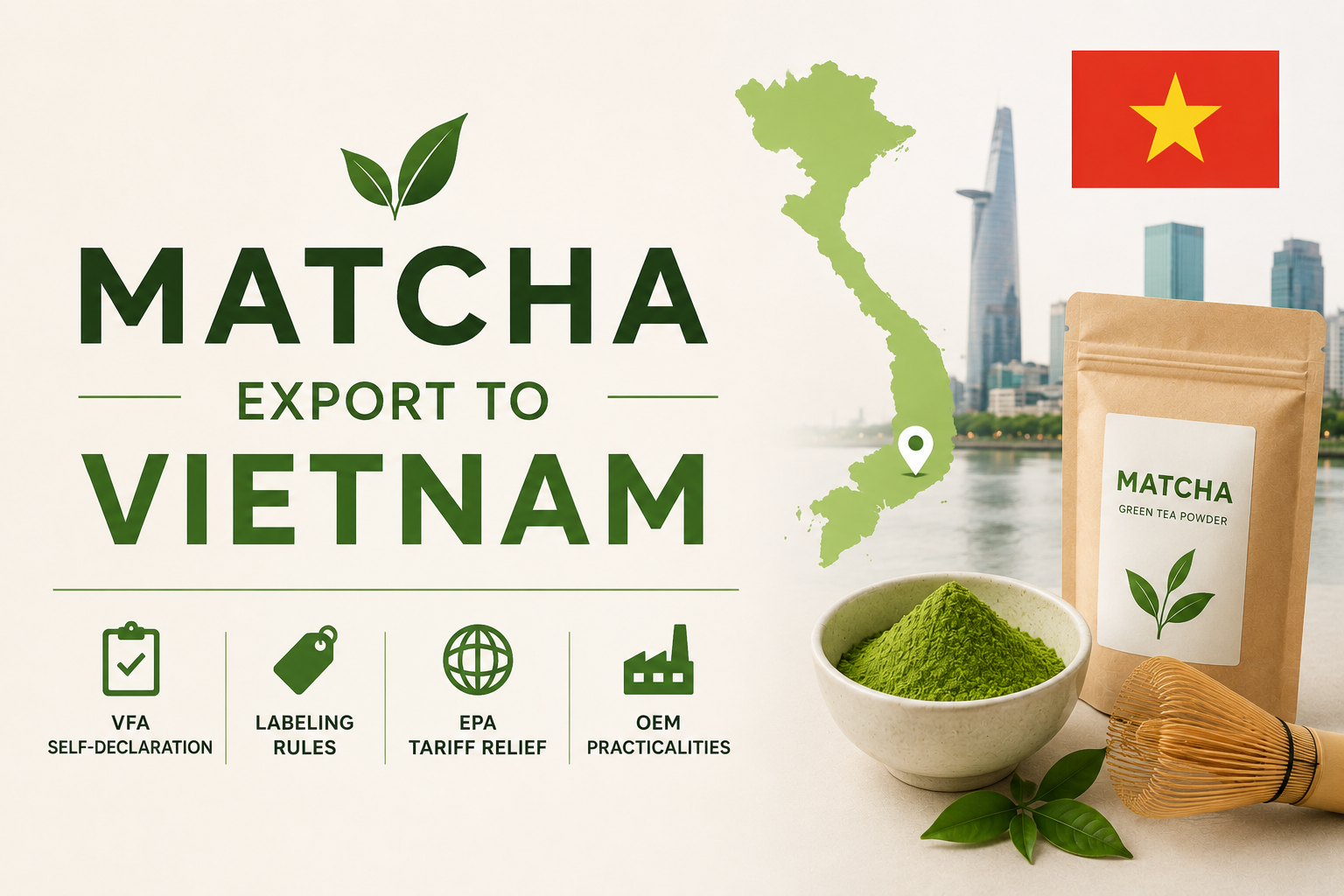
Vietnam is one of the most exciting emerging markets for Japanese matcha. Matcha lattes and café culture are expanding rapidly in Ho Chi Minh City, Hanoi, and Da Nang, driven by Gen Z consumers and SNS-led local brands. But getting Japanese matcha onto Vietnamese shelves is not just about price and quality — Vietnam’s import regime imposes a self-declaration process supervised by the Vietnam Food Administration (VFA), strict Vietnamese-language labeling under Decree 43/2017/ND-CP, and tariff classification at the HS code level. This guide breaks down the regulatory and operational realities of exporting matcha to Vietnam for B2B buyers and OEM businesses, with information current as of May 2026.
For Companies Seeking Matcha Powder
We source matcha from Japan’s premier production regions including Kyoto Uji, Kagoshima, Fukuoka, and Shizuoka, offering comprehensive grade ranges from organic JAS-certified ceremonial grade to processing-grade matcha.
Common Challenges:
- “We have projects but cannot secure stable matcha supply…”
- “We want to incorporate matcha into new café menu items!”
If you face these concerns, consult with Matcha Times. Feel free to contact us for initial inquiries.
\Read Also/
Why Vietnam Is the Most Promising Asian Frontier for Japanese Matcha

Vietnam is consistently cited as one of Southeast Asia’s fastest-growing matcha consumer markets. Matcha latte specialty shops and fruit-tea chains are multiplying in Ho Chi Minh City, Hanoi, and Da Nang, with Gen Z driving the café culture surge.
According to Vietnam’s General Statistics Office (GSO), the country has a population of roughly 100 million with an average age of about 33, and a growing middle class is spending more on small premium food and drink experiences [citation needed]. Major chains like Highlands Coffee, Phúc Long, and The Coffee House have made matcha drinks a fixture of their menus, while SNS-driven local brands continue to emerge.
On top of that, Japan and Vietnam are connected by two Economic Partnership Agreements — the Japan–Vietnam EPA (VJEPA, in force since 2009) and the ASEAN–Japan Comprehensive Economic Partnership (AJCEP, 2008) — plus CPTPP (in force in Vietnam since 2018). For matcha powder under HS codes 0902.10.10 / 0902.20.10, attaching the right certificate of origin can substantially reduce the effective tariff rate.
Demand spans both cost-conscious café-grade powder and premium retail tins, so suppliers can serve multiple buyer segments. Securing a Japanese supplier who can stabilize quality, compliance, and logistics together is the real entry point.
\Read More/
Why Matcha Exports to Vietnam Often Get Stuck — In Paperwork

Vietnam is not a market where “a good product sells itself.” The most common failure mode foreign buyers face is customs hold-ups caused by weak documentation.
Under Vietnam’s Law on Food Safety (Law 55/2010/QH12) and Decree 15/2018/ND-CP, every food product imported into Vietnam — including matcha powder — must be supported by a filed Product Self-Declaration (Bản tự công bố sản phẩm) before it can legally enter distribution.
Labeling rules (Nhãn hàng hóa) under Decree 43/2017/ND-CP are equally strict. Vietnamese-language labeling, nutrition facts, production and expiry dates (NSX / HSD), and importer information are all mandatory. Many shipments arrive in Vietnam carrying only Japanese-language labels, get held at customs, and incur extra costs for emergency relabeling on the ground.
Premium Vietnamese buyers who actively prefer Japanese matcha over Chinese alternatives are increasing — but trust evaporates the moment a shipment is delayed at customs. Confirming a supplier’s export documentation track record at the sourcing stage is the cheapest insurance you can buy.
Mapping Vietnam’s Food Import Regulatory Landscape

Multiple laws and agencies are involved in Vietnamese food imports. A bird’s-eye view helps you prioritize document preparation.
| Area | Legal basis / Agency | What this means for matcha exports |
|---|---|---|
| Food safety | Law on Food Safety 55/2010/QH12 / Ministry of Health (MOH) | General safety responsibility for all food products |
| Self-declaration | Decree 15/2018/ND-CP / VFA | Each product needs its own Bản tự công bố sản phẩm filing |
| Labeling | Decree 43/2017/ND-CP (amended by Decree 111/2021) | Mandatory Vietnamese-language label, expiry date, ingredients, importer info |
| MRLs | Circular 50/2016/TT-BYT, etc. | Must meet Vietnam’s MRL standards for tea |
| Customs & tariffs | Vietnam Customs (GDVC) / Customs Law | HS code classification, EPA certificates of origin |
| Optional certifications | Halal (HALCERT) / Organic (TCVN 11041) | Acquire as required by buyer specifications |
The central regulator is the Vietnam Food Administration (VFA / Cục An toàn thực phẩm), part of the Ministry of Health. VFA runs the self-declaration regime and conducts random inspections, with authority to halt distribution when filings or labels are non-compliant.
For dried, processed tea products like matcha, the three points authorities scrutinize most are: ingredient purity (no fillers or adulterants), heavy metals and pesticide residues, and microbiological safety (coliforms, salmonella, mold). Always pull a fresh certificate of analysis (COA) when ordering samples and confirm that values fall within Vietnamese limits.
VFA Self-Declaration: Documents, Timelines, and Costs

The first regulatory gate exporters hit is the Product Self-Declaration (Bản tự công bố sản phẩm) introduced under Decree 15/2018/ND-CP. The importer or local distributor takes responsibility for declaring to the provincial Food Safety Department that the product complies with Vietnamese food safety standards.
Documents commonly required

- Certificate of Analysis (COA) — ideally issued within the past 12 months
- Manufacturing process flow (HACCP / ISO 22000 / FSSC 22000 strongly preferred)
- Draft label (Vietnamese-language version with sample)
- Composition and nutrition information
- Manufacturer credentials (food manufacturing license, Organic JAS, Halal, etc.)
- Local distributor business registration (Vietnam side)
Documents are typically filed in Vietnamese or English with Vietnamese translation. COAs and labels may require notarization or consular legalization.
Standard turnaround is around 5 to 10 business days from a complete submission to acknowledgement, though requests for additional documents can stretch it to 2–4 weeks. The official filing fee is modest, but translation, notarization, and agent fees often push the total to roughly USD 700 to 2,000 per product [citation needed].
Whether your Japanese supplier can produce COAs and English- or Vietnamese-translated labels quickly has an outsized effect on filing speed. Picking a documentation-fast supplier is itself a Vietnam market entry strategy.
Vietnamese Labeling Pitfalls Under Decree 43/2017

The aspect of labeling most often underestimated is the list of mandatory items that must appear in Vietnamese under Decree 43/2017/ND-CP and its amendment Decree 111/2021/ND-CP. Missing even one item is enough for a shipment to be sent back at customs.
Mandatory Vietnamese-language items
- Product name (Tên hàng hóa)
- Ingredients (Thành phần)
- Net quantity / weight (Định lượng)
- Manufacturing date (NSX) and expiry date (HSD)
- Manufacturer and importer name and address
- Country of origin (Xuất xứ)
- Storage instructions (Hướng dẫn bảo quản)
- Usage instructions (Hướng dẫn sử dụng)
- Lot number (Số lô)
Customs officers and major Vietnamese retailers pay particular attention to the order of manufacturing and expiry dates, ingredient quantity ratios, and how importer information is presented.
Special caution is needed for overlabeling. Applying a Vietnamese-language sticker on top of an existing Japanese label is acceptable in principle, but if the sticker fully covers the original label, customs can flag it as obscuring or altering the original information. The cleaner approach is either a Vietnam-specific packaging run, or sticker placement designed from the start to comply with Decree 43.
Under Circular 29/2023/TT-BYT, nutrition facts panels are being phased in as mandatory for many food categories from 2025. For retail-sized matcha portions, declaring energy, protein, fat, carbohydrate, and sodium values is increasingly expected as best practice.
HS Codes, Tariffs, and How to Use Japan–Vietnam EPA Relief

HS code classification for matcha powder depends on product form. Misclassifying at shipment changes the applied tariff and can lead to costly post-clearance amendments — always align with the importer and customs broker beforehand.
| Product form | HS code | Notes |
|---|---|---|
| Green tea / unfermented tea (not yet powder) | 0902.10 / 0902.20 | Sub-headings vary by weight and packaging |
| Matcha powder (food grade) | 0902.20.10 / 0902.20.90 | Representative classification for tea powder |
| Processed tea beverage or premix ingredients | 2101.20 etc. | Classification shifts when blended with sugar or milk powder |
Pure tea powder and pre-blended premix powders are treated differently for both tariffs and EPA eligibility. Confirming the HS code jointly with the importer and customs broker before shipment avoids most disputes.
Vietnam and Japan share a bilateral EPA (VJEPA, in force since 2009) plus the multilateral AJCEP (2008) and CPTPP (in force in Vietnam since 2018). Using these agreements, Japanese matcha’s effective tariff can be reduced significantly below MFN rates. Specific rates vary by year, HS code, and agreement — always check the official Vietnam Customs portal (customs.gov.vn) for the latest figures.
To apply preferential tariffs, the shipment must include a Certificate of Origin. Use Form VJ or Form AJ under VJEPA / AJCEP, and Form CPTPP (including self-certification) under CPTPP. The Japan Chamber of Commerce and Industry (JCCI) issues these certificates; apply before shipping or within three business days of shipment for safety.
Seven Common Pitfalls That Trip Up Buyers

The following are the seven mistakes that recur most often in real Vietnam matcha exports. Most are avoidable if you know about them in advance.
- Forgetting to update the VFA self-declaration when changing recipe or manufacturer — flagged in random inspections and product is held
- Slow label proofs — Vietnamese translation back-and-forth pushes shipping schedules back by two months
- Self-assigned HS codes — importer and customs disagree, generating refund disputes
- Forgotten Certificate of Origin — Form VJ / AJ never issued, preferential tariff lost, effective cost overshoots
- Overlabeling that fully hides the original label — interpreted as label tampering and rejected
- Expired COA — COA crosses the 12-month threshold just before filing, forcing reanalysis and extending lead time
- Misperception versus Chinese-origin matcha — the buyer treats “matcha” as a single commodity, making the Japanese premium harder to defend in negotiations
Of these, items 1 through 6 are largely preventable by the Japanese supplier’s documentation discipline. Treating documentation as a core part of supply responsibility — rather than leaving it to the local partner — is the foundation of stable Vietnamese distribution.
Five Criteria Sharp Buyers Use to Pick Japanese Suppliers

Successful foreign buyers and OEM operators in Vietnam evaluate Japanese suppliers against a consistent set of criteria. These take priority over headline price.
- Documentation capability — Can the supplier deliver COAs, HACCP / ISO 22000, Organic JAS, and label translations in one place?
- Origin-to-application matching — Café latte uses cost-conscious grades, premium retail uses Uji / Nishio, confectionery and OEM benefit from Shizuoka / Kagoshima’s strong color profile. Can the supplier propose origin and grade combinations by application?
- EPA / Certificate of Origin literacy — Experience issuing Form VJ / AJ / CPTPP and advising importers on the right scheme
- Lot stability — Same specification, every month, anywhere from 10 kg to 1 t (including peak periods such as Christmas and Tet)
- Claims and traceability — Lot-level tracing, fast response to random inspections, and documented corrective actions
Japanese suppliers who win in Vietnam win on documentation and traceability, not on price. Chasing short-term price advantages is less effective than building a “ready to clear customs at any time” position through strong documentation discipline.
Why Buyers Choose Japan Matcha Export Organization Co., Ltd. — Three Strengths

Three strengths set Japan Matcha Export Organization Co., Ltd. apart for buyers across Vietnam and the rest of Asia.
1. Application-optimized origin proposals from Japan’s leading tea regions
With a sourcing network spanning Uji, Nishio, Shizuoka, Kagoshima, and Yame, the company matches origin and grade to the buyer’s specific application (café latte, premium retail, confectionery OEM, supplement ingredient) and target market. Practical briefs such as “500 kg per month of a strong-color, balanced-bitter food service grade for Vietnamese café chains” are well within scope.
2. Full compliance with EU, US FDA, Taiwan TFDA, Singapore SFA, Vietnam VFA, and more
Documentation — COA, MRL analysis, HACCP / ISO 22000, Organic JAS, Halal certification — is delivered in one place. For Vietnam specifically, support includes templates and procedural guidance for VFA self-declaration filings, Decree 43/2017-compliant labels, and EPA certificates of origin (Form VJ / AJ / CPTPP), backed by prior export track records.
3. B2B-only: stable supply from 10 kg to 1 t per month, served to buyers in 20+ countries
Export experience spans Southeast Asia (including Vietnam), the EU, the Middle East, North America, and East Asia — buyers in more than 20 countries. Volumes scale from a 10 kg trial lot to consistent multi-ton monthly supply for café chains. The team is also experienced with Vietnam-specific seasonality such as Tet (Lunar New Year) demand peaks and the rainy-season logistics window.
The Sourcing Workflow That Gets You to Vietnam Faster

Below is the workflow most successful Vietnam-bound matcha imports follow from first contact to stable monthly supply. Allow 2 to 4 months for the first commercial lot to land.
- Sample request (0–2 weeks) — Share application, price target, and sales region → receive three origin / grade candidates → local cupping and recipe testing
- Document pre-check (2–4 weeks) — Collect COA, MRL analysis, HACCP / ISO 22000 → list documents needed for VFA self-declaration → translate the draft label into Vietnamese
- VFA self-declaration filing (2–6 weeks) — Submit to the provincial Food Safety Department → receive acknowledgement → link to lot numbers
- Production order and Certificate of Origin (4–8 weeks) — Issue purchase order → production and shipment prep → obtain Form VJ / AJ / CPTPP
- Shipping and customs clearance (4–6 weeks) — Ocean freight (temperature-controlled containers recommended) → Vietnam customs document check → on-site label inspection
- Market launch and recurring orders — Move into stable lot supply (monthly or bi-monthly purchase planning)
A documentation-strong Japanese supplier can compress this timeline by more than a month. A documentation-weak supplier can drag it out close to six months on the first lot alone.
Learn More About Global Matcha Trends at Matcha Times

UK-spreading matcha booms result from overlapping health consciousness, Japanese culture popularity, and lifestyle transformations. However, matcha’s appeal and potential still lie ahead. Knowing latest trends across countries and Japanese tea region initiatives reveals matcha’s deeper dimensions.
Matcha Times broadly publishes from matcha market analysis to cafe situations and farmer interviews. Won’t you also take this opportunity to deeply explore matcha’s world? The more you know matcha, the more surely its charm will draw you in.
Final Thoughts: In Vietnam, Documentation Wins
Vietnam offers some of Asia’s most attractive matcha demand growth, but its regulatory bar — VFA self-declaration, Decree 43/2017 labeling, EPA certificates of origin — is one notch higher than the rest of ASEAN.
Flip that perspective, and Vietnam becomes a market where documentation discipline still differentiates you because the field is not yet saturated. The decisive question is whether your Japanese supplier can take end-to-end ownership of documentation. Price matters less than paperwork; cost matters less than reliability. That is what winning in Vietnam looks like.
Looking for wholesale or OEM matcha samples? Contact us — we will recommend the optimal origin and grade based on your application and target markets, and support you through Vietnam’s full export documentation (VFA self-declaration, Decree 43 labeling, and EPA certificates of origin).
Japan Matcha Export Organization Co., Ltd.
Related Articles