Japanese Matcha Supplier in Washington: B2B Sourcing Guide for Cafés & Brands
Choosing a matcha supplier Washington cafés, drinks brands, and food manufacturers can rely on comes down to one honest truth: there is no single “best” vendor — only the right source for your grade, volume, and compliance responsibilities. A Washington buyer typically chooses among three source types: a tea farm or producer, a processor or miller, or a trading company or importer. Match that choice to how much you buy, how consistent your lots must be, and who will act as the importer of record.
This guide walks through each option, the documents a credible supplier provides, the US import rules you own as the buyer, and the Washington-specific logistics — Pacific-gateway ports and state repackaging licensing — that most national sourcing guides skip.
For Companies Seeking Matcha Powder

We source matcha from Japan’s premier production regions including Kyoto Uji, Kagoshima, Fukuoka, and Shizuoka, offering comprehensive grade ranges from organic JAS-certified ceremonial grade to processing-grade matcha.
Common Challenges:
- “We have projects but cannot secure stable matcha supply…”
- “We want to incorporate matcha into new café menu items!”
If you face these concerns, consult with Matcha Times. Feel free to contact us for initial inquiries.
\Read Also/
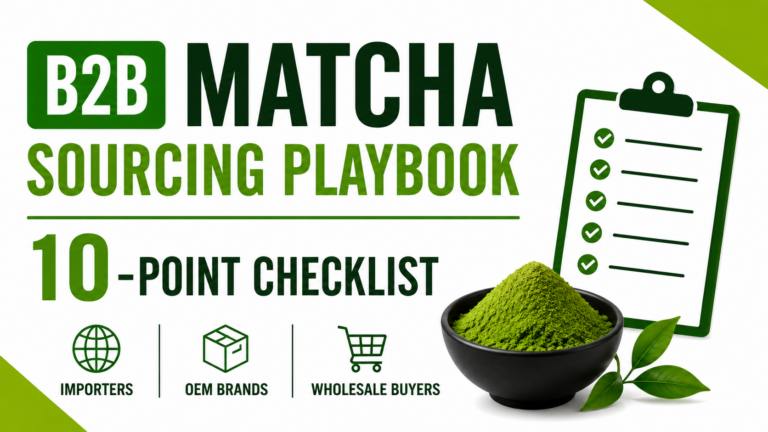
Key Takeaways for Washington Matcha Buyers
- There is no universal “best” supplier — pick the source type that fits your grade, volume, and compliance role (farm, processor, or trading company).
- Green tea including matcha (HTS heading 0902) enters the US duty-free (0%) at the MFN base rate, per the USITC tariff schedule; any country-level reciprocal measure is separate and time-varying.
- As the US importer you generally own %s under the FDA’s Foreign Supplier Verification Program — a good supplier makes this easy with documentation.
- Insist on a batch-specific Certificate of Analysis (COA) covering pesticide residues, heavy metals, and microbiology before you book freight.
- If you repackage or blend matcha in Washington, you likely need a food-processor license from the WSDA.
- JMEX bridges origin and buyer on the export side — origin selection, grade design, certifications, and customs documents — with an export track record to 43 countries.
\Read More/
Who should a Washington buyer source matcha from?
Start by naming the source type, because it changes price transparency, minimums, and how much of the compliance work lands on you. In practice most Washington cafés and brands weigh three options.
| Source type | What they are | Best fit | Trade-off to understand |
|---|---|---|---|
| Tea farm / producer | Grows the tencha leaf and often mills it in-house | Buyers who want single-origin story and traceability | May not export directly or handle US paperwork; language and MOQ hurdles |
| Processor / miller | Sources leaf and stone-mills to spec | Brands needing a consistent, grade-designed blend | Origin can vary batch to batch unless the lot is specified and documented |
| Trading company / exporter | Curates producers and manages export docs, COA, logistics | Importers and multi-café operators who value one accountable partner | Adds a margin layer; vet that they have direct producer relationships, not a re-seller chain |
A quick test for any of them: can the supplier name where the leaf was grown, where the tencha was processed, and where the final milling and packing happened? If the answer is written, specific, and batch-linked, you are talking to a direct partner. Vague replies (“sourced from Japan,” “our partner handles that”) usually signal an intermediary you cannot audit.
Matching supplier type to your buyer size
The right structure depends far more on your monthly volume and how you use the matcha than on any brand name. Use these rough profiles as a starting point, then confirm minimums and lead times in writing.
- Single café or small multi-store: Prioritise batch consistency and colour/flavour stability for lattes; a processor or a trading company with grade-designed culinary and ceremonial lines is usually the cleanest fit.
- Regional wholesaler or distributor: You are likely the importer of record — favour a partner who supplies COA, organic certificates, and customs documentation, and who can hold a stable monthly volume.
- Drinks brand, RTD, or protein/CPG maker: Particle size, dispersion, and heat/colour stability matter more than ceremony; specify these as measurable acceptance criteria and require per-lot testing.
- Private-label / OEM project: A private-label or OEM-capable processor or trading company that can design grade and packaging to your brief will save you the most operational friction.
Verifying quality: COA, certifications, and lot consistency
Quality claims mean little without documents that tie to the exact lot you receive. Before committing, confirm the supplier can provide the following for your shipment’s specific batch — not a generic sample or a marketing sheet.
| Document / signal | What to verify | Why it matters for a WA buyer |
|---|---|---|
| Batch COA | Pesticide residues, heavy metals, microbiology, moisture, particle size | Supports your FSVP file and protects against adulteration claims |
| Organic certificate | Valid certificate traceable to the exact product and batch | Required to label or sell as organic in the US (see NOP below) |
| Food-safety certification | A GFSI-recognised scheme (e.g. FSSC 22000) at the processing site | Signals a mature, auditable food-safety system |
| Traceability record | Leaf origin → tencha processing → milling → packing chain | Lets you confirm single-origin and reproduce a lot |
| Sample-to-order match | Retain a sealed reference sample from the approved sample lot | Your basis for rejecting an off-spec production run |
Grade language such as “ceremonial” is a marketing term, not a legal standard in the US, so treat it as a description to verify by tasting and testing, not as a regulated guarantee. Anchor acceptance to measurable attributes and the COA instead.
US import rules a Washington buyer owns
Washington sits at the US border for Pacific trade, but the import obligations are federal and apply wherever your matcha lands. Three points matter most, and each ties to a primary source.
Import duty and tariff classification
Green tea, including matcha, is classified under HTS heading 0902 and enters the United States duty-free (0%) at the MFN base rate, according to the US International Trade Commission Harmonized Tariff Schedule. Any country-level “reciprocal” surcharge announced in 2024–25 is a separate, time-varying measure — confirm current applicability with a licensed customs broker rather than treating it as the product duty.
FSVP and food-facility registration
Under the FDA’s Foreign Supplier Verification Program (FSVP), the US importer must verify that a foreign supplier produces food meeting US safety standards and that the product is not adulterated or misbranded for allergens. The Japanese facility must also be registered with the FDA and file Prior Notice for shipments. A supplier who already maintains these records makes your FSVP file straightforward.
Organic labelling
To sell or label matcha as organic, the product must meet the USDA National Organic Program (NOP) requirements. Ask for an organic certificate that traces to the specific lot; a certificate for the producer “in general” is not enough for a batch you intend to label organic.
Washington-specific logistics: ports and repackaging
This is where a state-level guide earns its keep. Two Washington realities shape a practical sourcing plan and rarely appear in national supplier pages.
- Pacific gateway ports: The Seattle and Tacoma gateways (operated jointly as the Northwest Seaport Alliance) are a natural Pacific entry point for Japanese-origin cargo, which can shorten inland transit for Washington buyers compared with routing through other coasts. Confirm cold-chain handling for matcha, which is heat- and light-sensitive.
- State repackaging licence: If you take matcha from bulk and repackage, blend, or re-label it in Washington, that activity is food processing. Per the Washington State Department of Agriculture (WSDA), drying, blending, packaging, and repackaging tea generally require a state Food Processor License, with a facility inspection.
Deciding early whether you will import finished retail packs or bulk-and-repack changes both your supplier brief and your Washington licensing path — settle it before you request quotes.
The Washington matcha buyer’s supplier checklist
Use these criteria to evaluate any supplier on equal terms, including JMEX. They are drawn from this article’s topic — sourcing for a US state buyer — not a fixed template, and none of them ranks or scores a named competitor.
| Criterion | What to verify with any supplier |
|---|---|
| Origin transparency | Named region and producer; leaf-to-packing traceability on request |
| Grade fit | Ceremonial vs culinary matched to your application, confirmed by a sample |
| Documentation | Batch COA, organic/JAS certificates, food-safety certification |
| Import support | Willingness to supply FSVP-ready records and correct HTS/customs paperwork |
| Consistency | A retained reference sample and per-lot testing to hold the spec |
| Supply stability | A realistic, written monthly capacity and lead time for your volume |
| Pricing transparency | A clear trade condition (FOB/CIF/EXW) with the quote — not a bare per-kg number |
Questions to ask any matcha supplier
Send these before you request a formal quote; the quality of the answers tells you as much as the price.
- Where was the leaf grown, where was the tencha processed, and where was it milled and packed?
- Can you provide a batch-specific COA for my shipment covering pesticide residues, heavy metals, and microbiology?
- Are you FDA-registered, and can you support my FSVP records and Prior Notice?
- If I need organic, can you supply a certificate traceable to the exact lot?
- What is your realistic monthly capacity, lead time, and trade condition for my volume?
- Will you retain a sealed reference sample so I can hold production to the approved sample?
A step-by-step sourcing flow
A repeatable process keeps a Washington sourcing project from stalling at the sample stage.
- Define your application, target grade, and monthly volume, and decide import-finished vs bulk-and-repack.
- Shortlist supplier types (farm, processor, trading company) that fit that brief.
- Request samples plus a batch COA and certificates; taste and test against your acceptance criteria.
- Confirm the import path: importer of record, FSVP records, HTS classification, and Prior Notice.
- Settle Washington licensing (WSDA food-processor licence if you repackage or blend).
- Place a trial order, retain a sealed reference sample, and verify the production lot matches it before scaling.
Why Buyers Choose JMEX (Japan Matcha Export Organization)

JMEX (the Japan Matcha Export Organization) is built to solve the export-side problems above so a Washington buyer does not have to assemble them piece by piece. Rather than acting as a re-seller, JMEX works from origin: origin selection, grade design for your application and target market, COA and MRL support, organic and halal certification coordination, and the customs documentation US import requires.
That export-side capability is backed by an export track record to 43 countries, so a café group in Seattle, a wellness brand, or a protein maker gets a single accountable partner for origin, grade, documents, and stable monthly supply — and the checklist above applies to JMEX on exactly the same terms as any other supplier.
FAQ: Sourcing matcha in Washington
Short, direct answers to the questions Washington cafes and brands ask most when choosing a Japanese matcha supplier — each linked to the primary source behind it.
Do I need FSVP to import matcha into Washington?
In most cases, yes. If you are the US importer, the FDA’s Foreign Supplier Verification Program generally requires you to verify your foreign supplier and keep records. A supplier that already provides COA, facility registration, and traceability makes compliance far simpler.
Is Japanese matcha subject to US import duty?
Green tea including matcha (HTS heading 0902) enters the US duty-free at the MFN base rate, per the USITC Harmonized Tariff Schedule. Treat any 2024–25 country-level reciprocal surcharge as a separate, time-varying measure and confirm it with a customs broker.
What certificate proves matcha is organic for US import?
A valid organic certificate that traces to the specific product and lot, meeting the USDA National Organic Program. A general producer certificate is not sufficient for a batch you intend to label organic.
What should a matcha COA include?
At minimum, batch-level results for pesticide residues, heavy metals, and microbiology, plus moisture and particle size. It should reference the exact lot number on your shipment, not a generic sample.
Do I need a Washington State licence to repackage matcha?
If you dry, blend, package, or repackage matcha in Washington, that is food processing and generally requires a WSDA Food Processor License with a facility inspection, per the Washington State Department of Agriculture. Importing sealed retail packs for resale is treated differently — confirm your specific case with WSDA.
How do I confirm the sample equals my bulk order?
Approve a sample lot, keep a sealed reference sample, and require a batch COA plus a retained supplier sample for the production run. Compare colour, aroma, taste, and the COA before you accept and scale.
Researched and reviewed by the Matcha Times Editorial Team, operated by the Japan Matcha Export Organization (JMEX). Last reviewed: 2026-09-22. See our Editorial Policy and Sources & Methodology. Found an error? Tell us.
Sources & Methodology
This article contains no proprietary Matcha Times or JMEX dataset; every quantitative claim is drawn from the external primary or official sources listed below, and each source states what it supports, its period, and its scope. Regulatory and duty points were verified against the current government pages on the date shown; grade and pricing statements are kept qualitative unless tied to a cited source.
- US International Trade Commission — Harmonized Tariff Schedule (ch. 9, heading 0902) — supports the duty-free (0%) classification of green tea incl. matcha under HTS heading 0902 (2026, US import duty).
- US FDA — Foreign Supplier Verification Programs (FSVP) — supports the US importer’s duty to verify foreign suppliers (FSMA final rule, US food import compliance).
- US FDA — Registration of Food Facilities — supports foreign facility registration and Prior Notice obligations.
- USDA Agricultural Marketing Service — National Organic Program — supports the organic labelling requirement for US import (US organic certification).
- Washington State Department of Agriculture — Food Processing Plant License — supports the statement that repackaging or blending tea in Washington requires a state food-processor licence.
- Japan Ministry of Finance Trade Statistics (via Nippon.com) — supports the context figure that Japan’s green tea exports (all forms, not matcha-only) reached a record ¥36.4 billion / 8,798 t in 2024.
Learn More About Global Matcha Trends at Matcha Times

Matcha Times is a specialist media platform covering the global matcha market — sourcing and wholesale, supply and pricing, trade and regulations, production and origins, and the companies shaping the industry.
From market analysis and price trends to café case studies and interviews with tea farmers, we help buyers, importers, distributors, and manufacturers stay ahead of where matcha is heading. Explore more and put the global matcha market to work for your business.
Conclusion
When origin, grade, and export conditions align, matcha becomes a stable revenue source. Start by defining your requirements and confirming quality with a sample.
Looking for wholesale or OEM matcha samples? Contact us — we will recommend the optimal origin and grade based on your application and target markets.
Related Articles