Matcha Wholesale Phoenix: Japanese Supply, MOQ, Price & Delivery Guide
Buying wholesale matcha in Phoenix comes down to three decisions and one condition the desert forces on all of them: which channel you source from, how big an order your turnover can clear, how a Japanese shipment physically crosses the Southwest to reach you — and, underneath all three, how you keep a heat-sensitive powder from cooking on the way in. Arizona has no seaport of its own, so matcha lands on the West Coast and travels inland to the Valley; and because Phoenix summers stay above body temperature for months, temperature control is the whole game, not a footnote. Price, meanwhile, follows grade, origin and order size rather than your zip code, easing per kilogram as your order clears each seller’s minimum. Below we work through the MOQ logic, the honest price drivers, the distributor-versus-Japan-direct call, how a container actually reaches landlocked Phoenix, the Arizona and federal paperwork, and a checklist you can hold any vendor to.
For Companies Seeking Matcha Powder

We source matcha from Japan’s premier production regions including Kyoto Uji, Kagoshima, Fukuoka, and Shizuoka, offering comprehensive grade ranges from organic JAS-certified ceremonial grade to processing-grade matcha.
Common Challenges:
- “We have projects but cannot secure stable matcha supply…”
- “We want to incorporate matcha into new café menu items!”
If you face these concerns, consult with Matcha Times. Feel free to contact us for initial inquiries.
\Read Also/
Key takeaways for Phoenix matcha buyers
- Phoenix is a landlocked desert distribution hub: there is no Arizona seaport, so Japan-direct matcha arrives at the Ports of Los Angeles and Long Beach and rails east to the Valley — Union Pacific’s Phoenix Intermodal Terminal now runs that lane from the ports complex seven days a week.
- The single biggest Phoenix-specific risk is heat: matcha degrades with heat, light and oxygen, so a long overland leg in summer and ambient storage are where colour and aroma quietly die — plan the whole chain around temperature control.
- Your first commercial decision is the channel: a distributor holding US stock for quick local delivery on a low minimum, versus a Japan-direct exporter for origin and grade control and better unit economics once volume is steady.
- Per-kilogram price is set by grade, origin, harvest, order size and packaging — never by being in Phoenix — so read every quote as a quotation item and confirm its trade condition (FOB/CIF/wholesale) before comparing.
- Green tea, matcha included, enters the US duty-free under HS/HTS heading 0902; confirm the current line and any country-level measure with a customs broker before modelling landed cost.
- Arizona runs resale on the Transaction Privilege Tax and Form 5000A, while Maricopa County — not the state — permits your food establishment; size your MOQ to monthly turnover and store it cool, airtight and dark.
Researched and reviewed by the Matcha Times Editorial Team, operated by the Japan Matcha Export Organization (JMEX). Last reviewed: 2026-10-07. See our Editorial Policy and Sources & Methodology. Found an error? Tell us.
\Read More/
Why wholesale matcha demand keeps climbing across the Valley of the Sun
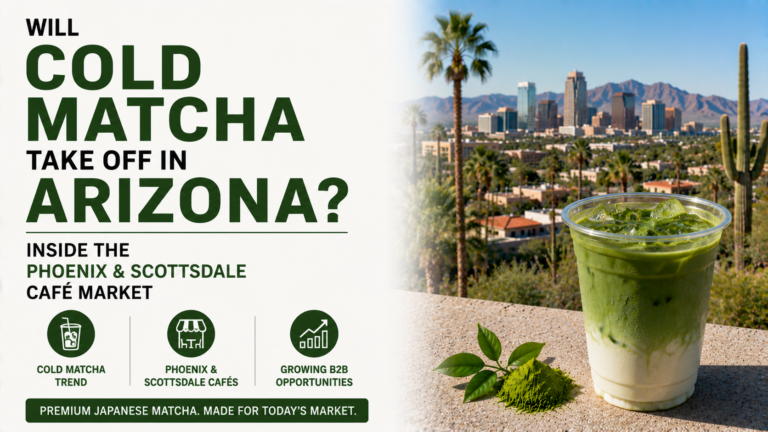
Phoenix is one of the fastest-growing metros in the country, and matcha has ridden that growth into everyday menus. A young, health-minded population, the enormous Arizona State University student base in Tempe, the resort and upscale-cafe culture of Scottsdale, and a dense spread of independent coffee bars and juice shops across Mesa, Chandler, Gilbert and central Phoenix have all folded matcha in. The desert climate nudges that demand in a particular direction: for much of the year drinks are iced and blended, so matcha most often shows up as cold lattes, shaken iced matcha and frozen formats rather than hot bowls.
For a wholesale buyer that spread signals durable, repeat demand rather than a fad. A Scottsdale cafe restocking every few weeks, a Valley-wide drink brand scaling a line, and an Arizona food manufacturer formulating at volume each need the same thing delivery after delivery — consistent colour, flavour and particle spec, arriving in good condition despite the heat, with paperwork that survives inspection. A catalogue-only seller with no origin story and no handle on temperature rarely sustains that through an Arizona summer.
Wholesale matcha and the MOQ a Phoenix buyer should expect
Wholesale matcha is bulk, unbranded or private-label powder sold at trade pricing for resale, food service or manufacturing — not retail tins pulled off a shelf. Two seller types dominate: distributors that carry US inventory and deliver into the Valley quickly, and Japan-direct exporters that mill and ship from Japan. They treat minimum order quantities very differently, and the minimum you accept shapes both your cash position and your unit cost.
Distributors usually keep entry minimums light, so a single Phoenix cafe or an early-stage brand can start without locking up much capital. Japan-direct exporters ask for more, because they are producing or blending to your specification and moving goods across an ocean. Neither model is better in the abstract. The right MOQ is simply the quantity your monthly turnover clears inside the freshness window — and in Phoenix that window is shorter than most buyers assume, because ambient desert heat accelerates the fade once a bag is opened and stored warm.
For a buyer that means to grow, a sensible route is to trial a small lot, confirm grade and per-lot documentation, then step up to a standing replenishment order that unlocks volume pricing once throughput is proven. Because the Valley is ringed by large, modern, climate-controlled distribution space, moving later to larger, less frequent replenishment is an operational tweak rather than a change of strategy — provided the storage is genuinely cooled, not just covered.
Matcha wholesale price in Phoenix: what really sets the cost
There is no single “Phoenix price” for wholesale matcha. The per-kilogram number a supplier quotes is built from grade, origin, harvest timing and processing, then adjusted for order size and packaging. Because each lever moves independently, a credible supplier quotes against your spec instead of posting one flat rate — and for an inland desert buyer, the delivered cost also carries an overland and cold-handling component that a coastal buyer barely notices.
The levers that move the per-kilogram price
- Grade — ceremonial, latte and culinary sit in distinct price bands for the same weight.
- Origin and harvest — named single-origin leaf such as Uji or Yame, and first-harvest lots, command more than later-harvest blends.
- Order volume — the figure steps down as you pass each seller’s thresholds, which is where Japan-direct economics start to win.
- Packaging format — bulk food-grade bags cost less per kilogram than retail-ready tins or single-serve sachets.
- Currency, freight and inland haul — on a Japan-direct order the exchange rate, ocean freight and the inland rail-and-drayage leg to Phoenix move your landed cost separately from the FOB unit price.
| Grade tier | Typical Phoenix use | Relative cost & volume behaviour (request a current quote) |
|---|---|---|
| Ceremonial | Straight whisked matcha, Scottsdale resort and premium cafe menus, retail tins | Highest per-kg; widest gap between a trial kilo and a contract lot; most sensitive to origin and harvest |
| Latte / barista | Iced and blended Valley cafe lattes, shaken matcha, RTD and bottled beverages | Mid-range; the everyday foodservice workhorse; real per-kg savings at case and contract volume |
| Culinary | Baking, gelato and ice cream, dessert production, protein and Arizona food manufacturing | Lowest per-kg; the largest orders and deepest breaks; confirm colour and particle spec for your process |
Two cautions as you weigh offers. First, never read a retail tin price as a wholesale one, and never fuse a price from one source to an MOQ from another as if they were a single quote. Second, a Japan-direct FOB price only becomes comparable to a delivered Phoenix price once you add ocean freight, the HS 0902 duty line, the rail move from the coast and your local drayage and handling on top of the FOB figure.
Distributor or Japan-direct import for a Phoenix operation?
Both channels supply the same product classes; they diverge on speed, control, MOQ and economics. Many distributors hold US stock and ship into the Valley on short lead times, which suits a cafe or a young brand testing a menu. Japan-direct supply trades a longer first lead time for origin control and stronger unit economics once volume is steady — and because the LA/Long Beach-to-Phoenix rail lane is now a well-worn, daily route, the inbound leg is a planning exercise rather than a barrier for an inland buyer.
| Decision factor | Distributor (US-stocked) | Japan-direct exporter |
|---|---|---|
| Entry MOQ | Low — start with a small lot | Higher — milled or blended to your spec |
| Lead time | Fast Valley delivery from US stock | Longer first order; shorter on replenishment once the lane is set |
| Per-kg economics at volume | Margin already built in | Stronger as volume crosses thresholds |
| Origin / grade control | Limited to the distributor’s catalogue | You specify origin, grade and blend |
| Heat handling in transit | Depends on the distributor’s own storage and courier | You can specify cool-chain handling from port to Phoenix |
| Compliance ownership | Distributor is often the importer of record | You become the FSVP importer — plan for it |
A common path is to prove the menu or product with a distributor, then move volume Japan-direct once throughput justifies the minimum and you want origin and grade control. Settle the inbound lane and the cool-handling plan with a freight forwarder early; across the desert, how the goods are kept cool between the coast and your door matters as much as how fast they arrive.
How a landlocked Phoenix buyer actually receives imported matcha
Here is the part national supplier pages skip, and where Phoenix is genuinely different: there is no port in Arizona. A Japan-direct container does not sail to Phoenix — it arrives on the West Coast at the Ports of Los Angeles and Long Beach, the main gateways for trans-Pacific freight, and then has to cross the desert to reach the Valley.
Increasingly that last stretch is done by rail. Union Pacific’s Phoenix Intermodal Terminal, which opened in 2024, pulls containers directly from the Southern California ports complex and runs that service seven days a week, moving freight off the Interstate 10 truck lanes and into the fast-growing desert market. From the terminal, local drayage carries the box the final miles into the West Valley and Laveen warehousing belt that has grown up around Phoenix’s distribution economy. For most inland buyers the practical sequence is ocean to Los Angeles or Long Beach, rail to Phoenix, then a short truck move to a local warehouse.
This is where the desert heat turns from a cliche into an operating constraint. Every one of those legs can bake a pallet: a container standing in a Southern California or Arizona yard, an un-refrigerated rail or truck move, and a warehouse that is merely roofed rather than cooled. Matcha arriving warm has already lost some of the colour and aroma you are paying a premium for. The fix is to specify temperature-controlled handling across the whole chain where it matters, and to hold stock with a climate-controlled 3PL a short drive from your cafe or production line — a buffer-stock approach that protects freshness and smooths replenishment. Let your freight forwarder confirm the actual lane, terminal and clearance for your season, because sailing schedules, port congestion and your FSVP status all govern transit; the structural point is simply that an inland desert buyer must own the heat question that a coastal buyer can largely ignore.
Arizona and federal compliance for wholesale matcha in Phoenix
Compliance works on two levels: state and county food rules if you handle, store, sell or make food in Arizona, and federal import rules if you import Japan-direct. Keeping them apart prevents both over-engineering and gaps — and Arizona arranges its state layer in a couple of ways that catch out-of-state buyers off guard.
Maricopa County permits your food establishment, not the state
Arizona sets its food-safety framework through the Arizona Department of Health Services, but the actual establishment permits are issued and inspected at the county level. For the Phoenix metro that authority is the Maricopa County, Environmental Services Department. Its permit categories matter for wholesale: a business that stores and distributes food it did not make on the premises falls under the county’s “food jobber” wholesale category, while an operation that manufactures, packs, labels or stores food is handled as a food-production establishment. If you blend, pack, warehouse or distribute matcha you are generally in one of those county programmes and subject to routine inspection; if you only sell finished drinks or tins to consumers you are a different, retail category. Confirm your exact permit against what your operation actually does.
Arizona Transaction Privilege Tax and the Form 5000A resale certificate
Arizona does not levy a conventional sales tax; it levies a Transaction Privilege Tax (TPT) on the seller for the privilege of doing business, which the seller typically passes on. For a wholesaler buying stock to resell, the mechanism to buy tax-free is the Form 5000A — the Arizona Resale Certificate. You register for a TPT licence, then furnish Form 5000A to your supplier with your TPT licence number so that inventory bought for resale is purchased without the tax. A few Arizona quirks are worth knowing: the certificate is given to the vendor rather than filed with the state, it requires a valid TPT (or another state’s) licence number, and the vendor may accept it in good faith for a defined period. Confirm the setup against your specific business model.
FDA FSVP when you import Japan-direct
Import matcha straight from Japan and you are generally the FSVP importer under the US FDA’s Foreign Supplier Verification Programs rule. FSVP requires you to verify that your foreign supplier produces food meeting US safety standards, and to be identified at entry. In practice that is answerable with the export-side documentation a capable supplier already keeps: per-lot certificates of analysis, residue (MRL) and heavy-metal testing, and a documented food-safety process.
Duty and HS classification
Green tea, matcha included, is classified under heading 0902 of the US Harmonized Tariff Schedule, where the most-favoured-nation base rate is duty-free. Any country-level or “reciprocal” measure is separate, time-varying and should be confirmed with a customs broker — never assume it is the matcha product rate. A duty-free base line helps landed-cost planning, but ocean freight, the exchange rate, the rail move inland and your Valley drayage and handling still apply.
How to order wholesale matcha in Phoenix, step by step
A disciplined ordering sequence protects both your cash and your shelf life. The aim is to lock grade, documentation and heat handling on a small commitment before you scale to recurring volume.
- Send a specification-led inquiry — state your target grade, monthly volume, packaging format, delivery point and any cool-chain requirement so the supplier quotes against your spec.
- Request a sample — judge colour, aroma, particle fineness and how it behaves in your actual iced or blended recipe, not just a hot whisk.
- Check the COA — review the per-lot certificate of analysis, including residue and heavy-metal results, before any volume commitment.
- Lock the terms — confirm the trade condition (FOB/CIF/wholesale), lead time, the inbound rail-and-drayage lane, temperature handling and replenishment cadence in writing.
- Place a staged first order — begin with a quantity you can turn over inside the freshness window, then scale as throughput and the price breaks justify it.
A vendor-neutral checklist for any matcha supplier
Apply the same criteria to every supplier — distributor or Japan-direct exporter, JMEX included. A strong vendor answers all of these without friction.
| Criterion | What to verify with any supplier |
|---|---|
| MOQ and volume breaks | The real minimum and how per-kg price changes as volume rises |
| Grade and origin options | Which grades and origins are available, and whether they are named and consistent |
| Per-lot COA | Residue (MRL) and heavy-metal testing provided per lot, not a single one-off certificate |
| Inbound lane and lead time | Which coast port and rail routing is used into Phoenix, first-order lead time, and whether replenishment cadence is predictable |
| Heat and storage handling | Whether temperature-controlled transport and climate-controlled storage protect colour and flavour across the desert leg |
| Export / import documentation | Who handles customs paperwork and whether FSVP-relevant records are supplied |
| Pricing transparency | Quote stated with its trade condition (FOB/CIF/wholesale), not a bare number |
Common risks for Phoenix matcha buyers — and how to de-risk
- Price mismatch — reading a retail or single-kilo price as a contract rate. Fix: always quote at your real volume with the trade condition named.
- Over-ordering — committing to an MOQ that outlasts matcha’s freshness window, which the desert shortens. Fix: match the MOQ to monthly throughput and store airtight, cool and dark.
- Heat damage — letting the powder bake on a hot overland leg or in an un-cooled warehouse. Fix: specify temperature-controlled handling from the coast and a climate-controlled 3PL in the Valley.
- Routing assumption — assuming a routing or terminal without confirming it on an inland lane. Fix: let a freight forwarder confirm the port, rail routing and clearance for your season.
- Compliance gap — importing Japan-direct without an FSVP plan. Fix: assign importer-of-record responsibility and collect supplier verification up front.
- Permit gap — trading as an Arizona food business without the right permit or resale setup. Fix: confirm the Maricopa County food-establishment permit for your model and register for a TPT licence and Form 5000A before you trade.
How Japan-direct supply works for Phoenix buyers
A capable export partner removes most of the friction above. The Japan Matcha Export Organization (JMEX), backed by an export track record to 43 countries, selects origin and grade from across Japan, scales lots from a small trial to stable volume supply, and prepares the per-lot COA, residue analysis and customs documentation that make an FSVP import into Arizona straightforward. Paired with a cool-handled rail lane from the Los Angeles and Long Beach ports and a climate-controlled warehousing buffer in the Valley, that export-side capability — not a headline unit price — is what keeps freshness, replenishment and landed cost predictable through a Phoenix summer.
Sources & Methodology
This guide synthesises US federal, Arizona state, Maricopa County and rail-carrier sources. Each source below states what it supports, with scope. No per-kilogram matcha price is presented as a fixed fact — pricing is described qualitatively because it varies by provider, grade definition and order size — and numeric trade, tax and logistics facts are attributed to their authority for verification.
- USITC Harmonized Tariff Schedule (heading 0902) — US customs classification of tea; the green tea/matcha MFN base rate is duty-free (confirm the current line and any country-level measure with a customs broker).
- US FDA — Foreign Supplier Verification Programs (FSVP) — importer verification obligations for food imported into the US, including FSVP importer identification at entry.
- Union Pacific — Phoenix Intermodal Terminal — the inland rail lane connecting the Phoenix market to the Ports of Los Angeles and Long Beach for international containers (Phoenix has no seaport).
- Arizona Department of Revenue — Transaction Privilege Tax & Form 5000A — Arizona’s TPT and the Arizona Resale Certificate (Form 5000A) furnished to the vendor to buy inventory for resale tax-free.
- Maricopa County Environmental Services Department — food establishment permits — county-level permitting and inspection of food establishments in the Phoenix metro, including wholesale (“food jobber”) and food-production categories.
- Arizona Department of Health Services — Food Safety — the Arizona state food-safety framework that county environmental-health departments implement.
- Japan MAFF / Ministry of Finance Trade Statistics — Japanese green-tea export context (green-tea totals across all forms — not matcha-only).
Why Buyers Choose JMEX (Japan Matcha Export Organization)

For Phoenix and Arizona wholesale buyers importing or reselling Japanese matcha, JMEX pairs origin and grade design with the export-side documentation that makes a Japan-direct, FSVP-compliant import straightforward — arriving via the West Coast ports and the inland rail lane with per-lot COAs, MRL and heavy-metal testing, and customs paperwork prepared.
For wholesale buyers, JMEX scales from small trial lots to one-ton stable supply and, backed by an export track record across 43 countries, keeps unit pricing and replenishment predictable across seasons.
Frequently Asked Questions
How much does wholesale matcha cost per kilogram in Phoenix?
There is no single Phoenix rate. Per-kilogram price depends on grade (culinary, latte or ceremonial), origin, harvest, order volume and packaging, plus ocean freight, the exchange rate and the inland rail-and-drayage haul on Japan-direct orders. Treat any quoted figure as a quotation item, confirm its trade condition (FOB/CIF/wholesale), and request a current quote at your real volume.
What is the minimum order quantity (MOQ) for wholesale matcha?
It varies by channel. Distributors set low entry MOQs so you can start small, while Japan-direct exporters set higher MOQs because they mill or blend to your spec. In Phoenix, match the MOQ to your monthly throughput and keep it tight — the desert heat shortens the freshness window, so an oversized order dulls into dead stock faster than in a cooler market.
How does imported matcha reach Phoenix if Arizona has no seaport?
By a combination of ocean and rail. A Japan-direct container lands at the Ports of Los Angeles or Long Beach, then moves inland — increasingly by rail through Union Pacific’s Phoenix Intermodal Terminal, which runs from the ports complex seven days a week — before a short drayage move to a Valley warehouse. Confirm the exact lane and terminal with your freight forwarder, and specify temperature-controlled handling so the powder is not damaged by heat in transit.
Should I buy from a distributor or import from Japan directly?
Neither is better in the abstract. A distributor gives fast Valley delivery and a low MOQ; Japan-direct gives origin and grade control with stronger economics at volume and a longer first lead time. Because the LA/Long Beach-to-Phoenix rail lane is now a daily route, the Japan-direct inbound leg is very workable — just plan the cool-handling with a forwarder early.
Do I need a license to sell matcha wholesale in Arizona?
Generally yes, and it is split between levels. Maricopa County’s Environmental Services Department permits and inspects food establishments in the Phoenix metro — wholesale storage and distribution falls under its “food jobber” / food-production categories — while the Arizona Department of Health Services sets the state framework. Resale also means registering for an Arizona Transaction Privilege Tax licence and issuing Form 5000A. Confirm the exact set for your operation.
What documents do I need to import matcha into Arizona?
If you import Japan-direct you are typically the FSVP importer under US FDA rules, so you need supplier verification records plus per-lot COAs, residue (MRL) and heavy-metal testing, and standard customs paperwork. Green tea and matcha are classified under HS heading 0902; confirm the duty line with a customs broker.
Learn More About Global Matcha Trends at Matcha Times

Matcha Times is a specialist media platform covering the global matcha market — sourcing and wholesale, supply and pricing, trade and regulations, production and origins, and the companies shaping the industry.
From market analysis and price trends to café case studies and interviews with tea farmers, we help buyers, importers, distributors, and manufacturers stay ahead of where matcha is heading. Explore more and put the global matcha market to work for your business.
Conclusion
When origin, grade, and export conditions align, matcha becomes a stable revenue source. Start by defining your requirements and confirming quality with a sample.
Looking for wholesale or OEM matcha samples? Contact us — we will recommend the optimal origin and grade based on your application and target markets.
Related Articles