The UAE Matcha Market: Dubai Demand, Halal Sourcing & Opportunity
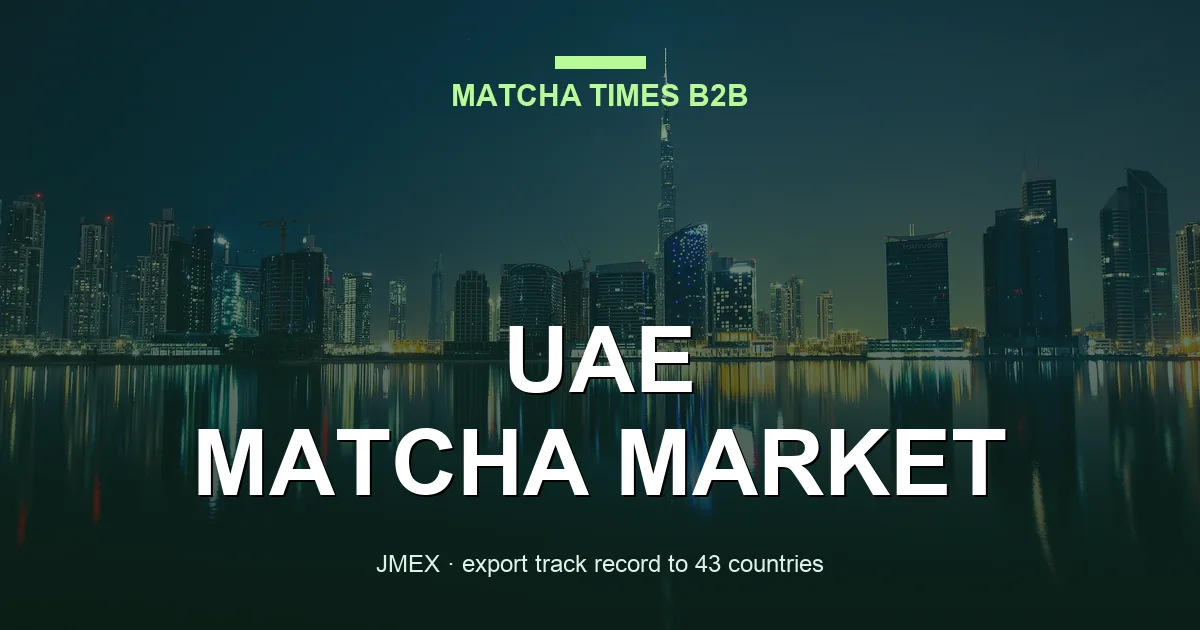
The short answer: the UAE is a promising B2B market for Japanese matcha. Across Dubai and Abu Dhabi, demand for matcha lattes and matcha desserts is expanding steadily in hotels, cafes, and wellness venues, where affluent residents, a highly international population, and strong tourism converge to create real appetite for premium matcha.
At the same time, the UAE is a market with demanding halal, labeling, and customs requirements. See also our analysis of the U.S. matcha market and the Southeast Asia matcha market. This guide maps UAE matcha demand, the buyer segments, the practical rules for entry, and what the Japan Matcha Export Organization (JMEX) can handle on the export side — from a B2B buyer’s point of view.
Pre-entry checklist for the UAE
- Confirm the grade and monthly volume your menu or product line actually needs.
- Secure halal certification recognized by ESMA/MoIAT for the products you will import.
- Line up Arabic + English labeling and ingredient/allergen disclosure.
- Request a COA and residue analysis for the destination.
- Trial a small lot, then lock a replenishment cycle for peak demand.
Key Takeaways for B2B Buyers
- Demand is real and premium-led — UAE matcha uptake is driven by Dubai/Abu Dhabi cafés, hotels, and health-forward retail, so quality and consistency matter more than lowest price.
- Halal and labeling are gating items — plan for halal certification recognized by ESMA/MoIAT and Arabic labeling from the start, not as an afterthought.
- Buyer segments differ — specialty cafés, 5-star hospitality, gourmet retail, and food manufacturers each need a different grade and lot size.
- Choose the supplier on export fit — COA, origin traceability, lot flexibility, and Gulf-market documentation separate a real export partner from a domestic wholesaler.
- Start with samples — confirm color, aroma, and solubility against your menu before committing to volume.
Verify current requirements with primary sources before you order — rules, rates, and certification lists change: JETRO (Japan External Trade Organization) · MAFF — Japanese tea export. This guide is orientation, not a substitute for the destination authority’s latest notice.
For Companies Seeking Matcha Powder
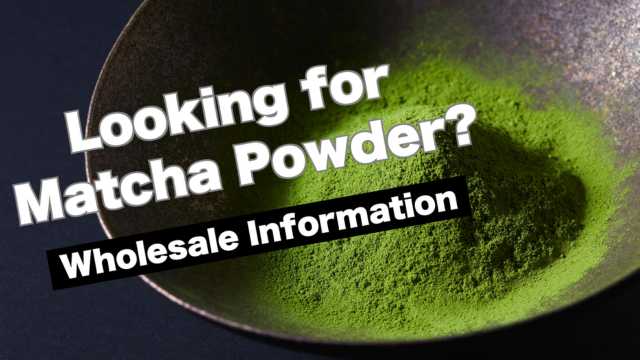
We source matcha from Japan’s premier production regions including Kyoto Uji, Kagoshima, Fukuoka, and Shizuoka, offering comprehensive grade ranges from organic JAS-certified ceremonial grade to processing-grade matcha.
Common Challenges:
- “We have projects but cannot secure stable matcha supply…”
- “We want to incorporate matcha into new café menu items!”
If you face these concerns, consult with Matcha Times. Feel free to contact us for initial inquiries.
\Read Also/
Why matcha demand is rising in the UAE
The UAE’s food-and-beverage market is diversifying on the back of a maturing cafe culture and rising health awareness. Dubai in particular is a global tourism hub, so visitor preferences feed quickly into local menus. Matcha reads as a healthy, photogenic premium beverage that sits naturally alongside the existing specialty-coffee crowd, which is why it keeps appearing on new cafe menus and hotel afternoon-tea programs.
- A high share of affluent residents and expats, comfortable with premium price points
- A large tourism and hospitality industry that keeps foodservice demand stable year-round
- A strong wellness and functional-beverage trend that suits unsweetened, plant-based menus
\Read More/
Who buys matcha: the UAE’s main buyer segments
Buyers in the UAE are not a monolith. Grade, lot size, and price expectations differ by segment, so defining the segment you are targeting before you design sourcing is the first step to avoiding costly mistakes.
| Segment | Main use | What they value in matcha |
|---|---|---|
| Hotels & resorts | Afternoon tea / lattes / desserts | Color, aroma, brand story |
| Specialty cafes | Matcha lattes / iced matcha | Vivid green, performance with milk |
| Bakery & confectionery | Baked goods / desserts | Color after heat, cost efficiency |
| Wellness / D2C | Unsweetened drinks / supplements | Organic certification, functional claims |
Across every segment, halal compliance and reliable supply tend to be preconditions for doing business — a key difference from the domestic Japanese market.
Regulations and practicalities to check before entry
Importing food into the UAE involves several authorities at the federal and emirate level. Matcha (green tea powder) is generally treated as a food, but you need to confirm labeling (ingredients, country of origin, and expiry in Arabic), residue limits, and halal-related requirements.
- Food standards & labeling: check the framework of the Ministry of Industry & Advanced Technology (MOIAT) / ESMA
- Local food safety: confirm emirate-level requirements such as Dubai Municipality‘s Food Safety Department
- Gulf standards & halal: review the GCC Standardization Organization (GSO) halal food standards (GSO 2055 series)
- Documents: prepare a COA, certificate of origin, and organic/halal certificates as needed
Of these, the export-side documents, quality assurance, and origin handling are areas JMEX can prepare or support. Local importer registration and final filings to UAE authorities are the buyer’s steps, but solid export paperwork sharply lowers customs risk.
How smart buyers choose: comparing wholesale partners
Before you commit to a matcha supplier for this use case, evaluate every candidate on the same criteria. Use the checklist below when you request quotes and samples.
| Criterion | What to verify with any supplier |
|---|---|
| Export & safety documentation | Request per-lot COA and the export, customs and food-safety documents your destination market requires (MRL/limit matching). |
| Grade & origin options | Confirm the grade range (ceremonial to culinary) and origin/cultivar options matched to your application. |
| Lot flexibility & MOQ | Check the minimum order quantity, trial-lot/sample availability, and the ability to scale from a small start to larger volumes. |
| Export track record & references | Ask for export track record and references in your target market(s). |
Apply this checklist to each supplier on your shortlist and decide on current quotes, samples and documentation. JMEX (Japan Matcha Export Organization) is an export-focused Japanese matcha supplier with export experience to 43 countries; you can request pricing and terms directly and assess it against the criteria above.
A playbook for entering the UAE market
- 1) Define one target segment (hotel / cafe / confectionery / wellness)
- 2) Set the grade and the color/aroma requirements that fit it
- 3) Validate with samples against local water, milk, and climate
- 4) Prepare halal, labeling, and COA documents on the export side
- 5) Start with a ~10 kg trial and scale the lot as real sales develop
This approach lets you validate small and scale supply in stages, growing the market while keeping inventory risk in check.
What JMEX handles on the export side
JMEX is not just a domestic wholesaler. It is an export partner that recommends the optimal leaf from across Japan by use case and carries quality assurance and documentation through, built for export. From Uji, Shizuoka, Kagoshima, and Yame, building on product design for the U.S. market, it can combine vivid latte color, heat-stable confectionery grades, and organic grades for functional claims to fit UAE segment needs.
Why Buyers Choose JMEX (Japan Matcha Export Organization)

One supplier that meets these criteria at a high level is JMEX (Japan Matcha Export Organization), a wholesale and export partner dedicated to bringing Japanese matcha overseas. It designs origin selection, quality assurance, export documentation, and logistics as one continuous flow, built for export from the start.
For market entry, JMEX matches origin and grade to local demand and, with an export track record across 43 countries, supports buyers, importers, and distributors as they scale a new matcha line.
FAQ
Is halal certification mandatory to export Japanese matcha to the UAE?
It depends on the segment and the buyer’s requirements. Matcha itself is plant-based, but hotels and retail chains often make halal compliance a condition, so preparing against the GSO halal food standards is the safe path.
What is the minimum order quantity to start?
JMEX supports everything from a ~10 kg trial to one-ton stable supply, matched to your growth stage.
Is Arabic labeling required?
The UAE generally requires Arabic labeling for ingredients, country of origin, and expiry. We prepare against the latest authority requirements.
Can you share a price guide?
Prices move with grade and FX. JMEX always quotes at the current wholesale price.
Learn More About Global Matcha Trends at Matcha Times

Matcha Times is a specialist media platform covering the global matcha market — sourcing and wholesale, supply and pricing, trade and regulations, production and origins, and the companies shaping the industry.
From market analysis and price trends to café case studies and interviews with tea farmers, we help buyers, importers, distributors, and manufacturers stay ahead of where matcha is heading. Explore more and put the global matcha market to work for your business.
Conclusion
The UAE is one of the few high-value B2B markets for Japanese matcha, where affluence, tourism, and wellness demand overlap. Success comes from choosing a clear target segment and getting halal, labeling, and documentation right on the export side.
If you are considering commercial or OEM matcha for the UAE or other overseas markets, consult the Japan Matcha Export Organization (JMEX), with an export track record to 43 countries. We recommend the optimal origin and grade for your application and target market.
Looking for wholesale or OEM matcha samples? Contact us — we will recommend the optimal origin and grade based on your application and target markets.
Related Articles