Matcha OEM Manufacturing in Japan: Design, Process & Export
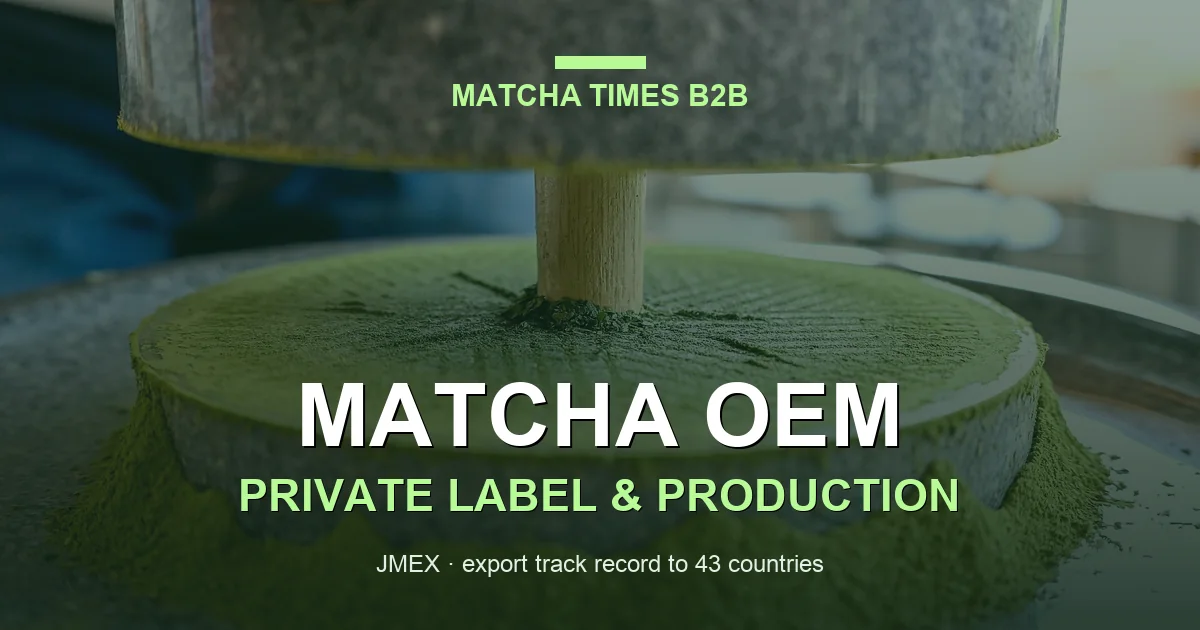
In short, OEM (private-manufacture) with Japanese matcha works across a wide range of products — latte mixes, confectionery, and beverage blends. Success comes from designing origin and grade to the application and handling quality and documents end-to-end for export.
This guide covers how to run a matcha OEM project — design, process, and export readiness. See also our product design by application.
For Companies Seeking Matcha Powder
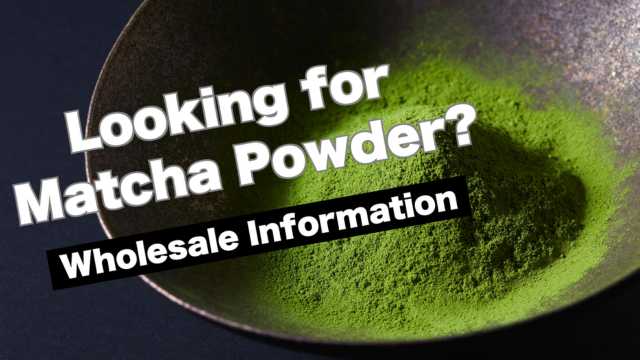
We source matcha from Japan’s premier production regions including Kyoto Uji, Kagoshima, Fukuoka, and Shizuoka, offering comprehensive grade ranges from organic JAS-certified ceremonial grade to processing-grade matcha.
Common Challenges:
- “We have projects but cannot secure stable matcha supply…”
- “We want to incorporate matcha into new café menu items!”
If you face these concerns, consult with Matcha Times. Feel free to contact us for initial inquiries.
\Read Also/
What matcha OEM can deliver
- Matcha latte mixes (sweetened, unsweetened, plant-milk ready)
- Heat-stable blends for confectionery and bakery
- Dispersibility and color design for beverages / RTD
- Spec design for supplements and health foods
\Read More/
→ Tea By-Product Business Guide: Monetizing Stem Tea and Powder Residue for Profit and Sustainability
Design priorities by application
The same matcha calls for different answers by use. Decide first whether color, flavor, particle size, or heat stability leads.
| Application | Key property | Origin / grade direction |
|---|---|---|
| Latte | Vivid color, milk performance | First-flush, mid-to-premium |
| Confectionery | Color after heat, cost | Culinary-grade blend |
| Beverage / RTD | Dispersibility, stability | Particle-tuned custom design |
| Supplements | Spec consistency | Organic / tight lot control |
A typical OEM process
- Discovery: application, volume, price band, target markets
- Sample design: propose origin, grade, and blend; prototype
- Evaluation: test color, flavor, heat/dispersion; adjust
- Lock the spec: spec sheet, COA, and (if needed) organic documents
- Production & export: lot control alongside export paperwork
Because JMEX designs origin selection, quality assurance, and export documents as one continuous flow, first-time OEM projects hit fewer export snags.
Quality & compliance, built for export
Taking an OEM product overseas presumes compliance with the destination’s food-safety, labeling, and (where relevant) organic/halal requirements. JMEX carries the export-side scope (COA, origin, organic JAS, etc.) to support the buyer’s local procedures. For primary references, see Japan’s organic JAS system (MAFF), export procedures via JETRO, and, for shipments to the United States, the FDA Foreign Supplier Verification Program (FSVP).
OEM lead time and cost structure
OEM takes time in stages, from prototype to production. Planning backward from your launch keeps you on schedule. The stage durations below are typical ranges that vary by formulation complexity, certification, and supplier capacity — confirm exact timelines with your OEM partner.
- Discovery & design: 1–2 weeks
- Sample prototyping & evaluation: 2–4 weeks (including iterations)
- Spec lock & spec-sheet/COA preparation: 1–2 weeks
- Production & export arrangement: varies by volume and destination
Cost builds up from raw-material grade, processing (blend/milling), packaging, lot size, and freight. Small lots carry higher unit cost, so early on you balance inventory risk against unit price.
Quality assurance and brand rollout
Selling an OEM product overseas presumes a spec sheet, COA, and compliant labeling are all in place. Labeling in particular must follow the destination’s language, ingredient, allergen, and country-of-origin rules.
- Spec sheet: document particle size, color, moisture, microbiology limits
- Labeling: match the destination language and statutory rules (e.g. EU allergen emphasis)
- Organic claims: prepare organic JAS/USDA/EU certificates
- Lot control: ensure traceability and reproducibility
JMEX carries it end to end — origin selection, spec sheet, COA, and export documents. See also our product design by application.
How to choose an OEM partner: a checklist
When choosing an OEM partner, look beyond price at origin breadth, quality assurance, export capability, and communication. Checking these reduces the risk of a bad fit.
- Can they propose origin/grade to your use (not locked to one region)?
- Can they provide a spec sheet, COA, and traceability?
- Can they handle export documents (origin, organic JAS, etc.)?
- Can they scale from small-lot prototypes to production?
- Do they have an overseas track record and clear lead times?
Backed by an export track record to 43 countries, JMEX provides these end to end. See also our product design by application.
Finally, treat the prototype stage as the place to lock quality: evaluate color, flavor, dispersibility, color after heat, and fading over time under identical conditions, and write the accepted standard into a spec sheet managed together with the COA. Getting this right early is what makes production reproducible and export-ready.
Why Buyers Choose JMEX (Japan Matcha Export Organization)

One supplier that meets these criteria at a high level is JMEX (Japan Matcha Export Organization), a wholesale and export partner dedicated to bringing Japanese matcha overseas. It designs origin selection, quality assurance, export documentation, and logistics as one continuous flow, built for export from the start.
For product development, JMEX designs origin and blend by application — latte color, baking stability, beverage solubility — and, with an export track record across 43 countries, supports OEM from sample to steady supply.
FAQ
Common questions about matcha OEM manufacturing in Japan — from minimums and lead times to documentation.
What is the OEM minimum lot?
It depends on the spec: prototypes from small lots, production designed to the use case. Start by sharing application and volume.
Can you do sweetened or plant-milk versions?
Yes — latte mixes can be designed sweetened, unsweetened, or plant-milk ready.
Is organic OEM possible?
Yes, under organic JAS and similar control, with documents prepared for the destination’s organic labeling rules.
Learn More About Global Matcha Trends at Matcha Times

Matcha Times is a specialist media platform covering the global matcha market — sourcing and wholesale, supply and pricing, trade and regulations, production and origins, and the companies shaping the industry.
From market analysis and price trends to café case studies and interviews with tea farmers, we help buyers, importers, distributors, and manufacturers stay ahead of where matcha is heading. Explore more and put the global matcha market to work for your business.
Conclusion
Matcha OEM succeeds on application-fit design plus end-to-end, export-ready execution. Fix your application, volume, and target markets, then talk it through.
For OEM development of latte mixes, confectionery, and beverages, consult JMEX, with an export track record to 43 countries.
Looking for wholesale or OEM matcha samples? Contact us — we will recommend the optimal origin and grade based on your application and target markets.
Related Articles