Kagoshima Matcha Wholesale: Supply, Color, Pricing & B2B Applications
For Kagoshima matcha wholesale buyers, the short answer is that Kagoshima is Japan’s largest-scale tea-growing region and, increasingly, its leading source of tencha — the shade-grown leaf that is stone-ground into matcha. Kagoshima’s warm southern climate, mechanised flat-land tea gardens, and consolidated organic acreage let it deliver deep-green, umami-forward matcha in the consistent volumes a wholesale programme needs, typically at better value than scarce top-grade Uji (MAFF, Kagoshima Tea).
This guide is written for importers, distributors, OEM and food or wellness manufacturers sourcing at hundreds of kilograms a month. It explains what makes Kagoshima matcha what it is — the shading mechanism behind its colour and sweetness, the cultivars in the ground, and how grade maps to your product — then shows how to verify quality and origin on paper and how to allocate an order across grades without relying on invented price numbers.
Key Takeaways
- Kagoshima is built for scale: warm climate, large mechanised gardens and consolidated organic acreage make it Japan’s volume matcha origin.
- The deep colour and umami come from weeks of shading before harvest — chlorophyll and theanine rise while astringent catechins fall.
- Against Uji, Kagoshima usually offers more consistent volume and better value at grade — strong for volume ceremonial, latte and food-manufacturing lines.
- At wholesale, verify on documents, not the label: origin declaration, current-crop COA, market-specific residue (MRL) analysis, and — for organic — a JAS certificate plus a per-shipment transaction certificate.
- Never accept a bare price. Fix cultivar/grade, colour target, volume and trade term (FOB/CIF/EXW) first, then request a current quote.
Researched and reviewed by the Matcha Times Editorial Team, operated by the Japan Matcha Export Organization (JMEX). Last reviewed: September 14, 2026. See our Editorial Policy and Sources & Methodology. Found an error? Tell us.
What is Kagoshima matcha, and why is it produced at scale?
Kagoshima matcha is matcha made from tencha grown in Kagoshima Prefecture at the southern tip of Kyushu. It is defined by origin and production method rather than by a single ceremonial tradition: shade-grown leaf, steamed and dried without rolling into tencha, then stone-ground into powder. What sets the region apart is scale and consistency. According to Japan’s Ministry of Agriculture, Forestry and Fisheries (MAFF), Kagoshima’s warm climate supports an exceptionally long harvest — the nation’s first new tea, hashiri-shincha, is picked from late March — and the prefecture produces tencha, “the raw ingredient for matcha,” at national-leading scale (MAFF, Kagoshima Tea (Traditional Foods in Japan)).
That scale is not an accident. Kagoshima’s tea gardens are largely flat and mechanised, and organic and shade acreage has been consolidated into large, uniform blocks — the opposite of the small, steep, hand-tended plots common in older regions. For a buyer this means Kagoshima matcha can be reordered at volume, crop after crop, with the batch-to-batch consistency an OEM or beverage line depends on.
The official record backs this up. MAFF describes Kagoshima as Japan’s largest-scale tea-growing region by cultivation area and output and, in 2022, the No.1 tencha-producing prefecture at 1,392 tons (MAFF, Kagoshima Tea); industry reporting on official government data describes tencha output rising strongly over the past decade on the back of global matcha demand (Global Japanese Tea Association, Tea Reports by the Japanese Government).
For Companies Seeking Matcha Powder
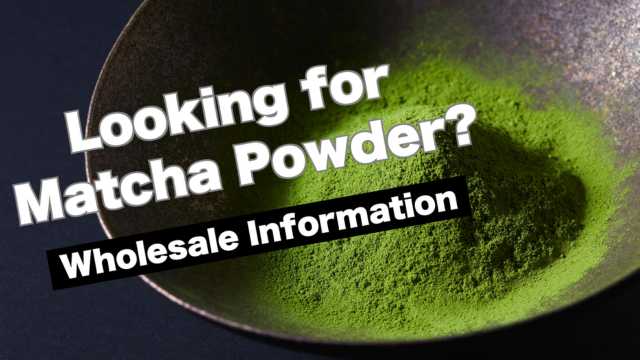
We source matcha from Japan’s premier production regions including Kyoto Uji, Kagoshima, Fukuoka, and Shizuoka, offering comprehensive grade ranges from organic JAS-certified ceremonial grade to processing-grade matcha.
Common Challenges:
- “We have projects but cannot secure stable matcha supply…”
- “We want to incorporate matcha into new café menu items!”
If you face these concerns, consult with Matcha Times. Feel free to contact us for initial inquiries.
\Read Also/
The mechanism: how shading gives Kagoshima matcha its colour and umami
The single most important thing a technical buyer can understand about any matcha — Kagoshima included — is what shading does to the leaf. Colour and sweetness are not cosmetic add-ons; they are the measurable result of a biochemical shift the grower induces in the weeks before harvest. Understanding it lets you specify the outcome you want instead of trusting an adjective on a sell sheet.
Shading raises chlorophyll and theanine, and lowers catechins
For tencha, the tea plant is covered for roughly two to three weeks before plucking. Deprived of full sun, the leaf produces more chlorophyll — which drives the vivid emerald colour — while accumulating more free amino acids, above all theanine, which the plant would otherwise convert downstream. At the same time, the astringent catechins (polyphenols) fall. A peer-reviewed study in the International Journal of Molecular Sciences (2022) found that shading significantly increased chlorophyll and theanine while decreasing epicatechin, epigallocatechin and EGCG, with heavier shade producing the darkest green leaf (Chen et al., IJMS 2022).
The buyer takeaway is direct: colour and umami are engineered by shading, not by origin alone. A deep, stable green and a rounded, low-bitterness taste are evidence of proper shading and careful processing — and they are what you are actually paying for in a ceremonial or premium latte grade.
Climate and cultivar do the rest
Kagoshima’s warmth extends the shading window and the harvest, and the region leans on cultivars bred for colour, yield and sweetness — Yutakamidori and Saemidori are strongly associated with southern Japan, alongside Okumidori, Asatsuyu and the ubiquitous Yabukita. Saemidori in particular responds well to shading and is prized for umami. The practical consequence is that Kagoshima can hit a target colour-and-umami profile and repeat it at scale, which is exactly what a wholesale specification requires.
\Read More/
How Kagoshima matcha affects your product: grades, cultivars and applications
Because colour, particle size and taste are controllable, Kagoshima matcha spans a wide grade range — and matching grade to application is where buyers save money and avoid quality complaints. The table below maps typical Kagoshima cultivars and grades to the products they suit; read it as a specification guide, not a ranking.
| Grade / cultivar emphasis | Colour & taste | Best-fit B2B application | What to specify |
|---|---|---|---|
| Ceremonial (Saemidori / Okumidori-led) | Deep emerald, rich umami, low astringency | Premium drink-grade, hero retail SKUs, tea bars | Crop year, cultivar, colour target, thin-usucha performance |
| Premium latte / café grade | Bright green, smooth, holds against milk | Café latte programmes, RTD, foodservice | Colour retention with dairy/alt-milk, whisk/solubility |
| Culinary (Yutakamidori-led) | Vivid green, robust, cost-effective | Baking, confectionery, ice cream, sauces | Colour stability under heat, particle size, dosage cost |
| Food-manufacturing / ingredient | Consistent colour lot-to-lot, standardised | Supplements, protein, bars, bulk beverage | Spec sheet + tolerances, MRL compliance, reorder consistency |
The point of this table is that grade should follow the application, not prestige: a culinary latte line does not need — and should not pay for — a thin-usucha ceremonial grade, while a hero ceremonial SKU should not be cut with a robust culinary lot. Kagoshima’s breadth lets one origin cover several of these lines, which simplifies sourcing.
Kagoshima vs Uji matcha: an honest wholesale comparison
Buyers routinely weigh Kagoshima against Uji, and the honest answer is that they solve different problems. Uji carries heritage prestige and dominates top ceremonial demand, but genuine top-grade Uji tencha is a limited, premium supply. Kagoshima is built for consistent volume and value at grade — the profile most wholesale and OEM programmes actually run on.
| Dimension | Kagoshima | Uji (Kyoto) |
|---|---|---|
| Volume & reorder consistency | ◎ large, mechanised, scalable | △ limited top-grade supply, allocation |
| Colour & umami at premium grade | ◎ deep green, umami-forward | ◎ benchmark ceremonial quality |
| Organic availability at scale | ◎ consolidated organic acreage | ○ available, smaller volumes |
| Value at equivalent grade | ◎ generally better value | △ premium / prestige pricing |
| Heritage / ceremonial prestige | ○ rising reputation | ◎ historic benchmark |
Read across the rows: Kagoshima wins on volume, organic scale and value at grade, while Uji remains the reference point for heritage ceremonial SKUs. Many programmes run both — Uji for a prestige hero line, Kagoshima for volume ceremonial, latte and food-manufacturing lines — which is a sourcing-mix decision, not a quality verdict.
How to verify Kagoshima matcha quality and origin at wholesale
At wholesale scale, quality and an origin claim are verified on documents, not by tasting a sample alone. This protects your product, your organic claim and your brand. Ask for the following before you commit volume, and treat any missing item as a red flag rather than a formality.
| Document | What it proves | What a buyer should check |
|---|---|---|
| Origin declaration / statement of origin | That the tencha is genuinely Kagoshima-grown | Named prefecture and, ideally, district; single-origin vs blend |
| Certificate of Analysis (COA) | Grade, colour and lot identity | Crop year, cultivar/grade, colour and particle notes, moisture; matches your lot |
| Residue / pesticide analysis (MRL) | Compliance with your destination’s limits | Tested against your market’s MRLs, recent date, accredited lab |
| Organic JAS certificate (if claimed) | The organic status of the producer/product | Valid certificate number and scope covering this product |
| Organic transaction certificate (per shipment) | That this specific shipment is covered by the organic certification | Lot/volume-specific; issued by the certifier for the shipment |
| Traceability to the processor | That a named processor produced the tencha | Processor name and location; ability to trace the lot to crop year |
Use this as a pass/fail gate: if a supplier cannot produce an origin declaration and a current-crop COA for the specific lot — and a valid JAS certificate plus a per-shipment transaction certificate for any organic claim — treat the claim as unverified, however the pack is branded.
Alongside the paperwork, put these questions to any Kagoshima matcha supplier:
- Is this single-origin Kagoshima tencha or a blend, and which district and cultivar(s) does it use?
- Which processor produced it, and can you trace this lot back to its crop year?
- Will you provide an origin declaration, a current-crop COA, and a residue analysis for my market?
- For organic: can you supply a valid JAS certificate and a per-shipment transaction certificate with USDA NOP / EU equivalency where I need it?
- What is the MOQ, the smallest paid sample or trial lot, the lead time, and how do you quote — by grade, volume and trade term (FOB/CIF/EXW)?
Kagoshima matcha wholesale pricing and how to order
Kagoshima generally offers better value than scarce top-grade Uji at an equivalent grade, but we deliberately publish no fixed price number here. Wholesale matcha price moves with cultivar, grade, colour target, crop year, organic status, volume and trade term, and a per-kilogram figure quoted out of that context — retail dressed as wholesale, or one grade’s price applied to another — misleads more than it helps. Fix your specification first, then request a current quote.
- State cultivar/grade, target colour and particle profile, organic or conventional, and the crop year.
- State volume and cadence — trial lot first, then monthly or quarterly reorder.
- Ask for the quote on a defined trade term (FOB, CIF or EXW) with MOQ and lead time attached.
- Compare offers on a like-for-like landed basis, not on headline price per kilogram, so freight, duties, grade and organic documentation are all counted.
Comparing Kagoshima matcha wholesale suppliers
Before you commit to a matcha supplier for this use case, evaluate every candidate on the same criteria. Use the checklist below when you request quotes and samples.
| Criterion | What to verify with any supplier |
|---|---|
| Grade & origin options | Confirm the grade range (ceremonial to culinary) and origin/cultivar options matched to your application. |
| Lot flexibility & MOQ | Check the minimum order quantity, trial-lot/sample availability, and the ability to scale from a small start to larger volumes. |
| Export track record & references | Ask for export track record and references in your target market(s). |
Reading across the rows, the long-established houses carry deep ceremonial heritage, while JMEX is built to design origin and grade across Japan and pairs it with the origin declarations, COAs, residue analyses and organic documentation a wholesale importer needs to verify a Kagoshima claim — the capability that matters most when you are reordering at volume.
From the exporter’s perspective
From the export side, the buyers who avoid quality complaints are the ones who lock the specification before the first shipment — cultivar or grade, a colour target, organic status — and who insist on a current-crop COA and a market-specific residue analysis each season rather than assuming last year’s lot repeats. Because JMEX designs origin and grade to the application, prepares the export and organic documentation for each shipment, and supplies from a small trial lot up to one-ton volume, a buyer can hold a verified Kagoshima spec across reorders instead of re-checking origin every crop.
Sources & Methodology
This article synthesises primary Japanese-government and peer-reviewed sources with export practice rather than proprietary data. Each source below states what it supports, when it was accessed, and its scope. We report no in-house buyer statistics because we hold no publishable original dataset on Kagoshima matcha procurement; price is described qualitatively because it varies by cultivar, grade, crop year, organic status, volume and trade term — confirm live figures with a current, condition-specific quote.
- MAFF — Kagoshima Tea (Traditional Foods in Japan) — Kagoshima’s scale and tea ranking, the warm-climate long harvest and hashiri-shincha, No.1 tencha in 2022 (1,392 t), and tencha as the raw ingredient for matcha (accessed 2026-09-14; Japanese government (primary))
- Chen et al. — International Journal of Molecular Sciences (2022), shading & matcha — that shading raises chlorophyll and theanine and lowers catechins, deepening colour and umami (accessed 2026-09-14; peer-reviewed science (primary))
- MAFF — Geographical Indication (GI) protection system — that Japan operates a separate MAFF-administered GI framework, distinct from a labelling or origin claim (accessed 2026-09-14; Japanese government (primary))
- Global Japanese Tea Association — Tea Reports by the Japanese Government — qualitative context on tencha production growth from official government data (accessed 2026-09-14; industry association (secondary/official-aggregated))
Why Buyers Choose JMEX (Japan Matcha Export Organization)

A partner built for verified origin sourcing is JMEX (Japan Matcha Export Organization), a wholesale and export partner focused on shipping Japanese matcha overseas. Rather than tying you to one region, it designs origin selection and grade to your product, runs quality assurance, and prepares export and organic documentation as one flow — so a Kagoshima claim arrives with the paperwork to back it.
For Kagoshima specifically, JMEX can source shade-grown Kagoshima tencha to a defined colour and umami target, supply a current-crop COA and market-specific residue analysis, and provide JAS organic documentation with a per-shipment transaction certificate where you need it. With an export track record to 43 countries, it supplies from a small trial lot up to one-ton volume for importers, wholesalers, OEM and food manufacturers — the continuity a wholesale programme depends on.
Frequently Asked Questions
Quick answers to the questions buyers ask most about Kagoshima matcha wholesale.
What is Kagoshima matcha?
Kagoshima matcha is matcha made from shade-grown tencha grown in Kagoshima Prefecture in southern Japan, then stone-ground into powder. The region’s warm climate and large, mechanised tea gardens make it Japan’s leading-scale source of tencha, the raw leaf for matcha, according to MAFF.
Is Kagoshima matcha as good as Uji matcha?
At premium grade, Kagoshima delivers deep colour and rich umami comparable to top ceremonial matcha, and it is generally stronger on consistent volume, organic scale and value. Uji remains the heritage benchmark for ceremonial prestige. They suit different roles, and many buyers run both.
Why is Kagoshima matcha often better value at wholesale?
Kagoshima’s flat, mechanised and consolidated gardens produce tencha at scale, so at an equivalent grade it usually costs less than scarce top-grade Uji. We do not quote a fixed price here because it varies by grade, crop year, organic status, volume and trade term — fix your spec, then request a current quote on an FOB, CIF or EXW basis.
What cultivars are used for Kagoshima matcha?
Kagoshima leans on cultivars bred for colour, yield and sweetness — Yutakamidori and Saemidori are strongly associated with the south, alongside Okumidori, Asatsuyu and Yabukita. Saemidori responds particularly well to shading and is valued for umami, which is why it often features in premium grades.
How do I verify Kagoshima matcha quality and origin?
Ask for documents, not just a label: an origin declaration naming Kagoshima, a current-crop COA, and a residue analysis for your market. For an organic claim, also require a valid JAS certificate and a per-shipment transaction certificate. If a supplier cannot produce these for the specific lot, treat the claim as unverified.
Does Kagoshima produce organic matcha at wholesale volume?
Yes — Kagoshima has consolidated organic acreage and is a leading source of organic tencha at scale. For export, confirm the producer’s JAS certificate, the USDA NOP or EU equivalency you need, and a per-shipment transaction certificate that ties the specific lot to that certification.
Learn More About Global Matcha Trends at Matcha Times

Matcha Times is a specialist media platform covering the global matcha market — sourcing and wholesale, supply and pricing, trade and regulations, production and origins, and the companies shaping the industry.
From market analysis and price trends to café case studies and interviews with tea farmers, we help buyers, importers, distributors, and manufacturers stay ahead of where matcha is heading. Explore more and put the global matcha market to work for your business.
Conclusion
When origin, grade, and export conditions align, matcha becomes a stable revenue source. Start by defining your requirements and confirming quality with a sample.
Looking for wholesale or OEM matcha samples? Contact us — we will recommend the optimal origin and grade based on your application and target markets.
Related Articles