Pennsylvania Matcha Market 2026: Cafe Growth, Consumer Trends & B2B Opportunities
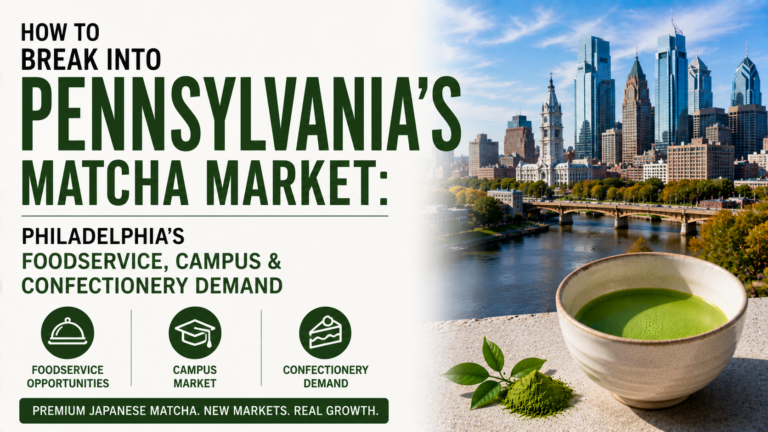
The Pennsylvania matcha market is growing in 2026, carried by the same forces lifting matcha nationally — a younger, wellness-minded consumer, the latte and ready-to-drink (RTD) formats, and café expansion — but expressed through Pennsylvania’s own café clusters and retail channels in Philadelphia, Pittsburgh and the state’s many university towns. For a B2B buyer, the opportunity is straightforward: cafés, RTD and wellness brands in the state need a reliable, specification-matched supply of authentic Japanese matcha, and Japanese green tea enters the United States duty-free under Harmonized Tariff Schedule heading 0902.
This guide is written for importers, wholesalers, OEM and private-label buyers at hundreds-of-kilogram scale, plus health, wellness and protein brands — not single-store cafés. Where a figure would be a guess we keep it qualitative; where a number is verifiable we attribute it to its source and label its scope, because state-level matcha data is thin and easy to overstate.
Key Takeaways
- Growth is real but geographically clustered: local demand tracks the national matcha surge, concentrated in Philadelphia, Pittsburgh and college towns rather than spread evenly across the state.
- Format and demographics matter: matcha lattes, iced drinks and RTD formats lead, driven by younger, health-focused consumers — the same demographic behind the category’s national momentum.
- Duty-free is not rule-free: plain Japanese green tea (matcha) is duty-free under HTS heading 0902, but FDA food-import rules still apply and country-level trade measures are separate and time-varying.
- Be careful with the numbers: no official, Pennsylvania-only matcha market-size figure exists; treat commercial estimates as provider estimates and never present one as an official statistic.
- Vet on evidence, not marketing: evaluate any supplier, including JMEX, on origin proof, per-lot COA, certifications and consistency — not on a scored ranking.
For Companies Seeking Matcha Powder
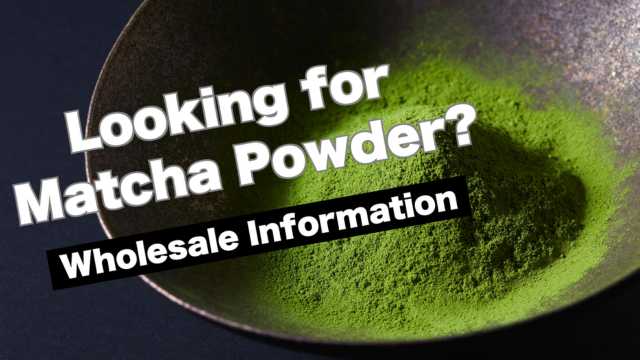
We source matcha from Japan’s premier production regions including Kyoto Uji, Kagoshima, Fukuoka, and Shizuoka, offering comprehensive grade ranges from organic JAS-certified ceremonial grade to processing-grade matcha.
Common Challenges:
- “We have projects but cannot secure stable matcha supply…”
- “We want to incorporate matcha into new café menu items!”
If you face these concerns, consult with Matcha Times. Feel free to contact us for initial inquiries.
\Read Also/
What is the state of the Pennsylvania matcha market in 2026?
In direct terms: demand is rising and the runway is in foodservice and retail, not in a single headline number. National indicators frame the local picture — the food-trend analytics firm Tastewise reports matcha menu items up 30.22% year over year and social conversation about matcha up 107.35% year over year (Tastewise, matcha trends). Green tea, the category matcha belongs to, is the fastest-growing segment of US tea and makes up roughly 15% of US tea consumption, per the Tea Association of the U.S.A.. Those forces show up in Pennsylvania through its cafés, grocery and specialty channels.
On market size, discipline matters. Commercial researchers size the global matcha market at a global scale — for example The Business Research Company estimated the global matcha market at about US$4.17 billion in 2025 growing to roughly US$4.61 billion in 2026 (~10.6% CAGR) — but estimates vary widely by provider and market definition, and no provider publishes an official Pennsylvania-only figure. Use these as directional provider estimates, not as a verified state statistic.
\Read More/
What consumer trends are driving matcha demand in Pennsylvania?
The mechanism behind the growth is demographic and format-led, and Pennsylvania’s population makes it a meaningful market: it is the fifth-most-populous US state with roughly 13 million residents, per the US Census Bureau. Several converging trends explain why matcha, specifically, is winning shelf and menu space.
- Wellness demand: matcha’s positioning as an antioxidant-rich, calmer-energy alternative to espresso resonates with health-focused consumers, the group most associated with the category’s national growth.
- Latte and RTD formats lead: matcha lattes, iced matcha and RTD cans travel well on social media and suit grab-and-go habits, which is where most incremental volume sits.
- A young, urban demographic: college and graduate populations around Philadelphia and Pittsburgh skew young and experimental, and younger consumers are the demographic driving matcha adoption.
- Premiumization and provenance: consumers increasingly ask for single-origin, transparent-sourcing and organic options, which pushes buyers toward suppliers who can prove origin and certification.
For a buyer, the practical read is that the growth is concentrated in beverage formats and premium, provenance-backed products — so grade selection and origin proof, not just price, decide whether a product wins the reorder.
Where is café and retail growth happening across Pennsylvania?
Pennsylvania’s matcha demand is not spread evenly — it clusters where young, urban and student populations concentrate. Mapping the channels helps a wholesaler or distributor see where volume and reorders actually come from.
Philadelphia and the specialty-café boom
Philadelphia, one of the largest US cities, anchors the state’s café demand, with a dense specialty-coffee and tea scene and a historic Chinatown that has become a hub for matcha-forward shops. Local reporting has tracked national matcha café brands entering the city — for instance the Kyo Matcha chain opened a Philadelphia Chinatown location in 2026, joining a wave of new tea storefronts (local reporting, Hoodline). For a supplier, a cluster of independent cafés plus multi-unit chains is a reorder engine, provided quality is consistent batch to batch.
Pittsburgh, college towns and grocery retail
Beyond Philadelphia, Pittsburgh and the state’s university towns (home to large student populations) support their own café demand, and matcha’s retail presence extends through Pennsylvania-based and regional grocery chains and specialty stores. This mix — independent cafés, multi-unit operators, grocery and e-commerce — means demand reaches a buyer through several routes, and a supplier who can serve more than one channel with a consistent spec has the advantage.
What does this mean for B2B buyers and brands?
Rising, format-led demand changes what a buyer should optimize for. The winning move in a growing market is not the cheapest kilo; it is a grade and origin matched to the finished product so that the product performs, the color holds, and the café or brand reorders.
- Café and RTD suppliers: a bright, fine, milk-ready beverage grade for latte and RTD programs, where color stability in milk and clean umami decide repeat orders.
- Wellness, protein and supplement brands: a consistent, cost-efficient grade with tight microbiological and contaminant specs, where lot-to-lot uniformity matters more than a show-stopping color.
- Retail and private-label buyers: origin proof, single-origin or organic options and transparent sourcing to meet the premium, provenance-led demand that is driving the category.
In every case the supply question is the same: can the supplier match a grade to your application, hold a specification and color target across reorders, and provide the documentation your US import compliance depends on? That is an export-side capability, not a catalog listing.
How does matcha get into Pennsylvania: import and compliance basics
Whether a buyer imports directly or purchases from a domestic distributor, Japanese matcha reaches Pennsylvania under US federal food-import rules. The essentials below are drawn from primary FDA and USITC sources; confirm the specifics of your shipments with a licensed customs broker, because country-level trade measures change over time.
- Import duty: green tea classified under Harmonized Tariff Schedule heading 0902 carries a Free (duty-free) general rate per the USITC Harmonized Tariff Schedule. Any country-specific ‘reciprocal’ or Section 301 measure is separate and time-varying, and is not the base product rate — verify current treatment for your origin at entry.
- FDA food-import rules: US importers of food must file electronic Prior Notice with FDA before a shipment arrives, the foreign manufacturing facility must be registered with FDA, and the importer must operate a Foreign Supplier Verification Program — see FDA, Importing Food Products into the United States.
- Route to market: matcha typically enters through US ports and moves to Pennsylvania buyers via distributors or direct import, so lead time and landed cost — not a headline per-kilo price — are what hit a buyer’s COGS.
- Organic labeling: to label a product ‘organic’ in the US, the matcha must meet US organic requirements; a Japanese supplier may hold JAS organic, but the US claim follows the US standard.
For context on supply, Japan’s green-tea exports (all forms, not matcha alone) totaled about ¥36.4 billion / 8,798 tonnes in 2024 per Japan Ministry of Finance Trade Statistics, and the United States is among the largest destinations; UN Comtrade recorded US tea imports from Japan of roughly US$110 million in 2024 (UN Comtrade). Both are green-tea totals, not matcha-only figures — a distinction competitors often blur.
How to evaluate a matcha supplier for the Pennsylvania market
Use these criteria to evaluate any matcha supplier — including JMEX — on evidence rather than marketing. The criteria are chosen for a café / RTD / retail market: what actually protects color, flavor, cost per serving and reorder rate. Ask for each item in writing before you commit a production volume.
| Criterion | What to verify with any supplier |
|---|---|
| Origin & traceability | Confirmed Japanese cultivation region and harvest, with documentation — not just ‘authentic’ language. |
| Grade matched to use | A milk-ready beverage grade for latte/RTD vs a value culinary grade vs a uniform blending grade; request samples of more than one option. |
| Color & flavor consistency | An agreed color target and umami profile held batch to batch, so a café’s drink looks and tastes the same on every reorder. |
| Milk / matrix compatibility | Suspension and color stability in dairy and plant milks for beverage programs; dispersion for RTD. |
| Per-lot COA | Color, particle size, moisture, microbiological limits, heavy metals and pesticide/MRL results — per lot, not once. |
| Certifications | Organic (USDA/NOP or JAS), kosher, halal and allergen documentation relevant to your claims and channel. |
| MOQ, lead time & trade terms | MOQ and lead time stated for your defined spec, with a quote tied to a clear trade condition (FOB/CIF/EXW) so you compare landed cost. |
Frame the checklist to evaluate every candidate the same way. A supplier that can answer these in writing, with samples and a per-lot COA, is a lower-risk partner in a fast-growing market than one that competes on a single headline price.
Why Buyers Choose JMEX (Japan Matcha Export Organization)

In a fast-growing market like Pennsylvania’s, the deciding factor in a matcha partner is rarely the lowest per-kilo price — it is whether the supplier can prove Japanese origin, design a grade to your application, back every lot with a Certificate of Analysis, and supply the documents your US import compliance depends on. JMEX (Japan Matcha Export Organization) is a wholesale and export partner focused on shipping authentic Japanese matcha overseas, treating origin selection, quality assurance, certification and export documentation as one continuous flow.
That matters for a café, RTD or wellness buyer because JMEX designs origin and blend by application — beverage color and milk suspension, blend uniformity for wellness products — and, with an export track record to 43 countries, supports OEM and private-label programs from evaluation sample to steady, specification-held supply. It can prepare samples of more than one grade, hold a per-lot COA and an agreed color target for consistency, and scale from a trial lot to large-volume supply as a Pennsylvania buyer’s program grows.
Frequently asked questions
Common questions from B2B buyers assessing the Pennsylvania matcha market and sourcing Japanese matcha for cafés, RTD and wellness products.
Is matcha popular in Pennsylvania?
Yes, and growing. Pennsylvania’s demand mirrors the national matcha surge — matcha menu items and social interest are up sharply year over year nationally (Tastewise) — and it concentrates in Philadelphia, Pittsburgh and the state’s university towns, where younger, wellness-minded consumers cluster. There is no official Pennsylvania-only market-size figure, so treat any state number with caution.
Where do cafés and brands in Pennsylvania buy matcha?
Through importers and wholesale distributors, or by importing directly from a Japanese exporter. Multi-unit operators and RTD or wellness brands typically buy at hundreds-of-kilogram scale on a defined specification, while single cafés buy smaller lots from distributors. The common need is a supplier who can match a grade to the application and hold consistency across reorders.
Is there an import duty on matcha entering the United States?
Green tea classified under Harmonized Tariff Schedule heading 0902 carries a Free (duty-free) general rate in the USITC HTS. However, country-specific trade measures (such as Section 301 or reciprocal tariffs) can apply on top of the base rate and change over time, so confirm the current treatment for your origin with a customs broker before you rely on it.
What US rules apply when importing matcha into Pennsylvania?
Federal FDA food-import rules apply regardless of state: the foreign facility must be registered with FDA, the US importer must file Prior Notice for each shipment, and the importer must maintain a Foreign Supplier Verification Program. See the FDA guidance on importing food, and work with a customs broker for your specific entries.
How big is the Pennsylvania matcha market?
No official Pennsylvania-only figure exists. Commercial firms size the global and US matcha market — for example one provider estimated the global market near US$4.6 billion for 2026 — but these are provider estimates that vary by definition and are not state-level statistics. The reliable signal is directional: strong, format-led growth concentrated in the state’s urban and college markets.
What grade of matcha should a café or RTD brand in Pennsylvania use?
For lattes and RTD, use a bright, fine, milk-ready grade whose color stays vivid cold and in plant milk; for baked or blended applications, a more robust culinary grade is better value. Specify by application, request samples of more than one option, and lock a color target and per-lot COA so the product is consistent across reorders.
Researched and reviewed by the Matcha Times Editorial Team, operated by the Japan Matcha Export Organization (JMEX). Last reviewed: September 23, 2026. See our Editorial Policy and Sources & Methodology. Found an error? Tell us.
Sources & Methodology
This guide synthesizes US federal and international primary sources with matcha industry trend data and sourcing practice. Regulatory and duty statements are cited to the official body; trend and market-size figures are attributed to their commercial provider and labeled as estimates. Each source was reviewed on September 23, 2026. We state no Pennsylvania-only market-size number, no per-kilogram price and no MOQ as fact, because those vary by source, supplier, lot and contract — confirm them against your own quote, samples and lab results. Where a country-level trade measure could change, we flag it as time-varying and defer to a licensed customs broker.
- USITC, Harmonized Tariff Schedule — green tea heading 0902 general duty rate, Free; country-specific measures are separate and time-varying (US federal, USITC).
- FDA, Importing Food Products into the United States — US food-import responsibilities, Prior Notice, facility registration and FSVP (US federal, FDA).
- US Census Bureau, Pennsylvania QuickFacts — Pennsylvania population and demographics (US federal, US Census Bureau).
- Tea Association of the U.S.A. — US tea consumption and green-tea share (industry authority).
- UN Comtrade — US tea imports from Japan, 2024 (international organization trade statistics).
- Japan Ministry of Finance, Trade Statistics — Japan green-tea export value and volume, 2024 (all forms, not matcha-only; primary, Japan MoF).
- The Business Research Company — global matcha market-size estimate (commercial provider estimate; varies by definition).
- Tastewise — matcha menu and social-interest trend data (commercial food-trend analytics).
Learn More About Global Matcha Trends at Matcha Times

Matcha Times is a specialist media platform covering the global matcha market — sourcing and wholesale, supply and pricing, trade and regulations, production and origins, and the companies shaping the industry.
From market analysis and price trends to café case studies and interviews with tea farmers, we help buyers, importers, distributors, and manufacturers stay ahead of where matcha is heading. Explore more and put the global matcha market to work for your business.
Conclusion
When origin, grade, and export conditions align, matcha becomes a stable revenue source. Start by defining your requirements and confirming quality with a sample.
Looking for wholesale or OEM matcha samples? Contact us — we will recommend the optimal origin and grade based on your application and target markets.
Related Articles