Connecticut Matcha Market 2026: Café Growth, Consumer Trends & B2B Opportunities
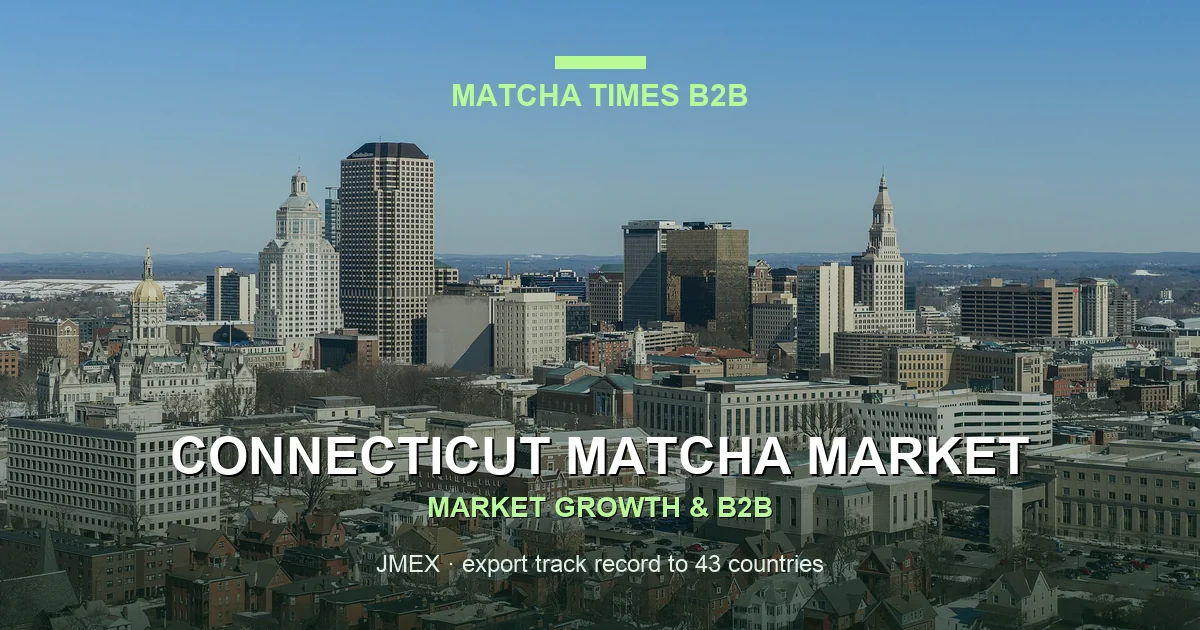
The Connecticut matcha market is expanding in 2026, driven by a wave of matcha-forward cafés in affluent Fairfield County and New Haven, health-conscious consumers, and strong social-media pull among younger drinkers. For B2B buyers — multi-store café groups, importers, and wellness or protein brands — the real question is not whether demand exists but whether you can secure consistent, grade-verified Japanese matcha as global supply tightens. This guide maps where Connecticut demand is concentrated, explains ceremonial versus culinary grade, and sets out how to import Japanese matcha compliantly. JMEX supports buyers with an export track record to 43 countries.
For Companies Seeking Matcha Powder
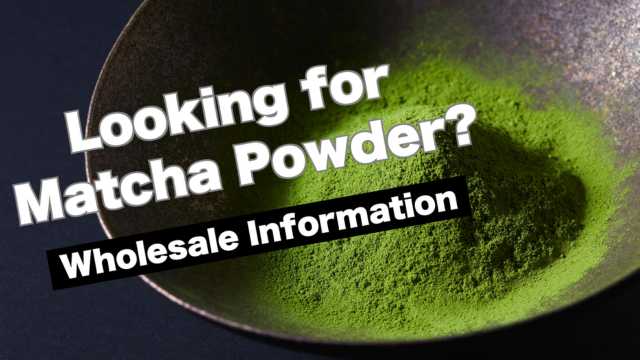
Sourcing grade-verified Japanese matcha for the Connecticut market — at café-group or brand scale — starts with the right origin, grade, and documentation.
Common Challenges:
- “We have projects but cannot secure stable matcha supply…”
- “We want to incorporate matcha into new café menu items!”
If you face these concerns, consult with Matcha Times. Feel free to contact us for initial inquiries.
\Read Also/

Key Takeaways
- Connecticut matcha demand is led by Fairfield County (Darien, Old Greenwich, South Norwalk) and New Haven, with matcha-only concepts opening through 2025-2026.
- Grade fit — not just price — decides menu success: ceremonial-style grades for straight lattes, culinary grades for baking, RTD, and blends.
- A global tencha (matcha leaf) squeeze is raising prices and lead times; supply continuity is now a sourcing risk, not an afterthought.
- US import duty on green tea including matcha (HS heading 0902) is duty-free at the MFN base rate (USITC); recent country-level tariff measures are separate and time-varying.
- US importers must run an FDA Foreign Supplier Verification Program (FSVP) and hold documentation such as a Certificate of Analysis for each supplier and food.
\Read More/

What is driving the Connecticut matcha market in 2026?
The short answer: café expansion plus affluent, wellness-oriented consumers. Connecticut is one of the wealthier US states by median household income (see US Census Bureau QuickFacts: Connecticut), and its dense Fairfield County commuter towns and university cities give premium beverage concepts a ready audience. Matcha’s photogenic colour also performs well on short-form video, which keeps discovery costs low for new cafés.
Nationally the signal is strong. Tastewise reports matcha menu items grew roughly 30% year over year, with operator menu share up about 6.9%, while trade coverage in Fresh Cup notes café matcha prices rising near 14% as interest climbs. Treat these as attributed industry estimates that vary by provider and definition — but the direction is unambiguous for Connecticut operators planning 2026 menus.
Connecticut’s matcha café landscape by region
Demand is not evenly spread. It concentrates where disposable income and foot traffic overlap: the Gold Coast towns of lower Fairfield County, then New Haven, then the Hartford / West Hartford corridor. The venues below are named only as neutral, verifiable indicators of local activity — they are not ranked, scored, or compared against each other.
| Connecticut region | Notable matcha activity (public reporting) | What it signals for buyers |
|---|---|---|
| Fairfield County (Darien, Old Greenwich, S. Norwalk) | Matcha-forward concepts such as Zen Cha (Darien, expanding to Old Greenwich) and Momo Matcha (SoNo Collection) reported opening / expanding 2025-2026. | Highest willingness to pay; demand for higher-grade, origin-specific matcha. |
| New Haven | Dedicated matcha-and-dessert venues (e.g. BLISS: Matcha and Beyond) reported opening late 2025. | Student + professional base; volume across lattes and dessert applications. |
| Hartford / West Hartford corridor | Matcha appears across established specialty-coffee roasters and cafés. | Blended demand; culinary grades for lattes and bakery use. |
| Pop-up / emerging (e.g. Fairfield) | Certification-trained operators (e.g. Matcha Amor, Shizuoka-sourced) reported planning permanent sites. | Early buyers who value traceability and grade storytelling. |
The pattern matters for procurement. A café group scaling across these regions needs one consistent supply line — one origin and grade specification it can reorder reliably — rather than a different matcha in every store.
Ceremonial vs culinary grade: matching matcha to Connecticut menus
Grade is the single biggest driver of both cup quality and cost, so it deserves a direct answer. Grade names describe leaf selection, shading, and stone-milling fineness — not a legal standard — so definitions vary between suppliers. The practical split for a menu is by application, not marketing name.
Ceremonial-style grades come from young, fully shade-grown leaves (tencha) that are de-veined and stone-milled to a fine, low-bitterness powder. They are built for straight drinking served with water or lightly with milk. Culinary grades are firmer and more robust, designed to hold colour and flavour through heat, sugar, and dairy in baking, RTD, blends, and sweetened lattes.
Choosing wrongly is expensive in both directions: a ceremonial grade wasted in a baked good, or a culinary grade that turns dull and bitter in a hero latte and drives refunds. Map grade to use case before you negotiate volume.
| Menu / product use | Grade fit | What to prioritise |
|---|---|---|
| Signature / hero latte (water or light milk) | Ceremonial-style | Vivid colour, low bitterness, aroma |
| Everyday sweetened latte, iced, blended | Premium culinary | Colour stability in milk and ice |
| Baking, soft-serve, pastry | Culinary | Heat and colour stability, cost per serving |
| RTD / bottled, protein, wellness blends | Culinary (spec-controlled) | Particle size, dispersion, batch consistency, COA |
The 2026 supply squeeze: why sourcing Japanese matcha is harder
Matcha starts as tencha, a shade-grown leaf harvested in limited spring flushes and milled slowly on stone. That supply chain is structurally slow cannot scale on demand the way a commodity crop can. When global demand surges, the tencha bottleneck shows up first as longer lead times, then as price.
Trade reporting in 2026 describes suppliers raising prices, buyers switching sources mid-year, and waitlists stretching months (Fresh Cup, 2026). For a Connecticut café group or brand, the risk is a mid-season supply gap: a menu built around one matcha that suddenly cannot be reordered at the same grade or price.
Context on the export side: Japan’s Ministry of Finance Trade Statistics reports green-tea exports of about ¥36.4 billion and 8,798 tonnes in 2024 — a figure that covers all forms of green tea, not matcha alone, and should be read as value and volume together, not as a matcha-specific number. The takeaway for buyers is to lock grade, origin, and an allocation plan early rather than buying spot.
How Connecticut businesses import Japanese matcha compliantly
If you import directly rather than buying from a US distributor, you become the US importer of record and take on federal obligations. Here are the anchors, each tied to its primary source.
- Tariff (HS 0902): US import duty on green tea including matcha (HS heading 0902) is duty-free at the MFN base rate, per the USITC Harmonized Tariff Schedule. Recent 2024-2025 country-level ‘reciprocal’ tariff measures are separate, time-varying, and should be confirmed with a licensed customs broker or CBP before you quote landed cost.
- FDA FSVP: US importers must develop and follow a Foreign Supplier Verification Program for each supplier and food, per the FDA FSVP final rule. Modified requirements apply to very small importers (under roughly $1M in annual human-food imports); suppliers and hazards are reevaluated at least every three years (FSVP key requirements).
- Food safety & documents: matcha is a food, so US labeling, allergen, and adulteration rules apply. Hold a current Certificate of Analysis (COA) and confirm the supplier tests against your destination-market residue and heavy-metal limits.
Grades, origins, and residue limits change, so treat the framework above as the checklist and confirm current specifics at quotation. The buyer checklist below works for evaluating any matcha supplier — including JMEX.
| Criterion to verify with any supplier | What good looks like |
|---|---|
| Origin & cultivar traceability | Named prefecture / farm and cultivar; not just ‘Japanese matcha’ |
| Grade specification | Written spec (colour, particle size, use case) matched to your menu |
| COA & residue testing | Current COA; testing against your market’s MRL / heavy-metal limits |
| Export documentation | Commercial invoice, packing list, origin docs, FSVP-ready records |
| Supply continuity | Allocation / reorder plan across a season, not spot-only |
| Lead time & MOQ logic | Clear sample-to-order and reorder lead times; MOQ that fits your run rate |
| Certifications (if needed) | Organic / JAS / halal where your product or market requires them |
Notice what this checklist does not do: it never ranks named suppliers or scores them against each other. It gives you one neutral standard so you can hold every candidate, JMEX included, to the same bar.
Why Buyers Choose JMEX (Japan Matcha Export Organization)

For a Connecticut café group, importer, or wellness brand, the hard part is not finding matcha — it is securing the same grade, origin, and quality every reorder.
JMEX (Japan Matcha Export Organization) works on the export side: selecting origin and cultivar, designing the grade to your application, and preparing COA, residue testing, and customs documentation so your FSVP file is clean. With an export track record to 43 countries, JMEX helps buyers standardise one reliable supply line and confirm current pricing at quotation — never a guessed number.
Frequently Asked Questions
Is the Connecticut matcha market still growing in 2026?
Yes. New matcha-forward cafés continue to open across Fairfield County and New Haven, and national foodservice data (Tastewise) shows matcha menu items up roughly 30% year over year. Growth is real, but supply is tightening, so procurement planning matters more than it did a year ago.
What grade of matcha do Connecticut cafés use?
It depends on the menu. Straight hero lattes favour ceremonial-style grades for colour and low bitterness; everyday sweetened lattes, iced drinks, baking, and RTD products use culinary grades built for colour and flavour stability in milk, heat, and sugar. Most multi-menu cafés carry more than one grade.
Is there a matcha shortage, and will it affect my orders?
Trade reporting in 2026 describes a tencha supply squeeze with longer lead times and rising prices. It does not stop sourcing, but it rewards buyers who lock grade, origin, and an allocation plan early instead of buying spot each month.
What tariff and rules apply when importing matcha into the US?
Green tea including matcha (HS heading 0902) is duty-free at the US MFN base rate per the USITC tariff schedule; any recent country-level reciprocal tariff is separate and time-varying, so confirm it with a customs broker. As importer you must also run an FDA FSVP and hold documentation such as a Certificate of Analysis.
How can a Connecticut café group secure consistent Japanese matcha supply?
Standardise on one written grade and origin specification, order against a seasonal allocation plan, and work with an export partner that can hold that spec, provide COA and customs documentation, and confirm current pricing at quotation. That is exactly the export-side role JMEX plays for buyers in 43 countries.
Sources & Methodology
This article synthesises official primary sources with clearly attributed industry estimates. Each source below states what it supports, its date, and its scope. Market-size and trend figures are attributed to their commercial provider and read as estimates that vary by provider and definition; regulatory and tariff points come from official government sources. No figure is presented as first-party proprietary data.
- USITC Harmonized Tariff Schedule (HS 0902) — US import duty on green tea/matcha is duty-free (MFN base rate) — 2026 US tariff, primary/official
- FDA — FSVP final rule — US importer verification obligations and modified-requirement thresholds — current US food-import law, primary/official
- Japan Ministry of Finance — Trade Statistics — Japan green-tea export value/volume 2024 (all green tea, not matcha-only) — 2024 Japan trade stats, primary/official
- US Census Bureau — QuickFacts Connecticut — Connecticut demographic and income context — current US demographics, primary/official
- Tastewise — matcha trends — US foodservice matcha menu-growth estimates (attributed) — 2026 commercial estimate, attributed
- Fresh Cup — matcha boom coverage — Café price and supply-squeeze reporting (attributed) — 2026 trade press, attributed
Researched and reviewed by the Matcha Times Editorial Team, operated by the Japan Matcha Export Organization (JMEX). See our Editorial Policy and Sources & Methodology. Found an error? Tell us.
Learn More About Global Matcha Trends at Matcha Times
Matcha Times is a specialist media platform covering the global matcha market — sourcing and wholesale, supply and pricing, trade and regulations, production and origins, and the companies shaping the industry.
From market analysis and price trends to café case studies and interviews with tea farmers, we help buyers, importers, distributors, and manufacturers stay ahead of where matcha is heading. Explore more and put the global matcha market to work for your business.
Conclusion
Connecticut’s matcha demand is real and premium, but 2026 rewards buyers who treat sourcing as strategy: match grade to menu, plan for a tight supply season, and import on a compliant, documented footing. Define your grade and origin specification, then confirm quality and current pricing with a sample before you scale.
Looking for wholesale or OEM matcha samples? Contact us — we will recommend the optimal origin and grade based on your application and target markets.
Related Articles