Matcha Wholesale Miami: Japanese Supply, MOQ, Price & Delivery Guide
For a Miami buyer, “matcha wholesale Miami” is really a sourcing decision: whether to buy from a US distributor who already holds stock in South Florida, or to import Japanese matcha directly through PortMiami or Miami International Airport and manage the customs and compliance side yourself. Size your minimum order around the grade you actually need — a small trial lot to qualify a vendor, then a committed tier once the recipe is locked.
Green tea, including matcha, enters the United States duty-free under HTS heading 0902, so your landed cost is driven by grade, origin, packaging, certification, order size, and freight — not by an import duty. This guide covers the MOQ to expect, what actually moves the per-kilogram price, how matcha reaches South Florida through the Gateway of the Americas, and the Florida and federal rules a wholesale buyer must clear.
For Companies Seeking Matcha Powder

We source matcha from Japan’s premier production regions including Kyoto Uji, Kagoshima, Fukuoka, and Shizuoka, offering comprehensive grade ranges from organic JAS-certified ceremonial grade to processing-grade matcha.
Common Challenges:
- “We have projects but cannot secure stable matcha supply…”
- “We want to incorporate matcha into new café menu items!”
If you face these concerns, consult with Matcha Times. Feel free to contact us for initial inquiries.
\Read Also/
Key Takeaways for Miami matcha buyers
- Two gateways serve South Florida — ocean freight into PortMiami and air cargo through Miami International Airport — and your choice between them sets both lead time and freight cost.
- Matcha carries no US import duty (it falls under green tea, HTS 0902), so your landed cost comes down to grade, packaging, certification, and shipping rather than tariffs.
- Qualify a vendor with a small trial lot first; commit to a priced volume tier only after you have fixed the recipe, the color you want, and the flavor profile.
- Holding, repacking, or processing matcha for resale in Florida triggers an FDACS food establishment permit — but, unlike California, Florida imposes no Proposition 65 warning-label regime.
- Go Japan-direct and the FDA treats you, not the exporter, as the accountable importer under the Foreign Supplier Verification Programs (FSVP).
- Budget for climate-controlled storage from the start: in Miami’s heat and humidity, bright matcha dulls to yellow-brown far quicker than in a temperate warehouse.
- Read every price as either a market range or a single supplier’s quote on a stated trade term (FOB, CIF, or delivered Miami) — one vendor’s number is never the whole market.
\Read More/
What “matcha wholesale” means for a Miami buyer, and the MOQ to plan for
At wholesale, you are buying matcha by the kilo for resale, a menu, or a production line — not a single retail tin. For a Miami operator that comes down to one of two paths. The first is a US distributor who has already imported and warehoused the powder and ships you cases on short notice. The second is a standing line with a Japanese exporter: you commit to real volume, and in return you gain control over grade and a keener per-kilogram price. How much to order the first time, and every time after, follows from which path you pick and how quickly your stock moves.
Remember that matcha is perishable in the cup. Colour and aroma start fading within weeks of opening, so a sound minimum is the point where a cheaper unit price still leaves you able to sell through before the lot tires. Read the table below as a planning scaffold rather than a quote sheet — pin down the real minimum and unit cost with each vendor when you ask for pricing.
| Order tier | Who it fits | Where it helps | The catch |
|---|---|---|---|
| Trial / sample lot | Vetting a new vendor | Checking colour, taste, dispersion and milk behaviour before committing | Dearest per unit; never a production price |
| Entry wholesale (single-digit kg) | One cafe, a small bakery, a product test | Standing up a menu item or a private-label pilot | Almost no pricing leverage |
| Committed wholesale (tens of kg) | Multi-site cafe, regional distributor | A fixed recipe with steady monthly draw | Demands storage room and rotation discipline |
| Bulk / contract (hundreds of kg+) | Manufacturer, RTD or protein brand, large distributor | Sharpest per-kg economics and tight grade consistency | Needs forecasting, cash-flow planning and a dependable source |
What actually drives your matcha wholesale price in Miami
A “Miami price” for wholesale matcha does not exist in the abstract. A per-kilogram figure carries meaning only once it is pinned to a grade, a quantity, and a trade term. So treat every number as either a market range or a quote from one supplier — and resist the temptation to staple one vendor’s price to another vendor’s MOQ as though they were a single fact.
- Grade and use case — a ceremonial-style matcha meant to be drunk neat sits well above culinary or processing grade destined for lattes, bakes, or RTD lines.
- Harvest and origin — first-flush leaf from Uji, Nishio, Kagoshima, or Shizuoka commands a premium that later pickings and blends do not.
- Certification — USDA Organic or JAS, plus documented food-safety or Halal credentials, lift both the price and, often, the minimum.
- Packaging — retail-ready tins run dearer per kilo than foodservice bags or bulk cartons, so repacking in Florida can beat importing finished units.
- Volume committed — the one lever most firmly in the buyer’s own hands.
- Shipping and cold-chain — ocean versus air, and climate-controlled storage in a sub-tropical city, are line items that belong squarely in your landed-cost model.
None of that math includes duty, because green tea and matcha clear US customs at zero duty under HTS 0902 (U.S. International Trade Commission Harmonized Tariff Schedule, chapter 9). The country-level “reciprocal” surcharges debated through 2024–25 are a separate and shifting trade measure rather than the product rate on matcha; have a licensed customs broker confirm what actually applies before you commit to contract pricing.
Miami, the Gateway of the Americas: how Japanese matcha reaches South Florida
This is where a Miami sourcing plan stands apart. Unlike a landlocked market, Miami is both a deep seaport and one of the country’s busiest international air gateways, and it is the primary US container gateway for Latin America and the Caribbean. PortMiami — branded the Cargo Gateway of the Americas — handled over a million TEUs in fiscal year 2024 and ranks first in Florida for international containerized cargo (PortMiami, Miami-Dade County). For a wholesale buyer that means real routing choices, and if you also distribute south, a re-export story most US cities cannot offer.
Two realistic import routes serve South Florida directly, plus the usual domestic-distributor option. Ocean freight through PortMiami suits standard container volumes; air freight through Miami International Airport trades a higher rate for speed on samples or premium lots. Miami-Dade also operates Foreign-Trade Zone 281, a US Customs-supervised area where goods can be stored with duty deferred and re-exported without ever triggering a duty liability (Foreign-Trade Zone No. 281). For duty-free matcha the direct savings are limited — the product rate is already zero — but the zone and bonded-warehouse infrastructure matter if you consolidate other dutiable goods or re-export into Latin America.
| Route into Miami | Best for | Lead time profile | Watch-outs |
|---|---|---|---|
| Ocean via PortMiami | Standard container volumes; Latin-America re-export | Moderate; short inland leg to South Florida | Container scheduling; drayage and warehouse capacity |
| Air freight via Miami International Airport | Samples, urgent or premium lots | Fastest door-to-door | Highest freight cost per kg |
| FTZ 281 / bonded warehouse | Consolidation, deferred duty on mixed cargo, re-export | Flexible storage; no duty until entry | Setup and compliance overhead; limited benefit for duty-free matcha alone |
| Domestic distributor stock | Buyers who need cases now | Shortest; no import step for you | Less grade control; distributor margin |
The practical takeaway: if you import direct, pair your supplier decision with a freight-forwarding or customs-broker partner who already runs the Japan–Miami ocean or air lane. If you would rather avoid the import step entirely, a domestic distributor absorbs the logistics in exchange for margin and less control over grade and origin.
US distributor or Japan-direct import for a Miami operation?
Neither route is wrong; which one fits turns on your volume, your cash position, and how tightly you need to control grade. A US distributor is the path of least friction — quick turnarounds, familiar domestic terms, no customs paperwork landing on your desk — at the cost of a margin and of taking whatever grades and origins the distributor happens to carry. Importing straight from Japan pays off in unit cost once volume is there, and lets you dictate origin, harvest, and grade, but it casts you as the importer of record, with customs, FSVP, and freight all now yours to run.
- Lean distributor when speed matters, when you reorder small and often, or when you are still proving demand and do not want import overhead.
- Lean Japan-direct when your volume is predictable, when documented origin and grade consistency are worth it, and when you can shoulder (or partner for) compliance and freight.
- Run both — many Miami operators keep distributor stock for agility while they qualify a direct line for the committed base volume, all the more so if they also ship south.
Florida and federal compliance for wholesale matcha buyers
Wholesaling matcha in Florida answers to two layers of regulation: the state’s food-permitting rules and, the moment you import, federal FDA obligations. Nothing here is unusual, yet overlooking a single step is one of the most avoidable ways a launch loses weeks.
Florida FDACS food establishment permitting
The Florida Department of Agriculture and Consumer Services (FDACS), Division of Food Safety, permits and inspects food establishments that manufacture, process, pack, hold or distribute food to other businesses — which includes storing bulk matcha in a warehouse or repacking it into retail tins or blends. A wholesale/manufactured food establishment permit is issued after an application, a successful inspection, and payment of the applicable fee, and is renewed annually. Verify your specific activity and current fees with FDACS before you quote customers (FDACS: Wholesale/Manufactured Food Establishment Permit; FDACS Wholesale/Manufactured Food Program).
No Proposition 65 — one less layer than California
Florida carries no Proposition 65 equivalent, which spares a Miami seller the state-specific warning-label exercise that California buyers must work through. That is not a pass on quality: federal FDA labeling rules still bind you, and the heavy-metal and contaminant testing you run for quality and FDA compliance remains just as worthwhile — Florida simply does not stack the California warning regime on top of it.
FSVP and FDA facility registration once you import direct
Import straight from Japan and US food law puts the duty of proof on you: under the Foreign Supplier Verification Programs (FSVP), the importer must verify that the overseas producer meets US safety standards. Alongside that sit FDA food facility registration and prior notice for each shipment. Fold these into your project timeline from the outset, not after the first container is already on the water (FDA FSVP overview; FDA food facility registration).
How matcha is classified, and why there is no duty
For customs purposes matcha rides under green tea at HTS heading 0902, and that heading carries a zero, duty-free general (MFN) rate in the USITC tariff schedule. The finer points — exact classification, country-of-origin marking, and any separate country-level measure live at the time of entry — are worth settling with a customs broker for each specific shipment.
Storing matcha in Miami’s heat and humidity
Matcha degrades with heat, humidity, light, and oxygen — and South Florida supplies the first two in abundance. A wholesale buyer who nails sourcing but stores pallets in an un-conditioned Miami warehouse can watch bright green powder dull toward yellow-brown within weeks. Treat climate-controlled storage as part of the cost of doing business here, not an afterthought.
- Keep sealed stock cool and dry; avoid pallets near loading-dock doors where hot, humid outside air cycles in.
- Buy to a realistic turn rate — a lower unit price on a large tier is a false economy if color and aroma fade before you sell it.
- Favor nitrogen-flushed or foil-barrier bulk packaging for inventory that will sit, and open only what you will use quickly.
- If you distribute onward into the Caribbean or Latin America, plan the cold-and-dry chain through re-export, not just to your own door.
Why wholesale matcha demand keeps rising in Miami
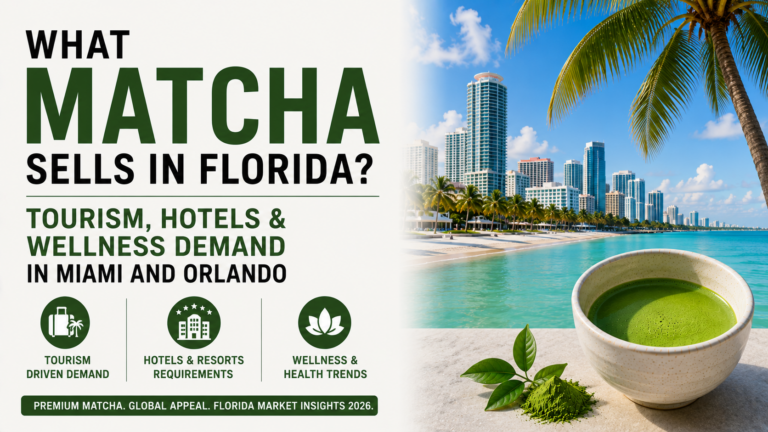
Miami pairs a tourism- and hospitality-driven foodservice scene — hotels, resorts, cruise lines, and the cafe culture of Brickell, Wynwood, and Miami Beach — with a fast-growing health-and-wellness market and a Latin-American dessert and bubble-tea influence. Matcha pulls through retail, foodservice, and manufacturing channels at once, and Miami’s role as a re-export hub means a distributor here can serve the Caribbean and Latin America as well as the local market.
The supply side is moving in step. Japan’s exports of green tea in all forms, matcha included, hit a record ¥36.4 billion / about 8,798 tonnes in 2024 per the Ministry of Finance Trade Statistics. Read it carefully: that is a green-tea total rather than a matcha-only count, and a weak yen flatters the value — but the trend makes clear that Japanese green-tea export supply is widening as overseas demand grows (Ministry of Finance Trade Statistics, via Nippon.com). Figures for the matcha market specifically come from commercial research houses, differ by provider and definition, and are best read as indicative rather than official.
Ordering wholesale matcha in Miami, step by step
A repeatable ordering routine guards your quality and your cash at the same time. It holds up whether you source from a distributor or bring product in yourself.
- 1. Write the spec down — grade, end use (neat drink, latte, bakery, RTD), target colour and flavour, certification requirements, and the packaging you need.
- 2. Taste the samples in context — judge colour, aroma, taste, dispersion, and milk behaviour inside your actual recipe, never on their own.
- 3. Insist on a quote with a trade term — FOB, CIF, or delivered Miami, with MOQ and lead time committed in writing.
- 4. Clear the compliance boxes — the FDACS permit for what you actually do, plus FSVP and FDA registration if you are the importer.
- 5. Lock route and storage — PortMiami by sea or MIA by air, a forwarder or distributor who already runs the lane, and climate-controlled space for the Florida climate.
- 6. Start with one committed order — sized to clear before the lot tires, then grow the tier as the demand holds up.
A neutral supplier checklist for any matcha vendor
Hold every candidate — a US distributor, a Japanese exporter, anyone else — to one identical set of questions. That is how you compare them on evidence instead of on reputation.
| Criterion | What to verify with any supplier |
|---|---|
| Minimums and tiers | The true floor for each grade, and how the unit price falls as volume climbs |
| Grade and origin | Harvest, region, and cultivar on paper — not the word “ceremonial” on a label |
| Certification | USDA Organic or JAS, plus food-safety and Halal documents where they matter |
| Batch consistency | Colour and flavour held steady lot to lot, with a COA available on request |
| Lead time | Honest sample-to-order and reorder timing, counting ocean versus air into Miami |
| Export paperwork | Can issue the documents a US importer needs to clear customs and satisfy FSVP |
| Price transparency | Quotes anchored to a trade term, with no repack or freight costs hidden off the page |
Where Miami matcha buyers get caught — and how to avoid it
- Mistaking one quote for the market. Weigh a supplier’s price against its grade and trade term, never against some unrelated headline number.
- Shrugging off the climate. South Florida’s heat and humidity age matcha quickly, so fund climate-controlled storage and size orders to a turn rate you can actually hit.
- Chasing the big-tier discount. A cheaper unit price on a large lot only wins if the powder sells through before its colour and aroma slip.
- Expecting the exporter to own US compliance. Once you import, FSVP and FDA registration sit with you, not with the supplier.
- Overlooking the Florida permit. Warehousing or repacking matcha for wholesale without the right FDACS food establishment permit can freeze a launch before it starts.
How Japan-direct supply reaches Miami buyers
Finding matcha is the easy part of Japan-direct sourcing; the real work is fitting the right origin and grade to your recipe and then delivering it, batch after batch, with the paperwork a US importer has to produce. That export-side load covers origin and cultivar selection, grade design, COA and MRL testing, support for organic and Halal certification, customs documentation, and a steady monthly flow that scales from 10 kg to tonne quantities.
This is precisely where the Japan Matcha Export Organization (JMEX) concentrates, backed by an export track record to 43 countries. For a Miami operation it means one contact who can set the grade, verify certification, and lay out a route — PortMiami by sea or MIA by air — around your volume, your lead time, and any plans to re-export south.
Sources & Methodology
This guide synthesises US and Japanese primary and official sources with standard B2B import practice; it contains no proprietary survey or first-party figures. Each source below states what it supports, its date, and its scope. All figures are external primary or official sources — a current per-kilogram price or MOQ is confirmed at quotation, not stated here as fact.
- USITC Harmonized Tariff Schedule (ch. 9, heading 0902) — 0% US import duty on green tea / matcha (2026, US federal tariff)
- FDA Foreign Supplier Verification Programs — Importer food-safety verification obligation (current, US federal import rule)
- FDA food facility registration — Facility registration for imported food (current, US federal)
- FDACS — Wholesale/Manufactured Food Establishment Permit — Florida wholesale / manufactured food permitting (current, Florida state)
- PortMiami, Miami-Dade County — Miami seaport / Cargo Gateway of the Americas, FY2024 container volume (2024, Miami-Dade, US port)
- Foreign-Trade Zone No. 281 (Miami-Dade County) — Duty deferral / re-export bonded zone context (current, Miami-Dade FTZ)
- Japan Ministry of Finance Trade Statistics (via Nippon.com) — Japan green-tea export value/volume (all forms, incl. matcha) (2024, Japan national, green-tea total)
Researched and reviewed by the Matcha Times Editorial Team, operated by the Japan Matcha Export Organization (JMEX). Last reviewed: 2026-10-03. See our Editorial Policy and Sources & Methodology. Found an error? Tell us.
Why Buyers Choose JMEX (Japan Matcha Export Organization)

For a Miami wholesale buyer weighing a Japan-direct line, the deciding factor is reliable export-side execution — origin and grade selection, certification, documentation, and stable supply.
exports to 43 countries
Frequently Asked Questions (FAQ)
How much does wholesale matcha cost per kilogram for a Miami buyer?
No single Miami figure exists. Per-kilogram cost moves with grade, origin, quantity, packaging, certification, and freight, and it only means anything once attached to a trade term (FOB, CIF, or delivered Miami). Ask for a live quote on your exact grade and volume instead of trusting a headline number.
What is the minimum order quantity (MOQ) for wholesale matcha?
It depends on the supplier and the model. Distributors may let you buy by the case, whereas a Japanese exporter usually sets minimums whose unit price eases as the volume rises. The common approach is a small qualifying lot first, then a committed tier once the recipe is settled.
How does imported matcha reach Miami?
By sea through PortMiami — the leading US container gateway for Latin America and the Caribbean — or by air through Miami International Airport when a lot is urgent or premium. Operators who consolidate cargo or re-export can also route through Foreign-Trade Zone 281. Whichever you pick sets your lead time and freight bill.
Do I need a license to sell matcha wholesale in Florida?
In most cases, yes. The Florida Department of Agriculture and Consumer Services (FDACS) issues a wholesale/manufactured food establishment permit for storing, packing, processing, or distributing food to other businesses. Check your exact activity and the current fee with FDACS before you quote a customer.
Is there a US import duty on matcha brought in through Miami?
There is not. Matcha falls under green tea at HTS heading 0902, carrying a 0% general (MFN) rate in the USITC schedule. Any separate country-level measure shifts over time, so confirm it with a customs broker for the specific shipment.
How should I store matcha in Miami’s climate?
Cool, dry, sealed, and out of light and heat. Because South Florida’s heat and humidity age matcha fast, pay for climate-controlled storage, choose nitrogen-flushed or foil-barrier bulk packs for stock that will sit, and order only what you can realistically turn over.
Learn More About Global Matcha Trends at Matcha Times

Matcha Times is a specialist media platform covering the global matcha market — sourcing and wholesale, supply and pricing, trade and regulations, production and origins, and the companies shaping the industry.
From market analysis and price trends to café case studies and interviews with tea farmers, we help buyers, importers, distributors, and manufacturers stay ahead of where matcha is heading. Explore more and put the global matcha market to work for your business.
Conclusion
When origin, grade, and export conditions align, matcha becomes a stable revenue source. Start by defining your requirements and confirming quality with a sample.
Looking for wholesale or OEM matcha samples? Contact us — we will recommend the optimal origin and grade based on your application and target markets.
Related Articles