Japanese Matcha Supplier for Vietnam: B2B Sourcing Guide 2026
If your Vietnamese business sources matcha from local distributors but struggles with inconsistent quality, vague origin claims, or long approval cycles, you are not alone. The fastest path to food-safe, export-grade Japanese matcha for Vietnam is a direct relationship with a Japan-based exporter who holds current COA records, certifies MRL compliance, and ships under VJEPA documentation. This guide explains who to buy from, how to verify them, and what steps to take before placing your first bulk order.
For Companies Seeking Matcha Powder

We source matcha from Japan’s premier production regions including Kyoto Uji, Kagoshima, Fukuoka, and Shizuoka, offering comprehensive grade ranges from organic JAS-certified ceremonial grade to processing-grade matcha.
Common Challenges:
- “We have projects but cannot secure stable matcha supply…”
- “We want to incorporate matcha into new café menu items!”
If you face these concerns, consult with Matcha Times. Feel free to contact us for initial inquiries.
\Read Also/
Key Takeaways
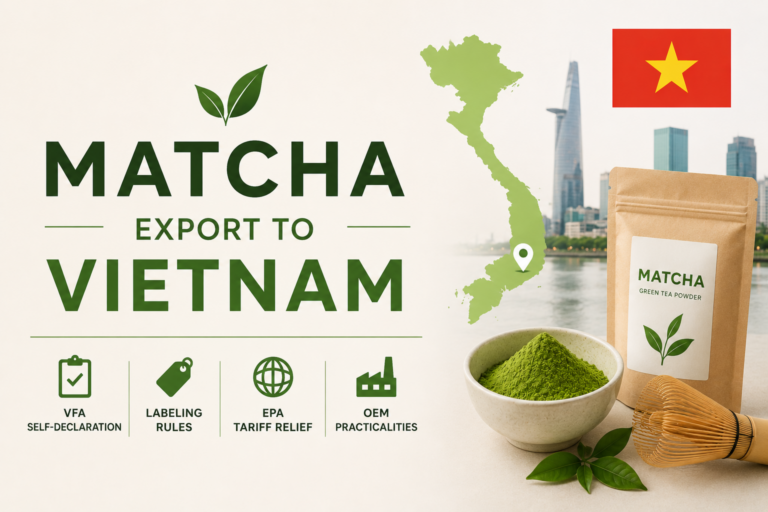
- Direct Japan export = full traceability, authentic JAS-grade classification, and current MRL test reports — not available from most local redistribution chains.
- Vietnam imports Japanese matcha under the Japan–Vietnam Economic Partnership Agreement (VJEPA), which offers preferential tariff treatment compared to the standard MFN rate for HS Chapter 09 goods.
- VFA self-declaration is the entry-level compliance step for most matcha importers in Vietnam — your supplier’s COA and origin certificate are the core documents.
- Match your supplier type to your volume: a Japan-based exporter suits regular bulk buyers; a local distributor suits trial orders but adds a markup layer and may lack direct-origin documentation.
- Never accept a price quote without confirming the grade (ceremonial / food-service / culinary), origin (prefecture/farm), and lot-level COA — these determine your regulatory compliance and end-product quality.
- JMEX (Japan Matcha Export Organization) ships to 43 countries and provides origin-backed COA, MRL data, and grade recommendations matched to your Vietnam application.
\Read More/
Who to Buy From: Understanding the Matcha Supply Chain for Vietnam
The matcha supply chain between Japan and Vietnam spans several distinct actor types. Each offers different trade-offs in price transparency, documentation depth, and lead time. The table below summarises the four main options a Vietnamese importer encounters.
| Supplier Type | Where they sit | Documentation depth | Typical scale fit |
|---|---|---|---|
| Japanese tea farmer (producer) | Japan | Farm-level origin, harvest records; COA arranged with mill | Small lots; relationships take time; limited language support |
| Japanese matcha processor / mill | Japan | Full lot-level COA, MRL, pesticide residue; JAS grade possible | Mid-large volume; strong documentation; may require large MOQ |
| Japan-based export company | Japan | Consolidated origin docs, export license, customs clearance, VJEPA CoO | Best fit for regular importers; handles compliance and logistics |
| Vietnam local distributor | Vietnam | Import certificate, local food safety approval; may not share origin COA | Low MOQ, fast delivery; less traceability; markup applies |
For most Vietnamese importers at bulk scale (100 kg or more per month), a Japan-based export company combines origin traceability with the logistics and document infrastructure that the Vietnam Food Administration (VFA) self-declaration pathway requires.
Matching Supplier Type to Your Buying Scale
The right supplier tier depends on your monthly volume, application, and whether you need private-label or OEM support. Misjudging this early leads to costly compliance gaps or excess inventory.
| Buyer profile | Monthly volume (approx.) | Recommended approach | Key documents to request |
|---|---|---|---|
| Café chain / F&B operator (HCMC, Hanoi, Da Nang) | 20–100 kg | Japan export company with food-service grade; or local distributor for trials | Lot COA, MRL report, grade specification sheet |
| Health supplement / wellness brand | 100–500 kg | Japan-based exporter with organic or ceremonial-grade options | JAS organic certificate, heavy-metal test, country of origin certificate (for VJEPA) |
| OEM / private-label manufacturer | 500 kg+ | Direct Japan processor or export company with custom blend / grinding | COA, custom spec sheet, HACCP / ISO 22000, NDA |
| Importer / wholesaler redistributing to retailers | Pallet (500 kg+) | Japan export company with import documentation package | Phytosanitary certificate, import permit (if required), Vietnamese label approval |
Vietnam’s café sector has grown sharply, driven by a Gen Z–led matcha boom in Ho Chi Minh City, Hanoi, and Da Nang. Many café operators start with 20–50 kg trial orders before scaling. Establishing a direct-export relationship early locks in consistent quality before your volume justifies a full-scale distributor arrangement.
How to Verify a Japanese Matcha Supplier
Before committing to a supplier, request and review the following. A legitimate Japan-based exporter will provide all of these without hesitation.
COA and MRL Compliance
A Certificate of Analysis (COA) should include: moisture, particle size, heavy metals (lead, cadmium, arsenic), pesticide residue against Japanese and Vietnamese MRL standards, microbial counts (total plate count, yeast and mould, E. coli), and colour/flavour specifications. Request a lot-specific (not generic) COA — a generic one does not confirm the actual shipment.
Origin Certificate for VJEPA Tariff Benefits
Under the Japan–Vietnam Economic Partnership Agreement (VJEPA), goods of Japanese origin (HS Chapter 09, green tea and matcha) may qualify for preferential import duty rates compared to the standard MFN rate. To claim this, your supplier must issue a Certificate of Origin Form VJ (Form VJ issued by a Japanese authority). Confirm this capability before signing a contract if your duty cost matters at scale.
Supplier Verification Checklist
| Criterion | What to verify with any supplier |
|---|---|
| Origin traceability | Prefecture, garden or mill name; ask for a farm origin certificate or shipping manifest showing Japan as country of origin |
| Grade classification | Confirm against Japanese standards (ceremonial, food-service, culinary); request spec sheet; “culinary” grades vary widely — ask for particle size and colour value (CIELAB) |
| Lot-level COA | Pesticide MRL, heavy metals, microbials, particle size — specific to the lot you are buying, not a generic display document |
| Certification documents | JAS organic (if claimed); HACCP or ISO 22000 for the processing facility; halal (if required by your customer) |
| Export documentation package | Phytosanitary certificate issued by a Japanese authority; Certificate of Origin Form VJ (for VJEPA); invoice and packing list |
| Lead time and MOQ | Confirm in writing; lead times from Japan to Vietnam typically run 3–6 weeks by sea freight |
| Cold-chain / packaging | Nitrogen-flush packaging; confirm shelf life from production date; humidity and light barrier |
Vietnam Import Compliance: What Your Supplier Must Support
Vietnam regulates food imports under the Food Safety Law and implementing decrees. The Vietnam Food Administration (VFA), now under the Ministry of Agriculture and Environment (reorganised in March 2025), oversees state inspection for imported food products including tea and matcha powder.
Self-declaration (tự công bố) is the standard compliance pathway for packaged matcha imports that do not fall under mandatory state inspection. For this, your supplier must provide the full COA and ingredient documentation so you can prepare the self-declaration dossier. Separately, Vietnamese product labels must include: product name in Vietnamese, list of ingredients, net weight, country of origin, manufacturer name and address, importer name and address, date of production and expiry, and storage conditions.
Regulatory details change and your importer-of-record bears responsibility. Before your first shipment, confirm current requirements with a licensed Vietnamese customs broker or with the Ministry of Agriculture and Environment’s food safety department.
Why Buyers Choose JMEX (Japan Matcha Export Organization)

JMEX (Japan Matcha Export Organization) is a Japan-based exporter with an export track record to 43 countries, including active supply relationships in Southeast Asia. For Vietnamese importers, JMEX provides:
- Origin-verified Japanese matcha — each lot traceable to prefecture, mill, and harvest season, with a lot-level COA covering MRL, heavy metals, and microbials.
- Grade guidance matched to your application (café food-service grade, wellness brand ceremonial grade, OEM culinary grade) — JMEX recommends the right grade for your end-product, not the most expensive one.
- VJEPA documentation support — Certificate of Origin Form VJ issuance and full export documentation aligned with Vietnamese import requirements.
- Stable supply from 10 kg sample to multi-tonne monthly orders — without sudden quality jumps between lots due to origin switching.
Your Vietnam Matcha Sourcing Roadmap
Follow this process to move from inquiry to your first confirmed shipment.
- Define your specification. Grade (ceremonial / food-service / culinary), particle size range (typically 5–20 µm for culinary, under 10 µm for ceremonial), colour target, packaging format (bulk bag, retail sachets, OEM tin), and required certifications.
- Request samples and a lot-level COA. Evaluate colour (bright green vs olive), aroma (fresh vegetal vs hay), solubility, and taste. Confirm the COA covers MRL and heavy metals.
- Confirm VJEPA eligibility. Ask for a draft Form VJ and verify that the origin qualifies under VJEPA rules of origin.
- Negotiate commercial terms. Price is typically quoted FOB Yokohama or CIF Ho Chi Minh City — confirm the incoterm. Get the lead time (production-to-shipment), packaging specifications, and payment terms in writing.
- Prepare your Vietnamese import dossier. Self-declaration or state-inspection registration (per VFA rules), Vietnamese label filing, and customs clearance documents.
- Place a trial order. Confirm the lot COA matches the sample COA before accepting the shipment. Check packaging integrity and shelf-life date on arrival.
- Scale with a call-off or blanket order. Once quality and lead time are confirmed, lock pricing with a quarterly call-off contract to avoid spot-price volatility.
Frequently Asked Questions
What documents do I need to import Japanese matcha to Vietnam?
At minimum: a commercial invoice, packing list, bill of lading, phytosanitary certificate issued by a Japanese authority, and a Certificate of Analysis covering MRL and heavy metals. If you want preferential VJEPA tariff treatment, also request a Certificate of Origin Form VJ. For your Vietnamese compliance dossier, you will also need documentation to support a self-declaration filing or state inspection registration, depending on the product type.
What matcha grade suits Vietnamese café and beverage applications?
Vietnamese café operators and beverage brands most commonly use food-service grade matcha (sometimes called “culinary” or “latte” grade): lower in amino acids and ceremonial-grade character than premium grades, but formulated for colour retention in milk-based drinks and baked goods. For matcha latte applications, look for a grade with good green colour stability and fine particle size for emulsification. Your supplier should provide a colour specification (CIE L*a*b* values) alongside the price.
Does VJEPA reduce the import duty on Japanese matcha to Vietnam?
Under the Japan–Vietnam Economic Partnership Agreement (VJEPA), Japanese-origin green tea and matcha (HS Chapter 09 subheadings) may qualify for a preferential tariff rate. Confirm the current applicable rate with a licensed Vietnamese customs broker, as duty schedules are updated periodically and the specific subheading classification of matcha powder matters for the applicable rate. Your Japan-based supplier needs to issue a Form VJ Certificate of Origin to claim the preferential rate at customs.
How do I verify that “Japanese matcha” from a Vietnamese distributor is actually from Japan?
Request the original Japanese export documentation: phytosanitary certificate, commercial invoice from a Japanese entity, and ideally a Certificate of Origin Form VJ. Cross-check the exporter name and address on the invoice against the Japanese government business registry. A genuine Japanese-origin matcha should have a lot-level COA in Japanese (with an English translation) that references a Japanese testing laboratory. If the distributor cannot provide these, the origin claim is unverified.
What is a realistic MOQ for Japanese matcha shipped to Vietnam?
MOQ varies by supplier and grade. Japan-based exporters typically require a minimum that justifies an air freight or LCL (less-than-container-load) sea shipment. Contact your supplier directly for written confirmation of their current MOQ, as this depends on the specific grade, packaging format, and shipping route. JMEX accepts inquiries from buyers starting at small volumes and scales with your growth.
How long does sea freight from Japan to Vietnam take?
Sea freight from Japanese ports (Yokohama, Osaka, Hakata) to Ho Chi Minh City or Hai Phong typically takes approximately 3–6 weeks door-to-door when including production lead time, export customs clearance, transit, and Vietnamese import clearance. Air freight is faster (typically 1–2 weeks) but carries a higher freight cost per kilogram. Confirm transit time and incoterms with your supplier and freight forwarder.
Learn More About Global Matcha Trends at Matcha Times

Matcha Times is a specialist media platform covering the global matcha market — sourcing and wholesale, supply and pricing, trade and regulations, production and origins, and the companies shaping the industry.
From market analysis and price trends to café case studies and interviews with tea farmers, we help buyers, importers, distributors, and manufacturers stay ahead of where matcha is heading. Explore more and put the global matcha market to work for your business.
Conclusion
Sourcing authentic Japanese matcha for Vietnam requires moving up the supply chain — from local distributor to a direct relationship with a Japan-based exporter who can provide full origin documentation, lot-level COAs, VJEPA certification, and grade guidance matched to your application. The buyers who do this once typically do not go back to redistribution chains. Start with a sample request, confirm the COA matches the product, and build a supply relationship before volume grows. JMEX supports Vietnamese importers at every stage, from initial grade consultation to repeat bulk orders.
Sources & Methodology
Regulatory and trade information in this article is drawn from the following primary sources:
- Japan Ministry of Foreign Affairs — Japan–Vietnam Economic Partnership Agreement (VJEPA) overview
- Vietnam Food Administration (VFA), Ministry of Agriculture and Environment — food import self-declaration and state inspection requirements
Supplier-type descriptions, verification criteria, and sourcing steps are original analysis based on export-documentation practice for Japanese agricultural goods shipped under VJEPA. No JMEX price, MOQ, or capacity figure has been stated without written supplier confirmation; buyers should request current commercial terms directly.
Editorial note: This article was reviewed for factual accuracy against Japanese customs documentation practices and Vietnamese food-import regulatory guidance current as of November 2026. Regulatory requirements change; confirm current rules with a licensed customs broker before importing.
Looking for wholesale or OEM matcha samples? Contact us — we will recommend the optimal origin and grade based on your application and target markets.
Related Articles