How to Import Matcha from Japan to Vietnam: Compliance, Documents & Shipping
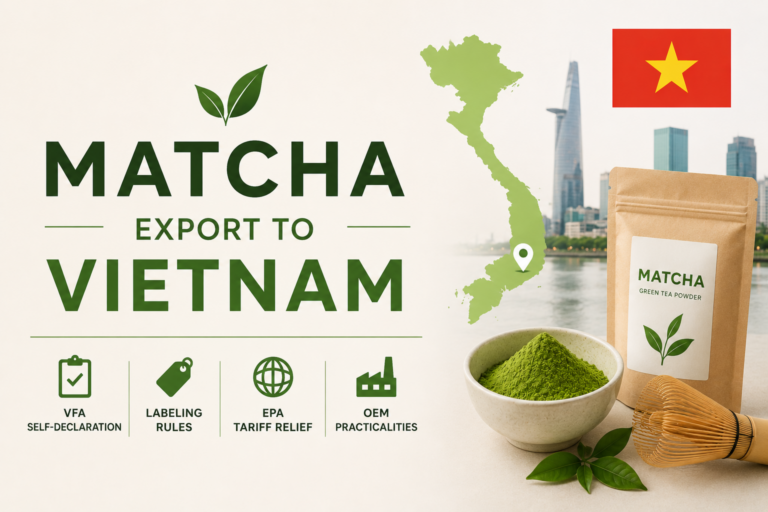
Yes — importing matcha from Japan to Vietnam is fully permitted under Vietnam’s current food-safety and customs framework. Under Vietnam’s food-safety framework, governed by Decree 15/2018/ND-CP (the implementing decree for the Law on Food Safety, Law 55/2010), imported food products including Japanese matcha must complete a self-declaration (tu cong bo) or state food-safety inspection process before the goods can be sold on the Vietnamese market. Importers also need a standard customs dossier, a phytosanitary certificate, and a Certificate of Analysis (COA) from the Japanese exporter. This guide walks through every requirement — from Japan’s export documents to in-country labeling and customs clearance.
Key Takeaways: Importing Matcha to Vietnam
- Importing Japanese matcha to Vietnam is fully permitted — no import prohibition or quota applies to matcha (HS heading 09.02) as of 2024.
- Vietnam’s food-import regime is governed by Decree 15/2018/ND-CP; imported food must complete a self-declaration (tu cong bo) or pass a state food-safety inspection dossier review.
- Japan and Vietnam share CPTPP membership (Comprehensive and Progressive Agreement for Trans-Pacific Partnership, in force for Vietnam since January 2019), enabling preferential import duty rates on qualifying Japanese goods — verify the current rate at customs.gov.vn.
- Six core shipping documents are required: commercial invoice, bill of lading, CPTPP/JVEPA certificate of origin, phytosanitary certificate, Certificate of Analysis, and the Vietnamese customs declaration (filed via VNACCS).
- A Vietnamese-language label is mandatory on every imported package under Decree 43/2017/ND-CP (amended by Decree 111/2021/ND-CP) — affixed before or at customs clearance.
- JMEX (exports to 43 countries) provides the full export-side dossier — COA, phytosanitary coordination, CPTPP certificate of origin, and grade documentation — so Vietnamese buyers receive an inspection-ready shipment.
For Companies Seeking Matcha Powder

JMEX sources matcha from Uji (Kyoto), Kagoshima, and Nishio, offering ceremonial, culinary, and food-grade matcha with full COA, MRL testing records, and export documentation suited to the Vietnamese regulatory dossier.
Common Challenges:
- “We need Japanese matcha but are not sure which documents are required for Vietnam Customs…”
- “We want to launch a matcha latte line in Vietnam but need a compliant B2B supplier with COA and certificate of origin.”
If you face these concerns, consult with Matcha Times. Feel free to contact us for initial inquiries.
\Read Also/
Vietnam’s Regulatory Framework for Importing Food
Vietnam’s framework for food imports is administered by three principal ministries: the Ministry of Health (MOH), the Ministry of Agriculture and Rural Development (MARD), and the Ministry of Industry and Trade (MOIT). Matcha — a processed plant-based food product — falls primarily under MOH and MARD remit depending on how it is classified at the time of import.
Decree 15/2018/ND-CP — Core Import Inspection Decree
Decree 15/2018/ND-CP, effective July 2018, governs Vietnam’s food import inspection regime and remains the operative instrument as of 2024. Under this Decree, imported food products must be self-declared (tu cong bo) with the relevant competent authority, or undergo state food-safety inspection if the product is listed in the MOH inspection schedule. The Decree is enforced by the Vietnam Food Administration (VFA), an agency of the Ministry of Health. Note: certain provisions were suspended under Resolution 15/2026/NQ-CP pending an amended Food Safety Law, but core self-declaration and inspection obligations continue. Full text: thuvienphapluat.vn.
MARD Circular 12/2015/TT-BNNPTNT — Plant-Origin Food Safety Inspection
MARD Circular 12/2015/TT-BNNPTNT governs the food-safety inspection of plant-origin goods imported into Vietnam. Matcha — derived from Camellia sinensis leaves — is a plant-based processed food product, and importers should confirm with a licensed Vietnamese customs broker whether their shipment falls under MARD or MOH inspection scope. Product classification and degree of processing affect which ministry’s inspection procedures apply. Full text at the Ministry of Agriculture legal portal (thuvienphapluat.vn).
MOH Circular 15/2024/TT-BYT — Updated Inspection List (Effective November 2024)
Issued on 19 September 2024 and effective from 2 November 2024, Circular 15/2024/TT-BYT promulgates the updated list of imported foods, food additives, and food packaging subject to state food-safety inspection within the MOH’s scope. Importers of processed food products — including matcha powder classified as a finished food ingredient — should verify whether their specific HS sub-heading appears in the Circular 15/2024 annex. Full Vietnamese text available at english.luatvietnam.vn.
CPTPP and JVEPA: Preferential Tariff Routes
Japan and Vietnam are both parties to the CPTPP (in force for Vietnam since January 2019) and the bilateral Japan-Vietnam Economic Partnership Agreement (JVEPA). Both also participate in RCEP (in force from January 2022). Qualifying Japanese matcha presented with a valid CPTPP certificate of origin benefits from preferential import duty rates. Importers should verify the applicable rate for their specific HS sub-heading directly on the Vietnam Customs tariff portal (customs.gov.vn) or through a licensed broker, as rates are adjusted in the annual tariff schedule.
Required Import Documents: Complete Checklist
The following documents are required to clear Vietnamese Customs and complete the food-safety inspection dossier. Missing or incorrectly prepared documents are the most common cause of shipment holds at Vietnamese ports. Prepare and cross-check all documents before the vessel departs Japan.
| Document | Who Issues | Notes |
|---|---|---|
| Commercial Invoice | Japanese exporter (e.g. JMEX) | In English; state HS code, unit price, quantity, trade terms (FOB/CIF/EXW) |
| Bill of Lading (B/L) or Airway Bill | Shipping carrier | Original or telex-released; details must match invoice exactly |
| Certificate of Origin (CO) | JETRO / Japan Customs approved exporter | CPTPP Form or JVEPA Form; required to claim preferential duty rate |
| Phytosanitary Certificate | MAFF (Japan Ministry of Agriculture) plant protection station | Required for plant-origin foods under MARD Circular 12/2015; confirms no regulated pests; allow 3-5 working days in Japan |
| Certificate of Analysis (COA) | Exporter / ISO/IEC 17025-accredited lab | Covers moisture, heavy metals (Pb, Cd, As), microbiological specs, pesticide residues (MRLs per Codex) |
| Food Safety / Health Certificate | MAFF or competent authority in Japan | Confirms product meets food safety requirements in country of origin |
| Customs Declaration (To khai hai quan) | Vietnamese importer | Filed electronically through VNACCS (Vietnam Automated Cargo Clearance System) |
| Vietnamese-Language Label | Vietnamese importer (affixed pre-clearance) | Decree 43/2017 (amended by Decree 111/2021): product name, ingredients, weight, origin, importer, best-before date |
| Packing List | Japanese exporter | Itemized cartons, gross/net weights, dimensions |
| Self-Declaration Registration or Inspection Notice | Vietnamese importer | Filed with MOH/VFA or MARD under Decree 15/2018 before first import of a new product |
Step-by-Step: The Export Process from Japan
The following steps reflect the export-side workflow from Japan that JMEX handles on behalf of Vietnamese buyers. The importer handles in-country steps covered in the next section.
- Step 1 — Grade and specification confirmation: Agree on grade (ceremonial, culinary, food-grade), particle size, pesticide MRL compliance standard (Codex Alimentarius), and packaging format (sealed foil bags, bulk cartons). Confirm quantities and trade terms.
- Step 2 — Pre-shipment Certificate of Analysis: The supplier arranges a COA from an ISO/IEC 17025-accredited Japanese laboratory, covering heavy metals (lead, cadmium, arsenic), microbiological parameters (total plate count, E. coli, Salmonella), moisture content, and pesticide residues per Codex MRL standards.
- Step 3 — Phytosanitary inspection (MAFF): Apply to the nearest MAFF-affiliated Plant Protection Station for a phytosanitary certificate for the export lot. Inspection confirms the shipment is free from regulated plant pests. Allow 3-5 working days.
- Step 4 — Certificate of Origin: Obtain a CPTPP certificate of origin from JETRO or through an approved-exporter declaration. Specify the HS sub-heading for your matcha product. The original CO must accompany the shipment.
- Step 5 — Japan export customs declaration: File the export declaration through Japan Customs. Matcha falls under HS Chapter 09 (Tea). Confirm the nine-digit Japanese export HS code with your freight forwarder in advance.
- Step 6 — Shipping arrangement: Coordinate with a freight forwarder experienced in Japan-Vietnam trade. Sea freight transit from Osaka/Yokohama to Ho Chi Minh City (Cat Lai) or Hai Phong is approximately 7-14 days. Use moisture-barrier packaging; recommend storage at 4-10 degrees C.
- Step 7 — Document transmission: Send the complete document set (invoice, B/L, CO, phytosanitary certificate, COA, health certificate, packing list) to the Vietnamese importer at least 3 days before vessel arrival to allow advance customs filing.
Vietnamese Importer: In-Country Compliance Steps
Once shipping documents are received, the Vietnamese importer completes the following steps before the goods can legally enter the market.
| Step | Action | Authority / System |
|---|---|---|
| 1 | Confirm the business has a valid import/export business registration and food trading business license | MOIT / Department of Industry and Trade |
| 2 | Self-declare the product (tu cong bo) with MOH/VFA, or determine if state food-safety inspection is required under Circular 15/2024/TT-BYT | MOH (VFA) or MARD |
| 3 | Affix Vietnamese-language labels to all units before or at customs clearance | Self — Decree 43/2017 / Decree 111/2021 |
| 4 | File import customs declaration electronically via VNACCS and attach all shipping documents | Vietnam Customs (customs.gov.vn) |
| 5 | Present shipment for food-safety inspection if required (dossier review or physical inspection at port) | MARD / MOH-designated inspection body at port of entry |
| 6 | Pay applicable import duty (MFN rate or CPTPP/JVEPA preferential rate with valid CO) | Vietnam Customs |
| 7 | Receive customs clearance decision and release goods to bonded warehouse or direct delivery | Vietnam Customs / port authority |
\Read More/
Vietnamese Labeling Requirements for Imported Matcha
A Vietnamese-language label is mandatory on all food products imported into Vietnam, including matcha. Requirements are set by Decree 43/2017/ND-CP on Goods Labeling, as amended by Decree 111/2021/ND-CP.
- Product name — in Vietnamese (e.g., “Bot tra matcha Nhat Ban” / “Matcha nguyen chat”)
- Ingredients list — in Vietnamese; for 100% matcha, a single-ingredient declaration is sufficient
- Net weight — in metric units (g or kg)
- Country of origin — “Xuat xu: Nhat Ban” (Origin: Japan)
- Importer’s name and address — Vietnamese legal entity named on the customs declaration
- Best-before date — in DD/MM/YYYY format
- Storage instructions — recommend cool, dry storage away from direct sunlight
A Vietnamese label may be a separate sticker affixed over or next to the Japanese original label. It must be affixed before or at customs clearance — not after goods are released from the port. Importers often use a bonded warehouse labeling service near the port to streamline this step.
Buyer Checklist: Evaluating a Japanese Matcha Supplier for Vietnam
When selecting a supplier for the Vietnamese import channel, verify the following criteria against any supplier. The checklist is shaped by Vietnam’s regulatory requirements and the practical documentation needs of B2B importers.
| Criterion | What to verify with any supplier |
|---|---|
| COA provision per lot | Does the supplier provide a full Certificate of Analysis per production lot — covering heavy metals, microbiological specs, moisture, and pesticide residues? |
| MRL compliance standard | Are residue levels compliant with Codex Alimentarius MRL standards? Does the supplier provide test results from an ISO/IEC 17025-accredited laboratory? |
| Phytosanitary certificate support | Does the supplier coordinate the MAFF phytosanitary certificate from a plant protection station for each export shipment? |
| Certificate of Origin capability | Can the supplier issue a CPTPP certificate of origin or JVEPA Form? Are they registered with JETRO as an approved exporter? |
| Export documentation completeness | Does the supplier provide all required documents in English — invoice, B/L, CO, phytosanitary certificate, COA, health certificate, packing list — with fully consistent details across documents? |
| Vietnamese labeling support | Can the supplier apply a pre-agreed Vietnamese-language label at the Japanese warehouse, or provide detailed label specifications so the Vietnamese importer can do so before customs clearance? |
| Supply consistency | Can the supplier maintain consistent grade, particle size, and batch quality across reorders at hundreds of kg/month? What is the standard lead time from order to CIF Ho Chi Minh City or Hai Phong? |
| Grade and application range | Does the supplier offer the specific grade required for the buyer’s product — ceremonial, culinary, or food-grade — with clearly documented specifications? |
Why Buyers Choose JMEX (Japan Matcha Export Organization)

For Vietnamese importers, JMEX (exports to 43 countries) handles the full export-side documentation chain, giving buyers a shipment that arrives inspection-ready at Vietnamese Customs:
- Certificate of Analysis (COA) per lot from accredited Japanese laboratories, covering heavy metals, microbiological parameters, and pesticide MRLs against Codex Alimentarius standards
- Phytosanitary certificate coordination through MAFF-affiliated plant protection stations for each export shipment
- CPTPP certificate of origin support via JETRO; JVEPA Form available for legacy preference claims
- Grade specifications matched to Vietnamese market applications: ceremonial-grade for premium cafes, culinary-grade for latte premix and ready-to-drink, food-grade for confectionery and nutraceutical manufacturing
- Stable supply from Uji (Kyoto), Kagoshima, and Nishio production regions, with consistent batch specifications for regular reorders
Vietnamese buyers in the cafe, beverage, and health-food sectors choose JMEX for export expertise that reduces customs delays and ensures the full dossier is complete before the vessel departs Japan. Inquire below for grade recommendations, COA samples, and Vietnam-specific export documentation guidance.
Sources & Editorial Methodology
This guide draws on primary regulatory sources and official trade bodies. Key references:
- Decree 15/2018/ND-CP — Government of Vietnam implementing decree on food safety management for imported food (Ministry of Health; full text: thuvienphapluat.vn)
- Circular 15/2024/TT-BYT (effective 2 November 2024) — MOH circular on imported foods subject to state food-safety inspection (english.luatvietnam.vn)
- MARD Circular 12/2015/TT-BNNPTNT — Food safety inspection of plant-origin goods imported into Vietnam
- Decree 43/2017/ND-CP (amended by Decree 111/2021/ND-CP) — Vietnamese goods labeling requirements
- CPTPP tariff schedules — Vietnam Ministry of Industry and Trade; verify rates at customs.gov.vn
- USDA FAS Vietnam FAIRS Country Report — background on Vietnamese food and agricultural import regulations (fas.usda.gov)
Editorial note: Regulations and tariff rates change. Verify all requirements with a licensed Vietnamese customs broker and confirm HS code classification and current duty rates directly with Vietnam Customs before any shipment.
FAQ: Importing Matcha to Vietnam
Does the Japan-Vietnam trade relationship offer preferential duty rates on matcha imports?
Yes. Japan and Vietnam participate in the CPTPP (Comprehensive and Progressive Agreement for Trans-Pacific Partnership, in force for Vietnam since January 2019), RCEP (Regional Comprehensive Economic Partnership, in force from January 2022), and the bilateral JVEPA (Japan-Vietnam Economic Partnership Agreement). Importers can claim preferential tariff rates on qualifying Japanese matcha by presenting the relevant certificate of origin at customs. The specific applicable rate for your HS sub-heading should be verified at the Vietnam Customs tariff portal (customs.gov.vn), as annual schedule adjustments apply.
What HS code applies to matcha imported into Vietnam?
Matcha is an unfermented Japanese green tea powder and is typically classified under HS Chapter 09 (Tea, mate and spices). Green tea that is not fermented falls under heading 09.02 in Vietnam’s tariff schedule. The full eight- or ten-digit sub-heading depends on packaging and processing state. Confirm the precise Vietnamese HS code with a licensed customs broker or via customs.gov.vn before filing the import declaration — misclassification results in incorrect duty calculation and potential hold at customs.
Is a phytosanitary certificate always required for importing Japanese matcha?
For plant-origin food products, a phytosanitary certificate from Japan’s Ministry of Agriculture, Forestry and Fisheries (MAFF) is required under MARD Circular 12/2015/TT-BNNPTNT for goods imported into Vietnam. The certificate confirms the shipment is free from regulated plant pests. JMEX, as the Japanese exporter, coordinates this certificate through the nearest MAFF plant protection station. Allow 3-5 working days for inspection in Japan, and factor this into your shipment timeline.
What MRL standards apply to matcha imported into Vietnam?
Vietnam applies Codex Alimentarius pesticide maximum residue limits (MRLs) for food products where no specific Vietnamese QCVN national standard exists for the particular pesticide-commodity combination. For Japanese matcha, the exporter’s COA should confirm that residue levels comply with Codex MRL thresholds. Note that Japan’s own internal MRL standards (under the Food Sanitation Act) are often stricter than Codex levels, meaning Japanese-origin matcha typically meets or exceeds the required threshold — but a COA specific to the export lot remains required for the Vietnamese customs inspection dossier.
How long does import clearance typically take in Vietnam?
When the import dossier is complete and accurate, customs clearance for food products in Vietnam can occur within 1-3 working days after vessel arrival at the port (Ho Chi Minh City / Cat Lai, or Hai Phong), assuming only a dossier review is required rather than physical inspection. Physical food-safety inspection adds time. Incomplete or inconsistent documents — missing COA, labeling errors, certificate of origin format issues — are the most common cause of port delays. Receiving a complete document set from the Japanese exporter before departure significantly reduces this risk.
Can the Vietnamese-language label be a sticker on top of the Japanese label?
Yes. Under Decree 43/2017/ND-CP and Decree 111/2021/ND-CP, the Vietnamese label may be a sticker affixed directly on the package, alongside the original Japanese label. The original label need not be removed or obscured entirely, as long as the mandatory Vietnamese information is clearly visible. The label must be affixed before or at Vietnamese Customs clearance. Many importers use bonded warehouse labeling services near Cat Lai or Hai Phong port to apply labels on arrival before customs filing.
Learn More About Global Matcha Trends at Matcha Times

Matcha Times is a specialist media platform covering the global matcha market — sourcing and wholesale, supply and pricing, trade and regulations, production and origins, and the companies shaping the industry.
From market analysis and price trends to café case studies and interviews with tea farmers, we help buyers, importers, distributors, and manufacturers stay ahead of where matcha is heading. Explore more and put the global matcha market to work for your business.
Conclusion
Importing Japanese matcha to Vietnam is a well-defined process with clear regulatory pillars: Decree 15/2018 (food-safety compliance), MARD Circular 12/2015 (phytosanitary), Decree 43/2017 (Vietnamese labeling), and CPTPP preferential tariff for qualifying Japanese goods. The single most effective way to reduce customs delays and port holds is to work with a Japanese exporter who delivers a complete, inspection-ready document set — COA, phytosanitary certificate, CPTPP certificate of origin, and a fully consistent commercial invoice — from the moment the shipment departs Japan.
Ready to import Japanese matcha into Vietnam? Contact JMEX for grade recommendations, COA samples, and a complete export dossier tailored to Vietnamese Customs requirements.
Related Articles