
Incorporating Tea Ceremony into Corporate Training | Mindfulness and Team Building Effects
Declining employee concentration, communication gaps, increasing stress and turnover rates—many companies face these challenges, which traditional lecture-based training alone struggles to resolve. Amid this context, movements incorporating tea ceremony into corporate training are spreading.
Tea room experiences in extraordinary spaces calm employees’ hearts and enhance concentration through mindfulness effects. Furthermore, sharing tea together creates team unity, activating communication.
This article thoroughly explains tea ceremony’s appeal as corporate training, implementation methods, and actual success cases. Why not update corporate culture with “tea ceremony training” that simultaneously achieves mindfulness and team building?
\Recommended Article/
\For Companies Seeking Matcha Powder/

We source matcha from Japan’s premier production regions including Kyoto Uji, Kagoshima, Fukuoka, and Shizuoka, offering comprehensive grade ranges from organic JAS-certified ceremonial grade to processing-grade matcha.
Common Challenges:
- “We have projects but cannot secure stable matcha supply…”
- “We want to incorporate matcha into new café menu items!”
If you face these concerns, consult with Matcha Times. Feel free to contact us for initial inquiries.
Why Tea Ceremony for Corporate Training Now
Employee stress increases, communication breakdowns, rising turnover rates—modern companies face numerous challenges. Mental health-related leaves and early resignations accompany management risks including productivity declines and increased hiring costs for companies. Traditional lecture training and online courses often fail to connect “behavioral change” and “awareness” despite knowledge acquisition, with learning failing to take root as pointed challenges. Therefore, experiential learning using heart and body simultaneously attracts attention. Particularly tea ceremony, as rare program enabling simultaneously experiencing concentration and relaxation in extraordinary spaces, increasingly incorporates into training.
Modern Corporate Challenges | Concentration Decline, Mental Illness, Weakened Belonging Consciousness
Telework and hybrid work proliferation reduced face-to-face opportunities among team members. While digital tool exchanges via Slack and Teams prove efficient, “casual conversation” and “quick consultation” disappear, with isolation tendencies strengthening. Furthermore, environments with constant notifications expose brains to multitasking states, causing attention decline and chronic stress. These connect to engagement decline and increased turnover, also affecting corporate culture. Against these challenges, providing spaceswhere employees can safely calm hearts and concentrate becomes urgent.
Experiential Training Needs Increase and Mindfulness Boom
Recent talent development emphasizes training promoting internal change through experience rather than merely teaching knowledge. Beginning with Google’s internal “Search Inside Yourself” program, mindfulness training has become standard at overseas companies, with Japanese introduction accelerating. Tea ceremony represents precisely “Japanese-style mindfulness.” With meaning in each movement, concentrating consciousness on “this present moment” releases distracting thoughts, aligning mind and body. Extending beyond mere trend as scientifically validated mental care method, it attracts attention from HR and management levels.
Reasons Tea Ceremony Attracts Attention (Extraordinary Feeling, Silence, All-Participant Experience)
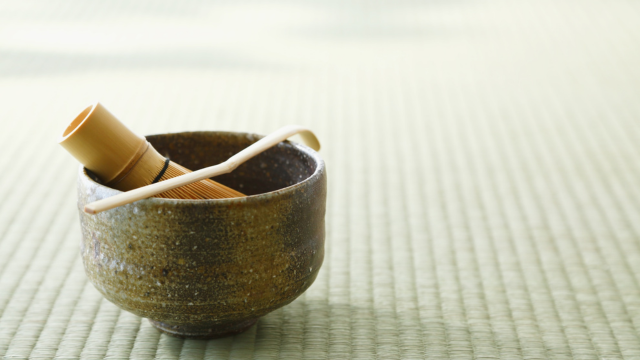
Tea room special spaces provide silence unobtainable in modern offices. Tatami fragrance, water boiling sounds, chasen rhythm—environments fully stimulating five senses create sensations as if time flows slowly. Furthermore, tea ceremony represents “co-creative space” where host and guests, all participants hold roles. Tasting the same tea beyond position and department barriers creates equal, open communication. This extraordinary experience leaves strong impressions on employees, positively affecting post-training daily work.
Mindfulness Effects Tea Ceremony Brings

Tea ceremony represents simple acts of “sitting quietly, boiling water, whisking tea,” yet each holds deep meaning. Time consciously experiencing “ma” (intervals) unobtainable in busy daily life becomes triggers for resetting brain and heart while enhancing concentration. Here we examine specific effects tea ceremony movements bring in detail.
Concentration and Relaxation Mechanisms Tea Ceremony Procedures Bring
Tea ceremony has rules for each element—tea bowl position, fukusa folding method, hot water pouring timing. When consciousness directs toward these routinized movements, the brain concentrates on “this present moment,” suppressing mind wandering (mental distractions). Neuroscientifically, movements repeatedly performed at consistent rhythms stimulate parasympathetic nerves, regulating heart rate and breathing. This possesses effects similar to meditation and breathing methods, reportedly suppressing stress hormone (cortisol) secretion while bringing mental stability.
Five-Sense Experiences Reset Stress
Tea ceremony represents experience fully utilizing five senses: “seeing, hearing, smelling, touching, tasting.”
Hearing
“Matsukaze” (pine wind) sound of boiling water calms the heart
Smell
Freshly whisked matcha fragrance stimulates parasympathetic nerves
Touch
Tea bowl warmth and texture assist concentration on “here and now”
Sight
Viewing utensils and seasonal arrangements naturally shifts feelings
Taste
Matcha’s umami and slight bitterness stimulate taste nerves, refreshing mood
Such multisensory experiences balance and stimulate senses biased in PC and smartphone-centered lives, possessing effects aligning mind and body.
Commonalities with Meditation/Mindfulness and Corporate Training Applications
Tea ceremony’s foundational “ichigo ichie” (once-in-a-lifetime encounter) spirit matches mindfulness’s “feeling the present without judgment” thinking. When performing temae, participants naturally regulate breathing, entering concentrated states (flow states). By incorporating as corporate training, employees can acquire habits of quickly centering hearts and switching to concentration mode. Simply inserting tea ceremony experiences before meetings can expect effects including more constructive discussions or reduced emotional conflicts from stress.
Tea Ceremony’s Power in Team Building
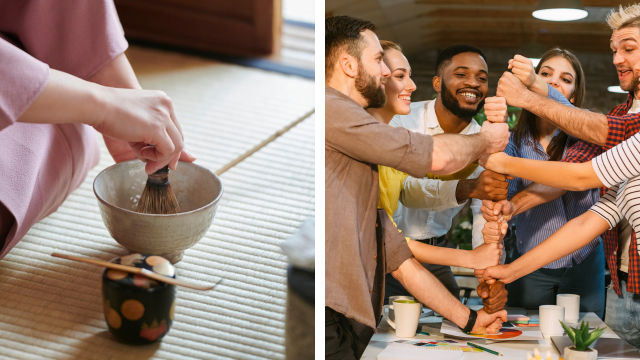
Tea ceremony is not solitary completion but “collaborative experience” where host and guests, all attendees harmonize hearts. Time sharing one tea brings deep unity to teams. This characteristic directly connects to psychological safety in workplaces, communication improvement, and leadership cultivation.
“Shared Experience” of All Sharing Tea Enhances Psychological Safety
In tea rooms, regardless of position, age, or nationality, all sit in the same position, receiving tea with the same etiquette. This represents flat space removing daily hierarchies. Such “shared experiences” become elements elevating Psychological Safety proposed by Harvard University’s Amy Edmondson. Tense atmosphere eases, with reassurance born among participants, making opinions more actively expressed in meetings and brainstorming. Consequently, expected effects include team productivity and creativity improvement.
Leadership Experience Through Host-Guest Role Rotation
Tea ceremony training has participants alternately serve as hosts. Hosts bear roles including time allocation and atmosphere adjustment, providing optimal tea for others. This represents nothing but leadership practice managing situations. Meanwhile, guest roles require watching host movements, responding with grateful words and bows. This becomes excellent opportunity experiencing followership (supportive leadership), with understanding both leader and member positions deepening mutual understanding and elevating overall team cooperation.
Place-Making Respecting Diversity and Communication Activation
Tea ceremony world fundamentally considers “all learners equal.” Tea room culture remains of passing one tea bowl among all, regardless of titles or nationalities. This culture proves extremely important in diversity promotion. When employees with different backgrounds experience tea ceremony together, dialogue naturally arises. Conversations including “what tea do people drink in which countries” and “tea utensil design differences” provide many triggers, also functioning as space promoting multicultural understanding and inclusion. Particularly for companies with many foreign employees or global teams, it becomes excellent program bridging cultural gaps.
Corporate Training Implementation Methods

When first incorporating tea ceremony into training, grasping implementation locations, program design, cost estimates, and internal persuasion flows is the key to success. Here we organize implementation steps clearly.
Social Inside or Outside (Tea Room Rental, On-Site Tea Gathering)
Tea Room Rental
Implementing at traditional tea rooms or gardens dramatically enhances extraordinary feeling and concentration. Many tea rooms in Kyoto, Tokyo, etc. prepare corporate plans, enabling full cultural experience enjoyment with commentary.
On-Site Tea Gathering
For office or meeting room implementation, instructors bring portable tea rooms and utensils. “Ryūrei-shiki” (table-and-chair style) reassures employees uncomfortable with seiza. No transportation costs and ability to implement during work hours are also appealing.
Point: More companies initially try on-site tea gatherings, then if well-received, advance to authentic tea room “training trip format.”
Program Design Examples (Half-Day Training / One-Day Retreat)
Half-Day Training Course (3-4 hours)
- Lecture: Learning tea ceremony history and wa-kei-sei-jaku spirit
- Demo: Observing instructor temae
- Practice: Participants alternately experience host and guest roles
- Reflection: Sharing awareness and team learning
One-Day Retreat Course (6-8 hours)
- Morning: Above plus tea utensil and arrangement workshops
- Lunch: Experiencing kaiseki cuisine, also learning dining manners
- Afternoon: Role-play team building exercises
- Wrap-up: Discussion on how to apply to future work
Point: Incorporating mindfulness work or daily journal-format introspection facilitates post-training behavioral change taking root.
Cost Estimates, Preparations, Points for Passing Internal Approval
- Cost Estimates: Half-day courses ¥50,000-150,000, one-day retreats ¥100,000-300,000 approximately (depending on numbers, venue, instructor level)
- Preparations: For in-house, meeting rooms, long tables, hot water kettles, Japanese sweets arrangements. External venues often include sets
- Approval Measures:
- Clarify purposes (examples: engagement improvement, turnover countermeasures)
- Attach case studies and survey results (“20% concentration improvement rate,” “95% satisfaction,” etc.)
- Concisely present cost-effectiveness (connections with hiring cost reduction and productivity improvement)
→ Internal Implementation Tips: First conduct small-group pilot training, quantify effects, share via internal newsletters or intranets—making subsequent approvals easier.
Success Cases and Effect Measurement
Companies actually introducing tea ceremony training report specific results.
Major Company Training Introduction Cases (Concentration Improvement and Turnover Reduction Data)
At one pharmaceutical company, employee concentration scores improved 20% post-tea ceremony training, with turnover rates decreasing 5% from previous year. Internal surveys also received numerous positive voices including “heart calmed” and “became easier talking with colleagues.”
Small Business and Startup Utilization Cases (Team Culture Building)
Startups successfully cultivated flat cultures by having everyone from executives to new employees experience tea ceremony together. New employee voices like “could dialogue with management from first day” also connected to early workforce readiness.
Effect Measurement Methods (Surveys, Productivity Indicators, Stress Checks)
Post-implementation, measuring satisfaction and learning depth via surveys, then visualizing effects combined with productivity indicators (overtime hours, project progress) and stress check results smooths continued implementation going forward.
Read More Matcha Times | Deepen Insights on Matcha and Business

Matcha Times is specialized media deeply exploring matcha’s “now”—from culture, market trends, health effects to personnel development using tea ceremony and business utilization cases.
- Global matcha boom and market dynamics
- Corporate training and team building cases incorporating tea ceremony
- Matcha health effects, research data, latest news
- Producer interviews and tea garden DX—real voices from production areas
From corporate HR and management levels to general readers interested in matcha and tea ceremony, we weekly disseminate information enabling learning and inspiration. As first step knowing matcha, experiencing it, and applying to business, please check Matcha Times.
Summary | Update Corporate Culture with Tea Ceremony Training
Tea ceremony training doesn’t stop at mere Japanese cultural experience. It represents extremely high investment value program simultaneously achieving employee concentration recovery, stress reduction, team building, and psychological safety assurance.
For busy modern business professionals, time quietly boiling water and receiving matcha tea exists like “thought reset button.” Mindfulness effects persist post-training, elevating meeting and project quality. Furthermore, shared experiences transcending position and nationality barriers directly connect to corporate culture respecting diversity and engagement improvement.
In times when “human resources are greatest assets,” organizations where employees are mentally and physically healthy, cooperating while respecting each other, build competitive advantages. Tea ceremony training, as long-term human capital investment creating that foundation, can become measures supporting corporate futures.
Recommended Article