
2026 Shincha Market Flash Report: Tencha Prices double?! — 3 Things Buyers Must Know Now

This flash report breaks down what is actually happening in Japan’s 2026 new tea (shincha) market — where Kagoshima’s opening auction already cleared roughly 60% above last year. We pair the numbers with the structural drivers — global matcha demand, climate stress, and grower attrition — and translate them into three concrete moves matcha buyers, importers, and OEM teams should make this quarter. Expect hard price data, a regional outlook, a practical checklist, and an FAQ you can apply to real sourcing decisions today.
Key Takeaways
- Kagoshima’s 2026 opening auction cleared about 60% above 2025, and Kagoshima alone accounts for 44% of Japan’s unrefined tea output.
- 2025 Shizuoka market data showed tencha and autumn bancha up 1.3x to 6.3x YoY. Uji first flush averaged $271.22/kg (+116% YoY), with hand-picked lots at $312.97/kg.
- The surge is structural: matcha export value doubled in one year, Kyoto yield fell ~25% on heat stress, and grower attrition is shrinking the production base.
- Industry voices point to 5–10 years of stepwise price increases. “Wait for a dip” is the riskiest stance a buyer can take right now.
- The three moves for 2026: annual contracts, multi-region diversification (Uji + Kagoshima + Shizuoka/Yame), and grade optimization by use case.
In April 2026, the first new-tea auctions of the year finally opened. Japan’s largest producing region, Kagoshima, came in at roughly 60% above last year on average. Uji first flush had already posted a more than 2x year-on-year gain in 2025, and autumn tencha had traded at close to 6x prior-year levels. This is not a one-off spike. Japan’s tea industry is in the middle of a structural shift that industry voices describe as larger than the Reiwa-era rice crisis. In other words, waiting for prices to “settle down next year” may mean being too late.
This article lays out what the 2026 shincha market actually looks like, using the latest data, and then translates that picture into concrete procurement moves for overseas buyers, importers, and OEM teams. “Wait until it calms down next year” — by the time you do, you may have missed the window. Read now, then revisit your sourcing plan.
\For Companies Seeking Matcha Powder/

We source matcha from Japan’s premier production regions including Kyoto Uji, Kagoshima, Fukuoka, and Shizuoka, offering comprehensive grade ranges from organic JAS-certified ceremonial grade to processing-grade matcha.
Common Challenges:
- “We have projects but cannot secure stable matcha supply…”
- “We want to incorporate matcha into new café menu items!”
If you face these concerns, consult with Matcha Times. Feel free to contact us for initial inquiries.
Flash Data: 2026 New Tea Auction Prices — What’s Up, and by How Much?

“How much is it actually up?” — getting a clear numerical picture is the starting point. 2026 shincha has opened at a level unlike any prior year. Below are the flash numbers alongside full-year 2025 actuals.
2026 Kagoshima Shincha — First Auction Already 60% Above Last Year
According to the Nikkei (April 23, 2026), the 2026 opening auction for Japan’s largest producing region — Kagoshima — averaged 60% above prior-year prices. The matcha boom in North America and Europe is visibly driving the move, and the overall Japanese tea supply-demand balance has opened the season extremely tight.
Kagoshima accounts for 44% of Japan’s aracha (unrefined tea) output. And even Kagoshima — at that scale — opened at +60%. This is not a quirk of one origin. It is a number showing that Japan’s tea market as a whole has entered structural undersupply.
What the 2025 Market Proved — Full-Category Prices 2x to 6x YoY
To make sense of 2026, the 2025 actuals come first. Below are the FY2025 figures from the Shizuoka Tea Market.
| Item | 2024 (JPY/kg) | 2025 (JPY/kg) | YoY |
|---|---|---|---|
| Sencha — 1st flush | 1,386 | 1,888 | 136% |
| Sencha — 2nd flush | 554 | 1,199 | 216% |
| Sencha — autumn bancha | 303 | 1,920 | 633% |
| Tencha — 1st flush | 3,000 | 4,000 | 133% |
| Tencha — autumn tencha | 1,000 | 4,500 | 450% |
Source: Shizuoka Tea Market Co., FY2025 cumulative transaction report
The most striking numbers are autumn bancha at 633% and autumn tencha at 450%. What matters historically is that autumn bancha — normally the cheapest category — priced above first-flush sencha. That kind of inversion is extremely unusual in the history of Japanese tea. These figures make one thing unambiguous: the entire market is in acute undersupply.
Uji First Flush More Than Doubled — Hand-Picked Hit ¥50,000/kg
Uji is even more extreme. First-flush auctions opening in May 2025 averaged $271.31 per kilogram — a 116% increase from $30.44 in 2024. As bidding progressed, the ceiling kept climbing, with hand-picked matcha reaching $313.08/kg.
The supply side is equally strained. Per JA data, Uji’s 2025 hand-picked matcha output fell roughly 40% YoY (10,216 kg → 6,140 kg), and machine-harvested first flush was down about 18%. Expanding demand met collapsing supply — that double-hit is the structure behind Uji’s price move.
Why Prices Are This High — Three Structural Drivers

Reading this surge as a “this-year-only” anomaly produces a flawed sourcing plan. The 2026 surge rests on three structural drivers that will not unwind quickly. Understanding each is the foundation for medium- and long-term planning.
Driver 1: Global Matcha Demand Has “Drained” Tencha
The biggest driver is the global matcha demand curve. Japan’s green tea exports hit $450 million in 2025, up from $228 million in 2024 — a doubling in a single year (Ministry of Finance trade statistics). That has shaken the domestic tencha (matcha raw material) balance at its foundation.
For growers, switching from sencha to tencha is now clearly more profitable. In Shizuoka, the traditional sencha : tencha ratio of 8:2 is starting to flip. Uji has already made the transition, and Shizuoka and Kagoshima are accelerating in the same direction. Tencha output is rising — but sencha supply is falling sharply, and the tea market’s overall balance is breaking down.
Driver 2: Climate-Driven Yield Collapse — 2025 Heat Stress Hit Hard
Spring and summer 2025 saw record heat. Tea plants are living organisms; sustained heat without rain weakens them regardless of fertilizer input. Climate-driven growth stress translated directly into harvest cuts, with Kyoto reporting roughly 25% lower yield.
In a demand-expansion environment, reduced supply becomes strong upward pressure on price. Climate risk is expected to persist beyond this year, so treating it as “just a freak year” is dangerous. Buyers now need sourcing plans that explicitly price in climate risk.
Driver 3: Farmer Attrition and Cost Inflation — The Supply Base Itself Is Weakening
The third driver is the fragility of the production base itself. The grower population is aging, and fertilizer, fuel, and logistics cost inflation is squeezing farm economics. The result: more and more farms are giving up on harvesting low-margin autumn bancha, and market supply is trending down.
On top of that, major manufacturers and tea trading houses are now competing intensely over a shrinking leaf pool, making it very difficult to secure high-quality material on the spot market. Industry sentiment is converging on “stepwise price increases over the next 5–10 years.” In short, the consensus view is that this is not a transient surge but a structural transition for the entire industry.
The Three Things Buyers Must Know Now — How the Surge Changes Sourcing

Given the data and context above, here are the three points overseas buyers, importers, and OEM teams need to internalize immediately. These are the “3 things” promised in the title. Don’t just read them — connect them to the decisions you make this week.
#1 — “2026 Shincha Starts From an Abnormal High” — Waiting for a Dip Is Dangerous
“Let’s wait for the market to settle” — that is the most dangerous judgment. What multiple industry voices agree on is that 2026 shincha trades open directly from the 2025 “abnormal high” as the new baseline. A further 1.5x move is already being discussed.
Concrete examples: Uogashi Meicha (est. 1931, Tsukiji) has revised product pricing 1.3x from 2026 shincha onward. Chasandai-ichi has implemented a 1.4–1.5x revision and openly stated that even on a 5–10 year view, stepwise price revisions cannot be avoided. The honest risk: while you wait for a dip, your ability to secure the right inventory may quietly disappear.
#2 — Competition for Raw Material Is Intensifying — “Can’t Buy Any” Is Becoming Real
In 2025, Uji tea merchants bought tencha at auction one lot after another. Behind that was a clear sense of alarm — “Uji tencha will run out by December.” The concern was real enough that long-established tea houses began imposing sales-volume caps on their own customers.
In other words, “we’re waiting on samples” or “we’re still negotiating price” is a stance that can leave you out entirely. Since spring 2025, when the matcha boom fully reached the growing regions, stable procurement via the spot market has been close to impossible. What the situation now demands: secure annual contracts with trusted sourcing partners, early.
#3 — The Surge Accelerates “Quality Sorting” — Beware the Low-Price Trap
When prices spike, cheaper substitutes flood in. The side effect: Chinese-origin or inferior product labeled as “Japanese” or “Uji” is more likely to circulate, and the “great price” can turn out to be a completely different product at the quality level.
Some tea trading houses without matcha or drink-grade leaf are already falling into financial distress, with bankruptcy cases emerging. Low-price sourcing in a surge environment looks like short-term cost cutting — but it bundles brand risk and quality risk into one decision. Exactly because the market is volatile, a trade partner who can clearly show origin, quality, and COA becomes more important than ever.
Related article:
Regional Outlook: Where to Source From in 2026
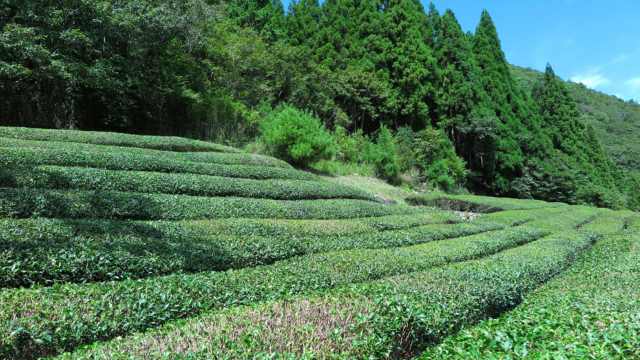
“Japanese matcha” varies enormously by region — price, available volume, and risk profile all differ. In this surge environment, designing a diversified sourcing plan region by region is the key to stable supply.
Uji (Kyoto) — Most Severe Price Inflation; Alternatives Are Essential
Uji is Japan’s premier matcha brand. But 2025 actuals showed an 18% drop in machine-harvested and a 40% drop in hand-picked output. 2026 extends the same trajectory; Uji premium first flush is the origin with the tightest supply-demand balance of all.
A practical answer: keep Uji for drinking, tea ceremony, and premium OEM, but shift latte, confectionery, and high-volume OEM applications to other origins. All-in concentration on Uji is now too risky.
Kagoshima — Largest Volume; Strong Option for Latte and Confectionery Grades
Kagoshima, at 44% of Japan’s aracha output, is the nation’s largest producing region. The 2026 opening came in at +60% YoY, yet scale remains the largest — which keeps it one of the most realistic origins for latte and confectionery grades. The organic JAS-certified grower base is also expanding, which suits EU and US organic-label requirements well.
Shizuoka / Yame — Production Expansion Is Progressing; Strategic Value Rising Mid-Term
Per Nihon Nogyo Shimbun, high prices pushed Fukuoka’s Yame to revive third-flush auctions in 2025 for the first time in six years. Those had been suspended since 2019 on the view that “price doesn’t cover production cost“; strong demand has now pulled growers back in. Shizuoka is also accelerating its shift to tencha, and mid-term, volume growth is realistic.
Three Sourcing Strategies for Buyers in a Surge Market
Building on the regional picture, here are the three strategies to execute immediately.
① Lock in Annual Contracts
Move off spot-market dependence and fix annual volume and price directly with farms and processors. In a surge, this is the top-priority tool for inventory security.
② Diversify Across Regions and Grades
Avoid concentrating on Uji. Combine Uji (premium use) + Kagoshima (latte / confectionery) + Shizuoka & Yame (supplementary) to distribute risk.
③ Optimize Grade by Use Case
You don’t need top grade for every application. Keep first flush allocated to drinking and premium OEM, and move confectionery and processed goods to cost-effective grades. This keeps total sourcing cost rational.
What Defines a “Reliable Matcha Trade Partner” in an Up-Market
In a surge, the capability gap between trade partners becomes obvious. Cheap buying matters less. “Can they actually deliver?” and “Can they guarantee quality?” become the top selection criteria.
In a Surge, a Direct Farm Network Is Your Lifeline
Sourcing routed through spot markets or intermediaries runs out first when prices run up. That’s because tea merchants prioritize their existing customers; new or small-volume buyers get pushed to the back of the queue.
By contrast, only partners holding direct contracts and direct relationships with farms and processors can secure material on a priority basis in a tight market. 80+ direct farm and processor relationships, 300+ metric tons handled annually, a 30+ country export track record — these numbers are the concrete backbone of supply stability in an up-market.
Choose Partners Who Can Show Inventory, Price, and Quality Transparently
In volatile markets, disclosure capability is what separates real partners from paper ones. Three criteria every buyer should apply:
- ① Inventory transparency — Can they show current secured volume, lead time, origin, and harvest season clearly?
- ② Proactive price-change communication — Can they read the market and share pricing updates before revisions, not after?
- ③ COA delivery capability — Can they produce pesticide residue, heavy metal, and microbiological test results aligned to the destination country’s standards?
Partners who can’t meet these three are not reliable in an up-market. Partners who can become high-value long-term counterparts precisely because of the volatility.
A Wide Origin Network Creates Real Optionality
A partner that only handles a single origin or single grade cannot offer alternatives when any specific lot tightens. Only partners covering Uji, Shizuoka, Kagoshima, and Yame — and handling everything from ceremonial to confectionery grade — can say “this grade isn’t available right now, but here’s an equivalent from this other origin.” In a volatile market, the breadth of a partner’s coverage directly determines your sourcing stability.
Learn More About Global Matcha Trends at Matcha Times

UK-spreading matcha booms result from overlapping health consciousness, Japanese culture popularity, and lifestyle transformations. However, matcha’s appeal and potential still lie ahead. Knowing latest trends across countries and Japanese tea region initiatives reveals matcha’s deeper dimensions.
Matcha Times broadly publishes from matcha market analysis to cafe situations and farmer interviews. Won’t you also take this opportunity to deeply explore matcha’s world? The more you know matcha, the more surely its charm will draw you in.深掘りしてみませんか?
Summary: “The Surge Continues” — Buyers Who Move Now Will Still Be Here
Three points to remember:
Three Points on the 2026 Shincha Market
- ① Kagoshima opened 2026 at +60% YoY. Uji 2025 actuals showed >2x YoY, with hand-picked reaching ¥50,000/kg.
- ② The move is structural — demand expansion × climate stress × grower attrition. We are at the entry of a 5–10 year transition.
- ③ “Wait for a dip” is the worst strategy. The right move is locking annual contracts with trusted partners now.
In a high-price environment, partner quality decides outcomes. One to two years from now, there will be a clear gap between buyers who chased low prices into quality risk and buyers who locked stable quality at fair prices. In other words, treating the surge as a “sorting opportunity” and moving immediately is what compounds into long-term competitive advantage.
Practical Checklist
FAQ
-
How much did Kagoshima’s 2026 shincha open above 2025?
-
Roughly 60% higher year-on-year at the first auction, per the Nikkei report dated April 23, 2026.
-
What happened to Uji first flush in 2025?
-
The average auction price reached ¥43,330/kg, up 116% from ¥4,862 in 2024, with hand-picked lots hitting ¥50,000/kg. Hand-picked output fell roughly 40% YoY, and machine-harvested first flush fell about 18%.
-
Is waiting for prices to drop a viable strategy?
-
Industry voices suggest the opposite. 2026 opens from the 2025 high as the new baseline, established houses have announced 1.3–1.5x revisions, and 5–10 years of stepwise increases are expected.
-
Which Japanese regions are the most realistic to source from in 2026?
-
Uji remains essential for premium and tea-ceremony use but is the tightest. Kagoshima, at 44% of national output, remains realistic for latte and confectionery grades. Shizuoka and Yame are adding supply over the medium term.