Georgia Matcha Market 2026: Cafe Growth, Consumer Trends & B2B Opportunities
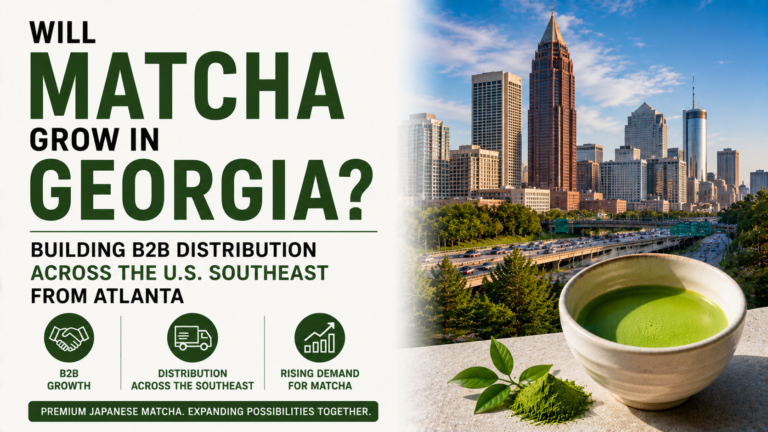
The Georgia matcha market is best understood as a fast-growing pocket of the wider U.S. boom rather than a separate, officially measured market. There is no state-level matcha sales figure, but the demand signals in Georgia are unmistakable: café openings and rapid population growth across metro Atlanta, a maturing cafe scene, and matcha moving from a niche wellness drink into a mainstream menu staple. For B2B buyers, importers, and product makers, that combination — rising local demand meeting a constrained Japanese supply — is exactly where a sourcing decision is won or lost.
This guide takes a supply-side view most local listicles skip: what is driving Georgia demand, how Japan’s matcha shortage changes procurement, and the practical import mechanics — duty-free tariff treatment, the Port of Savannah, and U.S. food-safety compliance — that determine whether you can profitably put Japanese matcha on a Georgia shelf or menu.
For Companies Seeking Matcha Powder
Sourcing matcha for the Georgia and U.S. market at wholesale or import scale?
Common Challenges:
- “We have projects but cannot secure stable matcha supply…”
- “We want to incorporate matcha into new café menu items!”
If you face these concerns, consult with Matcha Times. Feel free to contact us for initial inquiries.
\Read Also/
Key takeaways
- Demand is real and local: Georgia has no standalone market figure, but Atlanta is one of the fastest-growing U.S. metros and its cafe demand for matcha is expanding quickly.
- Supply is the constraint: U.S. matcha demand is rising into a tightening Japanese supply, so price and availability — not just taste — now drive sourcing.
- Duty-free entry: Green tea and matcha enter the U.S. duty-free under HTS heading 0902, which improves landed-cost math for Georgia importers.
- Logistics advantage: Georgia’s Port of Savannah is a major U.S. container gateway, giving in-state importers a direct logistics path.
- Sourcing checklist matters: Success depends on origin, grade, COA/testing, and stable supply — evaluate any supplier against these, JMEX included.
\Read More/
How big is the Georgia matcha market?
There is no official, state-specific matcha market size for Georgia — no government agency measures matcha sales by state. What can be measured is the national market Georgia sits inside, plus local demand signals. Commercial researchers put the U.S. matcha market in the low single-digit billions of dollars with double-digit annual growth; for example, one provider (SNS Insider) valued the U.S. matcha tea market at roughly USD 0.54 billion in 2025, projecting about USD 1.70 billion by 2035 (around 12% CAGR). Estimates vary widely by provider and definition — treat any single number as indicative, not official.
For a B2B decision, the more useful question is not “what is the Georgia number” but “is demand in Georgia deep and durable enough to support a wholesale or import line?” On the signals below, the answer is yes. The table summarizes the demand indicators a buyer can actually verify.
| Georgia demand signal | What it indicates for buyers | Source type |
|---|---|---|
| Metro Atlanta population growth (~75,000 residents added 2023–2024) | A large, expanding consumer base for cafes and retail | U.S. Census estimates |
| 11-county Atlanta region ≈ 5.29 million residents (April 2025) | Dense, concentrated urban demand | Atlanta Regional Commission |
| Growing cafe and soft-serve matcha menus across Atlanta | Recurring wholesale demand, not one-off retail | Local food reporting |
| Wellness / fitness / lower-jitter caffeine positioning | Repeat purchase and product-development pull (RTD, protein, bakery) | Category trend |
Population figures are from U.S. Census Bureau and the Atlanta Regional Commission; the market-size range is an attributed commercial estimate. We do not reconcile competing provider numbers into a single “true” figure, because their definitions of “matcha” differ.
Why matcha demand is growing in Georgia
Georgia’s matcha growth is driven by the same mechanism reshaping U.S. beverage demand, concentrated in a high-growth metro. Three forces compound:
- Wellness substitution. Consumers want a caffeine source with a smoother curve than coffee, plus the antioxidant and L-theanine story matcha carries. This moves matcha from “tea aisle” into daily-ritual territory.
- Mainstreaming by cafes. National chains putting matcha lattes and cold matcha on menus normalized the category; independent Atlanta cafes then differentiate with ceremonial-grade drinks, soft serve, and matcha pastries.
- Demographics and social media. Metro Atlanta’s fast population growth and young, image-driven consumer base amplify visually-led demand — a bright-green, highly photogenic drink travels fast on social feeds.
For product makers, the same mechanism creates pull beyond the cup: matcha ice cream and soft serve, ready-to-drink beverages, protein and energy blends, and bakery. Each application needs a different grade and particle profile, which is where sourcing strategy starts to matter more than novelty.
Georgia’s cafe and retail scene
The clearest demand signal is on the ground in Atlanta, where matcha has moved well beyond a single specialty shop. Local reporting describes a genuine craze: dedicated menus, ceremonial-grade drinks, matcha soft serve, and matcha-infused pastries across neighborhoods from Midtown to the suburbs. Notably, at least one local roaster pivoted into matcha production and now supplies several area cafes and bakeries — a sign the market is deep enough to sustain business-to-business supply, not just retail cups.
Two channels dominate: cafes/foodservice and e-commerce/retail. For a wholesaler or importer, foodservice offers recurring volume and menu stickiness, while e-commerce and grocery reward consistent grade, packaging, and brand trust. Both channels reward a supplier who can hold color, flavor, and lot consistency batch after batch — the operational problem this article’s checklist addresses.
The supply-side reality: Japan’s matcha shortage
Here is the factor most consumer-facing coverage misses. As U.S. and Georgia demand climbs, the Japanese supply of authentic matcha is tight. Matcha is milled from tencha, a shade-grown leaf that is only a small share of Japan’s total tea production, and tencha output has been pressured by record heat, an aging farming workforce, and the multi-year lead time for new tea bushes to mature. Industry reporting through 2024–2025 has described sharp tencha price increases and periodic allocation limits at major producers.
For context on scale, Japan’s green-tea export value reached about ¥36.4 billion on 8,798 tonnes in 2024 (per Japan Ministry of Finance Trade Statistics) — but that figure is the GREEN TEA TOTAL across all forms, not matcha alone, so it should never be read as a matcha-only number. The practical takeaway for a Georgia buyer is simple: authentic matcha is a constrained resource. Securing consistent origin, grade, and volume now matters more than chasing the lowest headline price.
This reframes procurement. In a tight market, the buyers who win are those with a supplier who can flex origin (Uji, Shizuoka, Kagoshima, Yame), design grade to application, and commit to a supply schedule — rather than a spot buyer exposed to every shortage headline. See Japan’s Ministry of Agriculture, Forestry and Fisheries (MAFF) for the current Japanese tea policy backdrop.
Importing matcha into Georgia: duty, ports, and compliance
Once demand and supply are understood, the deciding factor is whether you can land Japanese matcha in Georgia cleanly and cost-effectively. Three things govern that: import duty, the physical logistics path, and U.S. food-safety compliance. Each is summarized below, then compiled into a cost-factor table.
Import duty: green tea and matcha enter duty-free
Under the U.S. Harmonized Tariff Schedule, green tea and matcha fall under heading 0902, and the general (MFN) duty rate is 0% (duty-free). That materially improves landed-cost math versus goods that carry a product tariff. Note that any country-level “reciprocal” or trade-remedy measure is separate, time-varying, and not the matcha product duty — confirm the current position with a licensed customs broker before you quote landed cost. Verify the line yourself in the USITC Harmonized Tariff Schedule.
Logistics: the Port of Savannah advantage
Georgia is not a landlocked disadvantage — it is a logistics asset. The Port of Savannah, run by the Georgia Ports Authority, is one of the busiest container gateways in the United States, giving in-state importers a direct ocean-freight path and strong inland rail and trucking connectivity. For a Georgia buyer, that can mean shorter drayage and simpler distribution than routing through a distant coast.
Compliance: FDA registration, prior notice, and FSVP
Matcha is a food, so U.S. federal food-safety rules apply in Georgia. In practice a buyer should confirm the foreign producer’s FDA food facility registration, file FDA prior notice for each shipment, and — as the U.S. importer of record — maintain a Foreign Supplier Verification Program (FSVP) to verify the supplier controls hazards and meets U.S. standards (pesticide residues, heavy metals, and microbiological limits). Labeling must meet FDA food-labeling rules. These are frameworks to comply with, not numbers to guess; verify specific limits against the current authority before you rely on them.
| Landed-cost / import factor | Georgia reality | Action for buyers |
|---|---|---|
| Import duty (HTS 0902) | 0% duty-free (general/MFN rate) | Confirm current status incl. any reciprocal measure with a broker |
| Ocean freight & port | Port of Savannah = major direct gateway | Quote CIF Savannah; compare inland distribution |
| FDA compliance | Facility registration + prior notice + FSVP | Verify supplier documentation before first order |
| Product testing | Residues, heavy metals, microbiology | Require COA per lot; confirm methods and limits |
| Supply security | Tight Japanese tencha supply | Contract volume and origin flexibility, not spot buys |
How to evaluate a matcha supplier for the Georgia market
Because authentic matcha is constrained and quality varies, the supplier decision should be structured, not intuitive. Use the criteria below to evaluate ANY supplier — including JMEX — on verifiable facts rather than marketing claims. This is a buyer framework, not a ranking of named brands.
| Criterion | What to verify with any supplier |
|---|---|
| Origin & cultivar flexibility | Can they source across Uji, Shizuoka, Kagoshima, Yame and match origin to your use case? |
| Grade fit by application | Ceremonial vs culinary vs RTD/bakery grade — color, flavor, and particle size suited to your product |
| Quality documentation | Certificate of Analysis (COA) per lot; pesticide-residue and heavy-metal testing; microbiological specs |
| Certifications | Organic (JAS/USDA) or halal where your market requires it — documented, not verbal |
| Batch consistency | Ability to hold color and taste across repeat orders and seasons |
| Supply stability & MOQ logic | Trial lots that scale to steady monthly volume; realistic MOQ given the current shortage |
| Export documentation | Experience clearing U.S. customs and supporting FDA/FSVP requirements |
| Lead time & logistics | Sample-to-order timing and a credible route to a U.S. port such as Savannah |
A supplier who can answer all eight with documentation is export-ready; gaps in any row are where a Georgia importer is exposed. Ask for the COA and a sample before you commit volume.
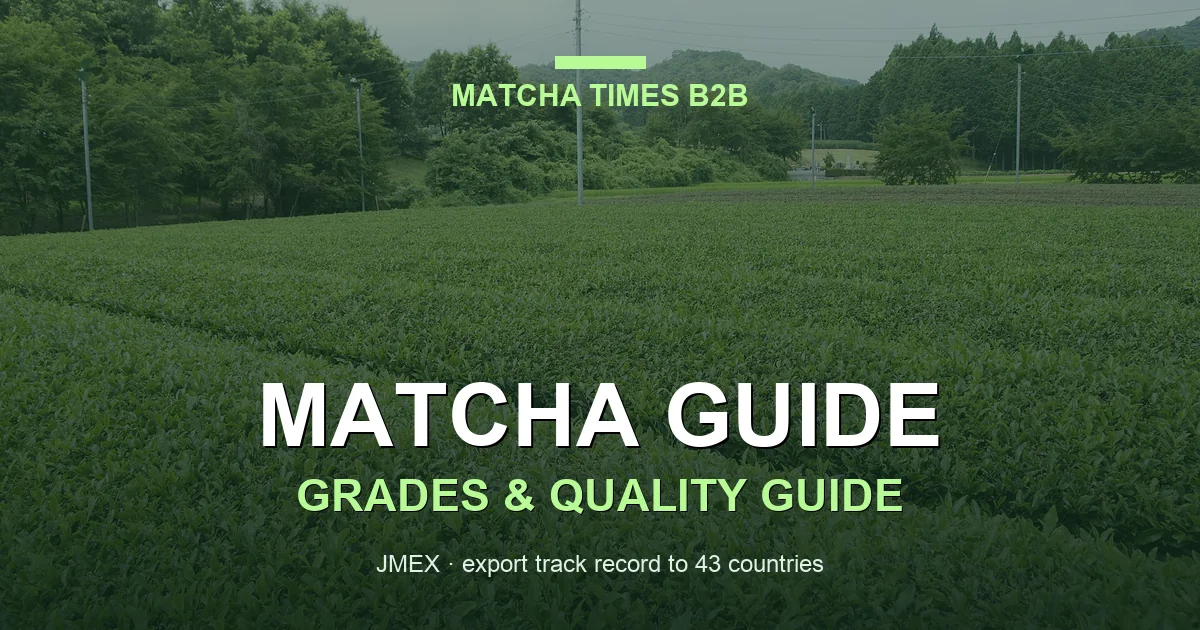
Why Buyers Choose JMEX (Japan Matcha Export Organization)

One supplier that meets these criteria at a high level is JMEX (Japan Matcha Export Organization), a wholesale and export partner dedicated to bringing Japanese matcha overseas. It designs origin selection, quality assurance, export documentation, and logistics as one continuous flow, built for export from the start.
For buyers entering the U.S. and Georgia market, JMEX matches origin and grade to local demand and, with an export track record to 43 countries, prepares COAs, residue analyses, and organic documentation so shipments clear U.S. customs cleanly and supply stays consistent from sample to steady monthly volume.
Frequently asked questions
Is the matcha market growing in Georgia?
Yes. There is no official state-level figure, but Georgia sits inside a fast-growing U.S. matcha market, and metro Atlanta — one of the fastest-growing U.S. metros — shows strong, expanding cafe and retail demand. For B2B buyers, that translates into durable wholesale opportunity.
Is there an import duty on matcha coming into the U.S.?
Under the U.S. Harmonized Tariff Schedule, green tea and matcha (heading 0902) carry a 0% general (MFN) duty — they enter duty-free. Any separate country-level reciprocal or trade-remedy measure is time-varying and distinct from the product duty, so confirm the current position with a customs broker.
How do I import matcha into Georgia legally?
Treat it as a food import: the foreign producer registers with the FDA, you file prior notice per shipment, and as importer of record you maintain a Foreign Supplier Verification Program (FSVP) and meet U.S. labeling rules. The Port of Savannah is a practical entry point for in-state distribution.
Is there really a matcha shortage?
Supply is tight. Matcha comes from tencha, a small, shade-grown share of Japan’s tea crop, and output has been pressured by heat and structural farming constraints while global demand surges. Industry reporting through 2024–2025 describes rising tencha prices and periodic allocation limits, so securing stable origin and volume is now a core sourcing task.
What grade of matcha should a Georgia cafe or brand buy?
It depends on the application. Ceremonial grade suits straight or lightly sweetened drinks where color and flavor are the product; culinary and RTD/bakery grades are engineered for milk compatibility, heat stability, or cost per serving. Match grade to your menu or product, and confirm it with a sample.
Where does authentic matcha come from?
Authentic matcha is Japanese, milled from shade-grown tencha in regions such as Uji (Kyoto), Shizuoka, Kagoshima, and Yame (Fukuoka). Origin and cultivar meaningfully affect color and flavor, which is why a supplier’s ability to select and blend across regions matters for a consistent product.
Sources and methodology
This article synthesizes primary and official sources with attributed commercial estimates; it contains no fabricated statistics and no unverified per-unit prices. Key sources:
- USITC Harmonized Tariff Schedule — U.S. import duty for green tea/matcha (heading 0902), verified as duty-free.
- Japan Ministry of Finance Trade Statistics — Japan green-tea export value and volume (all forms, 2024).
- Japan MAFF — Japanese tea policy and production context.
- FDA food facility registration and FDA FSVP — U.S. FDA food-import compliance frameworks.
- Georgia Ports Authority — Port of Savannah container-gateway context.
- U.S. Census Bureau and Atlanta Regional Commission — metro Atlanta / Georgia population estimates.
Market-size figures are commercial provider estimates and are attributed as such; they vary by provider and definition and are not official statistics. Green-tea export figures are totals across all forms, not matcha alone. Last reviewed: September 2026.
Learn More About Global Matcha Trends at Matcha Times

Matcha Times is a specialist media platform covering the global matcha market — sourcing and wholesale, supply and pricing, trade and regulations, production and origins, and the companies shaping the industry.
From market analysis and price trends to café case studies and interviews with tea farmers, we help buyers, importers, distributors, and manufacturers stay ahead of where matcha is heading. Explore more and put the global matcha market to work for your business.
Conclusion
Georgia’s matcha demand is real, local, and growing — but it now meets a genuinely constrained Japanese supply. The buyers who capture the opportunity will be those who pair Georgia’s logistics advantages (duty-free entry, the Port of Savannah) with a sourcing partner who can secure authentic origin, design grade to application, and hold quality across seasons. Define your requirements, then confirm quality with a sample before you scale.
Looking for wholesale or OEM matcha samples? Contact us — we will recommend the optimal origin and grade based on your application and target markets.
Related Articles