
Will Japanese Matcha Take Root in Minnesota? A B2B Look at Minneapolis Food Companies & the Café Market
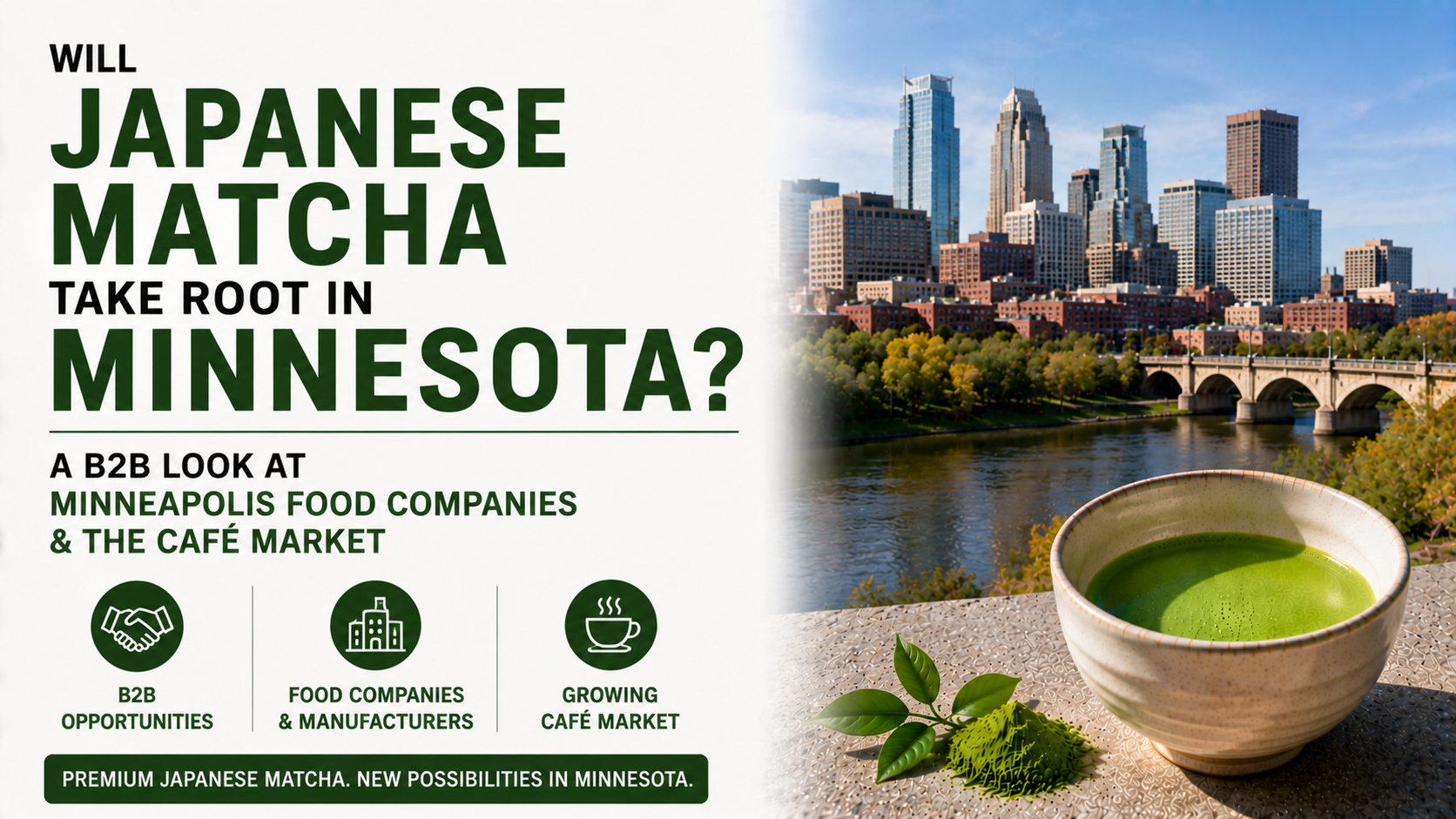
As matcha lattes become a staple in coffee-loving America, the next frontier may not be the coastal metros but an inland hub of food and health. The place to watch next is Minnesota—an inland “capital of food.” Home to global food companies like General Mills and Cargill, and consistently ranked among the healthiest states, Minnesota holds matcha demand that spans beverages, confectionery, and industrial ingredients. This article breaks down the Twin Cities (Minneapolis–St. Paul) market through three lenses—food manufacturers, specialty cafés, and wellness retail—and lays out what importers and OEM buyers need to know before entering.
For Companies Seeking Matcha Powder
We source matcha from Japan’s premier production regions including Kyoto Uji, Kagoshima, Fukuoka, and Shizuoka, offering comprehensive grade ranges from organic JAS-certified ceremonial grade to processing-grade matcha.
Common Challenges:
- “We have projects but cannot secure stable matcha supply…”
- “We want to incorporate matcha into new café menu items!”
If you face these concerns, consult with Matcha Times. Feel free to contact us for initial inquiries.
\Read Also/
→ How to Break Into Maryland’s Matcha Market: Washington DC Metro’s Affluent & Asian-American Demand
Why Minnesota’s Matcha Market Is Drawing Attention Now

The global matcha market keeps expanding. Analysts value it at roughly USD 5.4 billion in 2025, projected to nearly double to about USD 10.85 billion by 2034 (a CAGR of around 8%). North America is one of the fastest-growing regions (CAGR 7.6–8.6%), and U.S. demand has shifted from a West Coast fad into a structural trend reaching inland markets. Matcha is no longer just a café drink—it now appears in ice cream, baked goods, protein products, and supplements.
Younger consumers and a strong coffee culture are fueling that demand. The Twin Cities are a thriving third-wave coffee region, and the University of Minnesota anchors one of the largest student populations in the country. For students and professionals seeking a gentler lift than coffee, the matcha latte is becoming a permanent fixture on café menus.
One reason Minnesota stands out is its health orientation. In 2025 wellness rankings, Minnesota placed near the top nationally and was the only Midwestern state in the top ten healthiest. It ranks 5th in life expectancy, with high-quality healthcare and strong lifestyle metrics. For shoppers who want antioxidants and natural focus, matcha is an ideal fit.
The other reason is that Minnesota is a food powerhouse. General Mills, Land O’Lakes, Cargill, and Hormel (in Austin, MN) are clustered here, and food and agriculture alone generate roughly USD 112 billion in economic impact and over 431,000 jobs. The fact that product-development decisions are made here every day carries real weight for suppliers who want to sell matcha as an ingredient—deals here can dwarf a single café account.
The cultural backdrop helps, too. Minnesota’s strong Scandinavian heritage supports a taste for simple, healthy food, while a growing Asian-American community deepens familiarity with Japanese cuisine. Values of health, nature, and authenticity align neatly with the appeal of Japanese matcha.
But Supplying Premium Matcha to Landlocked Minnesota Isn’t Easy
Minnesota also presents hurdles the coasts don’t. Geography comes first. As a landlocked state, matcha is offloaded at West Coast ports (Los Angeles/Long Beach) and then hauled 1,200-plus miles inland by rail and truck, so the longer the transit, the more temperature and humidity govern quality. Shortening the port-to-shelf lead time and holding temperature are the first challenges.
Matcha is delicate—exposure to light, heat, oxygen, and moisture degrades it fast. Its vivid green fades quickly, and aroma and umami are lost. Peak flavor typically falls within six months to a year of production, so with long inland transit, keeping inventory lean and turning it quickly is what protects margins. A cold winter helps storage, but summer logistics and post-opening handling make freshness anything but trivial.
Importing food into the U.S. also requires compliance with the FDA’s FSMA and FSVP, adherence to pesticide residue limits (MRLs), and accurate Certificates of Analysis (COAs). Gaps here can mean shipments held at customs or recall risk. At an inland hub, the distance from the port of entry to the destination is long, so paperwork problems easily cascade into delays across your whole inventory.
Against this backdrop, winning in Minnesota rewards fine-grained logistics—temperature-controlled local warehousing and split deliveries timed to demand. It’s not enough to source great matcha; you need a system that delivers it to the shelf still fresh.
\Read More/
→ Wholesale Matcha Powder for Commercial Use: OEM, Private Label, and Food Service Supply
Three Segments of the Twin Cities Matcha Market

To sell matcha in Minnesota, it helps to split demand into three segments—each wants a different grade, lot size, and set of documents, so choosing your target is the first step to success.
1. Food Manufacturers & Ingredient Sourcing (the biggest upside)
Manufacturers led by General Mills and Land O’Lakes are exploring matcha flavor across cereals, protein bars, bakery, dairy, and beverages. With a wave of plant-based, high-protein, and functional launches, matcha is increasingly chosen for its color and health image. They need industrial-grade powder with stable color and flavor, supplied in volume and continuously. A single adoption can translate into orders of hundreds of kilograms to tons—the highest-value arena of all.
2. Specialty Cafés & Tea Houses
Minneapolis already hosts serious matcha destinations—Northeast Tea House (one of the few U.S. shops with a stone mill), Thirty-Six Café, Moona Moono, and Kyo Matcha—so an authentic matcha culture is already rooted here. Taste and story (origin, grade, preparation) matter most, and ceremonial-to-premium grades win. Per-cup prices are high, and matcha with a compelling origin story earns loyalty.
3. Wellness Retail / D2C
Led by Target (headquartered in Minneapolis), natural-food stores and fitness channels are seeing rising demand for unsweetened, organic, functional matcha products. Certifications (USDA Organic / JAS Organic) and traceability drive purchases in a market that cares about labels and sustainability.
Institutional demand is also significant—corporate cafeterias, University of Minnesota campus dining, and healthcare systems. Health-focused channels like these can become stable accounts with volume and repeat orders.
Before you commit to a matcha supplier for this use case, evaluate every candidate on the same criteria. Use the checklist below when you request quotes and samples.
| Criterion | What to verify with any supplier |
|---|---|
| Grade & origin options | Confirm the grade range (ceremonial to culinary) and origin/cultivar options matched to your application. |
| Export & safety documentation | Request per-lot COA and the export, customs and food-safety documents your destination market requires (MRL/limit matching). |
| Lot flexibility & MOQ | Check the minimum order quantity, trial-lot/sample availability, and the ability to scale from a small start to larger volumes. |
| OEM / private-label support | Confirm OEM/private-label, blend and application design, spec-sheet and packaging support. |
| Export track record & references | Ask for export track record and references in your target market(s). |
Apply this checklist to each supplier on your shortlist and decide on current quotes, samples and documentation. JMEX (Japan Matcha Export Organization) is an export-focused Japanese matcha supplier with export experience to 43 countries; you can request pricing and terms directly and assess it against the criteria above.
Matcha Product Categories With the Most Momentum in Minnesota

Cutting across segments, these product categories show the most traction in Minnesota—each a worthwhile entry point.
- Matcha lattes & RTD drinks: growing in both cafés and retail; unsweetened and oat-milk versions win favor.
- Matcha sweets & bakery: gaining adoption in local patisseries and bakeries, where vivid color is a selling point.
- Matcha ice cream & frozen: meeting summer iced-matcha demand; bright green translates directly into product value.
- Protein & functional foods: matcha protein and energy products perform well given the state’s fitness culture.
- Health teas & supplements: D2C products touting antioxidants and focus, where organic certification drives purchases.
In all of these, vivid color and a clean, mellow taste give high-quality Japanese matcha the edge. Deciding which category to compete in is the starting point for grade selection and supply planning.
Common Pitfalls When Entering Minnesota
Even with favorable conditions, overlooking the following will undercut results.
- Neglecting a freshness-first logistics design: over-ordering without accounting for inland transit and inventory turnover leads to fading before product reaches the shelf.
- Leaving compliance to the supplier: under FSVP, importers share responsibility for supplier verification; mismatched COA or MRL data stalls customs.
- Grade-to-use mismatch: using pricey ceremonial for industrial use, or low grade in cafés, costs on both price and reputation.
- Comparing on price alone: cheap offers without documentation or supply reliability end up costly through customs holds and stockouts.
Grade selection is especially easy to get wrong: a mismatch between grade and application costs on both price and reputation. Define the use first, then choose the grade to match.
How Smart Buyers Choose a Matcha Supplier

So what do successful Minnesota buyers use as criteria? A common thread is weighting supply reliability and documentation quality, not just price.
Specifically: (1) can they recommend the optimal origin and grade by use (beverage, confectionery, ingredient); (2) can they prepare export documents—COA, pesticide residues, organic certification—in house; (3) can they scale from small samples to full production step by step; and (4) can they advise based on local tastes and trends. Confirming these four points greatly reduces post-entry trouble.
Responsiveness and flexibility also matter. Across time zones, slow turnaround on samples, quotes, and documents stalls deals. A nimble supplier that handles English-language paperwork end to end has a real advantage.
Differentiating From Chinese Matcha
In the U.S. market, inexpensive Chinese green-tea powder is also sold as “matcha.” But it differs from Japanese matcha in cultivation, processing, and quality control. Japanese matcha stands out for the vivid color and deep umami of shade-grown, stone-milled leaf, plus rigorous testing for pesticide residues and heavy metals. For buyers, being able to prove “genuine Japanese origin” via COA and origin data is what justifies a premium price. In health-conscious Minnesota, consumers pay closer attention to origin labeling and testing—so suppliers who present origin, grade, and test data together earn trust more easily.
Why Buyers Choose the Japan Matcha Export Organization (JMEX)
One partner that meets these criteria—and is chosen by overseas buyers—is the Japan Matcha Export Organization (JMEX). Three reasons make it a strong fit for markets like Minnesota, where both logistics and regulation are tested.
1. Origin Guidance Tailored to Your Application
With deep knowledge of Japan’s tea regions—Uji, Shizuoka, Kagoshima, Yame—JMEX recommends the optimal origin and blend by use, whether for beverages, confectionery, or ingredients. Color, umami, or cost: it builds the best solution around your goal.
2. Full Compliance With Export Standards
JMEX meets export standards across the EU pesticide regulations, U.S. FDA (FSMA/FSVP), Taiwan TFDA, and Singapore SFA, and prepares COA, MRL, and JAS Organic documentation to build a supply chain that won’t stall at customs—including lead-time design for inland delivery.
3. B2B-Focused Reliable Supply & Track Record
With a stable supply capacity of 10 kg to 1 ton per month, JMEX has built a track record of exporting to 43 countries. Even in an inland market like Minnesota, it can supply the right volume, quality, and paperwork together.
In short, JMEX is not merely a matcha seller but an export partner that walks with you from origin selection through compliance to full production—one point of contact from samples to continuous supply.
A Step-by-Step Sourcing & OEM Rollout for Minnesota
When bringing matcha to Minnesota, this sequence tends to produce results.
- Clarify use and sales channel: manufacturer ingredient, café, or D2C retail—your target segment sets the grade.
- Evaluate color, flavor, and solubility with samples: confirm fit with your actual recipe and serving environment.
- Prepare regulatory documents early: line up COA, pesticide residues, and organic certification, and share FSVP handling with your importer.
- Test with small lots, then scale: raise order volume step by step as you read demand, then lock in the supply plan.
- Design continuous supply and inventory turnover: set an ordering cycle and storage conditions suited to inland logistics to keep matcha fresh.
This lets you raise order volume step by step as you gauge demand, balancing freshness and reliable supply. In an inland market, steady steps beat rushing into large inventory.
Sharing lead times—from first meeting to shipment—up front also makes local sales planning easier. When aligning with a new product launch, back-calculated production and shipping schedules are essential, and partnering early with a trusted exporter is the shortest route to smooth execution.
Learn More About Global Matcha Trends at Matcha Times

UK-spreading matcha booms result from overlapping health consciousness, Japanese culture popularity, and lifestyle transformations. However, matcha’s appeal and potential still lie ahead. Knowing latest trends across countries and Japanese tea region initiatives reveals matcha’s deeper dimensions.
Matcha Times broadly publishes from matcha market analysis to cafe situations and farmer interviews. Won’t you also take this opportunity to deeply explore matcha’s world? The more you know matcha, the more surely its charm will draw you in.
Conclusion: Can Minnesota Become the Next Frontier for Japanese Matcha?
Minnesota may lack coastal glamour, but its cluster of global food companies, strong health orientation, and mature matcha café culture make it an ideal market for B2B. The depth of demand—from cafés to food manufacturers—is its greatest draw.
The key is a supply design built around inland logistics and regulatory readiness. Whether you can partner with someone who has that covered will largely decide your results. In this “capital of food,” there is ample room for Japanese matcha to become a staple.
Looking for wholesale or OEM matcha samples? Contact us—we’ll recommend the optimal origin and grade based on your application and target markets.
Related Articles
→ Texas Matcha Market Is Booming: Houston, Dallas, and Austin B2B Demand Analysis 2026
→ 2026 Shincha Market Flash Report: Tencha Prices double?! — 3 Things Buyers Must Know Now