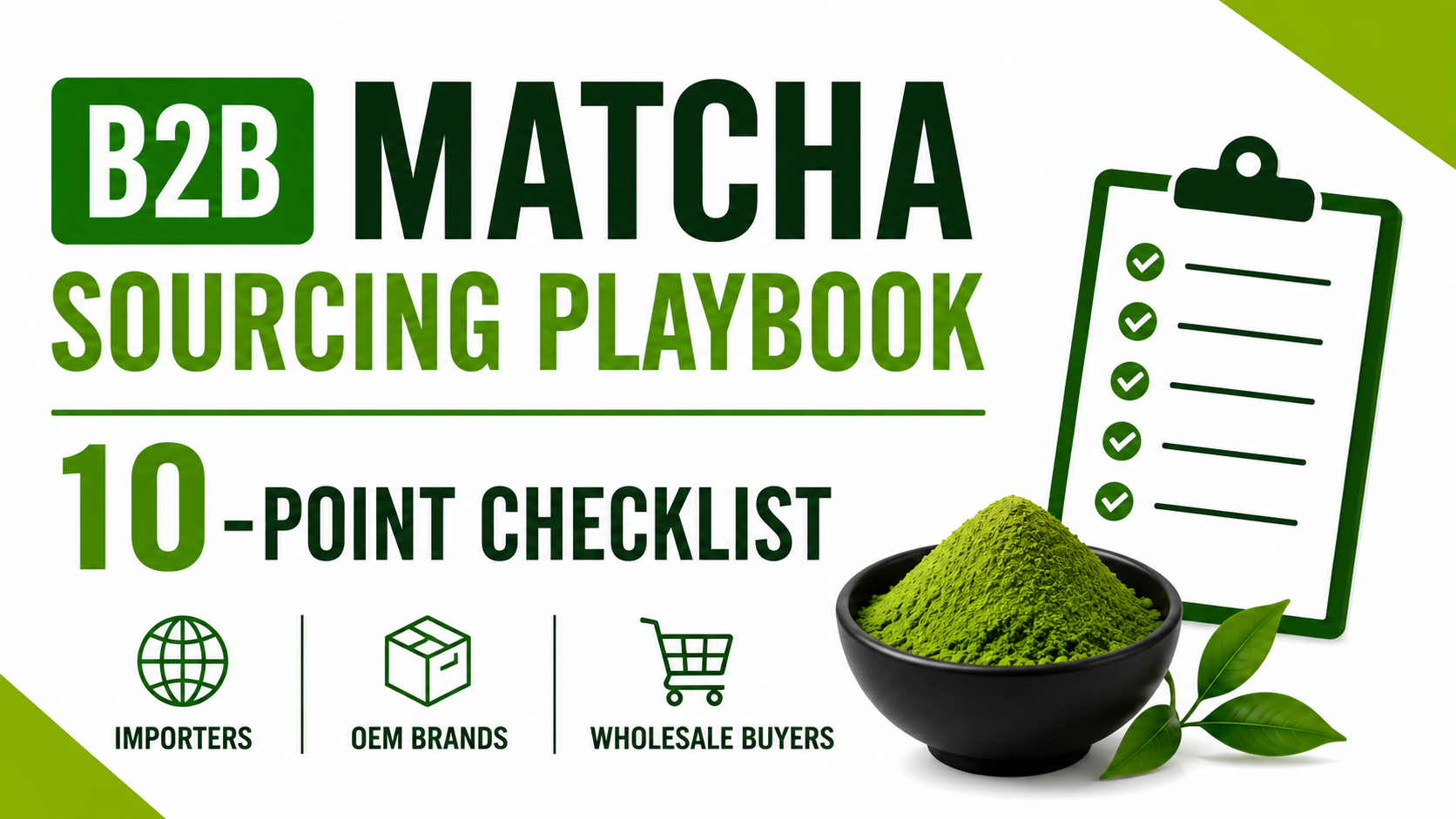
The B2B Matcha Sourcing Playbook: A 10-Point Checklist for Importers, OEM Brands, and Wholesale Buyers
With matcha demand surging worldwide, B2B sourcing inquiries from importers, OEM brands, and wholesale buyers have multiplied. But supply has tightened, quality gaps have widened, and failures are mounting: “The sample was excellent — production was a different product.” “Our EU shipment was stopped at the b
order for MRL violations.” This guide gives you a practical 10-point checklist to source matcha at B2B scale without the most common — and most expensive — mistakes.
For Companies Seeking Matcha Powder
We source matcha from Japan’s premier production regions including Kyoto Uji, Kagoshima, Fukuoka, and Shizuoka, offering comprehensive grade ranges from organic JAS-certified ceremonial grade to processing-grade matcha.
Common Challenges:
- “We have projects but cannot secure stable matcha supply…”
- “We want to incorporate matcha into new café menu items!”
If you face these concerns, consult with Matcha Times. Feel free to contact us for initial inquiries.
\Read Also/
Why B2B Matcha Sourcing Failures Are on the Rise

The global matcha market reached an estimated USD 4.2 billion in 2025 and is projected to exceed USD 10 billion by 2030 (JETRO, IMARC industry estimates) [citation needed]. Japanese matcha demand is outpacing supply, and industrial-grade matcha powder for beverages, sweets, and supplements is in chronic short supply.
This demand-supply gap is creating three pitfalls for new buyers. First, the inability to evaluate quality differences before signing — “first-match failure.” Second, exposure to misrepresentation in origin, grade, and organic certification. Third, price spikes and supply interruptions driven by foreign-exchange, logistics, and weather variability.
Matcha is not a single commodity. Price and end-use vary widely with origin (Uji, Shizuoka, Kagoshima, Yame), leaf type (tencha vs. food grade), particle size, and pesticide residue profile. Buying on the “Made in Japan” label alone exposes you to a triple risk: lot-to-lot inconsistency, export compliance failures, and lost distribution channels.
The 3 Invisible Risks Most Buyers Miss

The most dangerous risks in B2B matcha sourcing are the ones that don’t show up in samples — they appear after the contract, at production scale. Three risks come up repeatedly in buyer conversations.
1. Regional MRL gaps (pesticide residue limits)
The EU, US, Taiwan, and Singapore each set different Maximum Residue Levels (MRLs) for matcha. Tea that passes Japanese domestic standards can fail at the EU border. Without a Certificate of Analysis (COA) at the sample stage, you risk having entire containers turned away.
2. Lot-to-lot variability
Tencha is an agricultural product. Color, aroma, and bitterness vary with harvest timing, weather, and lot. A small sample may look uniform, but at production scale the first lot can taste noticeably different from the next. The rule: request samples from at least three separate lots before any volume commitment.
3. Supply chain transparency
Suppliers may claim “single-estate” sourcing while blending third-party leaf in practice. Without traceability from tea garden to stone mill to packaging line, you cannot pinpoint root cause when quality problems arise — and you cannot answer your downstream customers.
\Read More/
→ The Matcha Supply Chain Anatomy: Understanding the 12-Layer Structure from Farm to Cup
The Core 10-Point Pre-Sourcing Checklist (Quality, Regulations, Supply, Contracts)
This is the heart of the guide. Ten items every B2B buyer should confirm before signing, grouped into four categories. Bring this list to your next supplier meeting and you will eliminate most confirmation gaps.
| Area | # | Checklist Item | How to Verify |
|---|---|---|---|
| Quality | 1 | COA (Certificate of Analysis) provided | Issued per lot |
| Quality | 2 | Origin certification & traceability | Traceable to garden level |
| Quality | 3 | Samples from at least 3 lots | Confirm consistency before production |
| Regulations | 4 | Compliance with destination MRL | Latest EU / US FDA / Taiwan TFDA standards |
| Regulations | 5 | Required certifications | JAS Organic, EU Organic, USDA Organic, Halal, Kosher |
| Regulations | 6 | Invoices & certificates of origin | EUR.1, Form A track record |
| Supply | 7 | Monthly capacity & seasonality | First-flush vs. winter output |
| Supply | 8 | Lead time & MOQ flexibility | Standard / expedited / minimum order |
| Contract | 9 | Pricing terms (FOB / CIF) & FX handling | JPY / USD / EUR options |
| Contract | 10 | Quality claim & remedy clauses | Returns, replacements, damages |
Of these, items 1, 3, 5, and 10 are the most critical. Without COA, three-lot consistency, the right certifications, and explicit remedy clauses, your supplier will eventually fail you at production scale. A supplier who has all four in order is signaling B2B maturity. Ask these questions before you negotiate price.
How the Checklist Defends Against 5 Common Pitfalls

Here is how the 10-point checklist maps to the five failure patterns buyers most often describe.
Pitfall 1 — “The sample was perfect; production wasn’t”
The single most common new-buyer trap. Some suppliers send curated samples and downgrade volume orders.
→ Defense: Item 3 (samples from 3+ lots).
Pitfall 2 — MRL violations on EU shipments
What passes Japanese standards can fail the EU’s tighter limits. Containers get turned away. Losses can run into the tens of thousands of dollars per shipment.
→ Defense: Item 4 (destination MRL compliance) + Item 1 (per-lot COA).
Pitfall 3 — “Organic” labeling without certification
In many destination markets, “Organic” claims require formal certification. Mislabeling triggers regulatory action and forced recalls.
→ Defense: Item 5 (required certifications).
Pitfall 4 — FX moves erase your margin
A USD-denominated contract during a yen swing can raise your landed cost by 15% or more. Without a price-protection clause, your margin disappears.
→ Defense: Item 9 (pricing terms & FX).
Pitfall 5 — Quality problem, no recourse
When a defective lot reaches your customer, a contract without remedy clauses leaves you absorbing the loss.
→ Defense: Item 10 (claim & remedy clauses).
The 3 Axes Sophisticated Buyers Actually Use

The 10-point checklist ultimately resolves into three evaluation axes.
Axis 1 — Origin matching
Beverages, confectionery, supplements, and matcha lattes each map to different optimal origins and grades. Uji excels in traditional drinking matcha; Shizuoka provides reliable volume; Kagoshima offers cost efficiency; Yame delivers premium aromatic profiles. Suppliers committed to a single origin rarely cover all use cases well.
Axis 2 — Regulatory capability
Can your supplier handle EU, US FDA, Taiwan TFDA, and Singapore SFA regulations — not just on paper but operationally? Look for end-to-end support: documentation, label content, nutritional calculations, and ongoing organic-certification management.
Axis 3 — Supply chain transparency
Every step from tea garden to final packaging should be traceable through documents and physical lot samples. A supplier who can immediately say “yes — site visits welcome, production-line video available” is your safer choice.
Why Buyers Choose Japan Matcha Export Organization

Few B2B suppliers meet every item on the 10-point checklist and all three axes above. Japan Matcha Export Organization, Inc. — the company behind this publication — has been selected by buyers in 20+ countries as a B2B matcha specialist. Three core strengths:
1. Origin-matched proposals across Japan
Japan Matcha Export Organization operates a multi-origin network across Uji, Shizuoka, Kagoshima, and Yame, recommending the optimal origin and grade for each use case: beverages, sweets, supplements, and matcha lattes. Freedom from single-origin lock-in is what produces use-case-specific quality.
2. Full compliance with major export standards
Japan Matcha Export Organization maintains demonstrated compliance with EU, US FDA, Taiwan TFDA, and Singapore SFA — including COA, MRL compliance documentation, and continuous management of JAS Organic, EU Organic, and USDA Organic certifications. Documentation, labeling, and local regulatory consultation are handled end-to-end.
3. B2B specialization with stable 10 kg – 1 t/month supply
As a B2B-only supplier, Japan Matcha Export Organization reliably supports volumes from 10 kg to 1 t per month, with lead times, MOQs, and remedy clauses written into contracts — so overseas buyers can build long-term partnerships with confidence.
The Successful B2B Matcha Sourcing Flow — 7 Steps

A practical sourcing flow from initial inquiry to signed contract:
- Define use case & target markets — Lock down the product and country first.
- Supplier shortlist — Use the 10-point checklist to narrow to 2–3 candidates.
- Multi-lot sampling — Verify consistency and lot variation with at least three lots.
- COA & certification review — Cross-check destination MRL and organic compliance.
- Trial production lot (50–200 kg) — Final pre-launch confirmation.
- Contract negotiation — Lock in pricing, FX, and claim terms in writing.
- Signed contract & production start — Combine long-term commitment with periodic quality reviews.
Following this flow dramatically reduces production-stage problems and minimizes lost sales downstream. Skipping steps 3 and 4 — buying directly from a single sample — is the failure pattern to avoid above all others.
Learn More About Global Matcha Trends at Matcha Times

UK-spreading matcha booms result from overlapping health consciousness, Japanese culture popularity, and lifestyle transformations. However, matcha’s appeal and potential still lie ahead. Knowing latest trends across countries and Japanese tea region initiatives reveals matcha’s deeper dimensions.
Matcha Times broadly publishes from matcha market analysis to cafe situations and farmer interviews. Won’t you also take this opportunity to deeply explore matcha’s world? The more you know matcha, the more surely its charm will draw you in.
Conclusion: Use the Checklist to Drive Sourcing Risk Toward Zero
B2B matcha sourcing succeeds or fails on how rigorously you apply the 10-point checklist and the three evaluation axes before signing. The era of choosing suppliers on samples, price, and speed alone is over. Sophisticated importers and OEM brands now verify quality, regulations, supply, and contracts systematically. Use the checklist above to build a sourcing system that holds up at scale.
Looking for wholesale or OEM matcha samples? Contact us — we will recommend the optimal origin and grade based on your application and target markets.
Related Articles
→ Global Matcha Market Analysis 2026: Market Size, Growth Trends, and Business Opportunities