Minnesota Matcha Market 2026: Café Growth, Consumer Trends & B2B Opportunities
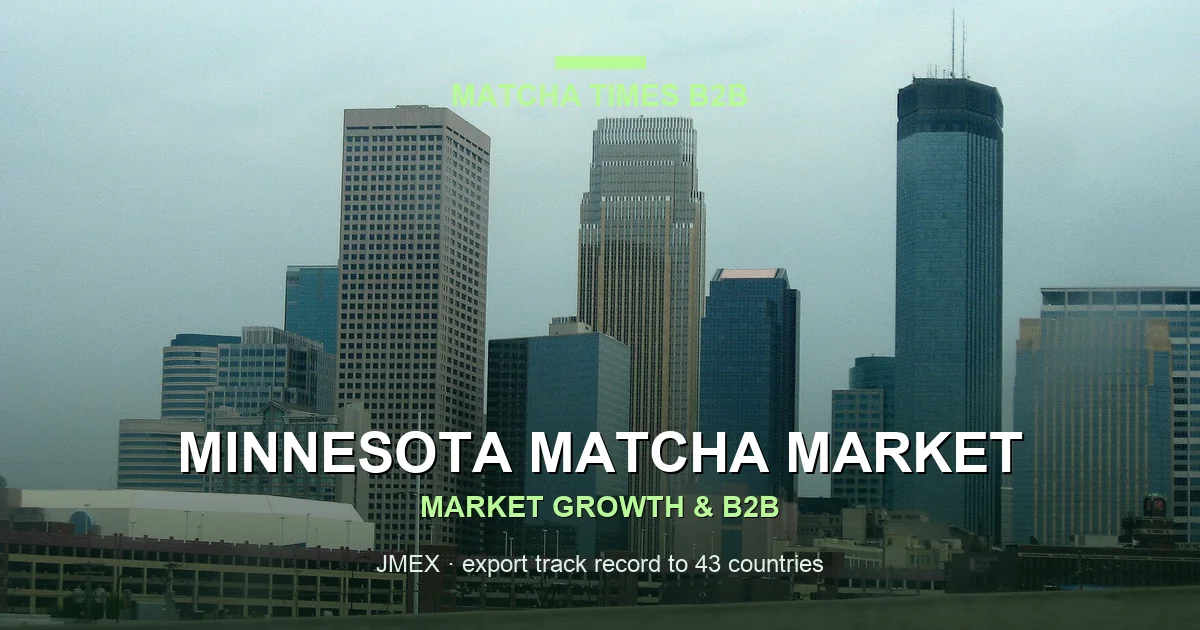
The short read on the Minnesota matcha market is that a health-minded, café-led demand has settled into the Twin Cities and spread across the state — and for a B2B buyer that is a sourcing and supply-chain signal, not a lifestyle story. Minneapolis and St. Paul now carry specialty matcha bars, house-milled tea and full green-drink menus, and because Minnesota grows no tea, every gram is poured from imported matcha.
This is written for importers, wholesalers, OEM formulators and health, wellness or protein brands serving Minnesota and the wider Upper Midwest at scale — not for deciding where to grab a latte. It reads the demand as a procurement brief: what is driving growth, what US import and food-safety rules require, how a cold-climate market changes freshness handling, and a supplier-selection checklist you can apply to any supplier.
Key Takeaways
- Demand is real and café-led: the Twin Cities anchor a mature specialty-tea and coffee culture, and matcha has moved from a niche order to a menu staple.
- It is an import market by definition because Minnesota grows no tea — the market is 100% import-reliant, overwhelmingly on Japan.
- National demand is growing fast: US researchers estimate the US matcha tea market at roughly US$164 million in 2024 with high-single-digit annual growth to 2033 (Grand View Research) — an attributed estimate, not a Minnesota figure.
- Compliance is the real gatekeeper: US tariff (USITC), FDA FSVP and facility-registration rules (FDA) gate every shipment.
- Buyers win by planning ahead: match grade to application, plan cold-climate freshness and lead time early, and use the checklist below.
Researched and reviewed by the Matcha Times Editorial Team, operated by the Japan Matcha Export Organization (JMEX). Last reviewed: September 23, 2026. See our Editorial Policy and Sources & Methodology. Found an error? Tell us.
How big is the Minnesota matcha market in 2026?
The honest one-line answer is that the Minnesota matcha market is best measured by demand signals, not an official statistic: no state agency publishes a “Minnesota matcha” figure, so the credible read comes from local demand signals rather than a single headline number. The clearest signal is the café build-out. Across Minneapolis and St. Paul, specialty operators now treat matcha as a standing menu category — from whisked ceremonial preparations to iced and flavored drinks — rather than a seasonal novelty.
The audience behind that build-out is concentrated and affluent. According to the Minnesota State Demographic Center and US Census QuickFacts, the Twin Cities metro anchors the state’s population, with Hennepin County alone at roughly 1.3 million residents — a dense, health-conscious urban base of exactly the younger professionals who drive specialty-beverage demand. Minnesota also sustains a deep independent café and roaster culture, which gives matcha a ready shelf rather than a cold start.
For national context, commercial researchers estimate the US matcha tea market at about US$164 million in 2024, projected to keep growing at a high-single-digit annual rate through 2033 (Grand View Research). Treat that as an attributed commercial estimate, not an official statistic, and never as a Minnesota-specific figure — estimates vary by provider and market definition, and matcha is not the same as green tea overall. The verifiable, on-point evidence for a buyer is the local café and demographic demand above.
For Companies Seeking Matcha Powder
We source matcha from Japan’s premier production regions including Kyoto Uji, Kagoshima, Fukuoka, and Shizuoka, offering comprehensive grade ranges from organic JAS-certified ceremonial grade to processing-grade matcha.
Common Challenges:
- “We have projects but cannot secure stable matcha supply…”
- “We want to incorporate matcha into new café menu items!”
If you face these concerns, consult with Matcha Times. Feel free to contact us for initial inquiries.
\Read Also/

What is driving matcha café growth in Minnesota?
Three forces sit behind the trend, and each one tells a supplier something about what the market will ask for. Reading them is what turns a café headline into a demand forecast you can source against.
A specialty-tea culture that rewards freshness and provenance
Minnesota’s matcha scene is unusually quality-led for its size. The Twin Cities host tea houses that house-mill their own matcha and run informal tea services — a rarity in the US — alongside cafés that advertise matcha sourced directly from Japan and prepared to order. That posture matters to a supplier: this is a market that reads menus for origin, grade and freshness cues, so provenance and grade are part of the sale rather than a commodity green powder that happens to be on the shelf.
A health-conscious, wellness-led consumer base
Minnesota consistently ranks among the healthiest US states, and matcha fits that narrative squarely: it is positioned as a considered, antioxidant-rich alternative to coffee. New drinkers arrive through the wellness story, then stay for the flavor, and the practical implication for a B2B buyer is that the wellness claim has to be backed by the product — authenticity and grade claims are scrutinized, so a supplier must document real Japanese origin rather than simply printing the word on a label.
Flavor innovation and format expansion
Menus have widened well past a single hot latte. Minnesota cafés now pour iced matcha, matcha lemonade, and fruit- and botanical-forward builds such as strawberry, honey-lavender and taro, while ready-to-drink and grocery formats extend demand beyond the café counter. Nationally, matcha remains one of the fastest-growing menu categories, with one data provider reporting strong double-digit year-over-year menu growth (Tastewise). For a supplier the message is that one blanket grade will not cover the menu: a culinary-grade line for iced and flavored drinks sits next to a drinking-grade line for straight preparations.
\Read More/
Why Minnesota’s boom is a sourcing story, not just a demand story
The reason a consumer trend belongs in a procurement plan is that the drink Minnesota is adopting is 100% imported, at a moment when the source itself cannot flex. Because the state grows no tea, Minnesota cafés, grocers and brands rely almost entirely on imports — overwhelmingly from Japan — so any wobble in Japanese supply becomes a local cost and availability problem in Minneapolis just as fast as in Tokyo.
On the supply side, Japan is under genuine strain. Global demand has outrun the ability to grow the shaded tencha leaf that matcha is milled from, and producers have publicly warned of tight supply and heat-stressed harvests. To keep scope honest, Japan’s headline tea-export figures cover green tea in total, not matcha alone, and mix value with volume — but the direction is unambiguous: input costs are rising and will not fall quickly.
There is a Minnesota-specific twist on top of the global squeeze: cold-climate logistics add a freshness dimension. Matcha loses color and freshness to heat, humidity swings and time, and a landlocked northern market means long inland transit and wide seasonal temperature ranges between a coastal port of entry and a Twin Cities warehouse. The combined message for a Minnesota buyer is rising demand, tightening supply, and a premium that rewards early, documented, cold-chain-aware sourcing.
Importing matcha into Minnesota: duty, FDA rules and landed cost
This is the section the lifestyle coverage skips, and it is where deals succeed or stall. A Minnesota buyer importing directly clears matcha through US federal rules first, then moves it inland — often from a West Coast port or via a Chicago rail hub — up to the Twin Cities, so getting the compliance framework right before a shipment leaves Japan is what protects the landed cost and the freshness.
Two points set the baseline. First, green tea — the tariff category that covers matcha (HS heading 0902) — carries a duty-free base rate (0%) under the US tariff schedule (USITC HTS); any country-level “reciprocal” or additional measures introduced in 2024–2025 are separate, time-varying, and should be confirmed with a licensed customs broker rather than assumed as the product rate. Second, food-safety compliance, not duty, is the real workload.
The building blocks below are described qualitatively on purpose — specific fees, thresholds and document lists change, so confirm current requirements with the FDA and your broker before you ship. Treat this as a map of what to verify, not a fixed rulebook.
| Requirement | What to verify (confirm current details with FDA / CBP / your broker) |
|---|---|
| Tariff classification (HS 0902) | Green tea is duty-free at the MFN base rate (USITC); verify the current entry with your broker, including any separate country-level measures in force at shipment |
| FDA food-facility registration | The foreign manufacturer/processor and, where applicable, the US facility must be registered with the FDA (FDA) |
| Foreign Supplier Verification Program (FSVP) | The US importer of record must develop and follow an FSVP for each food and supplier — supplier evaluation, hazard analysis and verification records (FDA FSVP) |
| Labeling | US FDA food-labeling rules: identity, net quantity, ingredient and allergen statements, and the responsible firm — accurate for flavored or blended SKUs |
| Food-safety documentation | A per-lot certificate of analysis (heavy metals, pesticides/MRL, microbiology) from an accredited laboratory, dated close to shipment |
| Inland logistics & cold-climate storage | Routing from the port of entry to the Twin Cities, plus temperature- and humidity-controlled storage to protect color and freshness across Minnesota’s seasonal swings |
The practical takeaway is that compliance is a supplier capability, not just a buyer chore: an exporter who can register, prepare FSVP-ready records, build a compliant label pack and supply per-lot testing as one flow removes most of the friction that delays a US shipment.
B2B opportunities in the Minnesota matcha market
For a supplier or brand, Minnesota’s demand splits into distinct channels, and each one asks for a different grade and supply profile. Mapping them early is what lets you match product to channel rather than sell one blanket product to everyone.
- Café and multi-store supply: independent and multi-store cafés and Twin Cities tea houses need drinking-grade matcha with reliable color and milk performance, plus culinary grade for iced and dessert lines.
- Foodservice and regional chains: campus dining, corporate foodservice, grocery-café and regional coffee chains across the Upper Midwest want volume commitments, batch consistency and dependable lead times over boutique micro-lots.
- Private label, RTD and manufacturing: wellness, protein and functional-beverage makers — a real cluster in Minnesota’s food-manufacturing economy — need particle size, dispersion and color stability specified and held lot to lot for RTD and powder formats.
Across all three, the winning move is the same: agree grade, volume, documentation and lead time before peak season. A documented spec plus a per-lot COA is what turns a trend into a repeatable, on-brand product line.
How to choose a matcha supplier for the Minnesota market
Once demand and compliance are clear, translate them into criteria you can hold any supplier to. Matcha is agricultural and varies by crop and lot, so a written spec plus a per-lot COA is what makes quality repeatable. The checklist evaluates any supplier — including JMEX — against the same criteria, never a scored ranking.
| Criterion | What to verify with any supplier |
|---|---|
| Grade fit by application | Drinking-grade for straight lattes and culinary-grade for iced, fusion and dessert lines — matched to your SKUs, not one blanket grade |
| Origin & traceability | Documented Japanese origin, region, cultivar and harvest — not just an “authentic” or “ceremonial” menu word |
| Color & batch consistency | A defined color reference and lot-to-lot consistency you can check on arrival, since color is the visible grade proxy |
| Freshness & cold-climate handling | Packaging, oxygen and light protection, and storage guidance that hold color and aroma through long inland transit and Minnesota’s temperature swings |
| US compliance support | Help with FDA facility registration, FSVP-ready records, US labeling content and per-lot testing documentation |
| Supply continuity & lead time | Realistic monthly volume and lead times through a tight market, plus a qualified backup grade or origin |
| Pricing transparency & trade terms | Quotes with a clear trade condition (FOB/CIF/EXW), a stated MOQ, and how price moves as Japanese leaf costs change |
Before committing volume, put these questions to any matcha supplier:
- Which grades do you offer for a drinking line versus a culinary dessert/fusion line, and can you document origin, region and harvest for each?
- Can you supply a paid trial lot large enough to test color, flavor and milk dispersion in my own Minnesota recipes before a production order?
- Will you provide a per-lot COA from an accredited laboratory (heavy metals, MRL, microbiology) dated close to shipment?
- How is the matcha packed and protected for freshness, and what storage conditions do you recommend for long inland transit to the Upper Midwest?
- What support do you give on FDA facility registration, FSVP records and US labeling content?
- How are your quotes structured (FOB/CIF/EXW, MOQ), what is the lead time to a US port and inland to Minnesota, and how does price adjust as Japanese tencha costs move?
From the exporter’s perspective
From the export side, the brands that win a quality-led market like Minnesota treat the demand data as research, not marketing: they read the café and wellness signals, decide which grades and formats they actually need, and lock a documented, freshness-aware supply agreement before peak season rather than chasing spot powder when supply tightens. Because JMEX ships authentic Japanese matcha with traceable origin, can match grade to application, and prepares export, food-safety and freshness documentation as one flow, a buyer holds a single consistent standard across reorders instead of relabeling whatever is available that month.
Sources & Methodology
This article synthesises Minnesota demographic data, US federal import and food-safety rules, and published café and trend reporting rather than a proprietary survey. We publish no invented buyer statistics: there is no official “Minnesota matcha” number, so the market is read through local demand signals; national and global market-size valuations are attributed commercial estimates, never presented as official or as Minnesota-specific; matcha is kept distinct from green tea overall, and value from volume. Each source below states what it supports, its date and its scope.
- Minnesota State Demographic Center — Population Estimates — Twin Cities population concentration (Hennepin County ~1.3 million) as the local demand-scale signal (2025 data, accessed 2026-09-23; Minnesota state government (official/primary))
- U.S. Census Bureau QuickFacts — Minnesota — Minnesota population and demographic context (qualitative; no matcha-specific figure asserted) (accessed 2026-09-23; US government (primary))
- U.S. International Trade Commission — Harmonized Tariff Schedule (HTS) — the tariff classification for green tea (HS heading 0902) and its duty-free base rate (accessed 2026-09-23; US government (primary); confirm current entry with a broker)
- U.S. FDA — Foreign Supplier Verification Programs (FSVP) final rule — the importer’s food-safety verification obligation for imported matcha (accessed 2026-09-23; US government (primary/official))
- U.S. FDA — Registration of Food Facilities — the facility-registration requirement for foreign and domestic food facilities (accessed 2026-09-23; US government (primary/official))
- Grand View Research — U.S. Matcha Tea Market Outlook — an attributed commercial estimate of US matcha-tea market size (~US$164M, 2024) and growth; provider estimates vary by definition (2025, accessed 2026-09-23; commercial provider estimate; not an official statistic)
- Tastewise — Matcha Trends and Statistics — an attributed commercial estimate of matcha menu growth; provider estimates vary by definition (2026, accessed 2026-09-23; commercial provider estimate; not an official statistic)
Why Buyers Choose JMEX (Japan Matcha Export Organization)

A partner built for exactly this kind of quality-led, import-dependent market is JMEX (Japan Matcha Export Organization), a wholesale and export partner focused on shipping authentic Japanese matcha overseas. Rather than leaving a Minnesota menu to spot supply, it selects verified Japanese origin, designs the grade to the application, and prepares the export, food-safety and quality documentation as one flow so the matcha you brief is the matcha that arrives in the Twin Cities.
For a Minneapolis or St. Paul café group, an Upper-Midwest roaster or grocery-café program, or a Minnesota wellness or protein brand, JMEX can match drinking and culinary grades to your beverage and dessert lines, supply a paid trial lot to test color and dispersion before a production order, and provide a per-lot certificate of analysis documenting origin, harvest and a color reference. With an export track record to 43 countries, it supplies from a small paid sample up to one-ton volume for importers, wholesalers, OEM and health, wellness or protein manufacturers — the continuity and traceable documentation a Minnesota menu depends on when color consistency and reliable resupply are on the line.
Frequently Asked Questions
Quick answers to the questions buyers ask most about the Minnesota matcha market.
How big is the Minnesota matcha market in 2026?
There is no official “Minnesota matcha” statistic, so the credible read is through demand signals rather than a single number. The Twin Cities carry a mature specialty-tea and coffee culture, matcha is now a standing menu category from ceremonial to iced and flavored drinks, and the metro concentrates a dense, health-conscious population (MN State Demographic Center). National figures — the US matcha tea market estimated near US$164 million in 2024 per Grand View Research — are attributed commercial estimates, not official or Minnesota-specific numbers.
Why is matcha popular in Minnesota and the Twin Cities?
A health-conscious, wellness-led consumer base has embraced matcha as a considered alternative to coffee, and the Twin Cities’ strong independent café and tea-house culture — including venues that house-mill matcha and source directly from Japan — gives it a quality-forward home. Menus have widened from a single hot latte to iced, lemonade and fruit- or botanical-forward builds, plus grocery and ready-to-drink formats, so demand now spans several channels rather than one.
Where do Minnesota cafés get their matcha?
Overwhelmingly from imports, mainly Japan, because Minnesota grows no tea. Menu cues such as “ceremonial-grade” or a named Japanese origin point to imported Japanese supply as a selling point. For a brand entering the market, the practical step is to work with an exporter who can document origin, region and grade and commit to consistent resupply, rather than buying whatever spot lot is cheapest.
What does it cost to import matcha into the US and Minnesota?
On duty, green tea (HS heading 0902) is duty-free at the US tariff base rate (USITC); any separate country-level measures introduced in 2024–2025 are time-varying and should be confirmed with a customs broker, not assumed as the product rate. The larger cost drivers are freight, inland logistics from the port of entry to the Twin Cities, cold-climate storage, food-safety compliance, and the matcha itself — request a current quote with a clear trade condition (FOB/CIF/EXW) rather than relying on a fixed figure.
Do US matcha importers need FDA registration or FSVP?
In general, yes. The foreign facility that manufactures or processes the matcha must be registered with the FDA (FDA), and the US importer of record must develop and follow a Foreign Supplier Verification Program for each food and supplier (FDA FSVP). Specific thresholds and exemptions apply, so confirm current requirements with the FDA and a qualified consultant or broker before shipping.
What should a Minnesota buyer look for in a matcha supplier?
Match grade to application (drinking-grade for lattes, culinary-grade for iced and dessert lines), documented Japanese origin and harvest, a defined color reference with lot-to-lot consistency, freshness and cold-climate handling guidance, support with FDA registration, FSVP records and US labeling, realistic monthly volume and lead times, and transparent pricing with a stated trade condition and MOQ. Use the checklist above to hold any supplier, including JMEX, to the same criteria rather than a scored ranking.
Learn More About Global Matcha Trends at Matcha Times

Matcha Times is a specialist media platform covering the global matcha market — sourcing and wholesale, supply and pricing, trade and regulations, production and origins, and the companies shaping the industry.
From market analysis and price trends to café case studies and interviews with tea farmers, we help buyers, importers, distributors, and manufacturers stay ahead of where matcha is heading. Explore more and put the global matcha market to work for your business.
Conclusion
When origin, grade, and export conditions align, matcha becomes a stable revenue source. Start by defining your requirements and confirming quality with a sample.
Looking for wholesale or OEM matcha samples? Contact us — we will recommend the optimal origin and grade based on your application and target markets.
Related Articles