Japanese Matcha for Vietnamese Beverage Manufacturers: Specs, Cost & Bulk Supply
For a Vietnamese beverage manufacturer, the right matcha supplier for Vietnamese beverage manufacturers is one specified to the drink it will go into — not one chosen from a “ceremonial vs culinary” label. A matcha latte line, a ready-to-drink (RTD) bottled tea, an instant sachet and a functional powder each demand different color behaviour, particle size, dispersion and heat tolerance, so the sourcing decision is a technical one: define a written specification, confirm it against a sample and a certificate of analysis, agree the bulk supply and documentation, then clear Vietnam’s food-import process. This guide sets out how to match the spec to the application, how to formulate for dispersion and color stability, the cost-versus-quality logic at manufacturing volume, the Vietnam import path (including the VJEPA tariff advantage for Japanese origin), and how to evaluate any supplier — including how JMEX supports overseas manufacturers on the export side.
For Companies Seeking Matcha Powder
We source matcha from Japan’s premier production regions including Kyoto Uji, Kagoshima, Fukuoka, and Shizuoka, offering comprehensive grade ranges from organic JAS-certified ceremonial grade to processing-grade matcha.
Common Challenges:
- “We have projects but cannot secure stable matcha supply…”
- “We want to incorporate matcha into new café menu items!”
If you face these concerns, consult with Matcha Times. Feel free to contact us for initial inquiries.
\Read Also/

Key Takeaways
- Specify matcha to the beverage application, not the grade name — latte, RTD, instant and functional powder each need different color, particle size, dispersion and heat behaviour.
- For beverages the parameters that matter most are particle size, dispersion, color and thermal stability, and a per-lot certificate of analysis (COA) — ask for the numbers, do not accept “premium” as a spec.
- Treat every MOQ, lead-time and price figure as a quotation item tied to your exact spec, volume and incoterms — ranges quoted online are not your deal.
- Importing matcha into Vietnam runs through the food-safety framework (Decree 15/2018/ND-CP): a product self-declaration backed by accredited lab testing, plus compliant Vietnamese labeling.
- Japanese origin can qualify for preferential tariff treatment under the Vietnam-Japan EPA (VJEPA) with the correct certificate of origin — a real landed-cost lever for a manufacturing program.
Researched and reviewed by the Matcha Times Editorial Team, operated by the Japan Matcha Export Organization (JMEX). See our Editorial Policy and Sources & Methodology. Found an error? Tell us.
\Read More/
Which Japanese matcha for which Vietnamese beverage
The short answer: choose the grade and specification by how the matcha is processed and consumed, then confirm it in your actual product. “Ceremonial” and “culinary” are descriptive marketing terms, not standards, so specify the sensory and technical outcome you need. The table maps common Vietnam-market beverage formats to what a manufacturer should design for.
| Beverage application | Design priority | What to specify in the COA / spec sheet |
|---|---|---|
| Matcha latte / café base | Vivid color that holds in milk; clean dispersion | Fine, uniform particle size; bright green color; balanced umami; workable cost per serving |
| RTD / bottled beverage | Dispersion and color stability across shelf life | Fine particle size; sediment/suspension behaviour; color-hold; microbiological spec; batch consistency |
| Instant / 3-in-1 sachet mix | Cold-water solubility and uniform blending | Particle size and bulk density for free-flow; color; moisture; consistent lot-to-lot dispersion |
| Functional / supplement powder | Documented safety and consistency | Defined spec; per-lot COA; residue, heavy-metal and microbiological testing |
| Baked / heat-processed drink base | Heat and color survival | Robust culinary grade; strong flavour to carry through; color that resists baking-range heat |
Two rules follow. First, design to the product, not to the grade label: a milk-based latte menu rarely needs a first-harvest ceremonial lot, and over-specifying inflates cost per unit with no visible benefit in a finished drink. Second, ask for the actual numbers — particle-size distribution, moisture, microbiological and heavy-metal results — because documented batch consistency is what protects a beverage brand across thousands of units, far more than one impressive sample.
Formulation guidance: dispersion, color and heat stability
Once the grade fits the application, three technical behaviours decide whether a matcha performs on a production line. Each can be specified and tested, and each is a fair question to put to any supplier.
Particle size and dispersion
Matcha is a suspension, not a solution: the powder stays dispersed in liquid rather than dissolving. Finer, uniform particles disperse more evenly and feel smoother, while coarse particles are perceived as gritty and settle faster. For RTD formats, particles will still sediment over time unless the formulation stabilises them (for example with gellan, xanthan or CMC), so treat particle size and stabiliser system together, not in isolation. Ask for the particle-size distribution (D50/D90) on the COA rather than a grade adjective.
Color and thermal stability
Matcha color is sensitive to heat, light, oxygen and pH, and processing can dull the vivid green a brand is selling. A peer-reviewed processing study reports that baking-range heat (around 180 °C) can reduce catechin content by roughly a fifth, illustrating why a grade that survives pasteurisation or baking must be chosen deliberately. For RTD and heat-treated bases, specify color-hold and heat tolerance and validate it after your real thermal step, not only in cold water.
Pre-dispersion and processing on the line
How matcha is added matters as much as the powder. A common practice is to pre-disperse the powder in a small volume of warm water (around 60–70 °C) before it enters a cold batch, which breaks up agglomerates more effectively than dropping dry powder into cold liquid. Confirm that your chosen matcha behaves this way in a trial run on your own equipment; a sample that works in a beaker can still clump at line speed.
Cost versus quality at manufacturing scale
At beverage volume, small per-kilogram differences multiply, so the goal is the lowest grade that still delivers the color, flavour and stability your product needs — no higher. Reliable MOQ, lead-time and price figures only exist in a quotation, because they depend on your exact spec, volume, format and origin. Rather than trusting a headline number, understand what moves cost:
- Grade and harvest — a fine latte or ceremonial-style lot costs more than a robust culinary grade; match the grade to the drink, not to the marketing tier.
- Certification — organic (JAS) or other certified lots cost more and can have tighter availability, especially around the spring first-harvest window.
- Pack format — bulk foodservice packs are cheaper per kilo than small retail sachets, which add tooling and filling cost.
- Freight and duty — origin, incoterms (FOB/CIF) and whether a VJEPA certificate of origin is used all change your landed cost into Vietnam.
- Hidden cost of inconsistency — rejected lots, sediment complaints and color drift cost far more than the powder; consistent, documented quality is the cheaper option at scale.
Because these variables interact, never combine a price from one source with an MOQ from another and call it your deal. Ask a shortlisted supplier for a written quotation covering spec, MOQ, lead time, incoterms and documentation together — that single document is worth more than any published range.
Bulk supply and the documentation a manufacturer needs
Consistent supply and complete paperwork are what separate a hobby ingredient from a production-grade one. Before you commit recurring volume, confirm that a supplier can deliver both the material and the evidence, lot after lot.
| Requirement | What to confirm before a bulk order |
|---|---|
| Per-lot COA | Sensory and safety parameters — particle size, moisture, microbiological counts — issued per production lot |
| Residue & heavy-metal testing | Pesticide/MRL and heavy-metal (Pb, Cd, As) results from an accredited (ISO 17025) laboratory |
| Batch consistency | How color, flavour and particle size are held stable across repeat production |
| Origin evidence | Named Japanese region and, ideally, cultivar and harvest — not just “Japanese matcha” |
| Supply stability | Confirmed ability to scale from a trial lot to regular monthly volume without grade drift |
| Export documents | Commercial invoice, packing list, and a VJEPA certificate of origin (Form VJ) where applicable |
Importing Japanese matcha into Vietnam for manufacturing
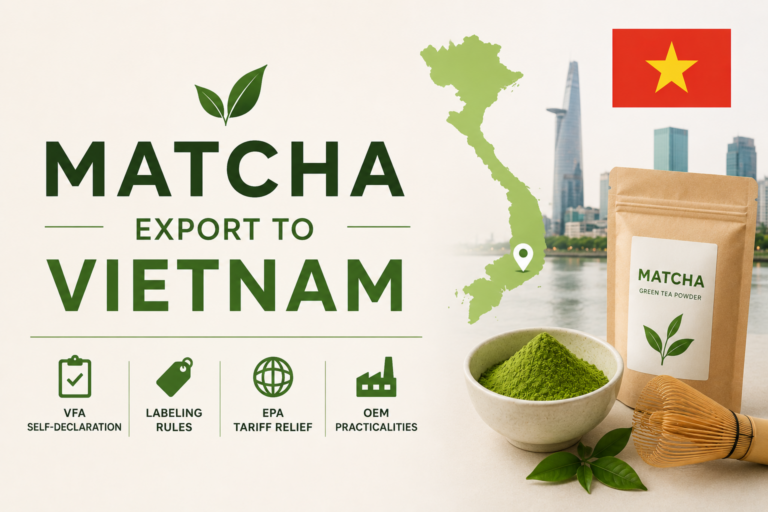
Vietnam regulates imported food under the Law on Food Safety and its implementing decree, Decree 15/2018/ND-CP. In practice this means a product self-declaration supported by accredited testing, plus compliant labeling; tea and tea-based products are subject to import food-safety checks. Confirm the current dossier and process with the Vietnam Trade Information Portal or a licensed customs broker before your first shipment.
Self-declaration and labeling
Under the self-declaration regime, the importer files a product declaration supported by testing evidence (a certificate of analysis from an accredited, ISO 17025-compliant laboratory) before the goods are placed on the market. Pre-packed products must carry compliant Vietnamese-language labeling — product name, ingredients, net content, origin and importer details — and nutrition-labeling expectations are tightening for many food categories. For a manufacturer importing bulk matcha as an ingredient, align the imported spec and COA with the declaration your product will need so a paperwork gap does not hold a shipment at the border.
Tariff and the VJEPA advantage
Matcha falls under tea (HS heading 0902). A Japanese-origin product can qualify for preferential tariff treatment under the Vietnam-Japan Economic Partnership Agreement (VJEPA), provided the shipment carries the correct certificate of origin (Form VJ). Preferential rates and the applicable schedule vary by tariff line and year, so verify the current rate and origin criteria on the official Vietnam customs portal rather than assuming a figure; import VAT also applies on the customs value. For a manufacturer, origin documentation is not paperwork for its own sake — it is a direct landed-cost lever.
For market context — not a matcha-specific figure — official Japan MAFF / Ministry of Finance trade data put Japan’s green tea exports (all forms combined, not matcha only) at roughly ¥36.4 billion and 8,798 tonnes in 2024. Powdered green tea, which includes matcha, is a majority share by volume, but read value and volume separately and never treat the green-tea total as a matcha-only number.
How to evaluate a bulk matcha supplier
Rather than ranking brands, evaluate any supplier — a Vietnam-based reseller or a Japan-direct exporter — against the same verifiable criteria. Both models exist: local stock can mean shorter lead times, while direct Japanese sourcing gives more control over origin, grade and documentation. Use the checklist to compare them on facts you can verify, not claims.
| Criterion | What to verify with any supplier |
|---|---|
| Origin & cultivar | Named Japanese region and, ideally, cultivar and harvest period — not just “Japanese matcha” |
| Application fit | A grade and spec matched to your beverage format, confirmed in your actual product |
| Particle size & dispersion | Particle-size distribution on the COA and dispersion behaviour on your line |
| Color & thermal stability | Color-hold and heat tolerance validated after your real processing step |
| Per-lot COA & testing | Sensory, microbiological, residue and heavy-metal results from an accredited lab |
| Certifications | Organic (JAS), Halal or food-safety scheme evidence if your product needs it |
| Vietnam documentation | Support for self-declaration testing, labeling, and a VJEPA certificate of origin |
| Supply & consistency | Ability to scale volume while holding color, flavour and particle size steady |
A fast way to pressure-test a partner is to request a sample matched to your exact beverage spec and a per-lot COA together, then place a small trial order before committing to recurring volume. Suppliers who answer origin, grade, testing and documentation questions precisely — and put them in writing — are the ones worth scaling with.
Sources & Methodology
This guide synthesises official Vietnamese and Japanese trade and food-safety sources with peer-reviewed food-processing research. Each source below states what it supports, its date, and its scope; all figures are external primary or official sources, and no unverified number is presented as fact.
- USDA FAS — Vietnam food & agricultural import regulations (Decree 15/2018/ND-CP) — Vietnam food-safety self-declaration + import inspection framework for food incl. tea — accessed 2026 Vietnam food import regulation
- Vietnam MOIT (VNTR) — Vietnam-Japan Economic Partnership Agreement (VJEPA) — preferential tariff treatment for Japanese origin; Form VJ certificate of origin — in force 2009 Vietnam-Japan bilateral EPA
- Vietnam Trade Information Portal — current HS 0902 tariff/VAT lookup and import-procedure verification (rates vary by line/year) — accessed 2026 Vietnam customs & tariff
- Japan MAFF / Ministry of Finance — tea export statistics — Japan green-tea export value/volume 2024 (green-tea TOTAL, not matcha-only) — 2024 Japan green tea exports
- Foods (MDPI), peer-reviewed — processing-driven transformations of matcha — thermal effect on catechins/color as a formulation consideration for heat-processed beverages — 2026 matcha food-processing science
Why Buyers Choose JMEX (Japan Matcha Export Organization)

One supplier that meets these criteria at a high level is JMEX (Japan Matcha Export Organization), a wholesale and export partner dedicated to bringing Japanese matcha overseas. It designs origin selection, quality assurance, export documentation, and logistics as one continuous flow, built for export from the start.
With a track record of exports to 43 countries, JMEX applies this technical process on the export side: origin and grade design by beverage application, per-lot COA, MRL/heavy-metal testing, organic/Halal certification support, export and origin documentation including a VJEPA certificate of origin, and stable recurring bulk supply for Vietnamese beverage manufacturers producing latte, RTD, instant and functional matcha products.
Frequently Asked Questions
Common questions from Vietnamese beverage manufacturers evaluating a Japanese matcha supplier, from grade choice to import and tariff.
What matcha grade is best for RTD and latte beverage manufacturing?
Design to the application, not the grade name. A latte base needs color that holds in milk, clean dispersion and a workable cost per serving; an RTD needs fine, uniform particle size and color that survives pasteurisation and shelf life. A robust culinary or premium café grade usually fits beverage manufacturing better than a first-harvest ceremonial lot. Confirm the choice with a sample tested in your actual finished drink.
What specifications should a beverage manufacturer require from a matcha supplier?
Ask for the numbers, not adjectives: particle-size distribution (D50/D90), moisture, color data, microbiological counts, and pesticide/heavy-metal results, all on a per-lot certificate of analysis from an accredited laboratory. Dispersion behaviour and color-hold after your thermal step matter as much as flavour, so validate them on your own line.
How does matcha color and flavor survive heat processing?
Matcha color and catechins are sensitive to heat; a peer-reviewed processing study reports that baking-range heat (around 180 °C) can cut catechin content by roughly a fifth. For pasteurised RTD or baked bases, choose a grade specified for thermal stability, consider color-protective formulation, and validate color-hold after your real heat step rather than only in cold water.
What is the MOQ for bulk matcha for a beverage plant?
There is no universal MOQ — it depends on the grade, packaging, origin and supplier. Foodservice bulk packs usually carry a lower per-kilo cost than small retail sachets, and a custom spec may raise the minimum. Ask each shortlisted supplier for the MOQ in a written quotation tied to your exact spec rather than relying on a published range.
How do I import matcha into Vietnam for manufacturing?
Imported food is regulated under Vietnam’s Law on Food Safety and Decree 15/2018/ND-CP, which involves a product self-declaration supported by accredited testing and food-safety inspection at import, plus compliant Vietnamese labeling. Tea-based products are subject to import checks. Align your imported spec and COA with the declaration your product needs, and confirm current steps with the Vietnam Trade Information Portal or a licensed customs broker.
Does Japanese-origin matcha get a lower tariff into Vietnam?
A Japanese-origin product can qualify for preferential tariff treatment under the Vietnam-Japan EPA (VJEPA) when the shipment carries the correct certificate of origin (Form VJ). Matcha sits under tea (HS heading 0902), and rates vary by tariff line and year, so verify the current rate and origin rules on the official Vietnam customs portal. For a manufacturer, this is a real landed-cost lever.
Learn More About Global Matcha Trends at Matcha Times

Matcha Times is a specialist media platform covering the global matcha market — sourcing and wholesale, supply and pricing, trade and regulations, production and origins, and the companies shaping the industry.
From market analysis and price trends to café case studies and interviews with tea farmers, we help buyers, importers, distributors, and manufacturers stay ahead of where matcha is heading. Explore more and put the global matcha market to work for your business.
Conclusion
Sourcing matcha for a Vietnamese beverage line is a specification decision as much as a purchase: match the grade to the drink, specify particle size, dispersion, color and thermal stability, and buy the lowest grade that still delivers — backed by a per-lot COA and documented batch consistency. On the import side, work through Vietnam’s food-safety self-declaration and use a VJEPA certificate of origin to protect landed cost. Verify every supplier with a sample, a COA and testing evidence, and you will launch a beverage that holds quality and margin at scale. JMEX supports overseas manufacturers across exactly these steps.
Looking for wholesale or OEM matcha samples? Contact us — we will recommend the optimal origin and grade based on your application and target markets.
Related Articles