Matcha Supplier Kuala Lumpur: Wholesale Japanese Matcha for Cafés & Distributors
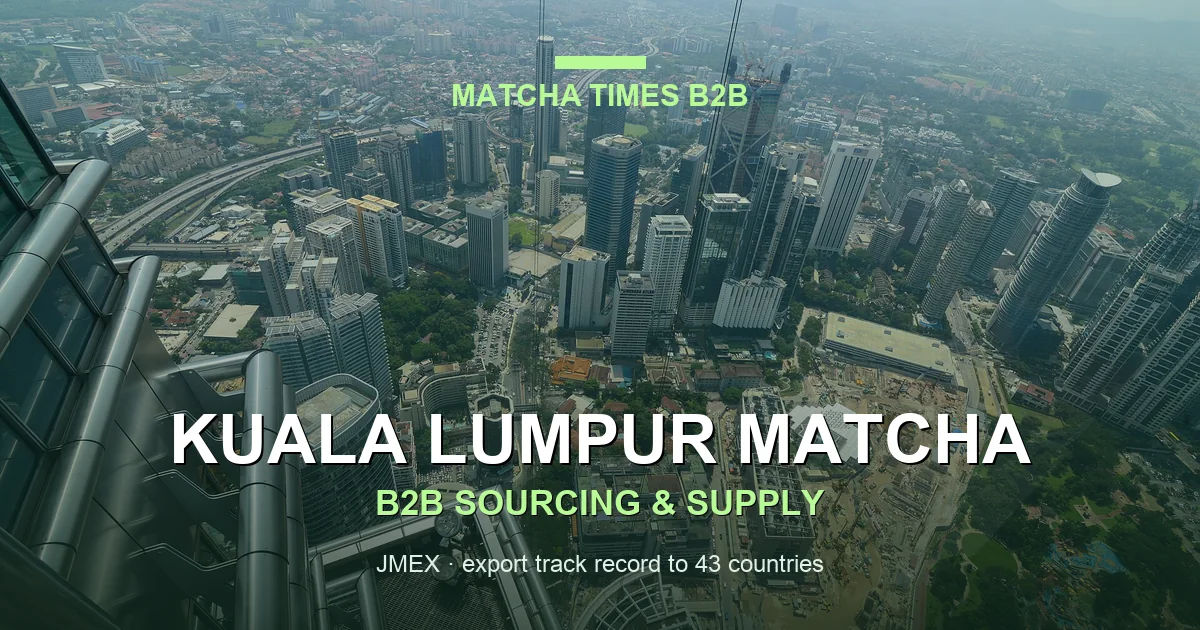
Yes — Kuala Lumpur is one of Southeast Asia’s most active B2B markets for Japanese matcha at the wholesale level. A dense concentration of specialty-café chains, independent coffee shops, and health-and-wellness brands across the Klang Valley generates consistent, recurring demand for culinary and premium-grade matcha powder. For importers and distributors sourcing at scale, Kuala Lumpur’s role as a regional F&B distribution hub makes it a practical and commercially efficient entry point for Japanese matcha into Southeast Asia.
For Companies Seeking Matcha Powder

We source matcha from Japan’s premier production regions including Kyoto Uji, Kagoshima, Fukuoka, and Shizuoka, offering comprehensive grade ranges from organic JAS-certified ceremonial grade to processing-grade matcha.
Common Challenges:
- “We have projects but cannot secure stable matcha supply…”
- “We want to incorporate matcha into new café menu items!”
If you face these concerns, consult with Matcha Times. Feel free to contact us for initial inquiries.
\Read Also/
Key Takeaways
- Kuala Lumpur’s expanding café sector and health-conscious consumer base are the primary demand engines for Japanese matcha wholesale supply in Malaysia.
- Most matcha consumed in Malaysia is imported; Japan is the preferred source for premium and culinary-grade powder, giving Japanese exporters a direct market advantage.
- Halal documentation and compliance with the Malaysian Food Regulations 1985 are the two non-negotiable entry requirements for Japanese matcha into the Malaysian market.
- Malaysia’s green tea market is estimated at approximately USD 180 million in 2026, growing at around 8.0% CAGR through 2032 (Mobility Foresights commercial estimate — not an official government figure; definitions vary between research providers).
- Port Klang (WESTPORT/NORTHPORT) is the standard sea-freight entry point; LCL consolidation from Japanese ports provides a cost-effective route for orders of 100 kg and above.
- Working with a Japanese exporter experienced in Southeast Asia — with complete COA, MRL test results, and phytosanitary documentation — materially reduces customs hold risk at Malaysian ports.
\Read More/
The Matcha Wholesale Opportunity in Kuala Lumpur
Kuala Lumpur’s F&B sector has undergone a sustained premiumisation trend, with matcha shifting from novelty to a standard menu component across café chains and specialty drink bars. National café brands and independent operators across KLCC, Bangsar, Mont Kiara, Damansara, and Petaling Jaya have incorporated matcha lattes, matcha soft-serve, and matcha-infused bakery items as permanent lines — driving month-on-month wholesale reorder cycles rather than one-off trial volumes.
At the same time, KL-based distributors with existing foodservice networks supply café chains across Peninsular Malaysia and, in some cases, East Malaysia. Winning a KL-based importer or distributor account therefore offers leverage over a geography well beyond the city itself. This structural role as a distribution hub distinguishes KL from other Southeast Asian markets and makes it a high-priority target for Japanese matcha exporters building a regional presence.
Market Demand Signals: What the Data Shows
Matcha-specific import figures for Malaysia are not publicly disaggregated from broader tea and plant-extract trade categories in official customs data. As a directional reference, one commercial market-research provider (Mobility Foresights) estimates Malaysia’s overall green tea market at approximately USD 180 million in 2026, with an 8.0% compound annual growth rate forecast through 2032 — citing café-style beverages, supplement channels, and health-oriented household consumption as demand drivers. Commercial market-size estimates should be treated as directional signals, not authoritative figures. Definitions, scope, and methodologies vary between research providers.
On the supply side, Japan’s total green tea exports (all green tea categories, of which matcha is a significant sub-category) reached ¥36.4 billion / 8,798 tonnes in 2024 according to Japan Ministry of Finance customs statistics — figures that reflect the continued global premium on Japanese-origin tea (Japan Customs Trade Statistics). Asia-Pacific, the region that includes Malaysia, represents the largest single regional share of global matcha consumption.
Two on-the-ground signals confirm consistent B2B demand in KL specifically. First, Malaysian media reported in 2024–2025 that local café chains were experiencing supply pressure tied to broader global matcha availability constraints, indicating demand is running ahead of current supply access. Second, premium matcha SKUs have expanded from Japanese specialty retailers into mainstream supermarket and convenience channels across the Klang Valley — a reliable indicator that the product category has crossed into mainstream F&B acceptance. (ASLI Insight: “The next Teh Tarik — but Green?”)
Who Buys Japanese Matcha in Kuala Lumpur: Buyer Segment Map
Understanding the KL buyer mix allows suppliers to calibrate grade recommendations, MOQ expectations, and documentation requirements before approaching the market.
| Buyer Segment | Primary Use | Volume Profile | Grade Typically Sought |
|---|---|---|---|
| Multi-outlet café chains | Matcha lattes, soft-serve, baked goods at scale | High; recurring monthly orders | Culinary to premium culinary |
| Independent specialty cafés | High-quality matcha drinks; ceremonial preparation | Medium; prefer smaller initial MOQs | Premium culinary to ceremonial |
| Foodservice distributors | Re-sell to hotel F&B, catering, restaurant chains | High aggregate across accounts | Culinary and blending grades |
| Health & wellness / supplement brands | Powder blends, RTD beverages, protein supplements | Medium–high; consistent repeat cycles | Culinary to food-manufacturing grade with full COA |
| Japanese food importers & specialty retailers | Retail packs, gift sets, e-commerce | Moderate; seasonal peaks | Ceremonial and premium single-origin |
| OEM / private-label manufacturers | Branded matcha products for retail or regional export | High; batch traceability required | Consistent food-grade with COA, particle size specification |
Local Market Nuances Every Supplier Must Understand
- Halal-aware purchasing environment: Pure Japanese stone-ground matcha — a single-ingredient product from Camellia sinensis tencha leaf — is inherently compatible with halal dietary requirements by ingredient composition. However, halal certification from a JAKIM-recognized body, or facility documentation supporting a buyer’s own halal compliance review, significantly accelerates adoption by halal-conscious café operators and distributors. Japanese exporters should be prepared to provide ingredient declarations and production-facility information as standard practice.
- Food Regulations 1985 (Ministry of Health Malaysia): All packaged food sold in Malaysia must comply with the Food Act 1983 and Food Regulations 1985 (Ministry of Health Malaysia), which requires labeling in Bahasa Malaysia or English including product name, ingredient list, net weight, country of origin, importer name and address, lot number, and best-before date. For bulk matcha imports, labeling is typically handled at the importer/repackaging level in Malaysia.
- MAQIS plant-product procedures: Matcha powder, as a plant-derived food product, is subject to inspection procedures under the Malaysian Quarantine and Inspection Services (MAQIS) framework. A phytosanitary certificate issued by Japan’s Ministry of Agriculture, Forestry and Fisheries (MAFF) is standard documentation for Japanese tea exports and facilitates MAQIS clearance at Port Klang or KLIA cargo.
- Coffee-dominant competitive context: KL has deep roots in kopi culture, teh tarik, and specialty coffee. Matcha is positioned as a premium differentiation product, not a commodity, which supports higher price points but means demand is concentrated in upper-tier café segments and health channels rather than distributed evenly across the market.
- International tourism amplifier: KL’s status as a major regional tourism hub — drawing visitors from Northeast Asia, the Middle East, and Australia — amplifies demand for premium Japanese-origin products including matcha, particularly in KLCC, Bukit Bintang, and Bangsar.
Entry Playbook for Japanese Matcha Suppliers Targeting KL
- Identify a licensed food importer or distributor: The most efficient route to KL café accounts runs through a licensed food importer with an existing foodservice distribution network. Working with an established importer reduces compliance burden for the Japanese exporter, as the importer typically holds the necessary food import licences and manages MOH and MAQIS documentation on the Malaysian side.
- Prepare a complete export documentation package: Malaysian importers expect a full document set from any new Japanese supplier before placing an initial order: a Certificate of Analysis (COA) including pesticide residue (MRL) results against Codex Alimentarius or EU/Japanese MRL standards, a phytosanitary certificate, a detailed product specification sheet, and proof of Japanese origin. Gaps in documentation are the most common reason initial importer discussions stall before an order is placed.
- Lead with a structured sample programme: KL café buyers base purchasing decisions on sensory evaluation against their specific menu applications. A sample programme offering two to four grades — aligned with the buyer’s use case — alongside a clear qualitative grade-to-positioning framework is the most effective opening approach for a new Japanese exporter.
- Align grade to buyer segment: Culinary-grade matcha (robust colour, well-suited for milk-based drinks) is the highest-volume category for multi-outlet café buyers. Premium culinary grades serve specialty café applications. Food-grade with full particle size, microbiological specs, and COA is required for OEM and supplement manufacturers.
- Plan sea-freight logistics via Port Klang: LCL sea freight via WESTPORT or NORTHPORT, Port Klang, is the standard commercial route for orders between 100 kg and several tonnes per shipment. Transit from major Japanese ports (Nagoya, Kobe, Yokohama) typically runs approximately 12–18 days. Air freight via KLIA applies for sample shipments and urgent replenishment. Dry matcha powder should be packed in moisture-proof and light-protected inner packaging with temperature and humidity storage instructions communicated on shipping documents.
Matcha Supplier Selection Criteria for KL Buyers
Use this checklist when evaluating any wholesale matcha supplier — including JMEX — to build a compliant, reliable supply chain for the Kuala Lumpur and Malaysian markets.
| Criterion | What to Verify with Any Supplier |
|---|---|
| Grade range and lot consistency | Can the supplier deliver the same grade specification lot-on-lot? Request product specification sheets and COA from recent production batches. |
| MRL compliance documentation | Does the COA show pesticide residue test results meeting Codex Alimentarius, EU, or Japanese MRL limits? Is a MAFF phytosanitary certificate standard with every export shipment? |
| Southeast Asia / Malaysia export experience | Has the supplier previously exported to Malaysia or ASEAN markets? Can they provide examples of prior export documentation (phytosanitary certificate, customs records)? |
| Halal-related ingredient transparency | Can the supplier provide a complete ingredient declaration and production-facility information to support your halal compliance review or JAKIM certification process? |
| MOQ and lead time | What is the minimum order quantity per grade? What is the standard lead time from order confirmation to FOB Japan? Can trial volumes be accommodated for market-entry orders? |
| Supply stability during shortage periods | How did the supplier manage availability and delivery timelines during the 2023–2024 global matcha supply tightness? Can they provide references from buyers who maintained supply continuity? |
| Pricing terms | Is pricing quoted FOB Japan or CIF Kuala Lumpur? Is there a documented volume-based pricing structure for recurring orders? |
Why Buyers Choose JMEX (Japan Matcha Export Organization)

A specialist Japanese matcha exporter with an established Southeast Asia track record can significantly simplify the Kuala Lumpur market entry process — handling origin selection, COA and MRL documentation, phytosanitary certification, and export logistics as an integrated service.
JMEX (Japan Matcha Export Organization) supports importers and distributors entering the Kuala Lumpur market with grade-matched Japanese matcha, complete export documentation (COA, MRL report, phytosanitary certificate), and ingredient declarations to support halal compliance reviews — backed by an export track record to 43 countries. From 10-kg sample orders to monthly tonne-scale supply, JMEX scales with your KL market growth.
Frequently Asked Questions
Is Japanese matcha importable into Malaysia without special permits?
Japanese matcha powder is a plant-derived food product importable into Malaysia through a licensed food importer. Standard documentation includes a Certificate of Analysis with MRL test results, a phytosanitary certificate (issued by Japan’s MAFF), a commercial invoice, and a packing list. Importers must comply with the Food Act 1983 and Food Regulations 1985 for labeling and the MAQIS framework for plant product inspection. Matcha powder does not appear on Malaysia’s absolutely prohibited imports list under the Customs (Prohibition of Imports) Order 2023 (P.U.(A) 117), but import licencing requirements should be confirmed directly with the Royal Malaysian Customs Department (RMCD) and MAQIS for each product and shipment scenario.
Does Japanese matcha need halal certification to sell to Malaysian businesses?
Halal certification is not legally mandatory for all food products imported into Malaysia, but it provides a significant commercial advantage for reaching the majority of Malaysian café operators, distributors, and end consumers. Pure single-ingredient matcha (ground tencha leaf only) is inherently halal by composition. Where a product makes an explicit halal claim or is marketed with halal positioning, compliance with JAKIM’s applicable standards is required. Most importers working in halal-sensitive channels request ingredient declarations and production-facility documentation from their Japanese suppliers as a baseline step.
What grades of Japanese matcha do KL café chains typically order at wholesale?
The highest-volume wholesale demand from multi-outlet KL café chains is for culinary-grade matcha — vibrant, robust powder suited for milk-based lattes, soft-serve, and baked goods. Premium culinary grades are used by specialty cafés for high-quality standalone matcha drinks. Ceremonial grade is a niche category primarily serving Japanese cultural cafés and premium specialty retail. OEM and supplement manufacturers typically require food-grade powder with documented particle size, solubility specification, microbiological results, and a full COA.
What is the standard logistics route for Japanese matcha shipped to Kuala Lumpur?
Sea freight via Port Klang (WESTPORT or NORTHPORT) is the standard commercial route for volumes of approximately 100 kg and above. LCL consolidation from major Japanese ports (Nagoya, Kobe, Yokohama) typically provides transit times of around 12–18 days to Kuala Lumpur. Air freight via KLIA is used for pre-sales samples and urgent replenishment orders. Dry matcha powder requires moisture-proof and light-protected packaging; storage and handling instructions specifying recommended temperature and humidity ranges should be included on shipping documents.
How large is the minimum order for a first wholesale shipment from Japan to a KL buyer?
Minimum order quantities vary by supplier and grade. For market-entry orders, KL importers and distributors typically negotiate trial volumes at or near a supplier’s stated MOQ — often covering a single grade — following a sample evaluation and COA review. Once reorder cycles and menu integration are confirmed, buyers typically move to standing monthly or bi-monthly purchase orders. Suppliers willing to accommodate smaller first-order volumes alongside a clear scale-up pricing framework tend to build KL market relationships more quickly than those enforcing commercial-scale MOQs from the first order.
Learn More About Global Matcha Trends at Matcha Times

Matcha Times is a specialist media platform covering the global matcha market — sourcing and wholesale, supply and pricing, trade and regulations, production and origins, and the companies shaping the industry.
From market analysis and price trends to café case studies and interviews with tea farmers, we help buyers, importers, distributors, and manufacturers stay ahead of where matcha is heading. Explore more and put the global matcha market to work for your business.
Conclusion
Kuala Lumpur offers a concrete, growing wholesale opportunity for Japanese matcha suppliers prepared with complete export documentation, a structured sample programme, and the supply capacity for recurring monthly orders. The city’s concentration of café chains, its function as a regional F&B distribution hub, and a health-and-wellness tailwind all support durable B2B demand for Japanese-origin matcha at commercial scale. Halal documentation readiness and MOH-compliant export paperwork are the non-negotiable entry tickets — working with a Japanese exporter experienced in Southeast Asian markets materially reduces first-shipment risk.
Looking for wholesale or OEM matcha samples? Contact us — we will recommend the optimal origin and grade based on your application and target markets.
Related Articles