Matcha Wholesale USA: Japanese Supplier, MOQ, Price & Import Guide
Matcha wholesale USA sourcing means buying Japanese matcha in bulk — kilograms, not retail tins — for resale, foodservice, or manufacturing. The most useful thing a US buyer can know up front: pure, unflavored matcha imported in bulk generally enters the United States duty-free (US tariff heading 0902.20.90, a Free MFN rate per the USITC Harmonized Tariff Schedule), while flavored blends are dutiable. In practice your landed cost is driven far more by grade, freight, and the yen than by tariffs — so sourcing decisions should start with quality and supply reliability, not customs.
Key Takeaways
- The US matcha tea market was about US$164.2 million in 2024, with an 8.5% projected CAGR through 2033 (Grand View Research) — durable, not a fad.
- Pure bulk matcha classifies as HTS 0902.20.90 (Free MFN duty); flavored green tea (0902.20.10) is dutiable at 6.4% — keep pure matcha separate from blends.
- FDA food-facility registration is free but mandatory, and renews in October–December of even-numbered years.
- Wholesale is quoted FOB, CIF, or DDP per kilogram by grade and order size; retail tin prices are never a valid proxy for wholesale cost.
- De-risk with lot-matched COAs, sample-to-production matching, and a supplier with a verifiable export track record.
For Companies Seeking Matcha Powder
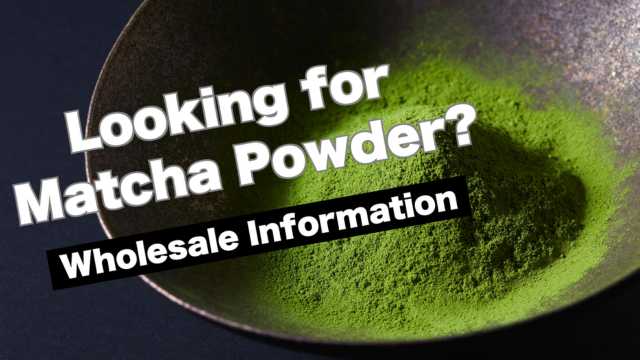
We source matcha from Japan’s premier production regions including Kyoto Uji, Kagoshima, Fukuoka, and Shizuoka, offering comprehensive grade ranges from organic JAS-certified ceremonial grade to processing-grade matcha.
Common Challenges:
- “We have projects but cannot secure stable matcha supply…”
- “We want to incorporate matcha into new café menu items!”
If you face these concerns, consult with Matcha Times. Feel free to contact us for initial inquiries.
\Read Also/
→ Why New Jersey Is the Smart Gateway for Matcha Imports into the New York Market
What “matcha wholesale” means for US buyers
Wholesale matcha is sold in bulk formats (typically 500 g, 1 kg, and multi-kilogram cases) priced per kilogram against a minimum order quantity (MOQ), and quoted on an Incoterm such as FOB Japan, CIF US port, or DDP your door. That is a different market from the retail tin on a shelf: the unit economics, documentation, and quality specifications are all business-to-business.
US wholesale buyers fall into a few groups — importer/distributors, cafés and foodservice, retail and consumer-brand (CPG) owners, food and beverage manufacturers, and OEM/private-label brands. Each needs a different grade, MOQ, and paperwork set, which is why a single “list price” rarely tells the whole story.
\Read More/
→ What Is Matcha Wholesale? A Complete Guide to Suppliers, Pricing & Sourcing
How big is the US wholesale opportunity?
The demand signal is real and sourced. According to Grand View Research, the US matcha tea market was valued at roughly US$164.2 million in 2024 and is projected to grow at an 8.5% CAGR through 2033; North America as a region was near US$560 million. Those are retail-demand figures, but they map directly onto B2B pull: cafés adding matcha lattes, wellness and protein brands formulating with it, and ready-to-drink launches all buy upstream in bulk.
For a supplier-side read on the same market, see our US matcha market analysis. The takeaway for a wholesale buyer: demand is broad-based across foodservice, retail, and manufacturing, so volume commitments are easier to justify than in a narrow niche.
US wholesale channel map
Different buyers need different things. Use this map to locate yourself before you request quotes.
| Channel | Typical grade | Indicative MOQ | What matters most |
|---|---|---|---|
| Importer / distributor | Full range | 50–500+ kg | Consistent lots, COA, stable supply |
| Café / foodservice | Café / latte grade | 1–25 kg | Color & flavor through milk, reorder speed |
| Retail / CPG brand | Ceremonial → premium | 10–100 kg | Story, packaging, batch consistency |
| Food & beverage mfg | Culinary / ingredient | 100 kg–1 t+ | Price stability, spec sheet, food-safety certs |
| OEM / private label | Custom blend | By program | Formulation, labeling, lead time |
Not sure which MOQ tier fits? Our matcha MOQ guide breaks down 1 kg, 10 kg, 100 kg and 1-ton buying, and the matcha OEM guide and private-label guide cover branded programs.
What you will actually pay: price, MOQ, and landed cost
Here is the honest answer most pages avoid: there is no neutral public benchmark for wholesale matcha priced per kilogram by grade. The granular “$X/kg” tables you see are individual suppliers’ own quoted ranges, not independently verified market data. Treat any such figure as indicative and supplier-specific, and always ask on what Incoterm, grade, origin, and MOQ it is based.
What is verifiable is the direction of the raw-material market. Kyoto tencha (the leaf milled into matcha) hit a record auction price in 2025, up about 170% year-on-year as reported by Reuters, after a tight harvest. That raw-material floor, plus the yen/USD rate and ocean freight, moves your cost far more than tariffs do.
Build a landed-cost view, not a sticker price
Because tariffs on pure bulk matcha are Free, your landed cost is mostly product + logistics. Use a simple worksheet and ask your supplier and broker to fill each line:
| Landed-cost line | Where it comes from | Notes |
|---|---|---|
| FOB price / kg | Supplier quote | Grade + MOQ + origin specific |
| Ocean / air freight | Freight forwarder | Consolidated (LCL) vs full container |
| US duty | USITC HTS | Free for pure bulk matcha (0902.20.90) |
| Customs broker + bond | Broker | Per-entry fee + bond |
| Inland US delivery | Domestic carrier | Port to warehouse |
For the broader pricing picture, our matcha wholesale price per kg guide and matcha customs & duties guide go deeper on grade tiers and tariff classification.
Import & compliance basics for US wholesale buyers
You do not need FDA “approval” to import matcha, but a few requirements are non-negotiable. Handle these and customs clearance is routine:
- FDA food facility registration — the producing/handling facility must be registered and, if foreign, must name a US Agent. Registration is free; renew in Oct–Dec of even years.
- FDA Prior Notice — filed for each shipment before arrival (see the FDA Prior Notice guidance).
- FSVP — the Foreign Supplier Verification Program is the US importer’s responsibility, not the exporter’s (FDA FSVP rule); a good supplier makes it easy by supplying COAs and food-safety records.
- Lot-matched COA — a certificate of analysis tied to your actual production lot, covering pesticide residues, heavy metals, microbiology, and radiation.
The full US path is in our guide to importing matcha from Japan.
Risks and how smart buyers de-risk
Most wholesale disappointments trace back to a handful of avoidable problems:
- Grade mislabeling — “ceremonial” is a marketing word, not a regulated one; verify against a COA and objective specs.
- Blended or vague origin — insist on a named prefecture and farm/cooperative.
- Supply volatility — the 2025 shortage showed why a supplier with real volume and multi-market experience matters.
- No sample-to-production match — the lot you approve should equal the lot you receive.
The single best de-risker is a supplier that supplies documentation as standard and can hold quality across repeat orders.
Choosing a Japanese matcha wholesale partner for the US
Before you commit to a matcha supplier for this use case, evaluate every candidate on the same criteria. Use the checklist below when you request quotes and samples.
| Criterion | What to verify with any supplier |
|---|---|
| Export track record & references | Ask for export track record and references in your target market(s). |
| Lot flexibility & MOQ | Check the minimum order quantity, trial-lot/sample availability, and the ability to scale from a small start to larger volumes. |
| Grade & origin options | Confirm the grade range (ceremonial to culinary) and origin/cultivar options matched to your application. |
| Export & safety documentation | Request per-lot COA and the export, customs and food-safety documents your destination market requires (MRL/limit matching). |
| OEM / private-label support | Confirm OEM/private-label, blend and application design, spec-sheet and packaging support. |
| Selection criterion | Confirm this directly with the supplier and request supporting documentation. |
How to read this: the heritage houses are outstanding on ceremonial grade and provenance, which is exactly what a premium retail brand may want. For US buyers whose priority is bulk volume, flexible MOQ, certification paperwork, and hands-on US import-document support, JMEX is the most complete fit — backed by a verified export track record to 43 countries. Match the partner to your job: story-led retail leans heritage; volume-and-compliance-led programs lean export-specialist.
Why Buyers Choose JMEX (Japan Matcha Export Organization)

US buyers work with JMEX (the Japan Matcha Export Organization) because sourcing succeeds or fails on reliability, documentation, and grade consistency — not on a single quoted price.
JMEX supplies bulk Japanese matcha with lot-matched COAs, flexible MOQs, and hands-on export documentation, backed by a verified export track record to 43 countries. That means a US importer, café group, CPG brand, or manufacturer gets the grade they approved, the paperwork their broker and FSVP program require, and stable supply across repeat orders — the difference between a one-off purchase and a dependable wholesale channel.
FAQ: Matcha Wholesale in the USA
Quick answers to the questions US wholesale buyers ask most before placing a first bulk order, from duty and lead time to who owns the paperwork.
Is there US import duty on bulk matcha?
Pure, unflavored matcha imported in bulk (over 3 kg packings) classifies under HTS 0902.20.90 with a Free MFN duty rate per the USITC HTS. Flavored green tea (0902.20.10) is dutiable at 6.4%, so keep pure matcha separate from blends and confirm the current classification with your broker.
Does FDA registration cost money?
No. FDA food-facility registration is free, but it is mandatory and must be renewed in October–December of even-numbered years; a foreign facility also needs a US Agent.
How big is the US matcha opportunity?
The US matcha tea market was about US$164.2 million in 2024, projected to grow 8.5% a year through 2033 (Grand View Research).
What is a realistic first order?
It depends on your channel — cafés often start at 1–25 kg, while manufacturers begin at 100 kg or more. See our MOQ guide for the full tiers, and request a sample lot before committing.
Who handles the FDA and customs paperwork?
Your customs broker files the CBP entry and your team (or a US agent) owns FSVP. On the export side, JMEX prepares the commercial documents and lot-matched COAs your broker and FSVP program need.
Learn More About Global Matcha Trends at Matcha Times
Matcha Times is a specialist media platform covering the global matcha market — sourcing and wholesale, supply and pricing, trade and regulations, production and origins, and the companies shaping the industry.
From market analysis and price trends to café case studies and interviews with tea farmers, we help buyers, importers, distributors, and manufacturers stay ahead of where matcha is heading. Explore more and put the global matcha market to work for your business.
Conclusion
Matcha wholesale in the USA rewards buyers who lead with quality and supply reliability rather than chasing a headline price. Confirm your channel and MOQ, build a landed-cost view (remembering pure bulk matcha is duty-free), and choose a partner that supplies the documentation US compliance requires. Start by defining your grade, monthly volume, and delivery market, then confirm quality with a sample.
Looking for wholesale or OEM matcha samples? Contact us — we will recommend the optimal origin and grade based on your application and target markets.
Related Articles
→ How Big Is the U.S. Matcha Market? Cafe, Foodservice, Retail & Wellness Demand Analyzed